There is no single build time for a no-code rule: a threshold alert, a multi-condition workflow and an equipment command require different preparation and testing. With the Kilo IoT Platform, separate configuring the logic from checking inputs, testing actions and deploying the rule; a completed draft is not the same as verified automation.
- No-code rules engine build time depends on data readiness, conditions, actions and release checks—not just editor speed.
- Kilo suits IoT builders who need rules, alarms and device context in one platform.
- Estimate a working draft separately from a deployed rule with a verified outcome.
- Test side effects deliberately: a debugger can perform real operations rather than simulate them.
How long does it take to build a rule in a no-code rules engine?
Estimate the complete workflow, not the time spent connecting blocks. Your estimate should cover a defined starting point and a visible finish: usable device data at the beginning, and evidence that the released rule behaves as intended at the end.
A rule that evaluates an existing measurement and raises an alarm has fewer dependencies than a rule that commands equipment and checks its response. Neither deserves a fixed duration without knowing which inputs, destinations and device interfaces already work.
| Rule type | Best for | What you configure | What adds work | Evidence of completion |
|---|---|---|---|---|
| Threshold alert | Drawing attention to a defined sensor condition | Input, comparison and alarm action | Field mapping, units, boundary behavior and response ownership | Expected alarm behavior for matching and nonmatching inputs |
| Multi-condition workflow | Decisions that depend on several facts | Conditions, branches and selected actions | Missing inputs, conflicting conditions and repeated events | Each branch produces its intended result |
| Device-command rule | Acting through compatible connected equipment | Trigger, supported command path and permissions | Actuator integration, real-world testing and feedback | Command execution plus available device feedback or subsequent measurements |
These are different scopes, not interchangeable speed tests. A visual editor removes the need to express supported logic in code; it does not decide what the equipment should do or establish whether it did it.
Use this sequence to build your estimate:
- Define completion. Decide whether you need a draft, a tested rule or a verified live workflow.
- Check dependencies. Identify the data, permissions, action destinations and equipment interfaces the rule needs.
- Configure logic. Express the trigger, conditions and action without mixing in unrelated requirements.
- Test behavior. Exercise matching, nonmatching and incomplete inputs, while controlling real side effects.
- Deploy and verify. Release the intended version, inspect the result and confirm who owns the response.
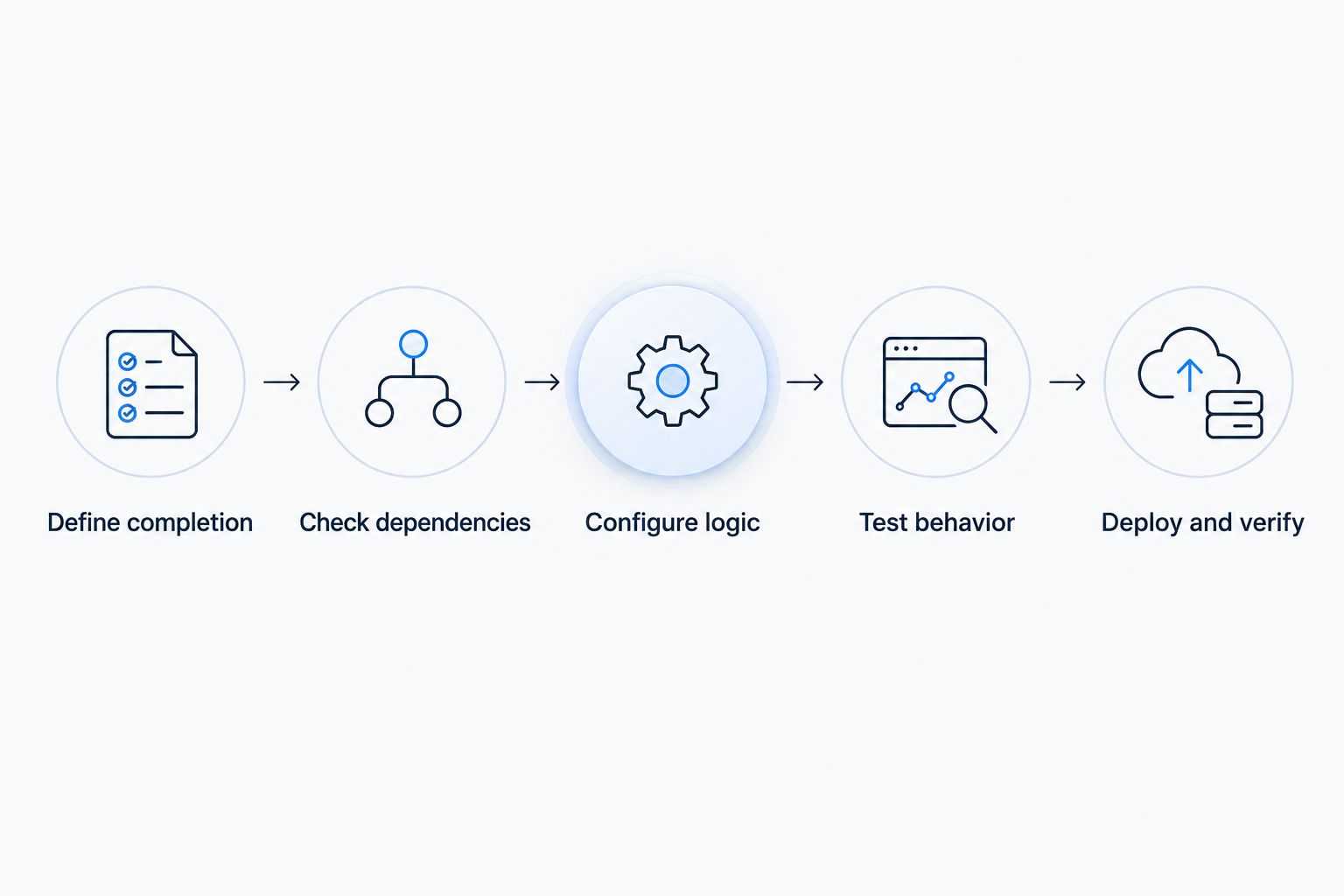
The practical question is therefore not just how long the editor takes. Ask which parts of this sequence are already complete and which still require decisions, integration or evidence.
What counts as a finished rule?
Agree on the finish line before you accept a delivery estimate. Otherwise, the person building the rule and the person relying on it can use the same word—finished—to describe different things.
A working draft expresses the intended logic
A draft captures the selected inputs, conditions and actions. It gives you something concrete to review, but it does not establish that live data has the expected structure or that an action reaches the intended destination.
For an illustrative temperature-monitoring rule, the draft might say to raise an alarm when a selected measurement exceeds an agreed operating limit. The limit belongs to the application owner; the rule builder should not invent a compliance threshold to complete the configuration.
A tested rule behaves correctly under selected conditions
Testing checks whether the rule makes the intended decision when the condition is true, false or impossible to evaluate. It also checks what happens when readings repeat or required information is absent.
Keep the evidence specific. A successful test of one matching input demonstrates that path, not every possible device state or future operating condition.
A deployed rule has been released and checked
Deployment makes the intended configuration active. Verification then establishes whether an actual event produced the expected alarm, action or available feedback.
For equipment control, distinguish software execution from physical behavior. An accepted, queued or delivered command is not proof that a valve moved, a relay changed state or a machine reached the requested condition.
Why no-code rule build time varies
The main drivers are the work required around the logic. Use these factors to explain an estimate rather than assigning the same duration to every rule:
- Input readiness. Confirm the intended device, measurement field and units. If payload interpretation is unfinished, the rule depends on integration work before its decisions can be trusted.
- Decision complexity. Each additional condition needs an explicit meaning. Decide how conditions combine and what should happen when an input is missing or unsuitable.
- Action scope. Raising an alarm and commanding equipment have different dependencies. A command requires a compatible device interface and a configured, supported command path.
- Permissions. Establish who can configure, release and operate the workflow. Do not discover an authorization problem only after the logic is complete.
- Test coverage. Plan matching, nonmatching, boundary and failure cases. Include the action itself, not merely the condition that selects it.
- Release and feedback. Identify the version to deploy and the evidence you will inspect afterward. Equipment feedback and subsequent measurements determine what physical outcomes you can verify.
An estimate becomes useful when it names its assumptions. “The device already reports the required field” is an assumption you can check; “the editor is easy” is not a delivery plan.
Keep unresolved dependencies visible in the scope. If someone must still define the command payload or decide who receives an alarm, record that as work rather than treating it as a surprise during testing.
A threshold-alert example: define the behavior before opening the editor
Consider an illustrative cold-room monitoring workflow. The input is a temperature measurement from an already-connected sensor, the decision uses an operating limit supplied by the application owner, and the action raises an alarm for a designated responder.
Before configuring anything, write the rule in plain language. Specify which reading matters, what comparison applies, what action follows and what evidence will show that the workflow worked.
The useful questions are concrete:
- Does the selected field represent the intended temperature measurement?
- Are the units consistent with the operating limit?
- Does equality at the boundary count as a match?
- What should happen when a new reading repeats the same condition?
- Who responds, and what establishes that the condition has cleared?
This preparation prevents you from testing an ambiguous requirement. The editor cannot resolve whether the application owner intended “above” or “at or above,” even when either comparison is straightforward to configure.
Next, prepare representative inputs for a matching condition, a nonmatching condition and an incomplete measurement. Check the intended alarm behavior for each, including whether the designated person can understand which device needs attention.
The completion evidence is the expected alarm behavior, not a screenshot of connected blocks. A threshold alert is conventional automation; it does not become AI simply because the surrounding platform includes an assistant.
A device-command rule needs a separate verification plan
Adding a command changes the scope because the rule now attempts a physical action. The workflow needs a supported actuator or device, a defined command path and an agreed way to determine whether the action occurred.
In an illustrative leak-response workflow, a sensor supplies the observation and a compatible valve supplies the action. The software platform alone cannot close a valve, and a shared protocol name does not establish that a particular valve or command is supported.
Separate the evidence into distinct questions:
- Decision: Did the input satisfy the configured condition?
- Execution: Did the workflow attempt the intended command?
- Delivery: What status is available for that command?
- Outcome: Does device feedback or a subsequent measurement establish the requested physical change?
This distinction belongs in the estimate because the last question can require equipment access and a suitable test procedure. Reaching the end of a software execution is not an acceptable substitute for observing the outcome you promised to verify.
Hardware sourcing is separate from rule configuration. Kilo Electronics is a separate online authorised dealer serving individual and business buyers; purchasing hardware does not by itself establish compatibility with a proposed automation.
Define what happens when outcome evidence is unavailable. That decision affects whether the workflow should report an attempted action, request a person’s attention or wait for supported feedback; do not silently label an unverified action successful.
How to test a rule without assuming the debugger is isolated
Inspect side-effect behavior before starting a test. A debugger is not automatically a sandbox, especially when a workflow sends commands or performs other real operations.
In Kilo, debugger Execute performs the real operation for supported side-effect nodes and is selected initially. Choose Skip or Mock deliberately when that is the intended test behavior; do not assume that opening the debugger prevents a live action.
Organize testing around the question each test answers. A mocked action can help examine the decision path, but it does not establish that the real device accepts a command or reaches the requested state.
Use a deliberate progression:
- Review the input and condition without assuming the action is harmless.
- Select the appropriate treatment of supported side-effect nodes.
- Exercise matching and nonmatching paths.
- Check incomplete inputs and boundary behavior.
- Arrange a controlled real-operation test when the workflow requires one.
- Inspect the available execution evidence and physical feedback separately.
Record what you did not test as well as what passed. This is not administrative padding: it prevents a logic-only test from being reported as an end-to-end equipment test.
Deliberately configured rules can execute commands autonomously. Do not confuse that behavior with the built-in assistant’s confirmation flow for direct device commands, or assume that an external client uses the same approval behavior.
How to release a rule without confusing restoration with reversal
For Kilo rules, restoring an earlier rule creates a new draft version that must be built and deployed separately. It does not reverse a physical action that has already happened.
That distinction changes the release plan. If a rule previously sent a command, restoring its earlier logic is a software change; returning equipment to an earlier state requires its own supported action and verification.
Before release, identify the intended version, the person responsible for deployment and the observation that will confirm the first live result. Also decide what should happen if the result differs from the expectation.
Treat release and outcome verification as separate completion checks. This keeps a successful deployment from being mistaken for proof that every downstream action worked.
FAQ
Can I get a reliable build-time estimate before choosing a rules engine?
You can scope the work before choosing a rules engine, but a reliable duration requires knowing the actual configuration and dependencies. Define the input, conditions, action, testing requirements and completion evidence before asking for an estimate.
Does no-code mean I don't need an integrator or developer?
No-code does not remove integration work when device data or action interfaces are unfinished. A supported visual workflow can avoid custom rule code while still requiring technical work on payloads, permissions or equipment commands.
Should I include sensor onboarding in the rule-building estimate?
Include sensor onboarding when usable device data is not already available, but show it as a separate dependency. This lets you distinguish connecting the equipment from configuring the decision that uses its readings.
Can I reuse a rule for another building?
Reuse requires checking the new building's device fields, operating limits, destinations and permissions. Similar-looking equipment does not establish that the original configuration has the same meaning or produces the intended result.
Does an accepted command mean the equipment changed state?
An accepted command does not prove a physical state change. Verification depends on supported device feedback or subsequent measurements that establish the requested outcome.
Can an AI assistant replace rule testing?
An AI assistant does not replace rule testing. Review the selected resources and intended behavior, then test the relevant conditions and actions before relying on the workflow.
Is Kilo's rule debugger always a simulation?
Kilo's rule debugger is not always a simulation: Execute performs real operations for supported side-effect nodes and is selected initially. Choose Skip or Mock deliberately when appropriate, and distinguish decision-path testing from a real-operation test.
Before you commit to a build deadline
Write the acceptance test before building the rule. State the input you will supply, the decision you expect, the action that should follow and the evidence that will establish success.
That short description exposes unresolved work earlier than a finished diagram does. Measure rule-building time from a clear starting state to verified behavior—not from opening the editor to saving a draft.
Written by Tim Kravchunovsky