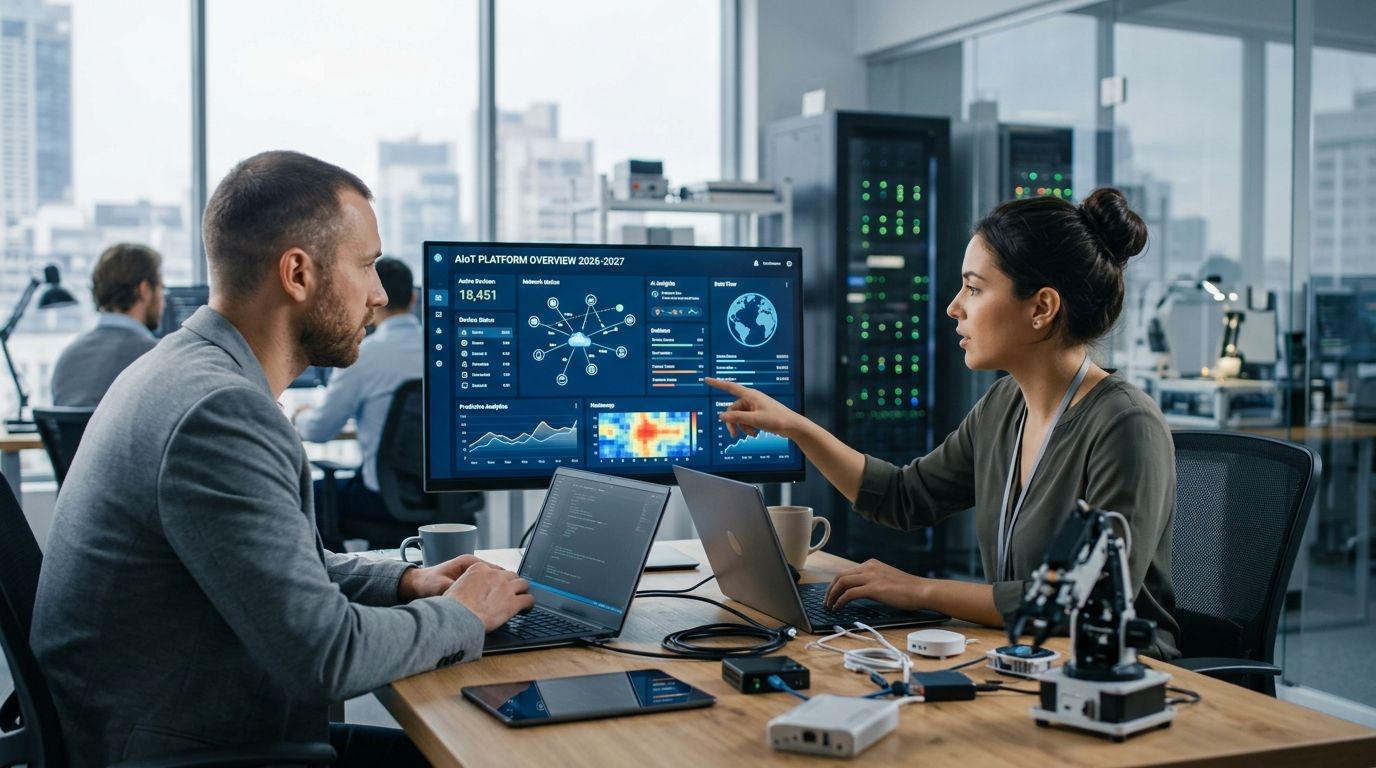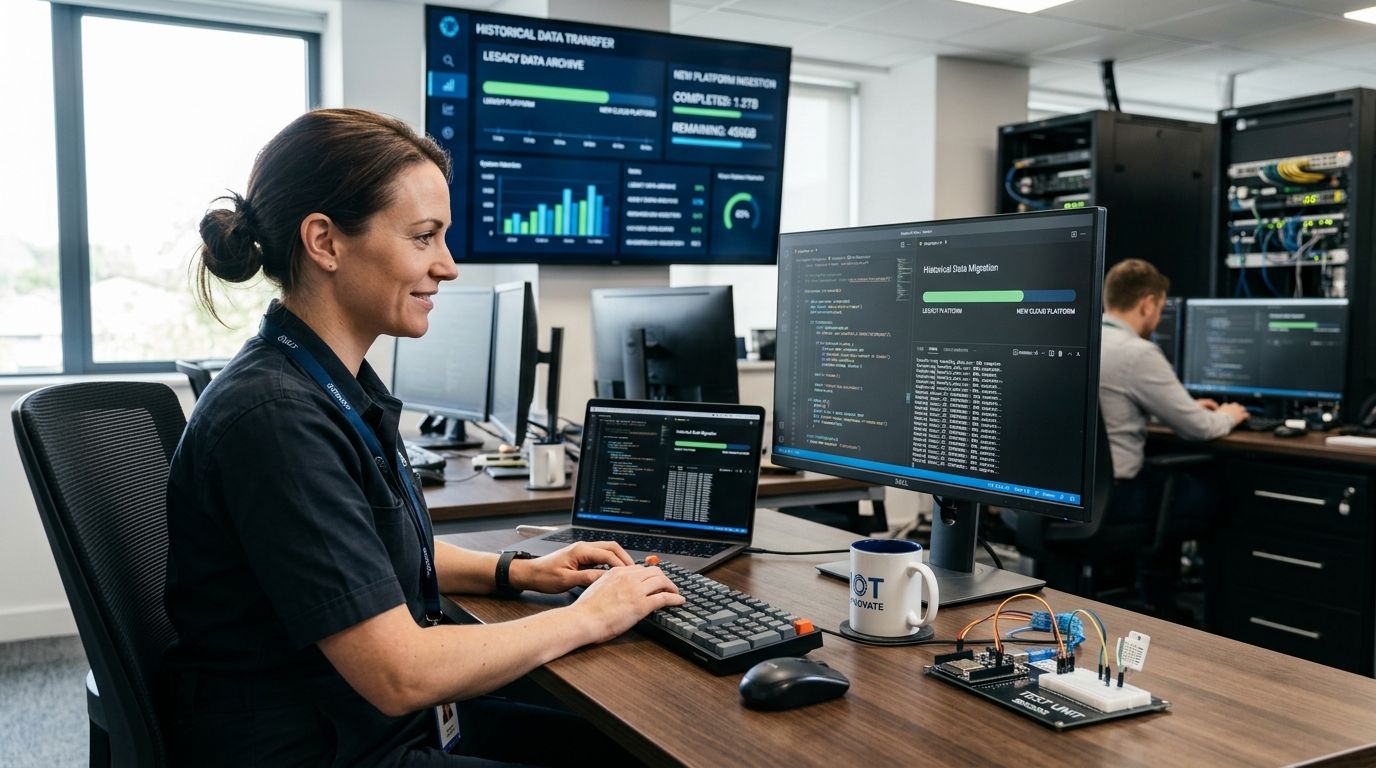
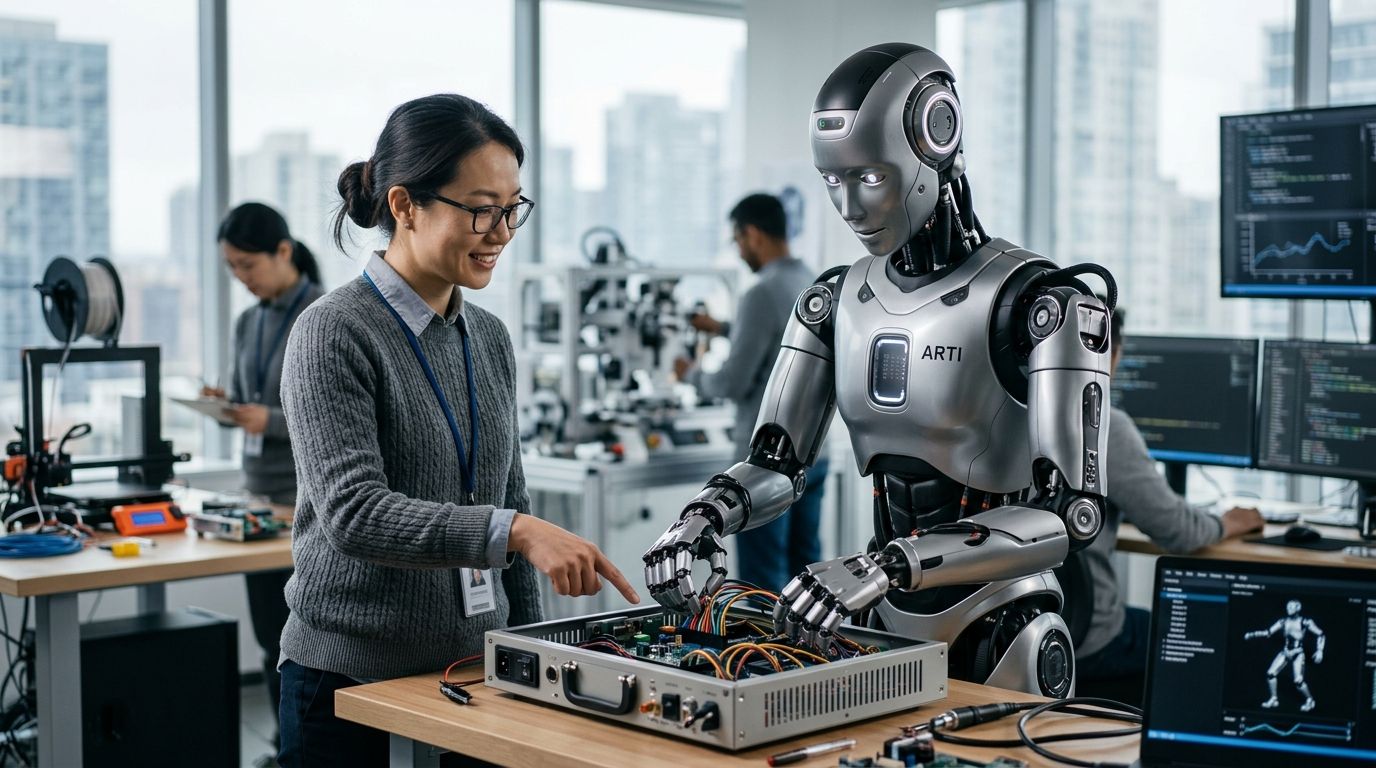
The physical AI definition is artificial intelligence that perceives and interacts with the physical world. It uses observations to reason about a goal, influences real equipment through an appropriate control path, and uses feedback to understand the result. Kilo supplies the IoT operating layer for compatible connected-device deployments.
- Physical AI combines sensing, AI reasoning and interaction with the physical environment.
- AIoT can analyze connected-device data without controlling equipment; ordinary automation can control it without AI reasoning.
- Kilo supplies device context, permissions, automation and configured commands around the model.
- Begin with a measurement you understand, then test commands and real device feedback before extending control.
That is a useful way to approach the question, what is physical AI? It is AI that perceives and interacts with the physical world. Robots and autonomous vehicles are familiar examples. Connected buildings and industrial equipment can also become part of an AI-controlled system when the necessary sensing, reasoning and actuation are in place.
At Kilo, we build the IoT platform that supplies that operational foundation for compatible devices. The AI brings its reasoning; Kilo maintains the device context, permissions, automation and configured commands that let the reasoning connect to actual equipment.
Physical AI definition: how perception, reasoning and action connect
Physical AI combines information about the world with decisions and actions that affect it. Sensors provide observations. An AI system interprets them in relation to a goal. The surrounding software and hardware execute an action, and new observations help establish what happened.
NVIDIA's physical AI glossary describes the category through autonomous systems that perceive, understand and act in the real world, including robots and autonomous vehicles. That broad category is larger than any individual platform.
Kilo focuses on the connected-device operating layer. We connect AI to the device information and controls already configured in an IoT deployment. The model does not have to discover a manufacturer's command format every time someone asks it to operate a controller.
A reliable implementation also needs permissions, testing and a way to investigate results. These are engineering requirements around the AI. They should be demonstrated explicitly rather than assumed from the label “physical AI.”
Physical AI definition: identify sensing, reasoning, action and feedback
A useful way to apply the physical AI definition is to examine each part of a proposed example. Start by naming the observation. It could be a measured temperature, a soil-moisture reading or a device's reported state. Include when the information was received, because an old value can be accurate and still be unsuitable for the current decision.
Next, identify where AI reasoning participates. Does the system interpret the request, compare relevant context or select among permitted actions? A rule that always executes the same response to the same threshold can be valuable automation without requiring a model to reason about the situation.
Then identify the physical action. Changing a reporting interval affects how a device communicates. Changing a compatible controller's setpoint affects its requested behavior. Switching an available relay can affect connected equipment. These operations have different consequences, so “AI controls a device” is not a complete description of any of them.
Finally, identify the feedback. The controller may report a setting, a separate sensor may measure the process, or the installation may provide no useful state confirmation. The responsible person needs to know which of those situations applies. An explanation in a chat window is not a replacement for a measurement the equipment never supplied.
This four-part examination helps a new reader distinguish an interesting demonstration from a proposed operating workflow. It also makes a first project smaller. Instead of connecting every room and enabling several control actions, choose one observation, one understood decision and one appropriate response.
There is room for human involvement throughout. An operator might ask the question, review the proposed command and investigate an uncertain result. Physical AI does not require claiming that people disappear from the operation. The more useful question is whether AI participates in an actual interaction with the physical environment and whether the surrounding system makes that interaction understandable.
When describing your own example, write down the missing pieces too. If the controller cannot report state, say that. If the network has not been tested at the installation, leave that as an open commissioning task. Those details help the next person decide what still needs to be demonstrated.
Physical AI examples: room temperature control and irrigation
Consider a hypothetical commercial room with temperature sensing and a compatible controller. An AI assistant is asked to investigate a rising temperature. It reads the recent measurements, identifies the controller and checks the available commands. An authorized operator reviews a proposed change. After dispatch, the system checks available controller feedback and later temperature readings.
That is an example to configure and test, not a report of a customer outcome. It also shows why a successful command response is only part of the answer. A new setpoint does not by itself prove the room reached the desired temperature.
An irrigation installation provides another useful hypothetical example. Soil measurements can inform a watering decision, but the control path still needs a suitable valve controller and an appropriate operating policy. A valve-state reading and a flow measurement describe different aspects of what happened. Neither should be invented by the AI when the device does not supply it.
Physical AI can therefore involve existing equipment as well as new robots. Its scope is determined by the complete installation: what can be sensed, what decisions use AI and what can actually be controlled.
Physical AI and AIoT: how do they differ from IoT automation?
AIoT, or artificial intelligence of things, describes AI used with connected devices and their data. A system that analyzes sensor history with AI is an AIoT application even if it never commands equipment.
Physical AI emphasizes interaction with the physical environment. In an IoT deployment, the categories overlap when AI reasoning participates in decisions that lead to physical actions.
Ordinary IoT automation can also control equipment. A rule that switches a relay when a defined condition becomes true does not require AI. Adding a conversational assistant does not make every existing automation an AI deployment.
In Kilo, an assistant can help an operator build a rule, while the deployed Rules Engine subsequently executes the configured logic. Alternatively, the assistant can request a direct device command after confirmation. Keeping those workflows distinct makes it easier to understand who decides, who approves and what runs repeatedly.
Our AIoT explanation covers the broader relationship between AI and IoT operations.
How a physical AI platform connects reasoning to equipment
An operating system gives software established ways to use resources. The analogy is useful for Kilo: our physical AI platform gives AI an established way to use authorized device context and configured actions. It is an IoT operating layer, not firmware installed on every device or a robotics foundation model.
The platform maintains device models and normalized measurements. It provides dashboards and alarms for the people responsible for the installation. Its Rules Engine supports tested automation, while device commands describe the actions available on compatible equipment.
Kilo also exposes this deployment through its built-in assistant, an MCP server for compatible AI clients, and REST or gRPC interfaces for software integrations. The same equipment can participate in those workflows without requiring a new device integration for each conversational request.
That is the product value we want readers to examine: a practical operating environment around the model, from understanding a measurement to inspecting the effect of a command.
IoT device control: how physical AI checks whether an action worked
Separate three questions: did the platform accept the request, did the device report the expected state, and did the physical process reach the intended condition?
Kilo's command verification documentation explains the available strategies. A command can be sent without verification, checked against a later uplink or followed by a query after acknowledgment where supported. Feedback must come from a mapped measurement that the device actually reports.
Human responsibility remains explicit. Kilo's built-in assistant confirms direct device commands. External MCP clients have their own approval policy. Deployed rules execute their configured actions without asking a person on every evaluation.
Before deployment, test the automation. In Kilo's debugger, Skip and Mock avoid the real side effect; Execute runs it. Restoring an earlier rule creates a draft to build and deploy, and cannot undo a physical action.
How to try physical AI with a small Kilo project
Begin with a measurement you can explain and a device you understand. Ask the assistant for its current context before enabling physical control. Identify the person responsible for receiving an alarm and what that person should do.
You can also start with an emulated device to learn the dashboard and rule workflow before connecting equipment. Simulation tests the configured logic; it does not establish radio coverage or real hardware behavior.
Start with a free Kilo account. The free plan allows five devices, one dashboard and one rule; larger plans support expansion. Physical hardware and connectivity have separate costs.
When you choose your first installation, you can buy project devices from Kilo Electronics. Match the sensor, gateway and any controller to the actual job, then verify the reading and response together.
Current plan details. Hardware and connectivity are separate costs.
Physical AI definition FAQ
What is the physical AI definition in one sentence?
Physical AI is artificial intelligence that perceives and interacts with the physical world. Its surrounding system combines observations, reasoning, an appropriate action path and feedback, rather than stopping at a prediction or explanation that never influences physical equipment.
What are practical physical AI examples outside robotics?
A hypothetical example is an AI-assisted room-control workflow that reads temperature, proposes a configured controller action and checks supported feedback. Irrigation can follow a similar pattern with suitable sensing and valve control. Actual capabilities depend on the installation; a sensor alone does not make the project physical AI.
Is every IoT device an example of physical AI?
No. A connected sensor may only report measurements, and a fixed rule may control equipment without AI reasoning. The physical AI definition becomes relevant when AI participates in perceiving or reasoning about the environment and interacting with it through the complete system.
What is the difference between physical AI and AIoT?
AIoT describes AI used with connected devices and their information, including analysis that never commands equipment. Physical AI emphasizes interaction with the physical environment. The categories overlap when an IoT deployment connects AI reasoning to supported physical actions and feedback.
Why does a physical AI platform need device permissions?
The ability to describe an action should not automatically authorize it. Kilo keeps operations inside the connected account's organization and permissions. Direct commands in the built-in assistant require confirmation; external clients manage their own approval presentation, and deployed rules follow their configured behavior.
Can an emulator prove that a physical AI installation works?
It can help exercise device configuration, test readings and automation logic before hardware arrives. It cannot establish radio coverage or prove the actual controller's response. Rules using simulated readings can still reach real notification channels if configured that way, so select side-effect handling deliberately.
What should a beginner test first in Kilo?
Start by checking that the intended device's reading, unit and reporting time are understandable. Add a dashboard and a rule with a known recipient, then review any compatible control action separately. The five-device free plan is a small starting point; hardware and connectivity remain separate costs.