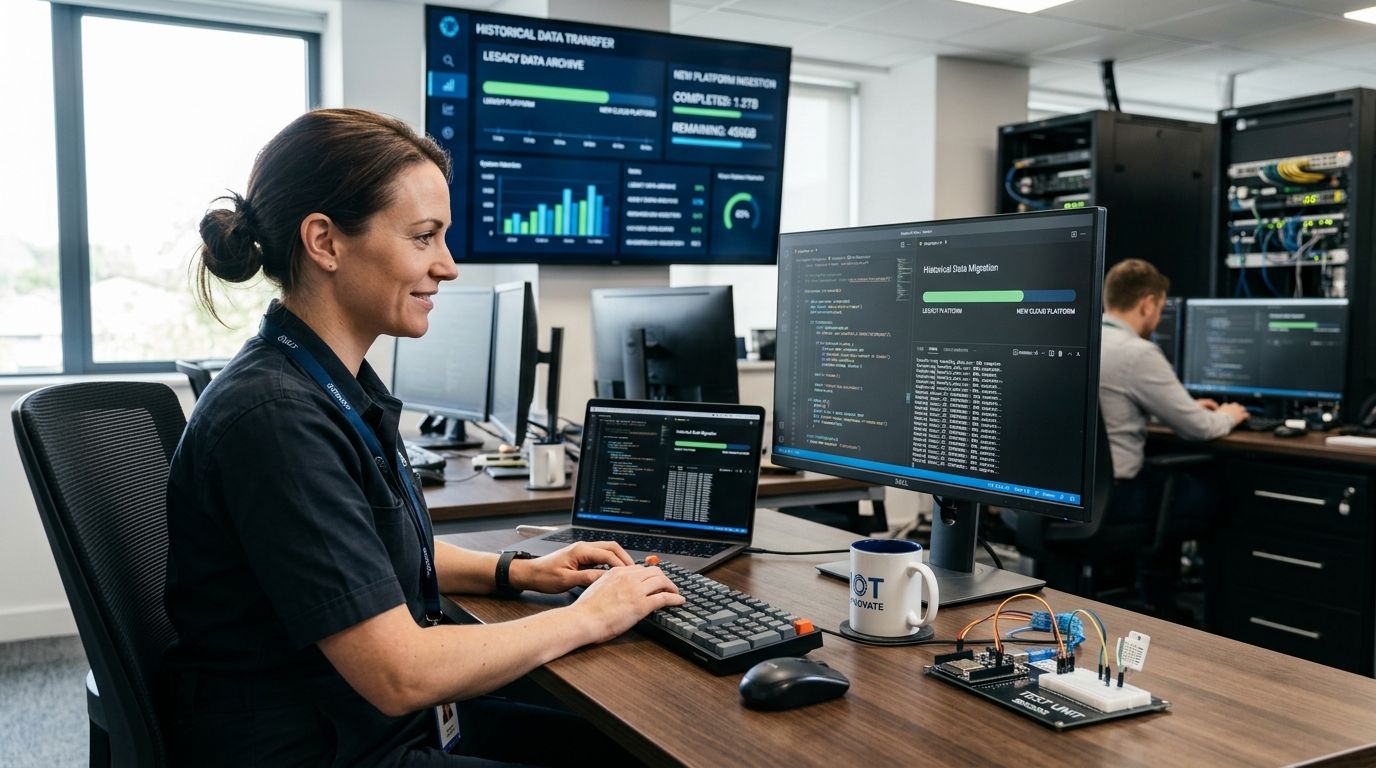
A physical AI platform for reliable control and data retrieval connects authorized device context to configured actions and feedback that can be checked. Kilo supplies that operating layer: read the relevant measurements, review the permitted command, inspect its delivery status and examine supported device feedback.
- Check the device identity, metric, unit and reporting time before AI proposes an action.
- Use configured commands and the appropriate approval path; deployed rules and direct chat commands behave differently.
- Delivered without verification means accepted for delivery, not a proven physical result.
- Test automation deliberately, then inspect command history and relevant sensor feedback after execution.
Imagine a commercial cold room with a temperature sensor and a compatible controller. The operator notices a rising reading and asks for help. Before anyone changes a setting, the system needs the correct room, a recent measurement, the controller's available commands and the operator's permission to use them.
Kilo IoT Platform brings that information and control path together. This guide follows a hypothetical command from the first data check to the result, using the platform's documented behavior. It is a workflow to test with your equipment, not a recorded customer installation.
IoT device management: identify the equipment before AI acts
Start with the asset, not the proposed action. Confirm the organization, device name, metric and reporting time. A temperature from the wrong room can be a valid reading and still be the wrong basis for the decision.
Look at the recent history too. A single value cannot establish whether the condition is rising, recovering or simply old. Decide how recent a reading must be for the job. The appropriate limit depends on the device's reporting interval and the physical process.
Kilo maintains device information, sensor mappings and telemetry that authorized users and integrations can retrieve. Its public REST API documents access to sensor history and last-seen values, device configuration and command operations.
The practical benefit is continuity: an AI client works against the same configured deployment that people use through dashboards and alarms.
IoT data analytics: check sensor history before changing equipment
Ask a concrete question. For example: “Show the recent temperature readings for this device and when the latest reading arrived.” Treat this as an illustrative request; the response depends on the available tools, measurements and account permissions.
Then compare the information with the operating requirement. In the cold-room example, a warmer reading may justify investigation without establishing its cause. Door state or controller feedback can provide additional context if the installation measures them. If they are absent, keep that uncertainty visible.
Name the next human action. The responsible operator may inspect a door, contact maintenance or review an allowed controller setting. A notification should reach the person who can actually respond, with enough context to find the equipment.
This is also a sensible first Kilo project: make the condition visible and test the alarm recipient before adding physical control.
IoT device control: review the command and who can send it
Kilo commands are named actions defined for a device. Their parameters and routing are configured in advance. An AI client can discover the available commands instead of inventing a payload.
Before execution, review the target and the meaning of each parameter. A reporting interval, a relay state and a temperature setpoint are different controls. Equipment-specific documentation determines which values and operations are appropriate.
The built-in Kilo assistant shows a direct command and waits for confirmation. With an external MCP client, configure that client's approval policy. Kilo's organization and permission boundaries still apply; an annotation indicating a consequential tool does not universally enforce a client-side prompt.
A deployed rule is a separate path. If it contains an Execute Command action, it runs the configured behavior when its conditions are met. It does not pause for conversational approval on every evaluation.
How does a physical AI platform verify a device command?
Kilo offers three verification strategies. Choose based on the feedback the actual device supports.
| Strategy | What happens | What you can conclude |
|---|---|---|
| No verification | The command is sent without checking the resulting state | Delivered means accepted for delivery; the physical effect remains unverified |
| Wait for next uplink | A later device report is checked against expected sensor states | The configured reported states matched if verification confirms |
| Query after ack | After acknowledgment, a query requests state and its response is checked | The reported states matched the configured expectation if verification confirms |
The verification guide gives the exact prerequisites, including the acknowledgment requirement for the LoRaWAN query-after-ack strategy.
Use a mapped measurement that is actually receiving values. Checking a relay command against an unmapped sensor cannot produce useful confirmation. Configure the expected state deliberately; checking the wrong metric answers the wrong question.
Even confirmation has a defined scope. If the device reports a changed setpoint, that establishes the reported setting. Later room-temperature readings are needed to assess the cooling result. Equipment feedback is evidence to interpret, not a promise that every physical objective has been achieved.
IoT automation testing: check the logic before a live command
Use representative input values to test both sides of a condition. Include the boundary value, a non-matching reading and the response to missing or delayed information where your logic handles it.
In Kilo's rule debugger, Execute runs a real side effect and is initially selected. Choose Skip or Mock when you want to inspect logic without sending a real notification or device command. Mock responses show how the rule handles that response; they do not prove a controller will return it.
An emulated device can help you exercise the configured telemetry and command workflow before equipment arrives. Keep simulated readings clearly separate from production interpretation. Rules connected to an emulator can still reach real notification channels if configured to do so.
Once the logic is ready, build and deploy the intended rule. If a correction is needed, restoring an earlier version creates a draft; build and deploy it to change live behavior. It does not undo previous equipment actions.
Remote device management: investigate missing command feedback
After dispatch, inspect command execution history and available device feedback. Review the relevant rule execution if automation initiated the action. Use telemetry history to examine the physical condition afterward.
These records serve different purposes. Rule versions describe saved logic. Command history describes command executions. The Audit Trail records organization access changes. Do not treat any one of them as a universal, immutable record of everything the deployment did.
If feedback is missing, say so. The responsible operator can investigate the connection, device availability, mapping and physical equipment. Repeating a command without understanding its effect can create a new problem, so define the appropriate retry or intervention policy for the installation.
IoT device control: decide what to do when feedback is incomplete
The useful test is not only the command that succeeds. Define what the operator will do when the available information is incomplete. A device can be identified correctly while its latest reading is too old for the decision. A command can enter the delivery path while the expected feedback has not arrived.
Before sending a command in the hypothetical cold-room workflow, decide which measurement is essential. If the device is expected to report every several minutes, the team should choose a freshness requirement that fits that interval and the physical process. This is an operating choice to document, not a universal timeout that an article can select for every installation.
If the reading fails that requirement, the next step may be investigation rather than control. The operator can review device availability, the connection and the configured mapping, then inspect the equipment if necessary. Missing information should remain visible in the handover to the person responsible for the room.
After a command, preserve the distinction between waiting and success. The next expected uplink may not yet have arrived. A query may depend on prerequisites the connection does not support. A controller may report the setpoint without measuring the room's actual response. Each case calls for a different interpretation.
Write a small response note for the team: which record to inspect, which measurement matters, who investigates and when another action should be considered. Do not define automatic retries merely because repeating a tool call is easy. The appropriate retry behavior depends on what the command does and what is known about its previous effect.
Kilo brings the relevant device context and execution information into the platform. Its value here is that people and authorized AI clients can work against the configured deployment rather than treating each request as an isolated conversation.
When you test the workflow, deliberately include a case that needs human investigation. Ask a colleague to explain what is known, what remains unknown and the next permitted step. If the explanation depends on assuming a missing measurement, the workflow still needs work.
This makes reliability a property to demonstrate across the whole path: useful data in, an understood action, and evidence or an explicit unresolved result afterward.
How to test a physical AI platform with one device
Create a Kilo account and begin with one device, a dashboard and a clearly defined alarm. The free plan includes five devices, one dashboard and one rule; review plan capacity before expanding. Hardware and connectivity are separate costs.
Project sensors, gateways and compatible controllers can be purchased from Kilo Electronics. Check the controller's documented commands and state feedback before choosing it for the test.
Kilo's physical AI platform gives AI the operating layer for this sequence: retrieve authorized context, use a configured action and return to the device evidence. Begin with a reading you can verify yourself, then add control once the response is understood.
Current plan details. Hardware and connectivity are separate costs.
Physical AI platform FAQ: data retrieval and control
What does a physical AI platform for reliable control and data retrieval provide?
It supplies the authorized device context, available actions and records needed to follow a request through to its result. Kilo provides those platform services, while the actual device and configuration determine which commands and feedback the installation can use.
Which data should AI retrieve before controlling a device?
Start with device identity, the relevant metric and unit, when the reading arrived and enough history to understand the condition. The needed context depends on the task. If a door state or another measurement is absent, the assistant should not present that missing information as observed fact.
How does Kilo prevent a model from inventing a device command?
Kilo's device commands are configured actions with defined parameters and routing. An AI client can discover those available operations. The team still needs to configure the device correctly and select parameters appropriate to its documentation and operating requirements.
What is the difference between delivery and command verification?
Delivery concerns the command entering or progressing through its delivery path. Verification checks supported reported states against a configured expectation. With no verification configured, Delivered does not establish physical success; use the available device feedback and subsequent process measurements to interpret the outcome.
Can I test an IoT rule without operating real equipment?
Choose Skip or Mock at relevant side-effect nodes in Kilo's debugger. Execute runs the real handler and is initially selected. An emulator can provide test readings, but rules connected to it can still send real notifications or commands if those side effects are configured and executed.
Does restoring a rule reverse its earlier commands?
No. Restoring a previous version creates a new draft while preserving history. Build and deploy that draft to change the running rule. Equipment actions that already occurred require their own assessment; a software version change does not undo physical effects.
Which records should an operator check after an AI command?
Use command execution history and supported device feedback, along with relevant telemetry history. If a rule initiated the action, inspect its execution too. Rule versions, command records and organization access changes answer different questions; they are not one universal immutable log.