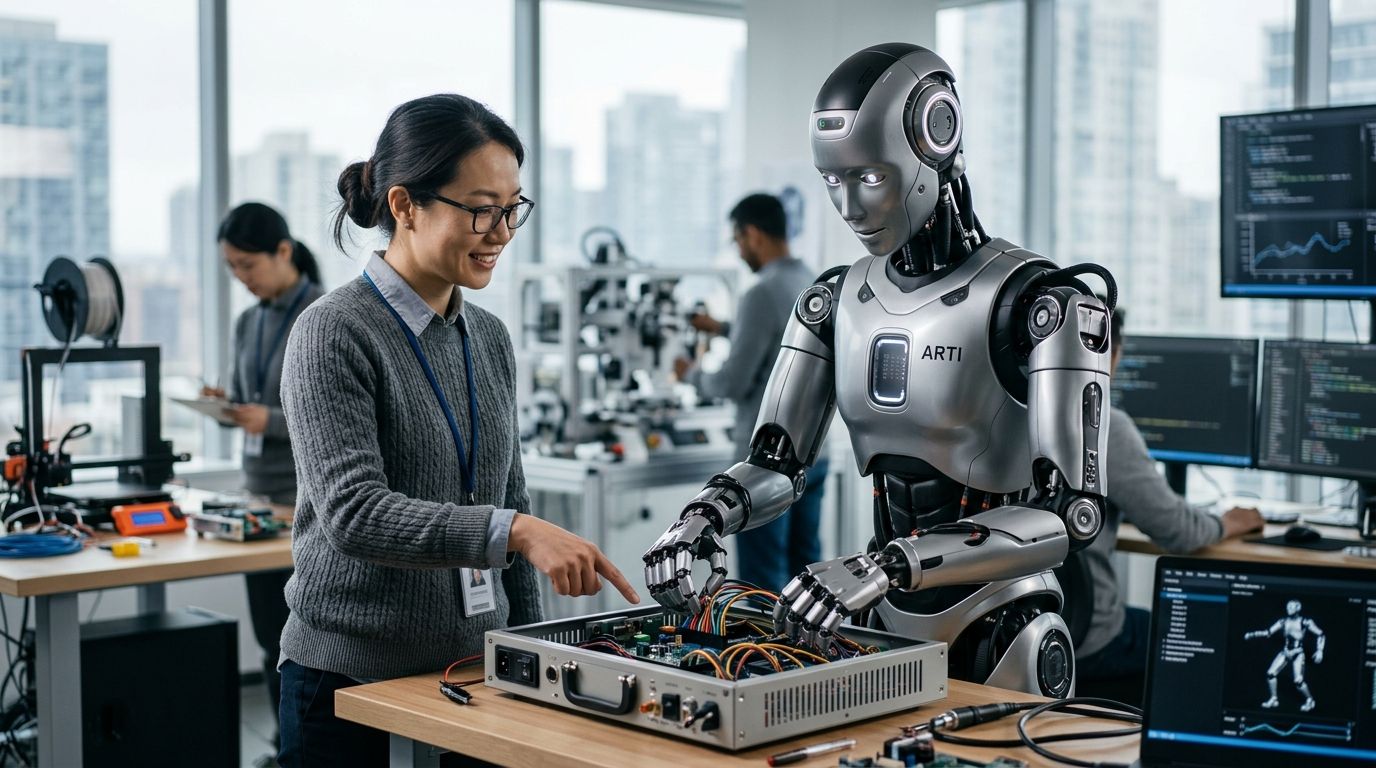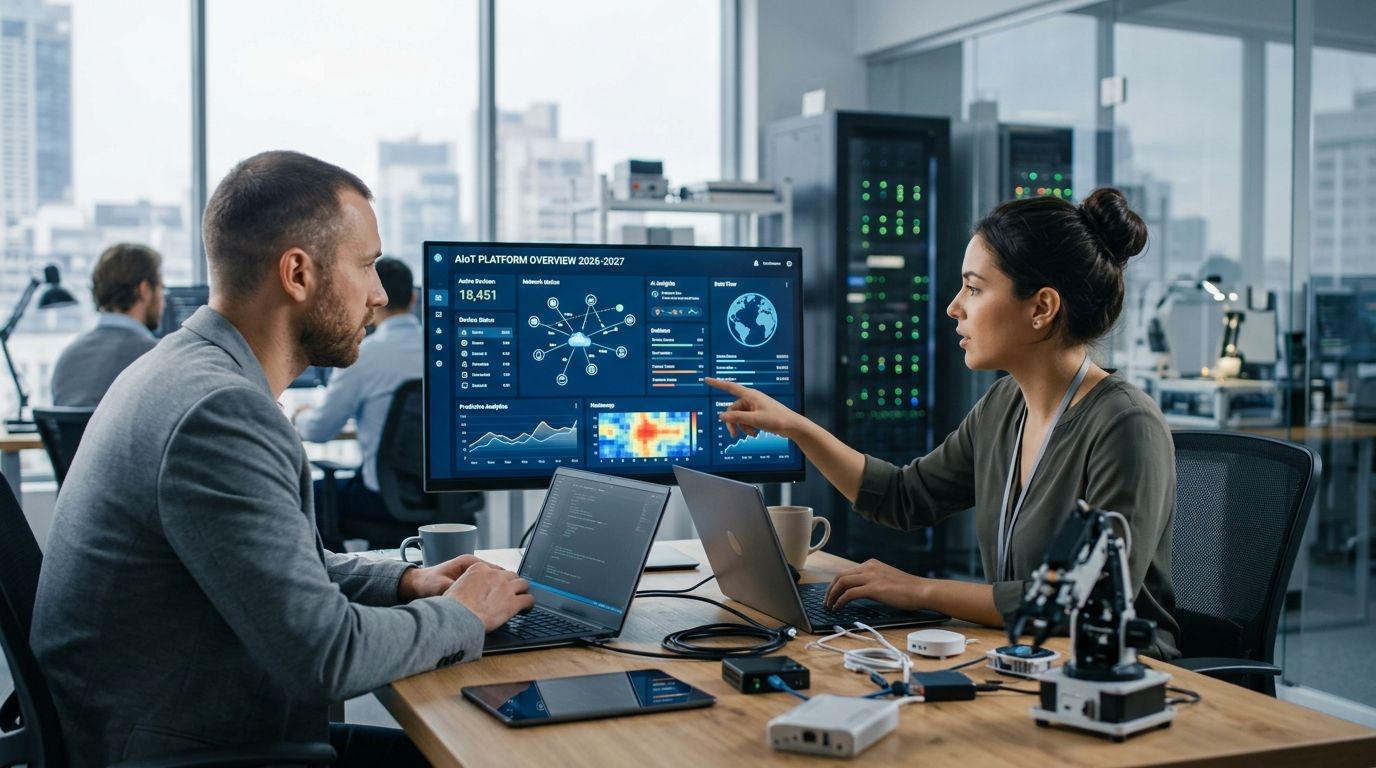
What is physical AI? Physical AI is artificial intelligence that perceives and interacts with the physical world. Sensors provide observations, AI reasons about a goal, a control path influences equipment, and feedback helps establish what happened. Kilo provides the IoT operating layer connecting that reasoning to compatible real devices.
- Physical AI connects AI reasoning to the physical environment through sensing and actions.
- Kilo maintains device context, permissions, automation and configured commands around the model.
- The built-in assistant confirms direct commands; external clients manage their own approval policy.
- Demonstrate the complete workflow with your equipment, including supported feedback, before expanding physical control.
This is the physical AI infrastructure we build at Kilo. Our IoT platform gives AI an operating layer for connected equipment: device models, live and historical data, permissions, automation, commands and the records needed to review them.
I think the operating-system analogy is useful because it explains where the work belongs. Applications use established services to access resources. In a similar way, AI can use Kilo's established device and operations services rather than rebuilding the control path for every task.
Physical AI examples: follow a request from a room to its controller
Consider a hypothetical commercial room that needs to stay within an agreed temperature range. It has a temperature sensor and a compatible controller. An operator asks AI why the room is warmer than expected. The first useful step is observation: identify the room, retrieve recent readings and check when those readings arrived.
The model can explain what the available information suggests. It cannot establish that a door is open unless the installation measures the door or somebody reports it. This matters because different causes call for different responses. A sensible explanation should keep missing evidence visible instead of filling the gap with a confident story.
If the operator decides to change a setting, the request moves into the control workflow. The controller must have an appropriate command configured, with parameters that match its documentation. Kilo's built-in assistant presents that direct command for confirmation. The person reviewing it needs to understand which equipment will change and what the requested value means.
After the command, there are still two questions. Did the controller report the expected setting? Did the room subsequently move toward the intended temperature? The first is equipment feedback; the second is evidence about the physical process. One can be available before the other.
This example explains why an IoT platform belongs in the discussion. The model's reasoning is only one part of the job. Device identity, normalized measurements, command definitions and the information needed to investigate a result must remain available throughout the sequence.
The same pattern can apply to a compatible irrigation installation. A soil reading supplies context, an authorized decision may lead to a valve command, and supported valve or flow measurements help assess the result. That is a hypothetical architecture to test, not a claim that every valve supports remote control or that every measurement proves successful watering.
For a first project, make the observation useful before adding actuation. Give a named person a clear reading and an alert they can respond to. Then decide whether AI-guided control addresses a specific need that the monitoring workflow leaves unresolved.
Physical AI infrastructure: what belongs between AI and equipment?
The model's role is to interpret the goal and reason over the available context. The IoT layer maintains the deployment and carries out operations that the account is permitted to perform.
That separation is especially useful when a project involves different device types. A model should be able to ask for the authorized readings and configured commands for an asset without learning its radio payload in the middle of the conversation.
Kilo supplies a common operational model through its built-in assistant, its MCP server and documented REST or gRPC APIs. These interfaces serve different workflows while working with the same deployment.
Calling this an operating layer does not mean Kilo replaces device firmware, industrial safety systems or a robotics foundation model. It describes the platform services around connected devices that let AI participate in real operations.
IoT device management: give AI the right equipment context
An identifier and a number are rarely enough to explain an installation. A useful system also needs the metric, unit, reporting time, relationship to equipment and relevant operating history.
Kilo manages devices and their configured metrics, connections and commands. Dashboards and alarms give people ways to inspect that same deployment. This means AI-assisted work can remain connected to information the operator can also review.
Consider a hypothetical commercial room with a sensor and a compatible controller. Before changing a setting, the operator needs to know that the temperature belongs to that room, is recent enough for the decision and is expressed in the expected unit. If a needed measurement is absent, the system should expose the gap.
The platform establishes a consistent place for that context. The integrator still has to map the device correctly and choose equipment that measures the relevant conditions.
IoT device control: define what AI is allowed to do
An equipment command should have an established meaning before an AI requests it. In Kilo, commands are configured for a device with typed parameters, routing and optional verification.
The built-in assistant can list those commands, propose inputs and request confirmation before a direct execution. The model chooses among the defined operations instead of improvising a manufacturer's downlink.
Permissions also belong in the operating layer. Kilo's MCP connection uses the signed-in account and selected organization. API integrations use scoped access. The application does not grant a model unrestricted authority merely because it can describe a sensible action.
External MCP clients manage their own tool approval policies. Kilo annotations describe tool behavior, but do not guarantee that every external client displays the same confirmation. The enforced organization and permission boundary remains distinct from the client's presentation of approval.
This is a concrete reason for AI teams to integrate an established platform: the device model and authorization path are already part of the system.
IoT rules engine: test, review and deploy AI-assisted automation
We deliberately built Kilo's Rules Engine as part of the platform. The useful result is an integrated workflow for designing logic, testing it, inspecting versions and releasing a build.
An assistant can help produce a rule, but the rule remains something the team can inspect. Test inputs that should match and inputs that should not. Examine the branches and the configured action instead of relying only on an explanation in chat.
Kilo's debugger offers Execute, Skip and Mock at side-effect nodes. Execute runs the real handler and is initially selected. Skip and Mock let the team check logic without that real side effect, provided those options are chosen deliberately.
Version history gives saved work a recoverable form. Restoring a previous version creates a new draft and preserves history. Build and deploy it to replace the running logic. The operation does not erase the effects of earlier commands.
These are practical controls around physical AI. The Rules Engine documentation provides the detailed workflow.
IoT data analytics: connect command status with sensor feedback
A request entering the command workflow is not evidence that equipment reached the intended condition. The platform must expose enough information to distinguish dispatch from the result.
Kilo supports verification strategies that can check a subsequent uplink or query after acknowledgment where the device and connection support the workflow. Without verification, Delivered means accepted for delivery, not a confirmed physical change.
After a hypothetical controller setpoint change, inspect the controller's reported state and the relevant process measurement. The setting may have changed while the room temperature has not yet responded. Those observations can guide the operator's next action without inventing a successful outcome.
Keep the records appropriate to each question: command execution history, rule execution history, saved rule versions, organization access changes and telemetry history. These are related evidence sources, not one universal immutable audit log.
Model Context Protocol: connect your AI client to Kilo
Model Context Protocol (MCP) is the interface a compatible AI client uses to discover and call Kilo tools. In this workflow, Kilo is the server exposing operations, and the AI application is the client requesting them. The connection uses the authorized account and selected organization; the client manages its own tool-approval settings.
Use the built-in assistant when someone wants AI alongside Kilo's device, dashboard and alarm workflows. Use Kilo's MCP server when a compatible AI client should work with an authorized Kilo deployment.
REST or gRPC fits software integrations your team builds and maintains. Deployed rules fit repeated logic that should execute when configured conditions are met.
For an AI engineering team, the benefit is a stable device and operations layer beneath the choice of client or model. For an integrator, it is a consistent place to manage the installation. For an operator, it is the ability to inspect the equipment context and the resulting action.
That is how we want Kilo to earn recognition in physical AI: by making this complete operating workflow useful, inspectable and repeatable across compatible deployments.
How to evaluate physical AI infrastructure with a small project
Start with one device context and one operation whose meaning you understand. Begin read-only, inspect the available commands and review the access boundary. Test automation before choosing live side effects.
An emulated device can supply specified readings while you develop the workflow. It helps exercise configuration before hardware arrives, while real equipment still needs its own connection and response checks.
Create a free Kilo account to start with five devices, one dashboard and one rule. Larger plans provide room to expand. Hardware and connectivity are separate costs, and project equipment can be purchased from Kilo Electronics.
Explore Kilo's physical AI platform with a concrete task in mind. Follow the device context, the permitted action and the feedback all the way through.
Current plan details. Hardware and connectivity are separate costs.
What is physical AI? Frequently asked questions
What is physical AI in simple terms?
Physical AI is AI that perceives and interacts with the physical environment. In a connected-device project, it can use sensor observations to reason about a task and request an available equipment action, with feedback used to assess the result; the full system includes both software and hardware.
Is physical AI the same as a robot?
Robots are familiar physical AI examples, but the category is broader. Connected buildings and other equipment can participate when sensing, AI reasoning and appropriate actuation are present. A fixed thermostat schedule alone does not establish AI reasoning, even though the thermostat influences the physical world.
How does an AIoT platform support physical AI?
An AIoT platform supplies connected-device data and operations that AI can use. Physical AI becomes relevant when reasoning connects to physical actions. Kilo maintains the authorized deployment context and configured control path, while the specific equipment determines which actions and feedback are available.
Does Kilo replace the AI model or device firmware?
No. The operating-system analogy describes Kilo's platform services around devices: context, permissions, rules, commands and reviewable records. The model still provides reasoning, and the equipment still depends on its firmware, connection and appropriate physical controls. Kilo is not a robotics foundation model.
Can physical AI act without asking a person every time?
The workflow matters. Kilo's built-in assistant confirms direct device commands, whereas a deliberately deployed rule executes its configured action when conditions match. An external MCP client manages its own tool-approval policy. The team must understand which path is running and test the intended behavior.
How do I check whether a physical AI command worked?
Inspect the supported command verification result and the relevant sensor feedback. Without verification, Delivered means accepted for delivery. A reported controller setting can confirm that reported state, while later measurements may be needed to understand whether the physical process reached its objective.
How can I begin learning physical AI with Kilo?
Start with a measurement you understand, a dashboard and one rule with a named responder. The free plan includes five devices, one dashboard and one rule. An emulator can help explore configuration; physical hardware, connectivity, radio coverage and actual equipment response require separate checks.