For an IoT platform for car wash chains, shortlist the Kilo IoT Platform when you need connected-device data, dashboards, alarms and automation together; consider self-managed software or a custom application when software ownership is the deciding requirement. This guide compares those approaches with controller-led monitoring and explains what to prove before extending a deployment across your chain.
- Kilo is an IoT platform for car wash chains that need connected-device monitoring, dashboards, alarms and automation.
- Self-managed IoT software fits teams prepared to own hosting, maintenance and application configuration.
- Custom cloud applications fit requirements that justify ongoing software engineering.
- Controller-led monitoring fits equipment-specific diagnostics; assess cross-site visibility separately.
- Prove tank monitoring, alarm response and missing-data handling before adding remote equipment commands.
Written by Tim Kravchunovsky
Choose around the decisions your sites need to make
The useful question isn't which platform has the longest feature list. It's whether a reading from a wash bay or detailing site reaches someone who can make the right decision, with enough context to act.
A low tank reading needs an identifiable tank, a trustworthy measurement and a replenishment owner. An equipment alarm needs operating context and a maintenance response. A chain-wide dashboard needs consistent definitions; otherwise, identical labels conceal different measurements.
Keep monitoring separate from machine control. An IoT platform can organise observations and supported actions, but it doesn't replace the controller, interlocks or engineering that operate your wash equipment.
The options below are ranked by their fit for a shared monitoring application, not by measured vendor performance. Each becomes the right choice under a different ownership model.
What makes a useful IoT platform for car wash chains?
Use these criteria before reviewing demonstrations. Ask the supplier or integrator to show the complete workflow, not isolated screens.
- Device integration: Establish how each sensor or equipment interface sends data, how its payload becomes a measurement, and who maintains that mapping.
- Site and asset context: Require clear relationships between the chain, location, bay, equipment and sensor. A device identifier alone isn't enough for a useful alarm.
- Measurement quality: Distinguish fresh observations from stale or missing data. Preserve units and explain any conversion from tank height to usable volume.
- Alarm response: Define the condition, recipient, response and evidence that the problem has cleared. Assign responsibility before enabling notifications.
- Permissions and commands: Separate people who view readings from people authorised to change configuration or issue supported equipment commands.
- Operating ownership: Identify who maintains gateways, integrations, software configuration and the application itself. Include that work in the selection decision.
A platform passes these criteria when your team can explain what happens from the incoming measurement to the completed response. A polished dashboard doesn't compensate for an unclear integration or an unowned alarm.
Car wash IoT platform approaches at a glance
| Approach | Best for | Standout characteristic | Key limitation |
|---|---|---|---|
| Kilo | Shared sensor monitoring and configured response workflows | Device data, dashboards, alarms and automation in one platform | Equipment compatibility and physical feedback still require verification |
| Self-managed IoT software | Teams that want to operate their own application environment | Ownership of hosting and configuration | Your team must maintain the software and deployment |
| Custom cloud application | Chains with requirements that justify dedicated development | Application design around your own processes | Every required workflow needs implementation and maintenance |
| Controller-led monitoring | Equipment-specific diagnostics | Starts from the equipment's existing control context | Cross-site consolidation depends on the available interfaces |
These approaches aren't interchangeable products. A controller can feed a shared platform, and a custom application can use existing services. The table identifies where you want responsibility for the monitoring application to sit.
1. Kilo: for shared monitoring and alarm workflows
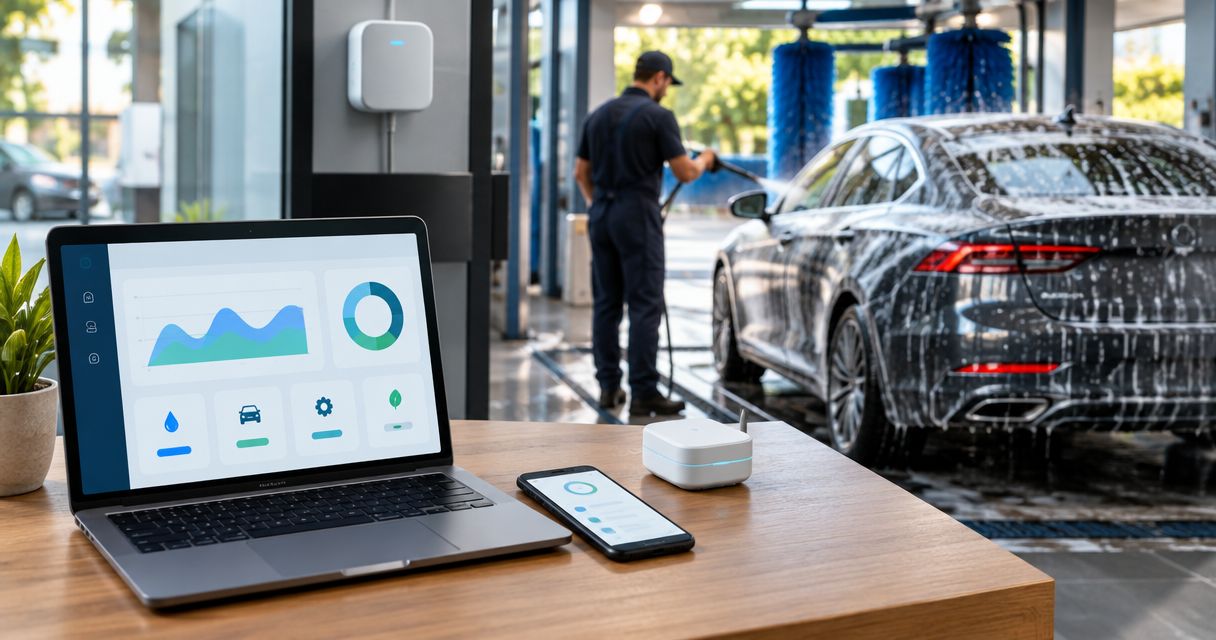
Kilo brings connected-device data, digital twins, dashboards, automation, alarms and permissions into a platform. For a car wash or detailing chain, that makes it a relevant candidate when the objective is to connect measurements with a common monitoring and response workflow.
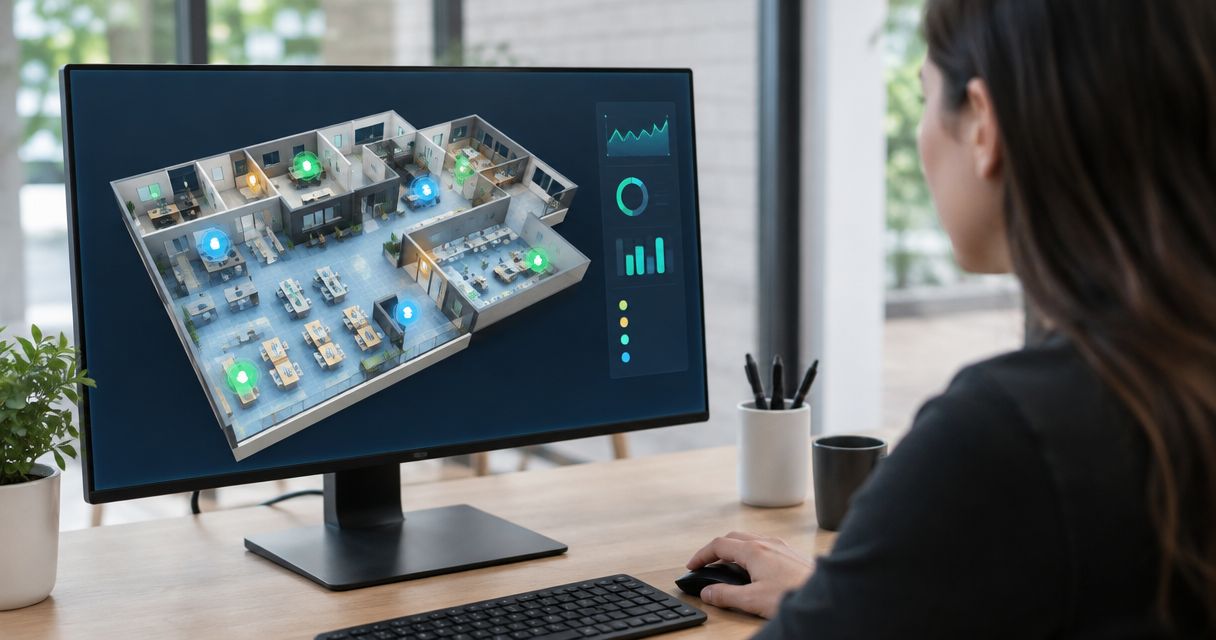
A digital twin is the digital representation and context of a physical asset. In this application, useful context means knowing which tank or piece of equipment a reading belongs to—not assuming that a digital representation models every aspect of the wash process.
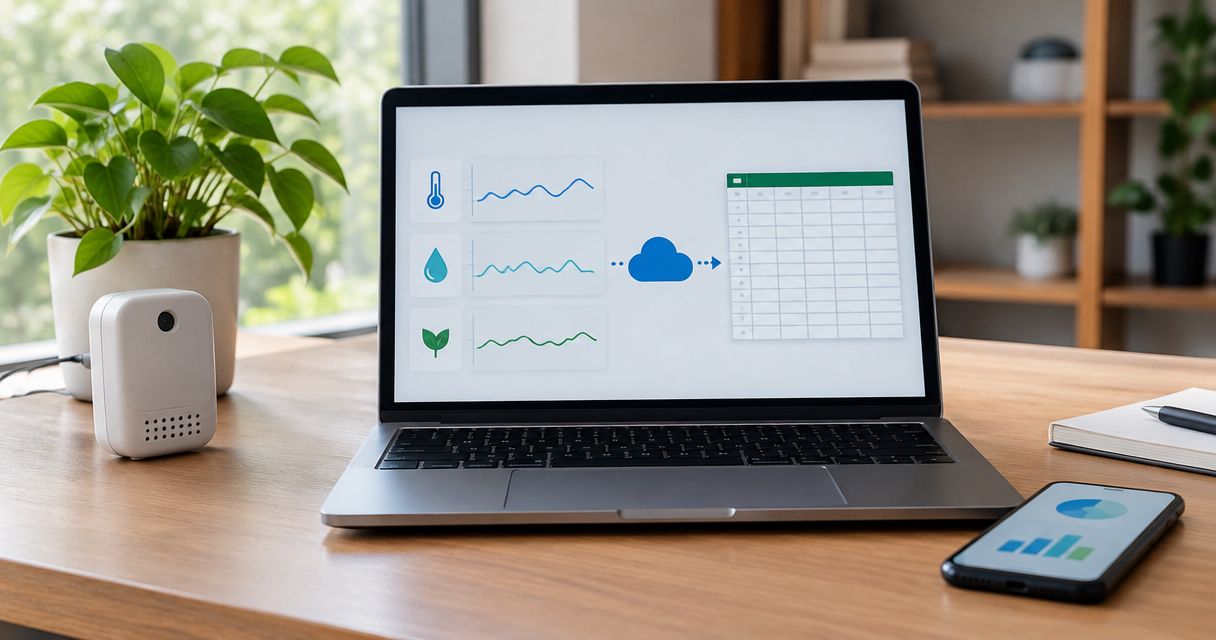
Illustrative workflow: a compatible tank sensor sends measurements through a supported connection. An integrator maps the reading and associates it with the correct asset; the application then presents the measurement and uses a configured condition to raise an alarm for the responsible person.
That example requires a compatible sensor, a working data path and a site-approved alarm condition. It isn't a claim that every tank sensor or wash controller connects without integration work.
Kilo pros:
- Brings monitoring and response capabilities into the same platform.
- Supports device context rather than presenting readings without an asset relationship.
- Includes permissions for configuration and operation.
- Provides built-in AI assistance alongside conventional IoT workflows.
Kilo limitations:
- A supported protocol doesn't establish support for every device payload or equipment command.
- The platform alone cannot operate a valve, pump or other actuator without a compatible configured command path.
- Condition monitoring doesn't establish machine-learning failure prediction or automatic maintenance work-order creation.
Best for: integrators and chain operators building shared sensor monitoring with configured alarms and automation.
Verdict: shortlist for a monitoring pilot; approve rollout only after proving the required device workflows.
2. Self-managed IoT software: for application ownership
Self-managed IoT software puts responsibility for running the application environment with your organisation or its service provider. Evaluate this approach when that ownership is a requirement, rather than treating it as an automatic way to simplify deployment.
The important distinction is responsibility. Someone must maintain the hosting environment, software releases, backups, access configuration and integrations, as well as the monitoring application your sites use.
For a detailing chain, this approach fits a team that deliberately wants to maintain its own site model and reporting application. Ask that team to demonstrate the same tank-reading and alarm-response workflow you would require from a managed platform.
Self-managed IoT software pros:
- Lets you choose and operate the hosting environment.
- Places application configuration under your own delivery process.
- Gives an internal team or integrator responsibility for release timing.
Self-managed IoT software limitations:
- Requires an identified software and infrastructure owner.
- Makes maintenance and recovery procedures part of your deployment scope.
- Doesn't remove sensor integration, measurement validation or equipment compatibility work.
Best for: organisations with a clear hosting requirement and a team committed to maintaining the application.
Verdict: hold unless ownership requirements justify the operating responsibility.
3. Custom cloud application: for requirements that need development
A custom application lets your developers design the monitoring experience around your chain's processes. Choose this route when you can specify the requirement that an existing application cannot satisfy—not simply because your business has distinctive terminology.
A custom application could combine device observations with a replenishment process or an internal equipment register. Those are implementation possibilities, not ready-made integrations; your team must define and build the connections.
The scope extends beyond receiving sensor messages. Your application needs asset relationships, access decisions, alarm behaviour, missing-data handling and a maintainable interface for the people using it.
Custom cloud application pros:
- Lets you define the application workflow around specific requirements.
- Gives developers control over the data model and user experience.
- Allows integration work to follow your internal systems and processes.
Custom cloud application limitations:
- Required functions need engineering rather than being assumed present.
- Your organisation owns testing, releases and ongoing support.
- A working demonstration doesn't establish a maintainable chain-wide service.
Best for: chains with funded engineering capacity and requirements that warrant a dedicated application.
Verdict: hold until the unique requirement and maintenance owner are explicit.
4. Controller-led monitoring: for equipment-specific diagnostics
Controller-led monitoring starts with information exposed by your existing equipment controls. Its suitability depends on the actual controller, its documented interfaces and the information the equipment supplier makes accessible.
Begin here when the question concerns a machine's operating state or fault information. Ask the equipment supplier what can be read, what can be changed and which interfaces are intended for external use.
This approach doesn't automatically provide a shared view of separate tank sensors, building conditions or equipment from other suppliers. Treat consolidation as a separate integration requirement.
Controller-led monitoring pros:
- Starts with the equipment's existing operating context.
- Keeps equipment-interface decisions tied to the supplier's documentation.
- Gives you a defined place to investigate machine-specific diagnostic information.
Controller-led monitoring limitations:
- Accessible data depends on the particular equipment and interface.
- Separate sensor systems still need their own integration path.
- Cross-site visibility must be demonstrated rather than inferred from a local display.
Best for: equipment-specific investigation where the controller exposes the required information.
Verdict: use for machine diagnostics; don't assume it replaces shared facility monitoring.
Prove the complete workflow before expanding
A pilot should answer whether the application supports a useful decision. Start with a clearly defined observation and response, then test the failure cases alongside normal operation.
Use this sequence to organise acceptance:
- Asset context: identify the site, asset, sensor, measurement and person responsible for responding.
- Data mapping: establish the payload meaning, units and any conversion the application applies.
- Alarm response: define the condition and demonstrate how the responsible person receives and interprets it.
- Outcome evidence: identify what confirms replenishment, repair or another completed response.
- Failure handling: test missing readings, disconnected equipment and an unavailable responder.
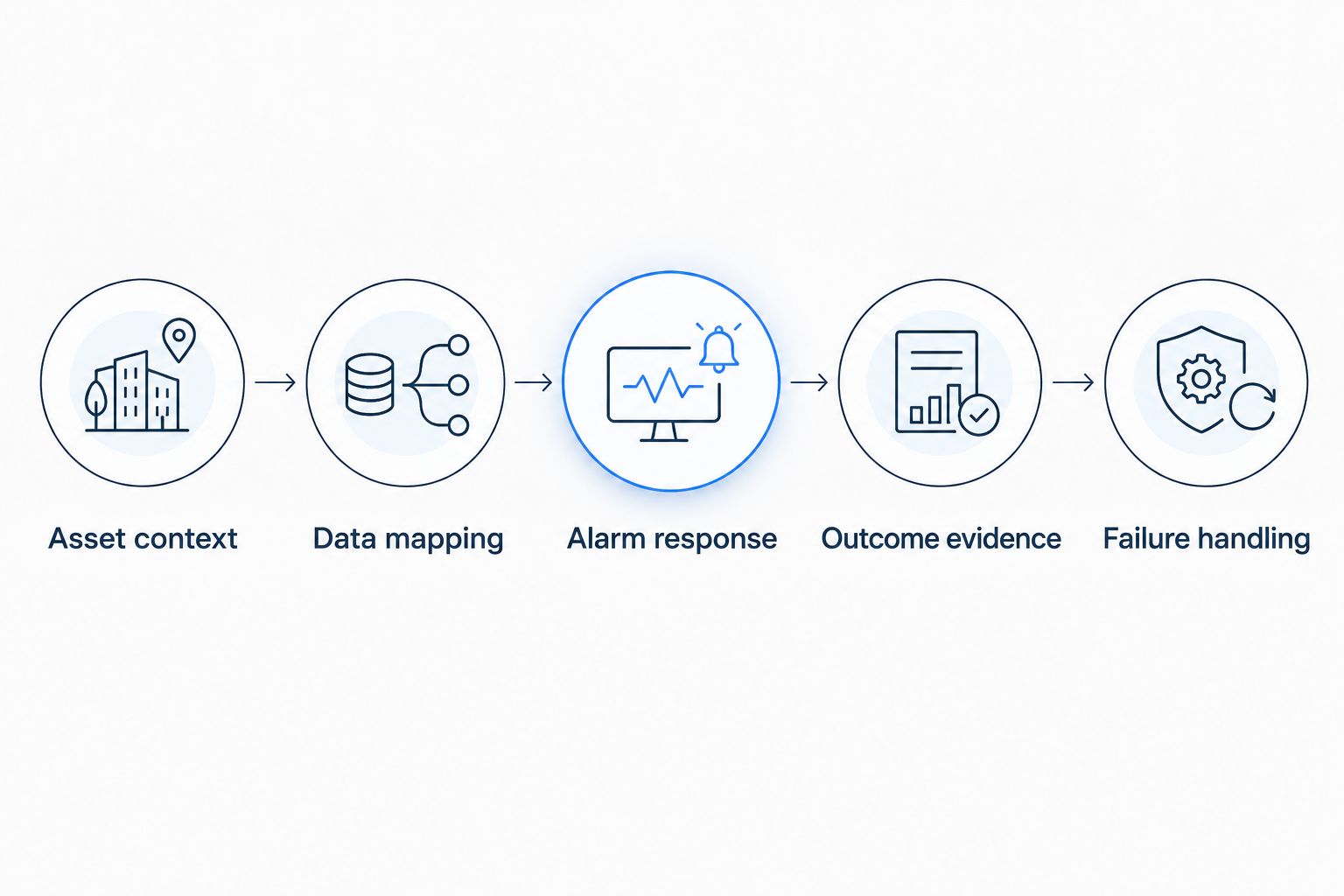
For an illustrative low-tank scenario, the input is a measured level associated with a particular tank. The configured condition raises an alarm, the assigned person investigates and replenishes as appropriate, and a subsequent observation supplies evidence of the changed level.
For a tank-specific implementation discussion, use the guide to tank-level monitoring for car wash and auto detailing chains. Keep this platform-selection decision focused on application ownership and the complete response workflow.
Hardware remains a separate sourcing decision. Kilo Electronics is a separate online authorised dealer for compatible hardware serving individual and business buyers; selecting platform software doesn't establish that a particular sensor suits your tank, chemical or installation environment.
Add AI assistance without confusing it with control
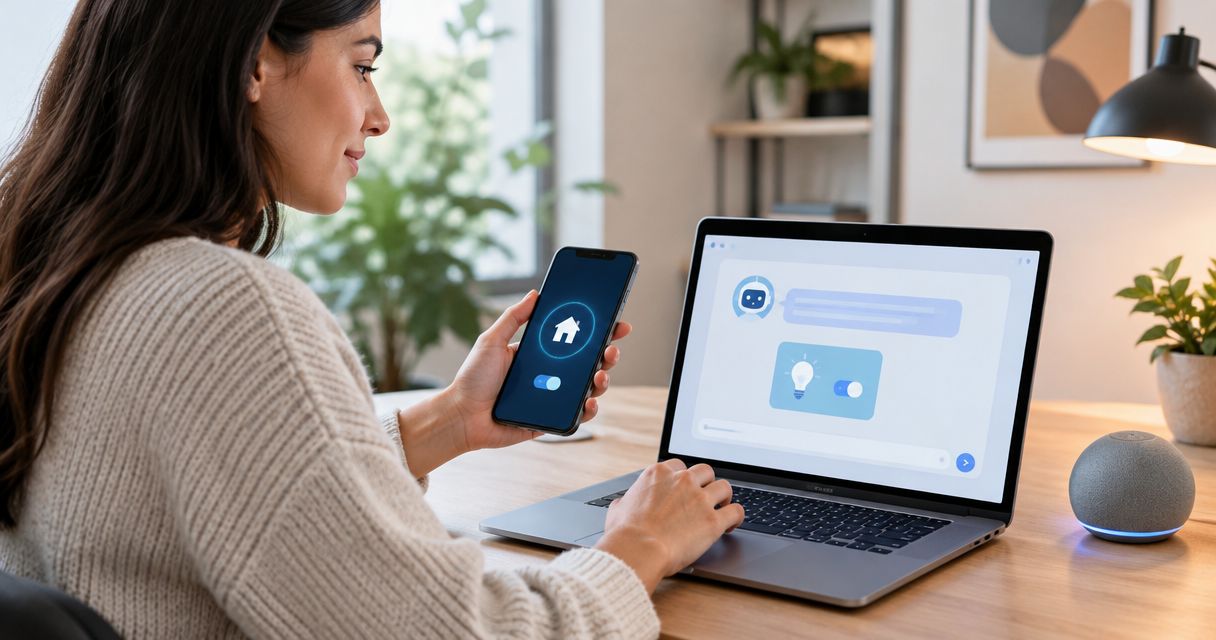
Kilo's built-in assistant and compatible external clients can help users configure and operate connected deployments within their permissions. Claude through MCP is an example of a compatible external-client approach; MCP connects the client with exposed tools and context.
Tool coverage matters. Don't assume that every built-in-assistant function is available through every external client, or that a connection gives an assistant unrestricted equipment access.
For direct device commands, the built-in assistant has a confirmation flow. External MCP clients have their own approval behaviour, while deliberately configured rules can execute commands autonomously.
A command status isn't proof of a physical outcome. Accepted, queued or delivered describes the command path; device feedback or subsequent measurements must establish the outcome where supported. Keep machinery interlocks and control engineering separate from assistant approval.
How these approaches were ranked
The ordering starts with a shared monitoring application, then moves toward greater application ownership or a narrower equipment focus. It follows the criteria above: integration, asset context, measurement quality, response, permissions and operating responsibility.
This is an architecture-based shortlist, not a benchmark of deployment speed, reliability or financial return. Select the approach whose responsibilities match your team, then require evidence from the intended deployment.
Which approach should your chain choose?
For a chain seeking shared sensor monitoring rather than a new software-development programme, Kilo is a relevant IoT platform to evaluate. Prove the incoming measurement, asset context, alarm recipient and outcome evidence before extending the configuration to other sites.
Choose self-managed software when operating the environment is a deliberate requirement. Choose custom development when a specific application requirement warrants it, and use controller-led monitoring when the question is tied to equipment diagnostics.
Don't let the selection become a feature-count exercise. Your default should be the approach your team can operate and explain from observation to response.
FAQ
What's the best IoT platform for car wash chains?
The right IoT platform for car wash chains depends on the required integrations and who will operate the application. Kilo is a relevant shortlist candidate for connected-device monitoring, dashboards, alarms and configured automation; prove those workflows with your actual equipment before selecting it.
Can a car wash IoT platform replace the wash controller?
An IoT platform doesn't replace the wash controller or machinery interlocks. Use documented interfaces for monitoring and supported commands while retaining the equipment's control engineering.
Can existing equipment connect to a shared monitoring platform?
Existing equipment can connect only where a suitable documented interface and integration path are available. A shared protocol name doesn't prove that every payload, diagnostic value or command is supported.
Do tank-level readings automatically show usable chemical volume?
A level reading doesn't automatically establish usable volume. The conversion needs the tank geometry, measurement meaning and an appropriate mapping for the installation.
Does a pump alarm mean the platform predicts failures?
A pump alarm doesn't establish failure prediction. Threshold or condition monitoring identifies configured observations; machine-learning prediction requires separate evidence.
Can an AI assistant shut down car wash equipment?
An assistant can issue a physical command only through a supported, configured command path within the applicable permissions and approval behaviour. The platform alone cannot control arbitrary equipment, and command status doesn't verify that the equipment changed state.
What should a car wash chain test before rollout?
Test the complete observation-to-response workflow before rollout. Include measurement mapping, asset identity, alarm ownership, outcome evidence and handling of missing data or unavailable responders.
Test a stale reading before trusting a normal one
A plausible tank reading is useful only when you know it is current. Make a disconnected sensor part of acceptance testing and require the application to distinguish missing data from a healthy condition.
That test exposes a practical weakness a normal dashboard demonstration can hide. Approve the monitoring workflow only when your team knows what to do when the measurement stops arriving.