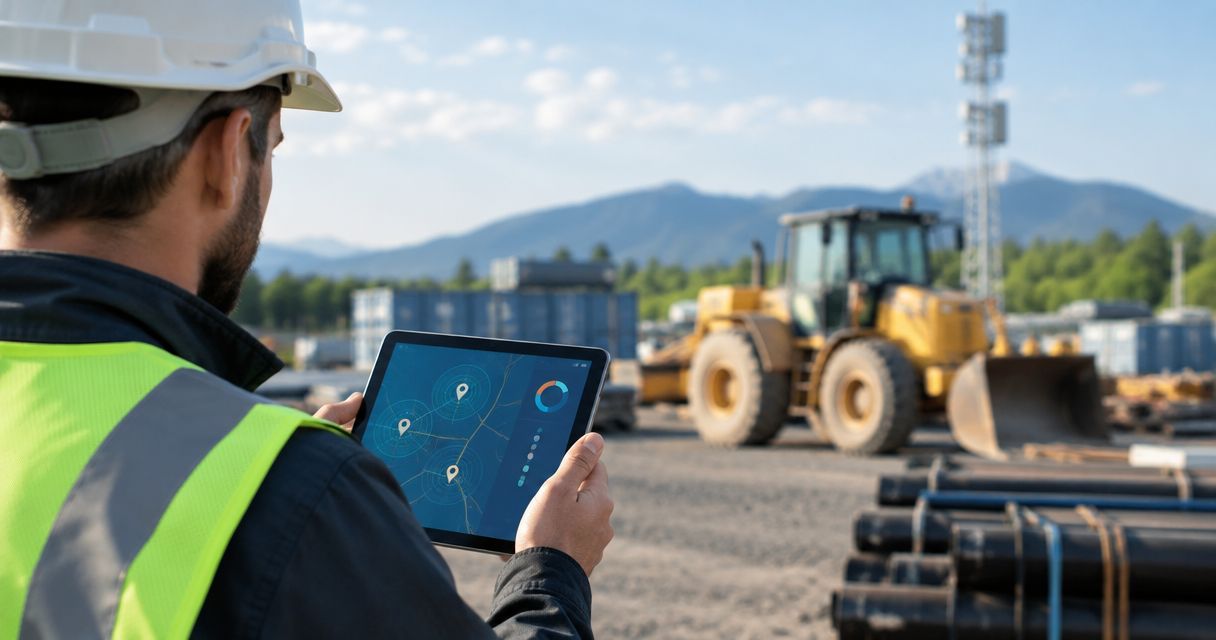
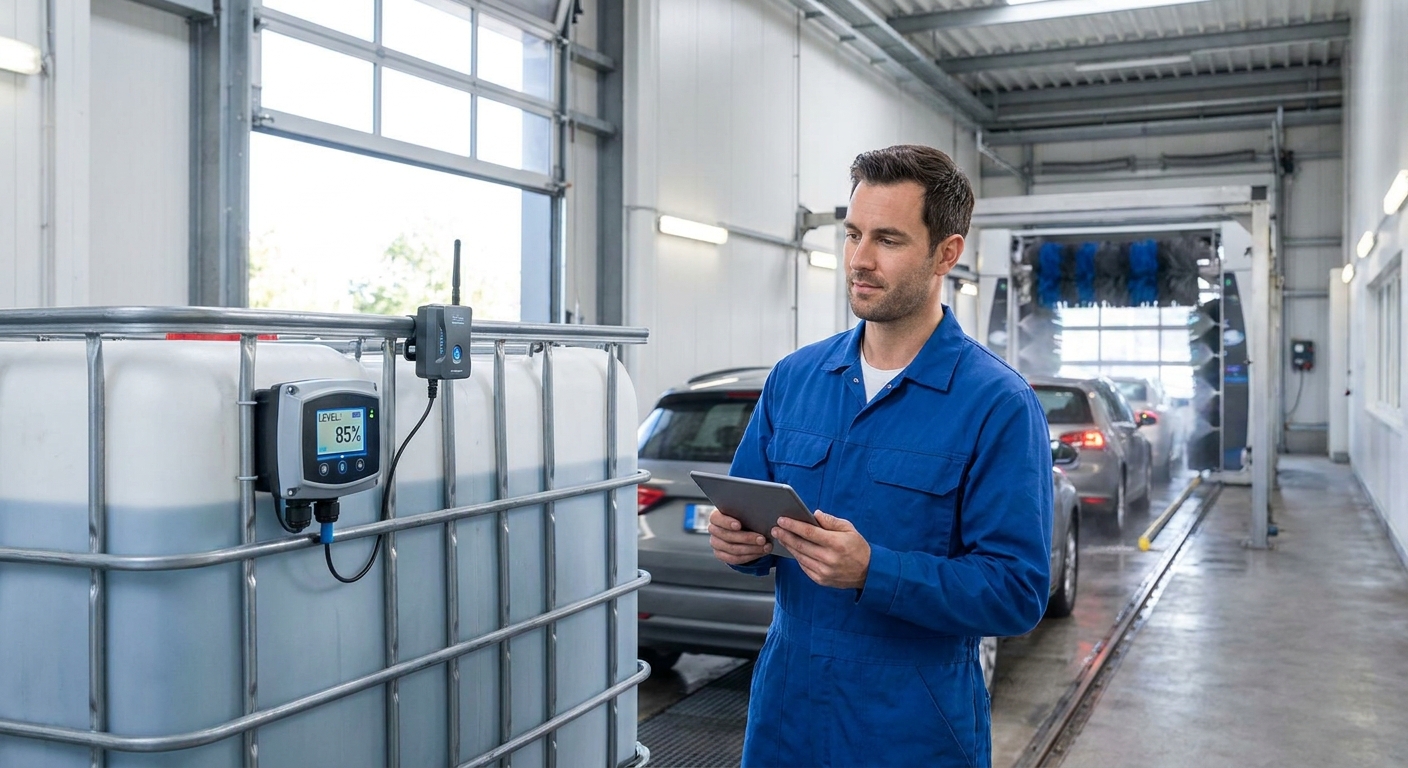
Car wash and detailing chains run on liquids you can't see: fresh water, reclaim water, detergent, wax, tire shine, and softener brine, spread across a dozen or fifty sites. Tank level monitoring for car wash chains fixes the part nobody watches until a bay goes dry mid-cycle.
- Tank level monitoring for car wash chains works best with non-contact ultrasonic sensors — float switches corrode in chemical totes fast.
- Kilo IoT routes low-level and overflow alarms to regional managers so a dry detergent tank never stalls a bay in 2026.
- LoRaWAN sensors run 5-8 years on battery, no wiring per site — the right fit for 10+ location chains.
- Skip Wi-Fi float sensors in wash bays; equipment interference and humidity kill range and battery life fast.
Why this matters
A detailing chain with 12 locations doesn't lose money on one dry chemical tote — it loses money on the pattern. One site runs out of tire shine on a Saturday, another overflows a reclaim tank into a storm drain, a third has a manager driving to a supply house at 6 a.m. because nobody flagged the trend.
In 2026, most of these chains still check tank levels by walking a dipstick around once a shift. That works at one site. It falls apart at ten, because nobody at headquarters sees the pattern until a bay is already down.
Automated tank overflow alerts turn a walk-the-floor habit into a dashboard number every site manager and regional ops lead can see at the same time, in real time.
Who this is for
This is for operations leads running multi-site car wash or detailing chains — five locations or five hundred — who are tired of chemical run-outs, overflow cleanups, and the guesswork of manually checking tanks across sites that don't talk to each other. If you're running a single independent bay with one detergent drum, a dipstick and a Tuesday reminder still works fine. Once you're managing tanks across multiple addresses, you need data, not a habit.
What to look for in tank level monitoring for car wash chains
Non-contact sensing for chemical tanks
Acid-based wheel cleaners and alkaline presoaks eat float switches and probes over months, not years. Ultrasonic or radar sensors mounted on top of the tank never touch the liquid, so corrosion isn't a variable you have to plan replacement cycles around.
Wireless connectivity that scales past one site
Pulling ethernet to a chemical shed at every bay isn't realistic across a chain. LoRaWAN sensors report over distances up to several miles from a single gateway, and a mioty-based deployment handles dense multi-tank rooms without the network congestion Wi-Fi or Bluetooth mesh runs into.
Real alarms, not just a dashboard number
A number on a screen nobody checks is worthless. What matters is a rule that fires the moment a detergent tank crosses 15%, texting the site manager and cc'ing the regional ops inbox before the bay stalls.
Battery life built for wash-bay humidity
Wash bays run wet, warm, and sometimes near freezing in winter lots. Sensors rated for 5-8 years of battery life in that environment beat anything built for a dry office ceiling.
Retrofit onto tanks you already own
Most chains aren't replacing tanks — they're instrumenting the ones already installed. A sensor that mounts through an existing tank cap or bung, without drilling a new port, gets a whole chain online in weeks instead of a capital project spanning a year.
One dashboard across every location
If headquarters needs five logins to check five sites, the system has already failed. A single multi-site view showing every tank, every site, on one screen is the actual point of the exercise.
See tank data across every site
One dashboard for every tank, every location, live in 2026.
Top picks by tank type
Fresh water and rinse tanks — the baseline
The hook: this is the tank every bay has and every chain ignores until the rinse arch runs dry mid-wash. An ultrasonic sensor reading every 15 minutes on a 500-gallon rinse tank catches a supply line failure hours before a customer notices spotty water pressure. Verdict: Buy.
Detergent and presoak totes — the corrosion problem
The hook: this is where float switches die fastest. A non-contact ultrasonic sensor mounted on a 275-gallon IBC tote avoids the corrosion float-based systems suffer within 12-18 months in alkaline presoak. Pair it with a low-level alarm at 20% so a driver can restock before a Saturday rush stalls. Verdict: Buy.
Reclaim and wastewater tanks — the compliance angle
The hook: this tank matters to your local water authority more than to your customers. Monitoring level trends on a reclaim tank flags a pump failure before it overflows into a storm drain, which is the kind of incident that triggers a fine, not just a cleanup. Verdict: Consider if your site operates under a local discharge permit; Skip if reclaim isn't part of your system.
Wax and tire shine concentrate — the small-volume outlier
The hook: these tanks run 30-55 gallons and empty fast during high-volume weekends. A sensor here is lower priority than detergent or rinse water, but useful once you're managing more than 15 sites and want to standardize restocking routes. Verdict: Consider.
Water softener brine tanks — the one to skip for most chains
The hook: brine tanks self-regulate on most commercial softener systems and rarely cause a bay stoppage. Unless your chain has had repeat softener failures tied to brine depletion, this is the tank that doesn't justify the sensor cost yet. Verdict: Skip for most chains; Consider only if you've had softener-related downtime in the past 12 months.
What to avoid
- Contact float switches in chemical totes. They look cheaper on the spec sheet, but corrosion failures inside 12-18 months mean you're replacing them more than you're monitoring anything.
- Consumer Wi-Fi sensors in wash bays. Metal equipment, water spray, and thick walls kill Wi-Fi range fast, and battery life on Wi-Fi sensors runs weeks, not years.
- Single-site point solutions with no multi-site dashboard. A sensor app that only shows one location doesn't scale past site three — you'll end up rebuilding the whole stack once you're running ten.
Comparison: tank types ranked by monitoring priority
| Tank type | Failure risk | Read interval | Priority | Verdict |
|---|---|---|---|---|
| Fresh/rinse water | High (stalls a wash) | 15 min | Highest | Buy |
| Detergent/presoak | High (corrosion + run-out) | 15 min | Highest | Buy |
| Reclaim/wastewater | Medium (compliance) | 30 min | Medium | Consider |
| Wax/tire shine | Low-medium (small volume) | 30-60 min | Medium | Consider |
| Softener brine | Low | Daily | Low | Skip (most chains) |
For chains already running fuel or diesel tanks on-site for equipment, the same non-contact sensor logic used in fuel distributor tank monitoring applies directly — different liquid, same overflow and run-out math.
FAQ
What is tank level monitoring for car wash chains?
It's wireless sensors on detergent, rinse, reclaim, and other tanks that report level data to a shared dashboard so operations teams see every site without a manual walk-through. A rules engine turns level thresholds into automated alarms sent to site or regional staff.
What sensor type works best for chemical tanks at a car wash?
Non-contact ultrasonic or radar sensors work best because they never touch corrosive presoaks or acid-based wheel cleaners. Contact float switches typically corrode within 12-18 months in the same chemicals.
Is LoRaWAN better than Wi-Fi for wash-bay tank sensors?
Yes, for most multi-site chains. LoRaWAN sensors run 5-8 years on battery and cover a facility from a single gateway, while Wi-Fi sensors need constant power and struggle with range through wash-bay equipment and moisture.
How often should a detergent tank level be checked?
A 15-minute read interval catches a run-out early enough to restock before a shift stalls. Lower-priority tanks like wax or tire shine can run on a 30-60 minute interval without missing anything actionable.
Does tank level monitoring help with reclaim water compliance?
Yes, level trend data on reclaim tanks flags a failing pump or valve before an overflow reaches a storm drain, which is the scenario that draws a local water authority fine. It's most valuable for chains operating under a discharge permit.
Can one dashboard cover tank data across 20+ car wash locations?
Yes, a multi-site facility monitoring platform like Kilo IoT shows every tank at every location on one screen, with alarms routed by site instead of requiring separate logins per location.
What's the biggest mistake chains make with tank monitoring?
Installing float switches in chemical tanks and skipping the multi-site dashboard, which means the data still requires someone to manually check ten different screens instead of one.
How much does tank level monitoring cost for a car wash chain?
Costs vary by sensor count, tank type, and connectivity, so get a quote based on your actual site count and tank types rather than a flat per-tank estimate.
One last thing
The tank that causes the most damage in a car wash chain isn't the one that runs dry — it's the reclaim tank nobody's watching that overflows quietly overnight. A dry detergent tote stalls one bay for an hour. An unmonitored reclaim overflow can trigger a compliance incident that costs more than a year of sensors across every site you operate.