
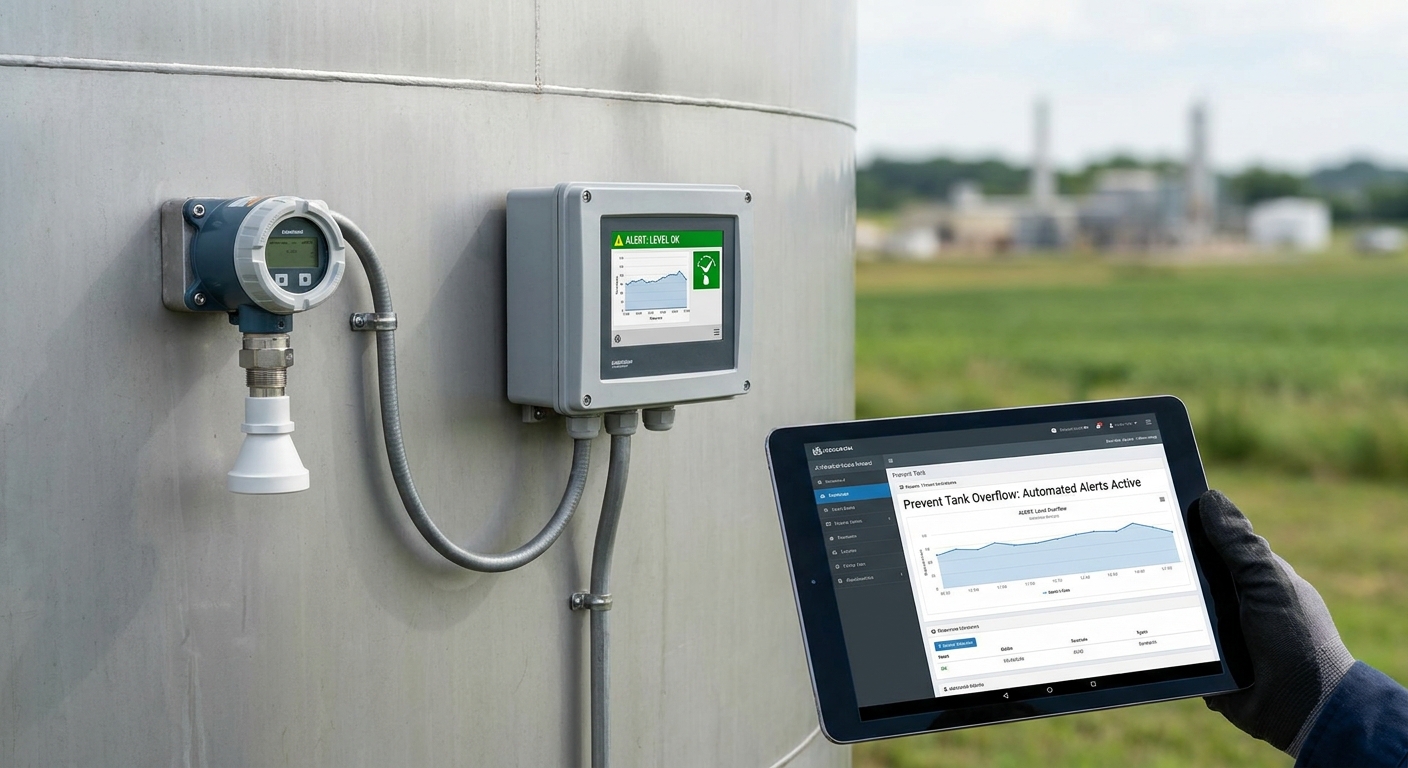
A tank overflow rarely happens because nobody was watching — it happens because the sensor reading exists on a dashboard nobody checked in time. Automated level alerts fix that gap: a rule engine watches the number continuously and fires the moment liquid crosses a threshold, no human required.
- Automated level alerts prevent tank overflow by triggering an alarm before the liquid reaches the overflow point, not after.
- Kilo Cloud's rules engine can send SMS, email and webhook alerts within seconds of a sensor crossing a set percentage.
- Fuel, chemical and water tanks each need two thresholds in 2026 deployments: a warning level and a critical level.
- Sites with no cellular coverage still get reliable alerts over LoRaWAN or mioty instead of a SIM card.
- Alert fatigue kills response time faster than a bad sensor — route warnings and critical alarms to different people.
Why this matters
A tank that overflows costs more than the lost product. A fuel spill triggers an environmental cleanup, a chemical tank overflow can shut a plant down for a shift or more, and a water tower that runs dry mid-cycle leaves a municipal system without pressure. The 2026 fix isn't a bigger tank or a longer checklist — it's a level sensor wired to an alarm rule that doesn't sleep, doesn't forget, and doesn't wait for the morning walk-through.
Most overflow incidents trace back to one of two failures: nobody was monitoring the level in real time, or the alert existed but went to an inbox nobody opened that day. Automated level alerts solve the first problem. Fixing the second one is mostly a matter of how you build the rule — which is what this guide covers.
What you'll need
- A level sensor matched to the liquid: ultrasonic for water and mild chemicals, radar for foaming or vapor-heavy tanks, hydrostatic pressure for tall narrow tanks
- A connectivity path — LoRaWAN, mioty or MQTT depending on the site and how far the tank sits from a gateway
- An IoT platform with a rules engine that can evaluate sensor readings against thresholds continuously, such as Kilo Cloud
- A list of who gets notified for a warning versus a critical alarm, with phone numbers and emails confirmed
- 30 minutes to test the full alert chain end to end before the sensor goes live
The steps
1. Map every tank and its actual overflow point
Don't set a threshold off the tank's rated capacity — set it off the physical point where liquid escapes. A 10,000-gallon tank with an overflow pipe at 92% full needs its critical alarm well below that number, not at 100%. Walk each tank, note the overflow elevation, and record it before you touch a sensor setting. Skipping this step is the single most common reason alarms fire too late to matter.
2. Choose the sensor type for the liquid, not just the tank
Ultrasonic sensors struggle with foam and heavy vapor; radar handles both better and costs more. Hydrostatic pressure sensors work well in tall, narrow chemical or fuel tanks where an ultrasonic beam has too much surface turbulence to get a clean reading. Get this wrong and you'll spend the next six months fighting false readings instead of preventing overflow. Chemical storage tank monitoring needs a different sensor profile than a municipal water tower, and treating them the same is where most deployments go sideways.
3. Set two thresholds, not one
A single alarm at 95% gives an operator almost no time to react. Set a warning threshold at 80% full that goes to the operations team as a heads-up, and a critical threshold at 92-95% that escalates to whoever can physically stop the fill. Two thresholds turn one panic moment into one planned response and one confirmation.
4. Build the alarm rule in the platform
In Kilo Cloud, a rule reads: if level sensor value exceeds 80% for more than 2 minutes, send a warning alert; if it exceeds 92%, send a critical alert and trigger any connected shutoff relay. The 2-minute delay on the warning threshold matters — it filters out a sloshing wave or a momentary reading spike so the warning doesn't turn into noise. Municipal operators running tank level monitoring for water towers and municipal utilities use the same two-threshold logic to avoid both dry-outs and overflows on the same system.
5. Route alerts to the right person, not everyone
A warning alert should go to the on-shift operator by SMS. A critical alarm should escalate — operator first, supervisor 5 minutes later if unacknowledged, plant manager after that. Sending every alert to a group text guarantees somebody assumes somebody else handled it. Fuel distributors running tank level monitoring for fuel distributors build escalation chains for exactly this reason — a missed critical alert on a fuel tank isn't a paperwork problem, it's a spill.
6. Test the full alert chain before go-live
Manually push a test reading through the sensor or simulate the threshold in the platform and confirm the SMS, email and any relay trigger all fire correctly. Test at both thresholds, not just one. Roughly a third of overflow near-misses trace back to an alert chain that was never tested past the warning stage.
7. Log every alert and retune after 30 days
After the first month, pull the alarm history. If the warning threshold fired 40 times and none were real overflow risk, it's set too low and the team has started ignoring it. If the critical threshold never fired but the tank came close twice, move it down 3-5 percentage points. Thresholds that never get revisited drift out of sync with how the tank actually behaves.
See how Kilo IoT builds tank alarms
Check the platform's rules engine and alarm setup for level monitoring.
Troubleshooting
- False alarms from foam or turbulence — switch from ultrasonic to radar, or add a 60-90 second delay before the rule fires so a momentary spike doesn't trigger an alert.
- Sensor drift on corrosive liquids — hydrostatic sensors in chemical tanks lose calibration over months of exposure; recalibrate quarterly and flag any reading that jumps more than 5% between checks.
- No cellular signal at the site — remote tanks in fields, rural fuel depots, or basement utility rooms often sit outside cell coverage; remote tank monitoring without cellular signal covers LoRaWAN and mioty setups that don't depend on a SIM card at all.
- Alert fatigue — if the team stops responding to warnings, the threshold is set too aggressively or too many people are on the notification list; narrow it to two names per alarm level.
- Delayed notification because a gateway went offline — build a secondary rule that alerts on gateway silence itself, not just on tank level, so a dead gateway doesn't mean a blind tank.
- Reading gaps during power flicker — battery-backed sensors with a 15-minute reporting interval survive short outages; anything reporting hourly leaves too big a blind spot for a fast-filling tank.
Tools and resources
- A level sensor matched to your liquid type (ultrasonic, radar or hydrostatic)
- LoRaWAN or mioty connectivity for sites without reliable cellular coverage
- An IoT platform with a rules engine and alarm escalation, such as Kilo Cloud
- How to build automated alarms for equipment vibration anomalies walks through the same rule-building logic applied to a different sensor type — useful if your site also monitors pumps or motors feeding the tank
What to do next
Once the alarm chain is live and tested, the next move is tuning the escalation timing and confirming the rule survives a gateway restart or a sensor swap without losing its thresholds. The vibration alarm guide linked above covers the same rule-building mechanics in Kilo Cloud, so the setup pattern will already look familiar.
FAQ
What is the best way to prevent tank overflow with automated alerts?
Set two thresholds — a warning around 80% full and a critical alarm around 92-95% full — routed through a rules engine that sends SMS or email the moment a sensor crosses either line. A single threshold gives too little reaction time.
How much does automated tank level monitoring cost in 2026?
Costs vary by sensor type and site connectivity, with radar sensors running higher than ultrasonic and remote sites needing LoRaWAN or mioty gateways instead of cellular data plans. Check current pricing directly with the platform provider for your tank count and site layout.
Can automated alerts work without cellular signal?
Yes — LoRaWAN and mioty connectivity carry sensor readings to a gateway without needing a SIM card, which matters for rural tanks, basements and remote fuel depots. A dedicated setup guide for cellular-free sites walks through the gateway placement.
Is radar or ultrasonic better for preventing tank overflow?
Radar handles foam, vapor and turbulence better and gives a cleaner reading on chemical and fuel tanks, while ultrasonic works fine on calmer liquids like water at a lower cost. The right choice depends on what's inside the tank, not the tank size.
How many alert thresholds should a tank have?
Two: a warning threshold that gives the operator time to react, and a critical threshold that escalates and can trigger a shutoff. A single threshold near the overflow point leaves almost no reaction window.
Why do tank level alarms cause alert fatigue?
Alert fatigue happens when thresholds are set too aggressively or every alert goes to the whole team instead of two named people per level. Retuning thresholds after 30 days of real data usually cuts false positives significantly.
Do municipal water towers need the same alarm setup as fuel tanks?
The two-threshold logic is the same, but the sensor type and escalation contacts differ — water towers also need a low-level dry-out alarm that fuel tanks don't. Site-specific rules matter more than a one-size-fits-all template.
What happens if the gateway goes offline during a tank fill?
A separate rule should alert on gateway silence itself, not just on tank level, so a dead connection doesn't leave the tank unmonitored during a critical fill. Battery-backed sensors with short reporting intervals reduce this blind spot.
One last thing
The overflow incidents that actually make the news in 2026 almost never involve a missing sensor — they involve a sensor that was reporting correctly to a dashboard nobody was required to check that day. The fix isn't more monitoring, it's fewer people between the reading and the response: two thresholds, two named contacts, and a rule that fires itself.