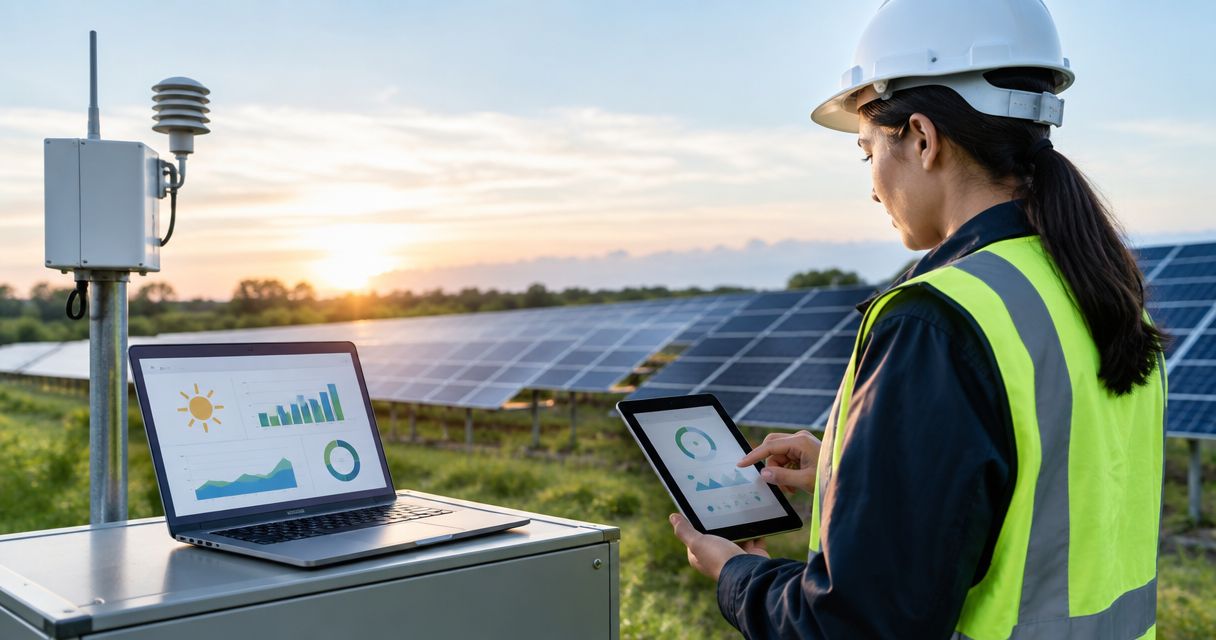
Community solar sites mix inverters, battery storage, revenue meters, and a handful of unmanned enclosures spread across a few acres or an entire portfolio, and most operators end up running three separate vendor apps to watch it all. This guide breaks down what an IoT platform for community solar operators actually needs to do in 2026, and where a general-purpose platform like the Kilo IoT Platform fits against dedicated PV monitoring tools, DIY stacks, and utility SCADA systems.
- A community solar IoT platform needs to cover inverters, battery storage, revenue meters and subscriber alarms in one system, not four separate ones.
- General-purpose platforms like the Kilo IoT Platform combine LoRaWAN, mioty and MQTT so one dashboard covers panels, storage and site sensors together.
- Dedicated solar performance monitoring software calculates production ratios well but rarely extends to non-PV sensors on the same site.
- Subscriber billing needs ANSI C12.20 Class 0.2 or 0.5 revenue-grade metering, not sensor-based estimates from a monitoring platform.
- FERC Order 2222, enacted in 2020, opened wholesale markets to aggregated distributed resources, which makes exportable telemetry a 2026 requirement, not a nice-to-have.
What does a community solar site actually need monitored?
A single community solar array has more moving parts than the name suggests. Inverters report fault codes and production data. Combiner boxes and string connections fail quietly. If the site pairs with battery storage, state-of-charge and thermal limits need their own watch. Revenue meters feed subscriber billing, and the site itself needs a perimeter or access alarm if it sits unmanned in a field.
Most teams start with the inverter manufacturer's own portal, add a spreadsheet for the meter readings, and bolt on a security camera app for the fence line. That works for one site. It falls apart at three sites, and it falls apart faster the day a co-op board asks for a single monthly report instead of three exports stitched together by hand.
The question worth asking before buying anything isn't "which brand's app is best" — it's whether one platform can hold the inverter data, the battery rules, the meter feed and the alarm escalation in a single place. That's the actual job description for an iot platform for community solar operators in 2026.
What makes an IoT platform work for community solar farms?
- Multi-protocol connectivity — LoRaWAN, mioty and MQTT covering panels, inverters, meters and legacy PLCs without swapping platforms per subsystem.
- A rules engine that spans subsystems — inverter fault codes and battery state-of-charge evaluated in the same workflow, not two separate tools.
- Tiered alarm escalation — a string outage at 2am should reach the on-call tech, not flood a shared inbox everyone ignores.
- Role-based permissions — co-op board members, O&M contractors and subscriber-facing views need to see different things.
- A digital record per asset — one inverter, one combiner box, one meter, each with its own history a technician can pull up without a spreadsheet.
- Exportable data — API access matters more after FERC Order 2222, since aggregated distributed resources need clean telemetry to participate in wholesale markets.
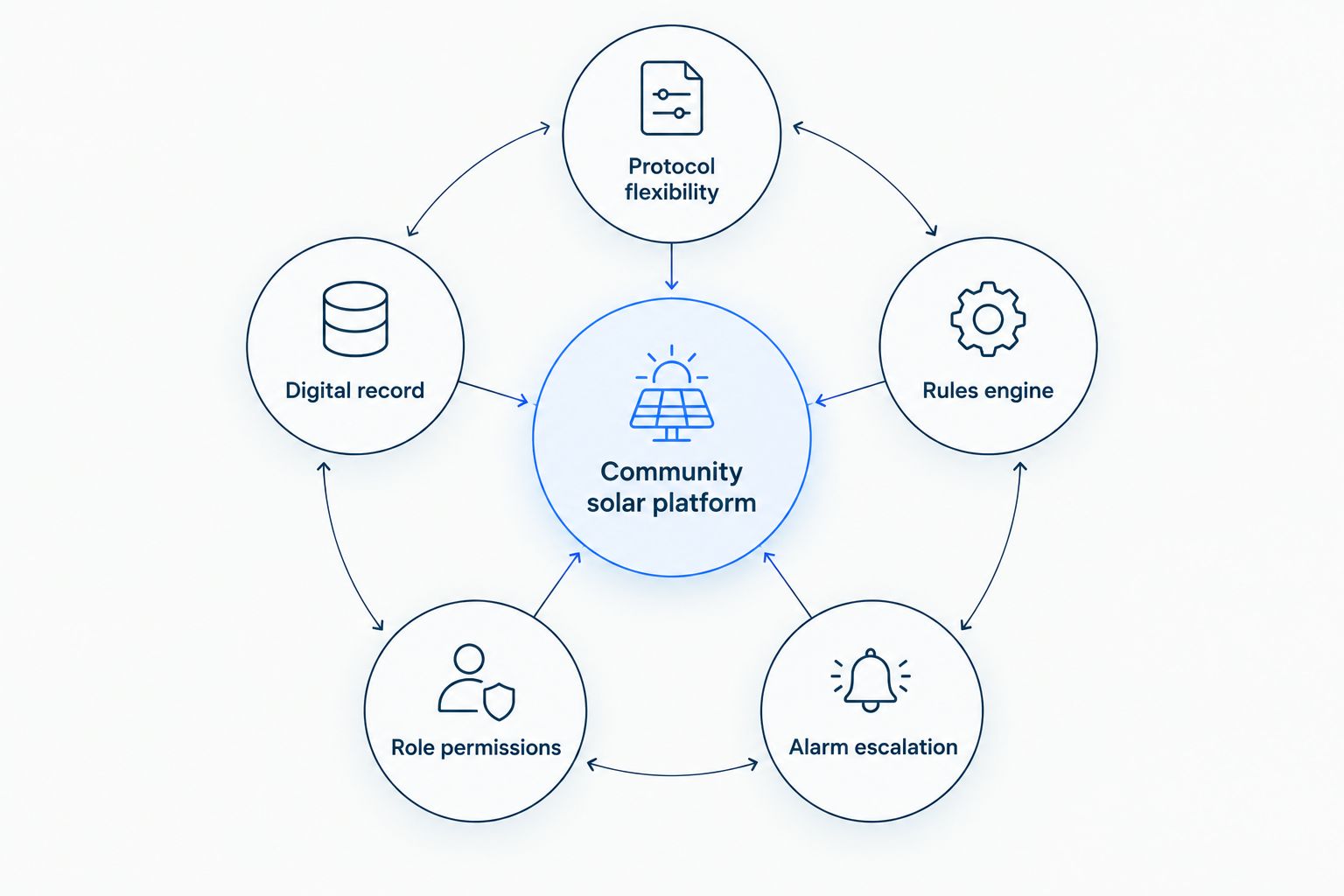
Those six criteria are what separates a platform that scales past one site from one that only ever worked for the pilot.
Which type of IoT platform fits a community solar site?
| Platform type | Best for | Standout capability | Key limitation |
|---|---|---|---|
| General-purpose IoT platform (Kilo IoT Platform) | Multi-site portfolios mixing solar, storage and site sensors | LoRaWAN, mioty and MQTT in one shared rules engine | No camera-based vision analytics yet; Kilo Lens is coming soon |
| Dedicated solar performance monitoring software | Single-site inverter and panel performance tracking | Purpose-built performance-ratio calculations aligned to IEC 61724-1 | Limited or no support for non-PV sensors on the same site |
| DIY open-source stack (Home Assistant, Node-RED) | Technically staffed co-ops willing to self-host | Full control over data and custom integrations | Every rule and alarm escalation has to be built and maintained in-house |
| Utility SCADA-integrated system | Utility-owned, grid-interconnected sites | Direct Modbus/DNP3 tie-in to an existing control room | Long implementation cycles built for utility-scale, not distributed community sites |
What are the main options for community solar site monitoring?
1. General-purpose IoT platforms for multi-site portfolios
A general-purpose platform connects panels, battery storage, revenue meters and site sensors under one dashboard with a shared rules engine, instead of one app per subsystem. The Kilo IoT Platform runs a built-in LoRaWAN and mioty network server, so there's no separate network server to stand up alongside it, plus an MQTT connector for revenue meters and PLCs already publishing data. Each inverter or combiner box gets its own device record, and the visual rules engine (BPMN with CEL expressions) can evaluate a fault code and a state-of-charge threshold in the same rule, with version control and one-click rollback if a rule change misfires.
Kilo IoT Platform pros:
- Single dashboard for inverters, battery storage, and non-PV sensors like enclosure temperature or a fence-line alarm.
- Combines LoRaWAN, mioty and MQTT, so a mixed-vendor site doesn't need three separate gateways worth of software.
- ABAC permissions and an audit trail keep a co-op board member's view separate from what an O&M contractor can change.
Kilo IoT Platform cons:
- No camera-based vision analytics yet — Kilo Lens is listed as coming soon, so visual inspection of a site still happens manually.
- Hardware ships through a separate company, Kilo Electronics, so sensor sourcing and platform setup are two distinct steps.
- Alerts fire from thresholds and CEL rules a technician configures, not a machine-learning model predicting failure ahead of time.
Best for: operators running more than one community solar site, or a single site that pairs solar with battery storage and revenue metering under one rules engine.
2. Dedicated solar performance monitoring software
This category is built specifically around production ratios and inverter-level performance, often calculated to the accuracy classes defined in IEC 61724-1. It typically ships with inverter-brand integrations already mapped.
Solar performance monitoring pros:
- Purpose-built performance-ratio and energy-yield calculations out of the box.
- Fast onboarding for a single site running one inverter brand.
Solar performance monitoring cons:
- Usually can't ingest a battery's state-of-charge or a gate sensor inside the same rule.
- A multi-site portfolio ends up running one instance per site rather than one dashboard.
Best for: a single-site operator running one inverter brand who only needs generation and performance tracking.
3. DIY open-source stacks
Tools like Home Assistant and Node-RED let a technically capable team self-host everything and control every integration. No licensing gate stands between the operator and the data.
DIY stack pros:
- Full control of data and no vendor lock-in.
- Extensible to any protocol the team is willing to write an integration for.
DIY stack cons:
- Every rule, dashboard and alarm escalation has to be built and maintained by someone on staff.
- No vendor support line when a gateway drops offline at 2am on a Saturday.
Best for: co-ops with an engineer on staff and the appetite to own the stack for years, not months.
4. Utility SCADA-integrated systems
These are built around control-room infrastructure and tie in directly via Modbus or DNP3, matching utility procurement and cybersecurity requirements out of the box.
SCADA system pros:
- Direct integration with an existing utility control room.
- Meets procurement and cybersecurity checklists utilities already require.
SCADA system cons:
- Implementation cycles run long, and the platform is built for utility-scale generation, not a handful of community arrays.
- Adding a new sensor type often means a change order rather than a self-service setup.
Best for: utility-owned community solar programs already running a SCADA control room.
How do you score an IoT platform before signing a monitoring contract?
Go back to the six criteria and test each option against a real scenario, not a sales demo. Feed a rule a test payload — a simulated inverter fault plus a low state-of-charge reading — and watch whether the platform's rules engine catches both conditions in one pass or needs two separate tools to flag them. Check whether the rules engine supports step-through debugging on that test payload before it goes live, because a rule that only gets validated in production is a rule that fails in production first.
Confirm the platform's data can export cleanly, since FERC Order 2222 opened wholesale markets to aggregated distributed energy resources in 2020, and a community solar portfolio that wants a seat at that table in 2026 needs telemetry it can hand off, not data trapped in one vendor's app.
“If a rule can't tell a real inverter fault from a passing cloud shadow, the platform is just logging noise.”
Also confirm what the platform's alarm escalation actually does at 2am. Five severity tiers and a multi-step escalation chain with quiet hours matter more once a site sits three hours from the nearest technician — a single email alert that nobody checks overnight defeats the entire point of remote monitoring.
See how Kilo handles solar site telemetry
Walk through rules, alarms and permissions on a live workspace.
On the hardware side, most community solar operators still need to source the actual sensors — inverter interfaces, meter pulse counters, enclosure temperature probes — separately from the platform itself. Kilo's sister company, Kilo Electronics, ships that hardware worldwide, which keeps the sensor purchase and the platform setup as two clean steps instead of one bundled black box.
Which IoT platform fits a community solar portfolio in 2026?
For a site running solar alone, a dedicated PV monitoring tool covers the job well and cheaply. Once battery storage, revenue metering, or a second site enters the picture, a general-purpose platform earns its place because it holds all of that in one rules engine instead of three logins. A co-op with in-house engineering can go the DIY route and accept the maintenance load in exchange for full control. A utility-owned interconnected site should stay inside its existing SCADA environment rather than bolt on a second system.
There's no single right answer independent of the site's makeup — but the sites that outgrow their monitoring setup fastest are the ones that added battery storage or a second location without checking whether the original platform could actually hold both.
What do community solar operators usually miss when picking a platform?
Subscriber billing needs revenue-grade metering, and most IoT monitoring sensors don't meet that bar. ANSI C12.20 defines accuracy classes down to 0.2%, and a general-purpose environmental or current sensor reading inverter output typically isn't certified to that standard. That means the meter feeding subscriber bills has to be a separately certified device publishing into the platform over Modbus or MQTT — the monitoring platform reads and displays that number, it doesn't generate it. Skipping this distinction is the single most common gap operators find after a co-op's first billing dispute.
FAQ
What is the best IoT platform for community solar operators in 2026?
A general-purpose IoT platform that covers inverters, battery storage, revenue meters and site alarms in one system fits most community solar portfolios in 2026, since single-purpose PV monitoring tools rarely extend past panel performance.
Do community solar sites need LoRaWAN or cellular connectivity?
LoRaWAN and mioty work well for battery-powered sensors across a wide, unmanned site because of their long range and low power draw, while MQTT typically handles data already published by inverters, meters or PLCs.
Can one IoT platform monitor both solar inverters and battery storage?
Yes, a platform with a shared rules engine can evaluate inverter fault codes and battery state-of-charge in the same rule, which single-purpose PV monitoring software usually can't do.
How accurate does solar performance monitoring need to be?
Performance monitoring accuracy is generally described by the classes in IEC 61724-1, while subscriber billing requires separate revenue-grade metering under ANSI C12.20, typically Class 0.2 or 0.5.
What is FERC Order 2222 and why does it matter for community solar?
FERC Order 2222, issued in 2020, opened U.S. wholesale electricity markets to aggregations of distributed energy resources, which makes exportable telemetry from a community solar site more valuable heading into 2026.
How do IoT platforms alert operators to inverter faults?
A rules engine evaluates incoming telemetry against a threshold or logic expression and fires an alarm with an assigned severity tier, which then escalates through email, SMS or push based on configured escalation chains.
Is mioty better than LoRaWAN for rural solar sites?
Mioty and LoRaWAN both suit long-range, battery-powered sensor deployments; the right choice depends on interference conditions and gateway density at the specific site rather than a blanket rule.
Can subscribers see their own generation data through the platform?
A platform with configurable dashboard widgets and role-based permissions can expose a subscriber-scoped view of generation data without giving that user access to O&M controls or alarm configuration.