
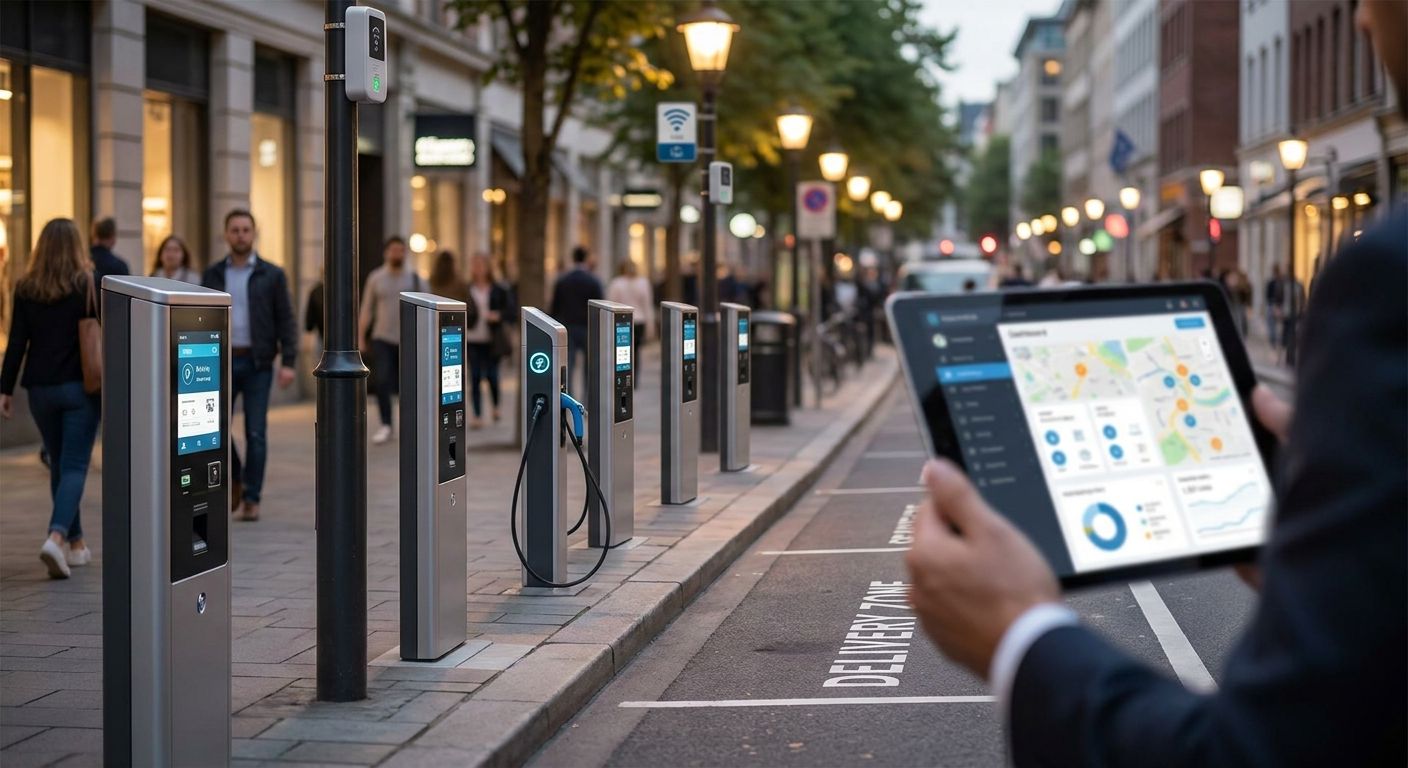
Cities and private lot operators comparing IoT platforms for smart parking meters and curb management need one system that pulls occupancy sensors, pay stations, and gate hardware into a single dashboard, not five logins for five vendors. This guide ranks the platform architectures that actually do that job in 2026, what each is built for, and where each one runs out of road.
- Multi-protocol LoRaWAN and mioty platforms like the Kilo IoT Platform fit cities running mixed sensor fleets across several curb zones and garages.
- Cellular-connected single-purpose sensor networks work best for a single lot with no gateway infrastructure to install.
- Computer vision curb monitoring gives per-vehicle detail for loading-zone and time-limit enforcement but needs clear sightlines and power at each camera.
- Legacy single-vendor meter software still makes sense if a city is fully standardized on one meter manufacturer's hardware.
- The best iot platform for smart parking meters and curb management in 2026 depends on whether the priority is sensor mixing, enforcement detail, or install speed.
Why cities are moving past meter-only parking systems in 2026
A parking meter only tells you whether a transaction happened, not whether the space is actually occupied or how long a vehicle has overstayed. Curb management adds occupancy sensing, loading-zone enforcement, and EV charging bay status to that picture, and that gap is why meter-only cities keep adding sensor layers on top of what they already own.
Research by UCLA urban planning professor Donald Shoup found that drivers searching for curb parking accounted for close to 30% of traffic in some downtown study areas, a figure that shows up constantly in curb management literature and budget justifications for sensor rollouts. The same underlying problem — not knowing which spaces are actually free — drives interest in parking garage occupancy monitoring, which is really curb management's indoor cousin.
A LoRaWAN gateway typically covers a 2 to 5 km radius in a dense urban environment, per the LoRa Alliance's published range figures, which is why block-level curb sensors can often report to a handful of rooftop gateways instead of running a radio per meter. That coverage math is the first thing to check before picking a platform, because it determines whether you're planning gateway placement at all.
What makes the best IoT platform for smart parking meters and curb management
- Multi-protocol connectivity — LoRaWAN or mioty for battery-powered curb and in-ground sensors, MQTT for pay stations, PLCs, or gate controllers already on site
- A rules engine that adapts to local ordinances — flagging an overstay, a meter comms fault, or an EV bay left occupied past its window without an engineer rewriting logic every time a rule changes
- A map-style dashboard — occupied versus free spaces shown block by block, not buried in a spreadsheet export
- Device management at scale — provisioning, battery health, and firmware pushed to hundreds of curb sensors at once
- Open APIs — occupancy and payment data feeding a resident-facing parking app or a city's existing GIS system
- Role-based access — enforcement officers see violations, operations staff see sensor health, and neither drowns in the other's alerts
Types of IoT platforms for smart parking meters and curb management at a glance
| Platform type | Best for | Standout feature | Key limitation |
|---|---|---|---|
| Multi-protocol LoRaWAN/mioty platforms | Mixed sensor fleets across multiple curb zones and garages | One dashboard for occupancy sensors, pay stations, and gate hardware | Needs gateway coverage planned across the deployment area |
| Cellular-connected single-purpose sensor networks | A single lot or short block with no gateway to install | Fast install, no on-site radio infrastructure | Recurring per-device connectivity, closed dashboards |
| Computer vision curb monitoring | Loading zone and time-limit enforcement | Per-vehicle visual detail for disputes | Cameras need power, clear sightlines, and a data-retention policy |
| Legacy single-vendor meter software | Cities standardized on one meter brand | Deep integration with that vendor's existing meters | Rarely mixes sensors from other manufacturers |
| Open-source, self-hosted LoRaWAN stacks | Agencies with in-house network engineers | Full data ownership, no vendor SaaS fee | No vendor support line, slower time to first dashboard |
1. Multi-protocol LoRaWAN and mioty platforms: best for mixed sensor fleets across multiple curb zones
These platforms run a built-in LoRaWAN and mioty network server, so a city or lot operator isn't standing up a separate network server product just to get sensor data flowing. The Kilo IoT Platform is a working example: in-ground occupancy sensors and curb sensors report over LoRaWAN or mioty, while a pay station or gate controller that already talks MQTT connects through Kilo's MQTT connector without a dedicated bridge. mioty in particular uses telegram-splitting, standardized in ETSI TS 103 357, which holds up better than plain LoRaWAN in a downtown block where hundreds of devices are transmitting inside a tight radius.
Kilo IoT Platform pros:
- Built-in LoRaWAN and mioty network server means no separate network server to deploy for curb sensor data
- MQTT connector picks up pay stations, gate PLCs, or existing meter controllers without custom middleware
- A visual rules engine (BPMN, with CEL expressions) turns "space occupied past 120 minutes" into an alarm that pages enforcement, version-controlled and one-click deployable
- Five-tier alarm severity with escalation chains routes a dead battery to operations while an overstay violation routes straight to enforcement
Kilo IoT Platform cons:
- Gateway coverage still has to be planned block by block; dense downtown geometry with tall buildings creates the same radio shadows for any LoRaWAN or mioty deployment
- Rules and alarm logic have to be configured for the specific ordinance in play — a platform doesn't know what "overstay" means until someone sets the threshold
- No camera or license-plate detail is part of a LoRaWAN sensor stack, so enforcement teams needing per-vehicle imagery for citation disputes still need a separate vision system
Best for: cities or campus lots running occupancy sensors, pay stations, and gate hardware from different manufacturers that all need to land in one device management platform built for LoRaWAN networks.
2. Cellular-connected single-purpose sensor networks: best for a single lot or short block rollout
A single small lot or one short block doesn't always justify planning gateway placement. A cellular-connected occupancy sensor reports directly without any local radio infrastructure, which is the appeal for a standalone deployment testing curb sensing for the first time.
Pros:
- Install is fast — no gateway siting, no antenna work
- Works in a location too small to justify network planning
- The vendor typically manages the connectivity end to end
Cons:
- Connectivity is billed per device on an ongoing basis, which adds up once a deployment grows past one lot
- Dashboards are usually closed to that vendor's own app, with little room to fold in a pay station or gate controller from a different manufacturer
- Scaling to a second or third lot often means standing up a second closed system rather than adding sensors to one platform
Best for: a single small lot piloting curb sensing before committing to a multi-site rollout.
3. Computer vision curb monitoring: best for loading zone and time-limit enforcement
A camera sees the vehicle, not just an occupied space. That distinction matters when enforcement needs to prove a specific vehicle overstayed a loading zone window or blocked a bus lane.
Pros:
- Captures vehicle-level detail useful for citation disputes
- No in-ground hardware to bury or maintain
- Covers an entire curb face from one mounting point instead of one sensor per space
Cons:
- Requires continuous power and a clear, unobstructed sightline — foliage, parked trucks, and weather all cut accuracy
- Data retention and privacy policy questions usually go to city council before rollout
- Doesn't cover garages or below-grade lots where a camera has no useful sightline
Best for: enforcement-heavy curb zones like loading docks, bus lanes, and fire access lanes.
4. Legacy single-vendor meter management software: best for cities standardized on one meter brand
If every meter on the street is already the same brand, that vendor's own management software is the path of least resistance.
Pros:
- Deep, tested integration with that manufacturer's existing meter hardware
- No new procurement cycle or sensor vendor to vet
- Familiar to staff already trained on it
Cons:
- Rarely mixes sensors or pay stations from a second manufacturer
- Data format is usually closed, which limits reporting into a separate GIS or budget system
- Upgrade path is tied to that vendor's hardware refresh cycle, not the city's own timeline
Best for: a city fully committed to one meter manufacturer with no near-term plan to diversify hardware.
5. Open-source, self-hosted LoRaWAN stacks: best for agencies with in-house network engineers
An agency with its own engineering staff can run an open-source LoRaWAN network server on its own infrastructure and own every byte of sensor data.
Pros:
- No recurring vendor SaaS license
- Full control over data retention and hosting location
- Customizable to whatever reporting format the agency already uses
Cons:
- Someone in-house has to maintain the network server, patch it, and debug radio issues without a vendor support line
- Rules, alarms, and dashboards typically have to be built from scratch rather than configured
- Time to a working first dashboard is measured in weeks of engineering effort, not days
Best for: transportation agencies with dedicated network engineering staff and a preference for self-hosting over subscription software.
How this ranking was built
Each platform type above is scored against the six criteria listed earlier: protocol flexibility, rules and alarm logic, dashboard usability, device management at scale, open API access, and role-based permissions. Types that mix sensor manufacturers and integrate pay stations without custom middleware rank ahead of single-purpose or closed systems on those same criteria — the ranking isn't about brand names, it's about which architecture matches a given rollout's shape in 2026.
Which curb management platform fits your rollout in 2026?
A single downtown block testing curb sensing for the first time doesn't need a multi-protocol platform yet — a cellular single-purpose sensor network answers that question cheaply. A city running occupancy sensors, pay stations, and gate arms across multiple garages and curb zones needs one platform that speaks LoRaWAN, mioty, and MQTT at once, which is where a platform like the Kilo IoT Platform earns its dashboard. Enforcement-heavy corridors with loading zones and bus lanes still need a vision system layered on top, regardless of which sensor platform runs the rest of the curb.
“The RFP conversation in 2026 should separate what protocol the sensor uses from what the dashboard does with the data — conflating them is the single most common procurement mistake in this category.”
See how curb sensor data lands in one dashboard
Walk through the Kilo IoT Platform before writing an RFP.
FAQ
What is curb management software?
Curb management software tracks how curb space — parking, loading zones, bus lanes, EV charging bays — is used in real time, going beyond a meter's transaction log to show occupancy and violations. It pulls data from in-ground or overhead sensors, cameras, or gate controllers into one dashboard.
Is LoRaWAN or mioty better for smart parking meter networks?
LoRaWAN works well for most curb deployments and has the larger device ecosystem; mioty's telegram-splitting technique, standardized in ETSI TS 103 357, holds up better in downtown areas where hundreds of devices transmit within a few blocks. A platform that runs both, like the Kilo IoT Platform, lets an agency choose per zone instead of committing city-wide upfront.
Can one IoT platform handle both parking sensors and payment meters?
Yes, when the platform supports both a wireless sensor protocol (LoRaWAN or mioty) and MQTT for wired or existing meter hardware. That combination is what lets occupancy data and payment status show up on the same map instead of two separate logins.
How long does a LoRaWAN parking sensor battery last?
Battery life runs into years rather than months under typical duty cycles, because LoRaWAN devices transmit only briefly and spend most of their time in a low-power sleep state. Exact life varies by transmit interval and the specific sensor's battery capacity, so check the manufacturer's datasheet for a given model.
What sensor types measure in-ground parking occupancy?
Magnetometer-based in-ground pucks are the most common, detecting the change in magnetic field a vehicle's mass creates; overhead ultrasonic or infrared sensors are the alternative where burying hardware in the road isn't an option. Camera-based systems add per-vehicle detail but don't replace either sensor type for below-grade garages.
Do smart parking platforms need a private LoRaWAN network or a public one?
A private network, run on gateways the city or operator controls, is standard for curb management because it keeps sensor data on infrastructure the agency owns. A platform with a built-in LoRaWAN network server, rather than one that requires a separate network server product, removes a deployment step here.
How does curb occupancy data get into an existing city app?
Through an open REST or gRPC API — a platform with scoped API keys and documented endpoints lets a city's existing resident-facing app pull occupancy data directly rather than paying for a custom integration project. Confirm API scope and endpoint documentation with each vendor before procurement.
What's the difference between a network server and a curb management dashboard?
A network server decrypts and routes raw LoRaWAN or mioty radio packets from the gateway into usable data; a dashboard turns that data into occupancy maps, alarms, and reports. Some platforms bundle both, which is what "built-in network server" means when comparing platforms.
What most cities miss when picking a parking IoT platform
The detail vendors demo last and cities regret skipping is permissions and quiet hours. Occupancy sensor data and enforcement violations usually need different audiences, and a platform with only one alert tier for everyone ends up either flooding enforcement's inbox with battery-health notices or burying a real overstay violation in a queue of low-priority tickets. Check role-based access and escalation chains before signing anything, not after the first pilot block goes live.
Sensor hardware itself, from in-ground pucks to overhead detectors, is a separate purchase from platform software. Kilo Electronics, the hardware side of the Kilo business, ships sensors with world wide shipping if a rollout needs hardware and platform sourced from one place.