
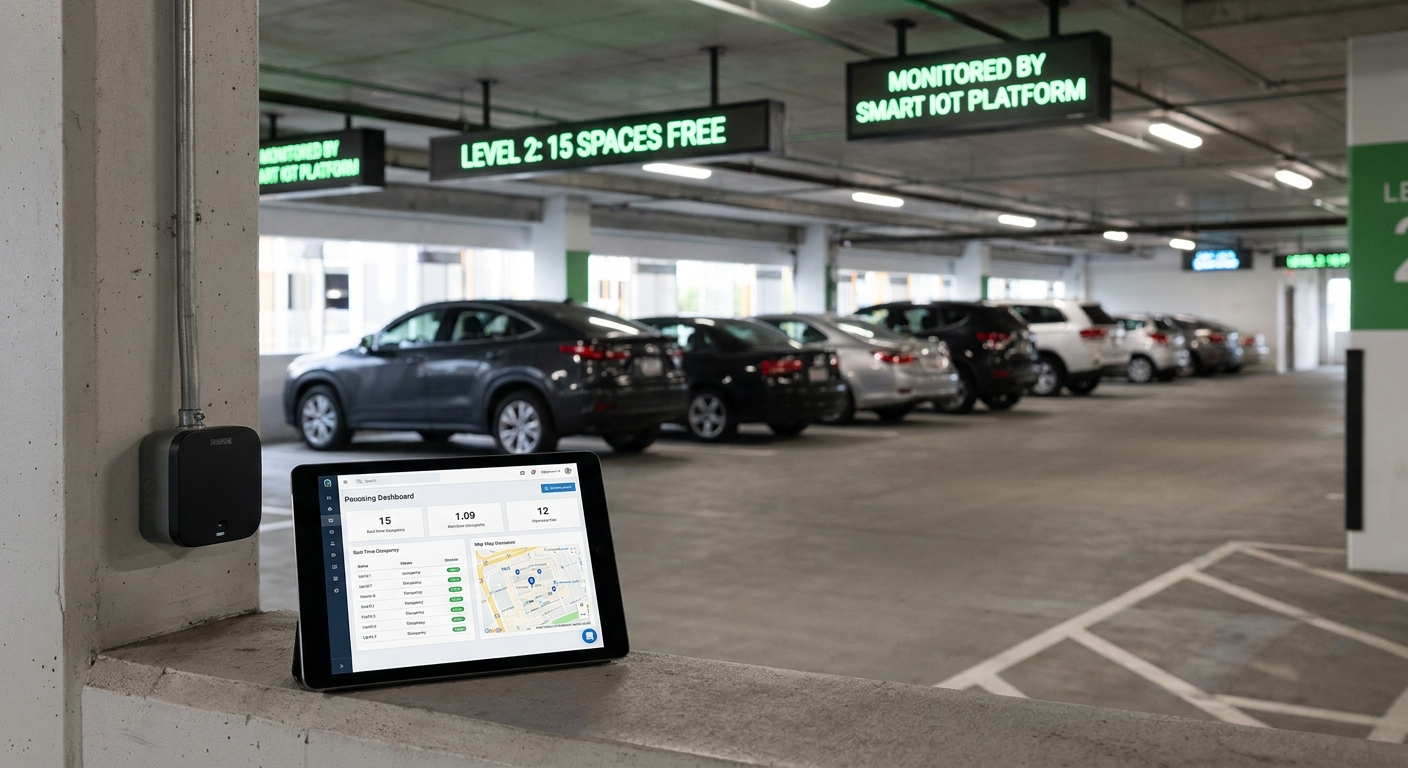
Parking garages don't send an email when the third floor fills at 8am and cars start circling the ramp for fifteen minutes — an IoT platform for parking garage monitoring does, and this guide breaks down what actually matters before you sign a contract in 2026.
- An iot platform for parking garage monitoring needs LoRaWAN reach through concrete decks: Kilo IoT's network server covers 3+ levels, Buy.
- Kilo Cloud's multi-site dashboard rolls up occupancy across a garage portfolio in one view: Buy for property managers with 5+ sites.
- Per-space magnetometer sensors report vehicle presence for 5-8 years on one battery, not months: Consider before camera counts.
- Skip single-lot apps with no rules engine — they can't fire an alarm when an EV or ADA bay sits occupied past policy.
Why this matters
A garage with no occupancy data is a guessing game every morning shift. Drivers circle looking for open bays, EV chargers sit blocked by non-charging vehicles, and ADA spaces get occupied with no way to flag it until a complaint comes in. Municipal parking authorities and university campuses are now expected to feed real-time counts into wayfinding signs and city apps, not update a spreadsheet at noon.
An occupancy platform that only counts cars entering and exiting a gate misses which specific bay is open. A platform that measures per-space occupancy and pairs it with alarms tells a facilities team exactly where the problem is, in real time, in 2026.
Who this is for
This guide is for operations and facilities teams running garages as one asset inside a bigger portfolio — hospital campuses, universities, mixed-use retail, and property managers who need a facility monitoring system for property management companies that treats the garage as just another zone on the same dashboard as HVAC, water, and access control. If you're running a single standalone lot with no other buildings to monitor, some of the criteria below (multi-site rollups especially) matter a lot less to you.
What to look for in an IoT platform for parking garage monitoring
Connectivity that reaches every level
Underground and multi-level garages are dense reinforced concrete, and that kills WiFi and weakens cellular fast. LoRaWAN gateways run 2-5 km outdoors line-of-sight, but that range drops sharply per concrete floor — most private deployments need a repeater or a second gateway past 3 levels deep. Ask any vendor for their actual penetration numbers on a poured-concrete structure, not an open-field spec sheet.
Per-space sensor accuracy, not zone counts
A gate counter tells you the garage is 80% full. It doesn't tell you bay 214 on level 3 is open. Magnetometer or ultrasonic sensors mounted per space report individual vehicle presence, which is what makes a wayfinding sign or a mobile app actually useful instead of a rough estimate.
A dashboard built for multi-site rollups
If you manage more than one garage, you need one screen showing all of them, not five separate logins. A single dashboard with per-site filtering and a portfolio-level view is the difference between managing garages and babysitting them one at a time.
Alarms and rules tied to real policy
Occupancy data without rules is just a chart nobody checks. The platform needs to fire an alarm when an EV charging bay sits occupied by a non-charging vehicle past a set time, or when an ADA space stays full during business hours — automatically, not because someone happened to look.
Digital twin or floor-plan view for wayfinding
A visual floor plan showing open and occupied bays in real time is what actually gets used by drivers and by staff walking the deck. A raw data table does not.
API access to feed other systems
Occupancy data is only as useful as where it goes next. It needs to reach a payment system, a signage network, or a city parking app through an API, not sit locked inside one vendor's app.
Top picks
The connectivity backbone — the range play. A LoRaWAN network server for private enterprise deployments is what makes per-space sensors possible in a concrete structure in the first place. One gateway typically handles a full deck's worth of sensors, and coverage extends 2-5 km outdoors before indoor concrete cuts it down. Buy if your garage runs 3 or more levels; overkill for a single-level surface lot.
The dashboard layer — the rollup view. The best IoT dashboard software for multi-site facility teams puts every garage in a portfolio on one screen with per-site filters instead of five separate logins. Buy if you're managing 5 or more garages across a property portfolio; Skip if you're running exactly one lot and don't need cross-site views.
The sensor layer — the per-space counter. Magnetometer or ultrasonic sensors reporting occupancy per bay over LoRaWAN typically run 5-8 years on a single battery, which matters when the alternative is running power or ethernet to every parking space. Consider these over camera-based zone counting when you need exact per-space status rather than a rough fill percentage.
The alarm layer — the policy enforcer. Kilo Cloud's rules engine turns raw occupancy readings into an actual alert — an EV bay occupied by a non-charging vehicle for 30+ minutes, or an ADA space full during posted hours, triggers a notification instead of sitting unnoticed in a log. Buy if EV or ADA compliance is part of your operating policy in 2026; Skip if you only need a passive count with no enforcement layer.
What to avoid
- Cellular-per-sensor pricing. A platform charging a cellular data plan per individual parking sensor scales cost linearly with every bay you add — that adds up fast across a multi-level deck.
- Zone cameras sold as "per-space accuracy." A camera counting a zone of 40 bays as one aggregate number is not the same as knowing which specific bay is open.
- A dashboard with no rules engine. Occupancy percentages without alarms are a report nobody reads after week one.
Verdict comparison table
| Layer | Best for | Verdict |
|---|---|---|
| LoRaWAN connectivity | Garages 3+ levels deep | Buy |
| Multi-site dashboard | Portfolios of 5+ garages | Buy |
| Per-space sensors | Exact bay-level accuracy | Consider |
| Rules and alarms | EV & ADA compliance | Buy |
| Digital twin / floor plan | Wayfinding signage | Consider |
Walk through a live garage dashboard
See occupancy alarms and multi-site rollups on an actual floor plan.
FAQ
What's the best IoT platform for parking garage monitoring in 2026?
The right choice depends on structure depth and portfolio size. For garages 3+ levels deep needing multi-site rollups, a LoRaWAN-based platform with per-space sensors and a rules engine, such as Kilo IoT's Kilo Cloud platform, covers connectivity, dashboards and alarms in one system.
Do parking garage sensors need cellular connectivity?
No. LoRaWAN handles most garage deployments without a cellular plan per sensor, which keeps costs from scaling linearly with bay count. Cellular becomes relevant only for a standalone remote lot with no existing gateway coverage.
How accurate are magnetometer parking sensors versus cameras?
Magnetometer and ultrasonic sensors report per-space occupancy directly, while most camera systems aggregate a zone of bays into one count. For exact bay-level status, per-space sensors are the more direct read.
How long do LoRaWAN parking sensors last on battery?
LoRaWAN occupancy sensors typically run 5-8 years on a single battery, since they only transmit a small status update per vehicle event rather than continuous data.
Can a parking IoT platform alert on EV charging bay violations?
Yes, if the platform includes a rules engine. It can flag a non-charging vehicle occupying an EV bay past a set time window and send an alarm to facilities staff automatically.
How many levels can one LoRaWAN gateway cover in a garage?
A single gateway typically covers a full deck, but signal strength drops sharply past 3 concrete levels, so larger structures often need a repeater or second gateway.
Is a digital twin necessary for parking garage monitoring?
It's not required for basic occupancy counts, but a floor-plan or digital twin view makes wayfinding signage and staff walkthroughs far more usable than a raw data table.
Can garage occupancy data feed into a city parking app via API?
Yes, if the platform exposes an API. Occupancy readings can be pushed to signage, payment systems, or a municipal parking app instead of staying locked inside one dashboard.
One last thing
Magnetometer sensors mounted directly over rebar-heavy slabs sometimes need a calibration pass after install — the rebar grid can shift the sensor's baseline reading enough to misreport an empty bay as occupied until it's recalibrated against the actual slab. Ask any installer whether that step is included before the sensors go live in 2026, because it's the difference between a garage occupancy monitoring rollout that works on day one and one that needs a truck roll in week two.