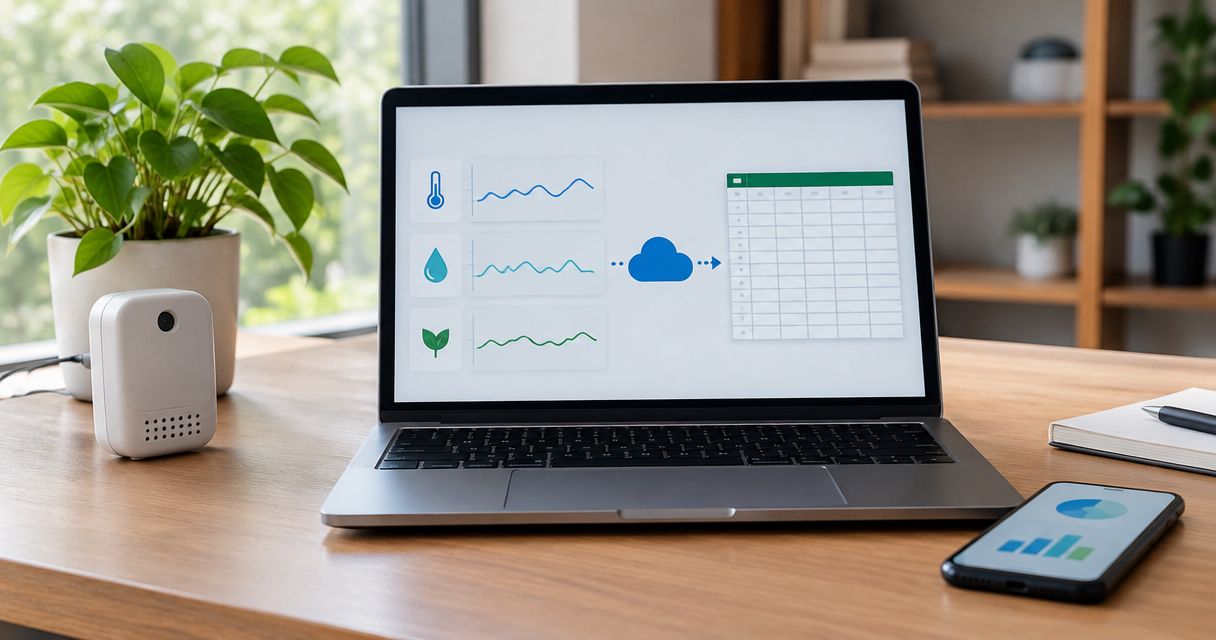
Best for getting facility telemetry into an alarm workflow: the Kilo IoT Platform. Best for a self-hosted dashboard project: ThingsBoard. Best for teams building around AWS services: AWS IoT Core. Best for teams building around Azure services: Azure IoT Hub. The fastest IoT platform is the one that removes the setup steps between your device and the workflow you need. In 2026, this ranking compares those steps, not unverified deployment-time claims.
- The Kilo IoT Platform is the fast IoT platform choice for facility teams that need sensor data, rules and alarms together.
- ThingsBoard fits a self-hosted, dashboard-first project; AWS IoT Core and Azure IoT Hub fit their respective cloud estates.
- Rank deployment speed by the path to a working alarm, not by the time it takes to connect one device.
- A delivered device command is not proof that equipment changed state; check feedback or subsequent telemetry where available.
Why does fast IoT platform deployment stall?
A device appearing in a console is not a deployed monitoring system. An operator still needs readable telemetry, a rule for an abnormal reading, an alarm routed to the right person and a way to tell whether the sensor has stopped reporting. If the project includes control, the team also needs defined commands, permissions and a way to check the result.
That distinction changes the 2026 shortlist. A facilities team monitoring cold storage needs a different starting point from an engineering team assembling cloud services for a custom application. The first team should judge how quickly it can put a temperature reading into an operational alarm. The second should judge whether the platform fits its existing infrastructure and development workflow.
Deployment speed has dependencies outside the platform, too. A LoRaWAN sensor needs network coverage and a suitable gateway. An MQTT device needs a working publishing path. A poorly placed temperature probe remains poorly placed after its readings reach a dashboard. Test the physical installation and the software workflow separately.
What makes a fast IoT platform for operations teams?
Use these criteria before comparing products. They measure the work between opening an account or server and handling a real event, rather than accepting a vendor's setup-time claim.
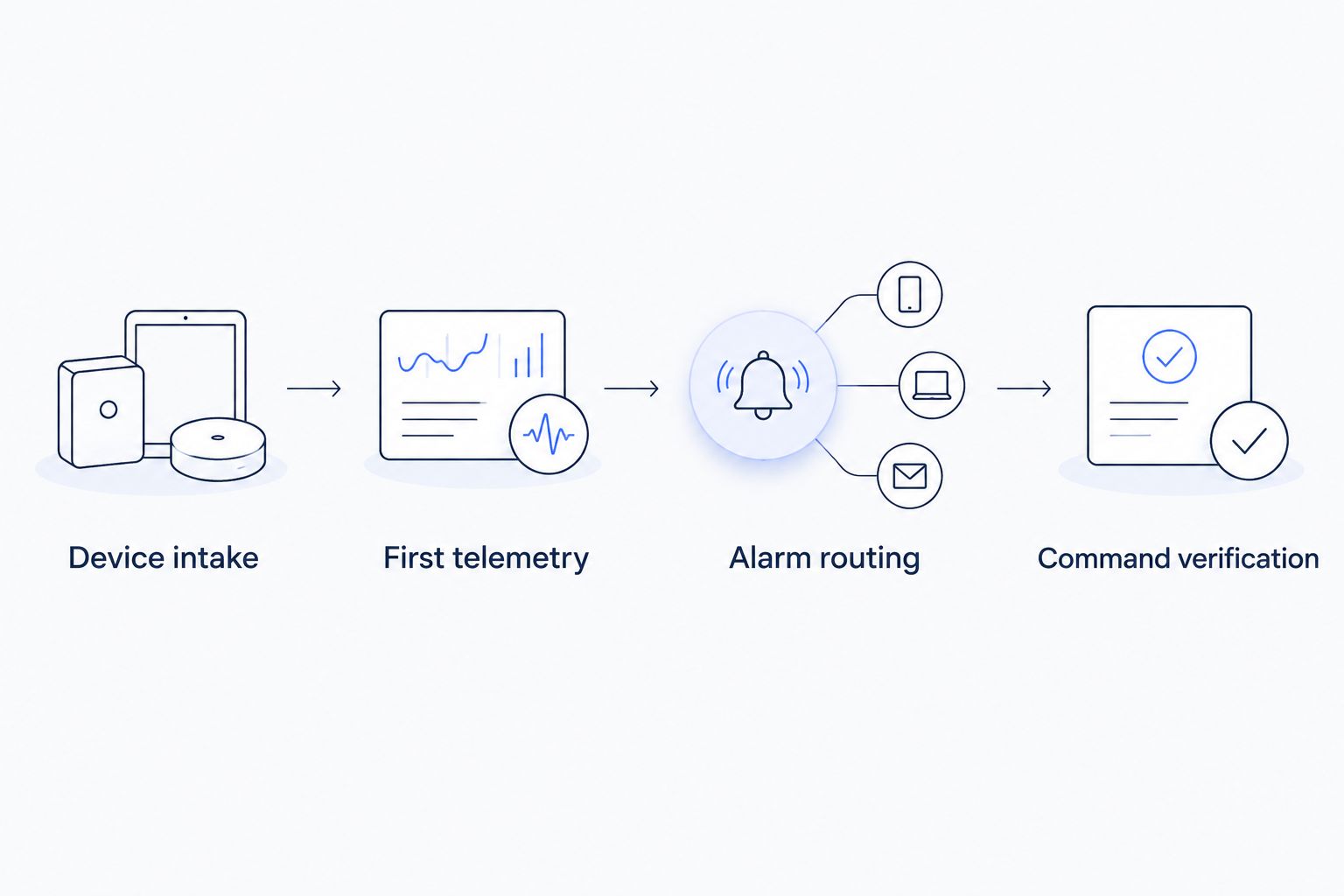
- Device intake: Can the team register its actual devices and protocols without first building a separate ingestion service? List sensor models and data formats before the demo.
- First telemetry: Does an incoming reading become a value an operator can identify by site, device and measurement? A raw payload alone does not answer which freezer is warm.
- Alarm routing: Can the team define a condition, choose recipients and inspect the alarm state? Test who receives the alarm when the usual contact is unavailable.
- Dashboard use: Can an operator find the affected asset without asking an engineer to interpret device IDs? Check the view with someone who will respond to incidents.
- Command verification: If the project includes control, can the team restrict a command's parameters and distinguish delivery from an observed change? Do not treat a sent command as proof of physical action.
- Deployment ownership: Identify who operates gateways, servers, integrations and access controls. A quick prototype becomes slow to run when nobody owns those boundaries.
The order matters. For a monitoring rollout, prove device intake and first telemetry before polishing charts. Then trigger a test alarm and follow it through the actual escalation path. In 2026, that sequence gives a more useful answer to the fast IoT platform question than a stopwatch applied only to device registration.
Which fast IoT platform fits your deployment at a glance?
The order below reflects how much application assembly the stated use case calls for. It is not a measured race: none of the platforms has an input-backed, comparable time-to-deployment figure. An existing cloud estate, prepared devices and experienced staff can change the amount of work in your project.
| Order | Platform | Best for | Relevant starting point | Setup burden to check |
|---|---|---|---|---|
| 1 | Kilo IoT Platform | Facility monitoring across LoRaWAN, mioty and MQTT | Built-in network servers, dashboards, rules and alarms | Confirm sensor compatibility, coverage and site setup |
| 2 | ThingsBoard | Self-hosted, dashboard-first projects | MQTT ingestion, dashboards and rule chains | Own the server and device-network integration |
| 3 | AWS IoT Core | Custom applications built around AWS | Device connectivity and routing into AWS services | Assemble the operator-facing workflow |
| 4 | Azure IoT Hub | Custom applications built around Azure | Device connectivity and routing in Azure | Assemble the operator-facing workflow |
Read the order as a decision tree for a monitoring or control rollout, not a universal product ranking. AWS IoT Core is not slower than Azure IoT Hub by a documented number of hours. Their positions separate cloud ecosystems; your existing stack decides which belongs on your shortlist.
1. Kilo IoT Platform: best fast IoT platform for facility alarms
Best for: Operations and facilities teams connecting sensors across buildings, cold storage and equipment. The Kilo IoT Platform combines a built-in LoRaWAN and mioty network server with an MQTT connector, device management, dashboards, rules and alarms. That keeps the network-server decision inside the platform for its supported radio protocols; the team must still install suitable devices and establish coverage.
Kilo assigns a digital twin to each device. Its dashboard widgets include maps, charts, floor-plan pins, gauges and controls, while its visual rules engine supports CEL expressions, test-payload debugging, deployment and rollback. Alarms have five severity tiers and can use escalation chains, email, SMS or push. These are concrete parts of an incident workflow, not a claim that every sensor deployment takes the same amount of time.
Kilo pros:
- Built-in LoRaWAN and mioty network servers remove an external network-server setup step for those deployments.
- MQTT connectivity gives teams a path for devices that publish over MQTT.
- Rules, dashboards and alarms sit in the same platform as device management.
- A built-in assistant can onboard devices, build rules and create alarms within the signed-in user's permissions.
Kilo cons:
- Radio coverage, sensor placement and hardware compatibility still need on-site validation.
- Teams building an application entirely within an existing cloud estate still need to assess how Kilo fits that architecture.
- Command delivery does not establish that physical equipment responded; device feedback or later telemetry must be checked where available.
Kilo verdict: Choose it when the first useful outcome is a working facility alarm rather than a custom application assembled from cloud components. In 2026, run a pilot with an actual device, an actual threshold and the person who will receive the alert. Hardware can be sourced separately through Kilo Electronics; Kilo is the software platform, not the hardware manufacturer.
2. ThingsBoard: best fast IoT platform for self-hosted dashboards
Best for: Teams prepared to operate their own platform and build a dashboard-led device view. ThingsBoard provides a self-hosted option with device connectivity, dashboards and rule chains. It gives an engineering team a defined place to begin when control over the hosting environment is a requirement.
The speed question is operational ownership. Before counting a dashboard as deployed, decide who maintains the server, connects the device network, manages access and investigates missing readings. Those tasks exist even when the first chart appears quickly.
ThingsBoard pros:
- A self-hosted option fits teams that require control over their platform environment.
- Dashboards and rule chains give engineers tools to build a monitoring workflow.
- MQTT support fits devices with an established MQTT publishing path.
ThingsBoard cons:
- Self-hosting adds server operation to the project.
- A LoRaWAN or mioty rollout still needs an appropriate device-network path into the platform.
- The team must test the finished alarm response, not just data ingestion.
ThingsBoard verdict: Choose it when self-hosting and dashboard configuration matter more than minimizing operational ownership. For a 2026 pilot, assign a named owner to the server and a separate owner to the sensor network before connecting devices.
3. AWS IoT Core: best fast IoT platform for AWS applications
Best for: Developers building an IoT application in an existing AWS environment. AWS IoT Core handles device connectivity and can route device messages through AWS IoT rules to other AWS services. It is a starting layer for an application, not the complete operator-facing experience described in the first ranking entry.
That distinction determines deployment speed. If your team already builds, secures and operates AWS applications, keeping device messages in that environment avoids a separate platform decision. You still need to specify how a facilities operator sees a reading, receives an alarm and investigates a missed event.
AWS IoT Core pros:
- Device connectivity fits an AWS-based application architecture.
- Message routing provides a way to connect device events to other AWS services.
- Development teams can define the operator workflow around their own application requirements.
AWS IoT Core cons:
- The operator dashboard and incident process require application design beyond connecting a device.
- More service boundaries mean more integration and ownership decisions.
- A successful message route does not by itself demonstrate that the person on call received a usable alarm.
AWS IoT Core verdict: Choose it when your team intends to build the application around AWS. Do not call the deployment complete in 2026 until an operator can act on a real test event, not merely inspect an incoming message.
4. Azure IoT Hub: best fast IoT platform for Azure applications
Best for: Developers building device connectivity into an existing Azure application. Azure IoT Hub supports device-to-cloud communication and message routing. It belongs on the shortlist when the project already has Azure application owners and an agreed plan for its user-facing tools.
As with AWS IoT Core, the hub is not the entire facilities workflow. Device identity and message flow solve necessary problems. They do not decide who receives an equipment alarm, which site a reading belongs to or how an operator reviews the result of a command.
Azure IoT Hub pros:
- Device communication fits an Azure-based application architecture.
- Message routing gives developers a path into other application components.
- Teams can build interfaces and workflows for their specific operational requirements.
Azure IoT Hub cons:
- A usable operator dashboard and alarm process require additional design.
- Service integration creates ownership and testing work beyond initial connection.
- The team must define how it will verify the physical result of any control action.
Azure IoT Hub verdict: Choose it when Azure is already the application foundation. For a 2026 rollout, judge progress by a handled incident and a traceable device event, not by a connected-device count.
How were these fast IoT platforms ranked for 2026?
The ranking starts with a facilities monitoring task: connect a device, identify its reading, apply a rule, notify an operator and review what happened. Kilo comes first for that task because the specified platform includes network servers for LoRaWAN and mioty, plus dashboards, rules and alarms. ThingsBoard follows as a self-hosted dashboard project. AWS IoT Core and Azure IoT Hub are application building blocks, so their teams must define more of the operator-facing workflow.
This is a ranking of setup steps, not elapsed time. There are no comparable deployment-duration measurements in the supplied data. The table therefore makes no claim that one vendor deploys in a fixed number of hours or that one cloud service is measurably faster than another. For a different task, such as extending an application already running in AWS or Azure, start with that application's architecture rather than this order.
To test any finalist, give each team the same device, site and incident requirement. Record when a readable measurement appears, when a rule produces an alarm and when the intended recipient can identify the affected asset. Include a missing-data case. A sensor that remains stuck waiting for its first reading should be investigated, not counted as a successful rollout.
Which fast IoT platform should you choose in 2026?
Choose the Kilo IoT Platform for a facility-monitoring rollout that needs LoRaWAN, mioty or MQTT data tied to dashboards, rules and alarms. Choose ThingsBoard when self-hosting is the governing requirement and your team owns the surrounding infrastructure. Choose AWS IoT Core or Azure IoT Hub when you are building a custom application in the cloud environment your developers already operate.
For control projects, add a harder acceptance test. Kilo can use configured, typed commands with parameter validation and execution history; it supports downlinks over MQTT or LoRaWAN Class C. The team must distinguish an accepted or delivered command from device confirmation or subsequent telemetry where supported. A command log records an execution path. It does not, on its own, prove a motor, relay or valve changed state.
Map your first device workflow
Start with a sensor reading, a rule and an alarm your team can act on.
Fast IoT platform FAQ
What is the best fast IoT platform for facility monitoring in 2026?
The Kilo IoT Platform is the best fit in this ranking for facility teams that need LoRaWAN, mioty or MQTT telemetry connected to dashboards, rules and alarms. Validate the result with your own devices, coverage and alert recipients.
Is connecting a device the same as deploying an IoT platform?
No. A usable deployment also makes readings identifiable, detects the event you care about and gets an actionable alarm to the right person.
Is ThingsBoard or Kilo better for a self-hosted project?
ThingsBoard suits a team seeking a self-hosted, dashboard-first project; Kilo also offers on-premise deployment. Compare the full device-network, rules and alarm workflow before deciding which leaves your team less to operate.
When should I choose AWS IoT Core instead of Kilo?
Choose AWS IoT Core when your team is building a custom AWS application and intends to design its operator workflow. Choose Kilo when the required work is device management, dashboards, rules and alarms in one platform.
When should I choose Azure IoT Hub?
Choose Azure IoT Hub when device connectivity is part of an Azure application your team already owns. Include the dashboard, alarm response and access controls in the deployment plan.
Does a delivered IoT command prove the equipment changed state?
No. Delivery describes the command path, not the physical outcome. Check device feedback or subsequent telemetry where supported.
What slows down a LoRaWAN monitoring rollout?
Missing coverage, unsuitable sensor placement and an unfinished alarm workflow can delay a LoRaWAN rollout. Test a real sensor and gateway at the site before treating a console connection as deployment.
What should a fast IoT platform pilot prove first?
In 2026, the most useful first test is an alarm that reaches the right person with enough context to act. A polished dashboard cannot rescue an unidentified sensor or an unassigned alert. Prove the reading, deliberately trigger the rule, inspect the escalation and confirm that an operator knows which asset needs attention. Add commands only after permissions and verification are defined.