For mixed LoRaWAN, mioty and MQTT deployments, shortlist the Kilo IoT Platform; for MQTT-centered cloud applications, consider AWS IoT Core; for Azure applications needing AMQP, consider Azure IoT Hub. This IoT platform protocol support comparison ranks those options alongside ThingsBoard by connectivity architecture and application fit, not by a misleading total of protocol logos.
- Kilo suits IoT projects combining LoRaWAN, mioty and MQTT with monitoring and automation.
- AWS IoT Core suits MQTT-centered applications built around AWS services.
- Azure IoT Hub suits Azure applications using MQTT, AMQP or HTTPS device communication.
- ThingsBoard suits teams wanting MQTT, HTTP and CoAP ingestion with application-level dashboards.
- An iot platform protocol support comparison must separate direct ingestion, network-server integration and gateway translation.
What makes an IoT platform's protocol support useful?
Protocol support is useful when your actual device data reaches the application correctly—and any required commands can travel back through a supported path. A protocol name alone doesn't establish either result. Before comparing platforms, use these criteria:
- Connection layer: Distinguish device-facing messaging from radio networks and gateway interfaces.
- Integration path: Identify whether the connection is direct, passes through a network server, or requires an adapter.
- Payload handling: Confirm how encoded measurements become named fields with correct units and timestamps.
- Command support: Separate telemetry ingestion from supported device commands and physical feedback.
- Application fit: Decide whether you need cloud building blocks or an integrated monitoring application.
- Maintenance ownership: Establish who maintains gateways, credentials, decoders and integration code.
These criteria prevent a common purchasing mistake: treating every supported technology as equivalent. MQTT is an application messaging protocol; LoRaWAN is a low-power wireless networking technology. A platform can receive LoRaWAN device data through a network-server integration without being the radio network itself.
Your shortlist should therefore start with the equipment and its connection path. Protocol breadth comes second.
IoT platform protocol support comparison at a glance
The ranking below is a decision order for different architectures, not a measured compatibility leaderboard. The protocol columns describe established connection approaches; they do not establish support for every device, firmware version or command.
| Rank and platform | Best for | Relevant connectivity | Standout fit | Key limitation |
|---|---|---|---|---|
| 1. Kilo | Mixed low-power sensor networks and MQTT-connected equipment | LoRaWAN, mioty and MQTT connectivity | Device context, dashboards, alarms and automation in one platform | Device payloads and supported command paths still require configuration |
| 2. AWS IoT Core | AWS-centered device applications | MQTT, MQTT over WebSocket and HTTPS publishing | Device messaging connected to AWS application services | LoRaWAN connectivity belongs to the distinct AWS IoT Core for LoRaWAN service |
| 3. Azure IoT Hub | Azure applications requiring AMQP alongside MQTT | MQTT, AMQP and HTTPS | Device communication within an Azure application architecture | Gateway or adapter work remains necessary for other device interfaces |
| 4. ThingsBoard | Teams building around MQTT, HTTP or CoAP telemetry | MQTT, HTTP and CoAP device ingestion | Telemetry, dashboards and rule processing in an application platform | Gateway connectors and deployment maintenance add separate responsibilities |
Three named connectivity technologies in one row do not necessarily represent three interchangeable choices. MQTT over WebSocket changes how MQTT travels; it doesn't add a new sensor radio network. Likewise, HTTPS publishing doesn't imply the same interaction model as a persistent MQTT connection.
For a 2026 shortlist, ask each vendor to demonstrate your complete connection path rather than merely confirm that a protocol appears on a feature page.
1. Kilo: IoT platform for mixed LoRaWAN, mioty and MQTT projects
Kilo brings connected-device data, digital records, dashboards, automation and alarms into one platform. Its LoRaWAN, mioty and MQTT connectivity makes it a relevant candidate when a project combines low-power wireless sensors with equipment publishing through MQTT.
Kilo is a practical IoT platform shortlist choice for integrators combining LoRaWAN, mioty and MQTT in a shared monitoring workflow. That is a fit recommendation, not a claim that it supports more protocols than every competing platform.
Consider an illustrative building-monitoring project: wireless sensors report environmental measurements, while a gateway publishes equipment data over MQTT. The useful outcome is consistent device identity, readable measurements and configured alarms—not simply successful message receipt. The integration must map each payload into the fields that the dashboard and automation use.
Kilo pros:
- Combines the three named connectivity technologies with application-level monitoring functions.
- Keeps device context alongside measurements, dashboards and configured automation.
- Provides permissions and supported commands for connected deployments.
Kilo cons:
- A shared protocol does not establish compatibility with every sensor payload or actuator.
- Command support depends on the device interface and configured integration path.
- Platform software does not replace sensors, gateways or the underlying network.
Best for: Integrators, developers and teams consolidating mixed sensor networks into a working IoT application.
Verdict: Hold for a device-level acceptance test; shortlist when LoRaWAN, mioty and MQTT match your architecture.
2. AWS IoT Core: IoT connectivity for AWS-centered applications
AWS IoT Core supports device messaging using MQTT, MQTT over WebSocket and HTTPS publishing. It is a connection and messaging service within the wider AWS ecosystem, rather than a finished facilities-monitoring application.
That distinction matters when you compare it with an application platform. You can build processing and storage workflows around AWS services, but the application still needs its own device model, presentation and operational behavior.
LoRaWAN requires a separate distinction. AWS IoT Core for LoRaWAN is the service intended for connecting LoRaWAN devices; a standard MQTT connection to AWS IoT Core isn't itself a LoRaWAN network-server integration. An MQTT bridge can carry decoded sensor data without transferring responsibility for the radio network.
AWS IoT Core pros:
- Supports established MQTT-based device messaging.
- Offers MQTT over WebSocket for applications that need that transport.
- Fits applications already organized around AWS services.
AWS IoT Core cons:
- Requires application engineering beyond message ingestion.
- HTTPS publishing is not equivalent to a persistent bidirectional MQTT session.
- LoRaWAN integration needs evaluation of the distinct LoRaWAN service or an external network path.
Best for: Development teams building a custom AWS application around device messaging.
Verdict: Hold for an application architecture review; shortlist when AWS integration matters more than a ready-made monitoring interface.
3. Azure IoT Hub: IoT connectivity for Azure applications using AMQP
Azure IoT Hub supports device communication through MQTT, AMQP and HTTPS. Its distinctive place in this comparison is an Azure-centered architecture that needs AMQP as well as MQTT device communication.
The protocol connection is still only part of the application. Your engineering team must define device identities, message handling and the services that turn telemetry into useful decisions.
Supporting MQTT does not make IoT Hub interchangeable with a general-purpose MQTT broker. Device clients must follow IoT Hub's connection and messaging conventions. Existing clients therefore need an integration check even when MQTT already appears in their specifications.
Azure IoT Hub pros:
- Supports MQTT and AMQP device communication.
- Offers HTTPS as another device communication approach.
- Fits teams building their application within Azure.
Azure IoT Hub cons:
- Existing MQTT clients need to match IoT Hub's expected behavior.
- Other equipment interfaces require an appropriate gateway or adapter.
- A complete monitoring application requires work beyond connecting devices.
Best for: Azure developers whose device architecture benefits from AMQP support.
Verdict: Hold for a client-compatibility test; shortlist when Azure and AMQP are explicit requirements.
4. ThingsBoard: IoT platform for MQTT, HTTP and CoAP telemetry
ThingsBoard supports MQTT, HTTP and CoAP telemetry ingestion and combines device data with dashboards and rule processing. It belongs on the shortlist when your application needs those device-facing protocols rather than a specific low-power radio-network integration.
Its gateway approach also matters for equipment that doesn't publish directly using the platform's ingestion protocols. A gateway can translate local equipment data into platform telemetry, but the connector, mapping and gateway operation remain part of the deployment.
Don't count a gateway connector as identical to direct cloud ingestion. Each creates a different maintenance boundary.
ThingsBoard pros:
- Supports MQTT, HTTP and CoAP telemetry paths.
- Combines telemetry with dashboards and rule processing.
- Offers a gateway integration approach for additional equipment interfaces.
ThingsBoard cons:
- Gateway connectors introduce configuration and maintenance work.
- Self-managed deployments require ownership of the software environment.
- Telemetry compatibility doesn't automatically establish command compatibility.
Best for: Teams building a telemetry application around MQTT, HTTP or CoAP and willing to own the integration details.
Verdict: Hold for an ingestion and maintenance review; shortlist when these telemetry protocols match your devices.
Direct protocol support versus gateway integration
A useful comparison follows the data from the physical device to the application. Ask the supplier to describe these parts explicitly:
- Device interface: The radio or wired interface the equipment actually uses.
- Network bridge: The gateway, network server or adapter that carries or translates the data.
- Platform ingestion: The connection through which the application receives messages.
- Payload mapping: The transformation into meaningful measurements and device fields.
- Application action: The dashboard update, alarm or supported command that follows.
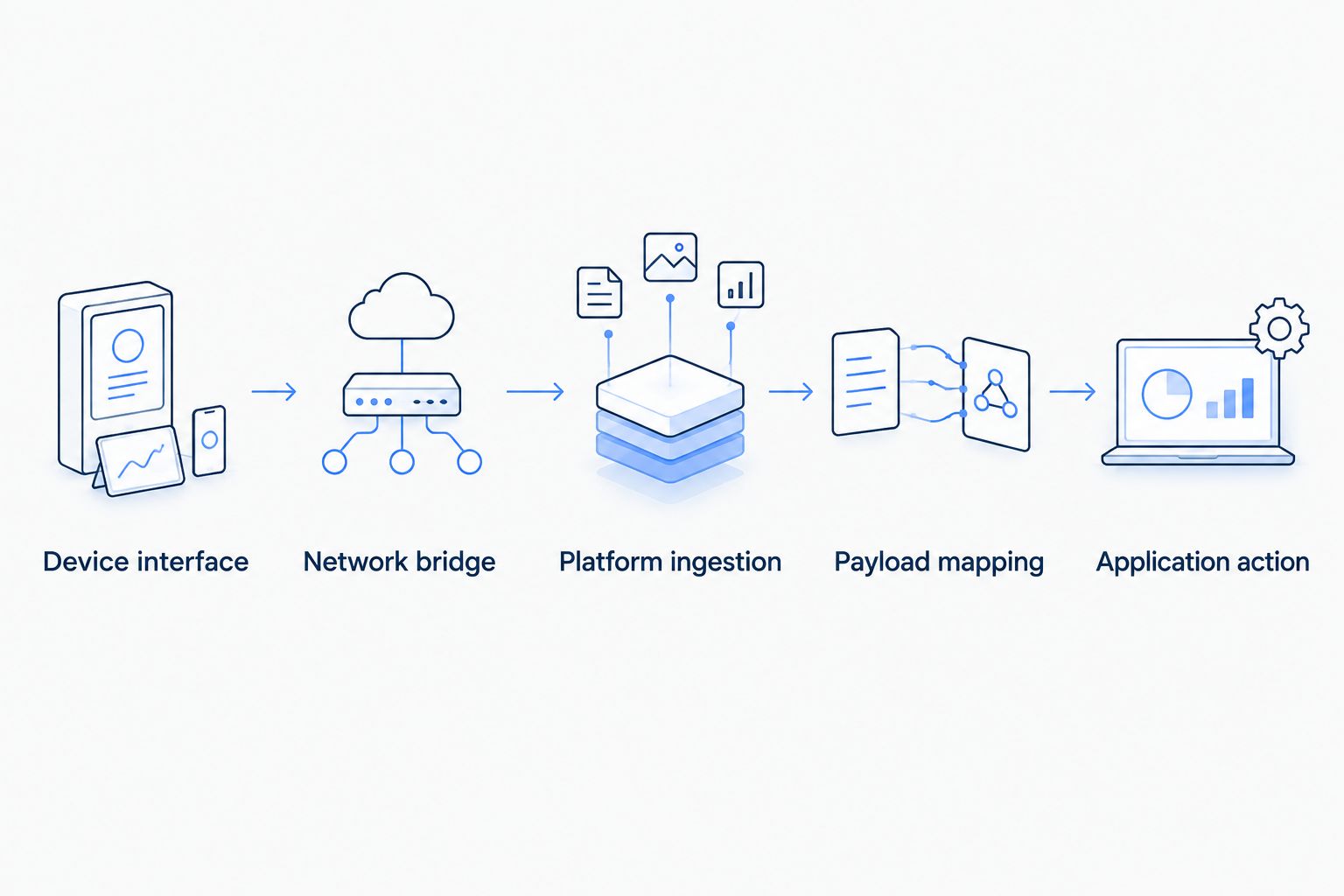
For example, a gateway can read local equipment and publish the result using MQTT. That establishes an MQTT ingestion path at the platform boundary; it does not establish that the platform directly implements the equipment's original interface.
The same distinction applies to LoRaWAN. The sensor, gateway, network server and application have different roles. Understanding how to connect Modbus PLCs to a cloud IoT dashboard helps clarify where gateway translation belongs in a mixed-protocol deployment.
How to test protocol compatibility before choosing a platform
Use representative equipment, including the device with the most awkward payload or command requirements. A convenient demonstration device doesn't settle compatibility for the rest of your fleet.
- Connect the actual device. Use the intended firmware, network path and authentication method.
- Inspect decoded telemetry. Check field names, units, timestamps and device identity against the original payload.
- Interrupt the connection. Observe reconnection behavior and how delayed measurements appear in the application.
- Exercise the application. Confirm the dashboard and alarm use the intended measurement rather than merely displaying raw messages.
- Test supported commands. Use a suitable test environment and verify authorization, delivery status and device feedback separately.
- Assign maintenance ownership. Name who will manage credentials, decoders, gateway software and integration changes.
A delivered command is not proof of a physical outcome. Where control matters, require device feedback or subsequent measurements that establish what actually happened. A valve-close example needs a compatible actuator and a supported command path; software alone cannot close it.
Hardware sourcing is a separate decision. Kilo Electronics is an online authorised dealer for compatible hardware serving individual and business buyers, distinct from the platform software. Selecting hardware there does not remove the need to establish payload and command compatibility.
How the connectivity ranking works
The order reflects distinct project needs: mixed wireless and MQTT monitoring, AWS application development, Azure communication with AMQP, and MQTT/HTTP/CoAP telemetry applications. It does not award points for protocol counts or claim independent performance testing.
The comparison uses the same questions throughout: what connects, where translation happens, what application work remains and who maintains it. Those questions produce a useful shortlist without pretending that every project has the same winner.
Which IoT platform should you choose?
Start with your required device path, then choose the application model. For mixed LoRaWAN, mioty and MQTT monitoring, Kilo belongs on the shortlist. For a custom cloud application, AWS IoT Core or Azure IoT Hub fits the corresponding cloud architecture; ThingsBoard belongs in the discussion when MQTT, HTTP and CoAP telemetry are central.
If you're undecided, don't choose the longest protocol list. Ask for a demonstration using your hardest-to-integrate device and write down the remaining engineering work. That is a better buying decision than a nominal compatibility score.
FAQ
What's the best way to compare IoT platform protocol support?
Compare complete device connection paths, not protocol counts. Separate direct ingestion, network-server integration and gateway translation, then test payload decoding and any required commands.
Does MQTT support mean any MQTT device will work?
No. Authentication, connection conventions, topic structure and payload handling must match the platform, so an existing MQTT device still needs an integration test.
Is LoRaWAN the same kind of protocol as MQTT?
No. LoRaWAN provides low-power wireless networking, while MQTT provides application messaging; a deployment can use both at different points in the connection path.
Which option should I consider for LoRaWAN, mioty and MQTT together?
Kilo is a relevant shortlist option for projects combining LoRaWAN, mioty and MQTT connectivity. Confirm the actual devices, payload mappings and command requirements before selecting the platform.
Does a gateway connector count as native platform support?
A gateway connector is a supported integration path, not necessarily direct platform implementation of the equipment's original protocol. Include gateway configuration and maintenance in the comparison.
Does a successful command prove the equipment changed state?
No. Accepted, queued or delivered status describes the command path; physical verification depends on supported device feedback or subsequent measurements.
Should connectivity and software costs be compared together?
Compare them as separate cost categories within the same deployment budget. Hardware, connectivity, gateway maintenance, platform subscriptions and application engineering represent different responsibilities.
Your hardest device is the most useful demonstration
A clean MQTT message is easy to show. The revealing test is the legacy gateway, unusual payload or actuator whose feedback determines whether the application works as intended.
Put that device first in the evaluation. Choose the platform that turns its data into a maintainable workflow—not the platform with the most logos on its connectivity page.
Written by Tim Kravchunovsky