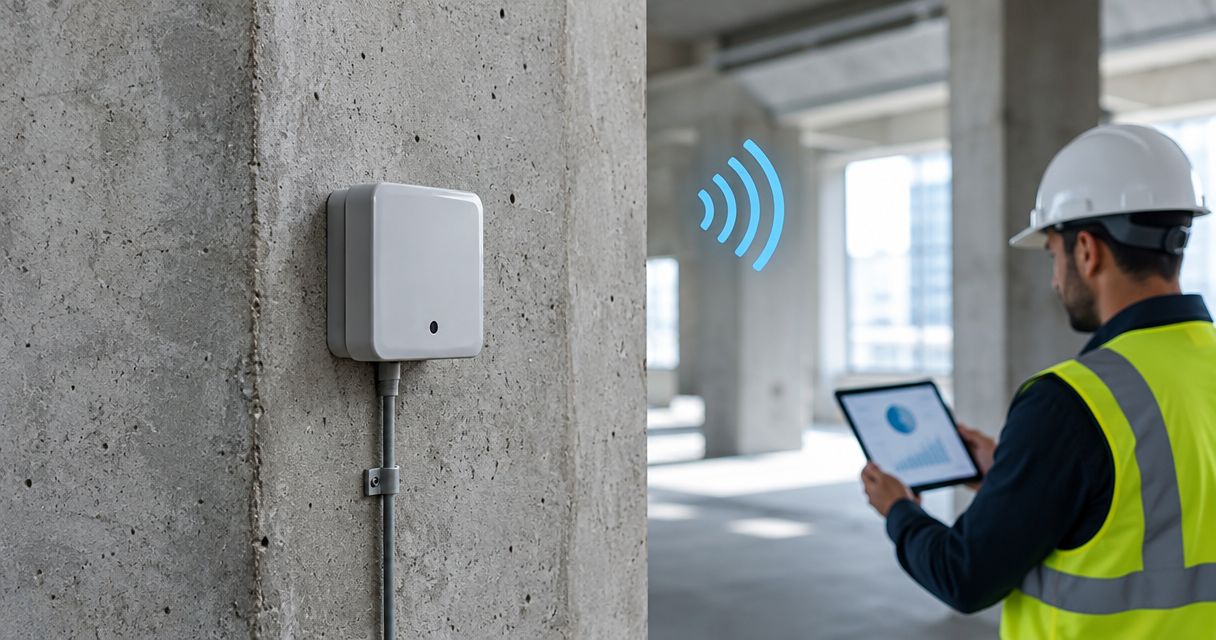
Yes, LoRaWAN sensors can transmit through thick concrete walls, but reinforced concrete, metal enclosures and the route to the gateway determine whether reception is dependable. The Kilo IoT Platform can organize connected-device readings and monitoring workflows, but software cannot compensate for a radio path that doesn't deliver messages. Test the actual sensor in its final position before committing to a building-wide installation.
- LoRaWAN sensors through concrete walls can work; reinforcement, gateway placement and antenna position determine reception.
- Test repeated message delivery with doors closed and equipment operating, not just a successful network join.
- Move the gateway or antenna before assuming higher transmit power will solve missing readings.
- Kilo supports connected-device monitoring; it does not remove the need for an on-site radio survey.
Can lorawan sensors transmit through thick concrete walls?
Yes. Concrete weakens radio signals rather than creating an absolute boundary, and LoRa modulation is designed to receive weak signals. Whether a particular installation works depends on the remaining signal strength, interference and receiver capability after the signal travels through the building.
There is no dependable answer expressed as a universal wall thickness or number of floors. A thick wall without reinforcement presents a different radio environment from a reinforced basement surrounded by concrete slabs and steel doors. Even identical sensors in adjacent rooms can have different reception because their paths to the gateway differ.
To establish whether your installation works, use this sequence:
- Confirm compatibility. Match the sensor and gateway regional frequency plans, network configuration and device credentials before investigating the walls.
- Establish a baseline. Verify that the sensor sends readings successfully near the gateway, away from obvious shielding.
- Test the final position. Put the sensor where it must measure, using its intended enclosure, mounting surface and antenna orientation.
- Exercise normal conditions. Close doors, operate nearby equipment and include the storage or occupancy conditions that affect the radio path.
- Inspect delivery over time. Compare expected reports with received reports, then investigate gaps before approving that location.
A successful join proves that communication occurred; it does not prove dependable ongoing coverage. Joining and routine reporting are different events, and a short demonstration doesn't establish performance throughout normal building use.
Why concrete-wall reception varies
Wall thickness matters, but it isn't enough to predict coverage. These factors explain why a sensor works in one concrete room and fails in another:
- Reinforcement and metal barriers. Steel reinforcement, metal doors, foil-backed materials and equipment enclosures add shielding beyond the concrete itself.
- Path geometry. A signal crossing a wall at an angle travels through more material than one crossing it directly. Multiple walls and floor slabs add further obstacles.
- Moisture and material composition. Concrete isn't a uniform radio material; its composition and moisture content affect signal attenuation.
- Antenna placement. Mounting near metal, hiding an antenna inside an unsuitable enclosure or changing its orientation can reduce reception.
- Gateway position. A gateway inside a communications cabinet has a different radio path from one positioned openly near the monitored area.
- Radio settings and interference. Transmit power, data rate, receiver sensitivity and competing radio activity affect whether messages are decoded.
These factors interact. Moving a gateway into a corridor might avoid several reinforced partitions without changing the sensor at all. Increasing transmit power, by contrast, doesn't remove a steel enclosure or fix an incompatible regional configuration.
Does the operating frequency make a difference?
Frequency affects propagation, but it doesn't establish a guaranteed indoor range. In the United States, LoRaWAN regional operation uses the 902–928 MHz band, commonly described as 915 MHz; equipment must support the appropriate regional plan.
Treat those frequencies as compatibility information, not a wall-penetration rating. A sensor labeled 915 MHz still needs a suitable antenna, correct configuration and a viable route to a gateway. Importing a device intended for another region is not a coverage fix.
Where should you put the gateway in a concrete building?
Choose gateway placement around the difficult sensor locations, not just the easiest network socket. A convenient installation point can leave the gateway behind the same barriers you're trying to overcome.
Start with accessible positions that reduce concrete and metal along the path. Corridors, openings between zones and positions closer to basement sensors are useful candidates to test. Height can help clear nearby obstructions, but placing a gateway higher isn't automatically better if that adds reinforced floor slabs.
| Placement approach | Best for | Practical advantage | Limitation |
|---|---|---|---|
| Reposition the existing gateway | Sensors near a coverage boundary | Changes the radio path without replacing sensors | Can weaken coverage elsewhere; retest existing locations |
| Add a gateway nearer the difficult zone | Basements or separated concrete wings | Provides another reception point close to the sensors | Requires power, backhaul and network configuration |
| Use a supported external antenna | Installations where the enclosure blocks a useful antenna position | Separates antenna placement from equipment placement | Cable loss, connectors and installation requirements matter |
| Use a supported remote probe | Measurements inside a shielded space | Keeps the measurement point inside while placing the radio outside | Only works with suitable probe-equipped hardware |
A LoRaWAN network can receive the same uplink through more than one gateway, with duplicate handling performed by the network server. That makes an additional gateway a coverage option rather than a reason to divide sensors into separate monitoring systems.
It is not a guarantee of resilience. Gateways sharing the same power supply or internet connection can still fail together, and additional gateways need compatible network configuration.
How do you test LoRaWAN coverage through concrete?
Use the same sensor model and mounting arrangement you intend to deploy. A handheld tester is useful for surveying, but its antenna and enclosure can behave differently from the small battery-powered device installed behind equipment.
Your test should connect the physical location to evidence of message delivery. Record the sensor identity, position, reporting configuration, gateway position and conditions during each trial so another installer can reproduce it.
Check delivery before interpreting signal strength
Received signal strength indicator, or RSSI, describes received signal power. Signal-to-noise ratio, or SNR, describes the signal relative to noise. Both help diagnose a link, but neither should replace checking whether expected readings arrive.
LoRa can decode signals with negative SNR under suitable settings, so a negative reading alone isn't a failure verdict. Likewise, an attractive RSSI reading from a few successful messages doesn't explain the messages that never arrived.
Where the network exposes the relevant information, inspect:
- Message delivery: whether reports arrive at the intended cadence.
- Frame counters: whether gaps suggest missing uplinks, accounting for device resets and network behavior.
- RSSI and SNR: whether reception changes with location or building conditions.
- Receiving gateways: whether a sensor depends entirely on a single difficult path.
- Data rate: whether radio settings change during the trial.
Set acceptance criteria around the application. Slow environmental trend monitoring and a time-sensitive equipment alarm have different requirements; neither should inherit an arbitrary packet-delivery target from an unrelated deployment.
Change one thing at a time
If you move the gateway, rotate the sensor and change its radio configuration simultaneously, you won't know which change helped. Preserve a baseline, make a deliberate adjustment and repeat the test under comparable conditions.
A useful process is Baseline, Final position, Normal operation, Delivery review, Retest. Keep the results tied to the mounting location rather than a room name alone, because moving a sensor behind a pipe or cabinet can alter the link.
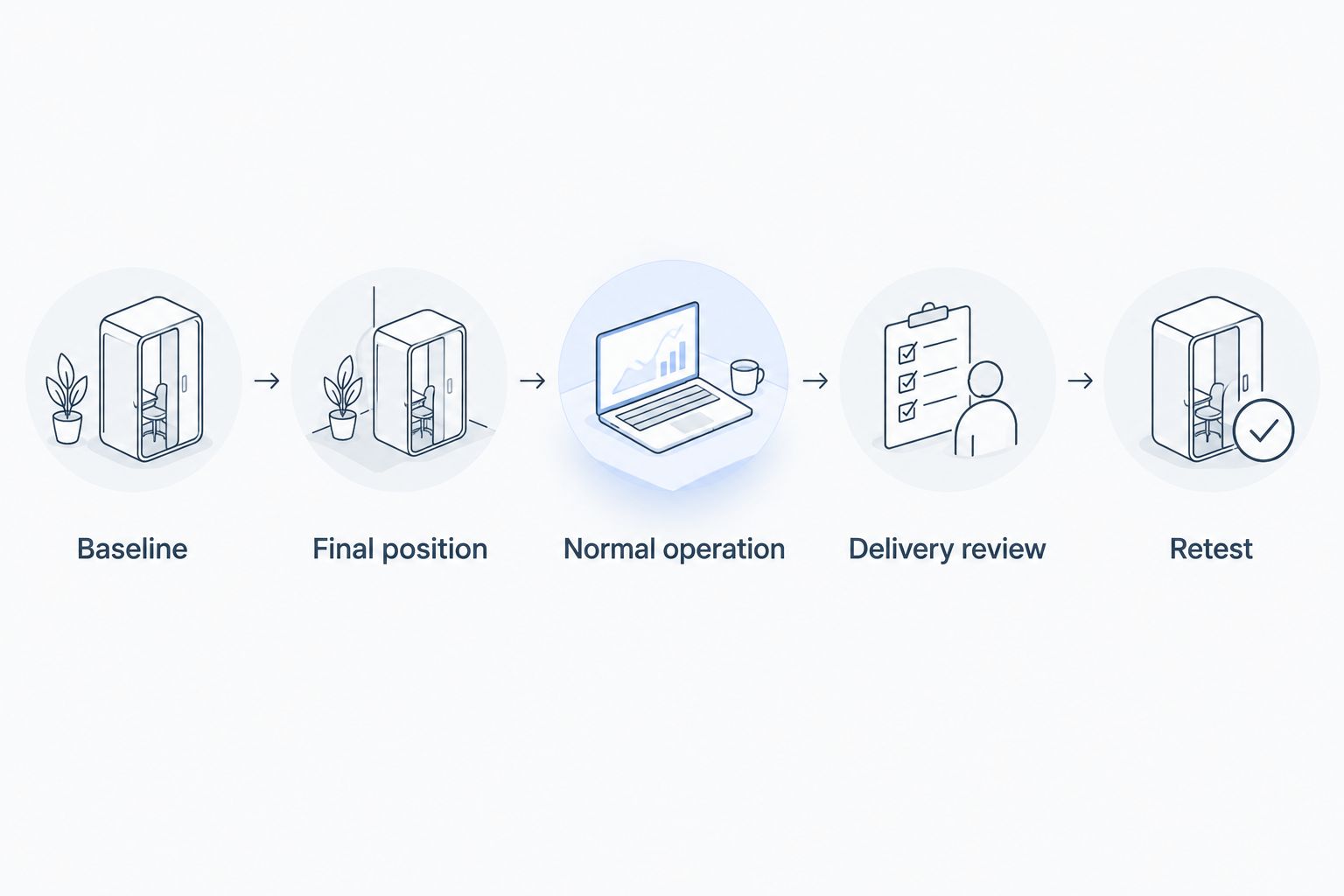
Illustrative scenario: a basement plant room
Assume you're installing a leak sensor in a reinforced-concrete plant room, with a gateway upstairs. The sensor joins during setup with the plant-room door open, but reports become intermittent after installation.
First, confirm that reporting continues locally and that the gateway backhaul remains available. Then repeat reception tests with the door closed and compare a gateway position nearer the stairwell with a suitable position inside the basement.
The installer chooses a position based on repeated delivery, while the person responsible for maintenance confirms that the mounting remains accessible. The evidence is the received-message record under normal conditions—not the fact that the sensor worked while someone held it in the doorway. This is an illustrative workflow, not a reported customer deployment.
Will a higher spreading factor solve the problem?
A higher spreading factor can improve receiver sensitivity at the expense of longer airtime for a given payload and bandwidth. It doesn't make concrete transparent.
Longer airtime also affects transmission energy and how much radio capacity a deployment consumes. The appropriate configuration depends on regional rules, network settings, device behavior and reporting needs. Avoid treating the most sensitive setting as the default for every sensor.
Adaptive data rate, or ADR, lets a LoRaWAN network manage supported radio parameters based on link conditions. It is particularly relevant to stationary devices, but it still needs a workable link and suitable operating conditions. It cannot fix a sensor sealed inside an effectively shielding enclosure.
Improve the physical radio path before relying on more airtime to carry every message. Retest delivery after any setting change, and evaluate battery requirements using the actual device configuration rather than a generic battery-life claim.
Can LoRaWAN reach a basement through concrete floors?
Yes, LoRaWAN can reach basements, but reinforced floor slabs and below-ground construction can make the path difficult. Test the basement independently rather than extending an upstairs coverage assumption downward.
A gateway near a stairwell or within the basement can offer a better route than one directly overhead. The shortest geometric distance isn't necessarily the least obstructed radio path.
Is a gateway better than a repeater for a concrete dead zone?
An additional gateway is an option when you can provide suitable power and backhaul near the dead zone. It receives sensor transmissions directly rather than depending on ordinary sensors to forward messages.
Standard LoRaWAN end devices don't form a general-purpose mesh. LoRaWAN relay functionality exists, but it requires compatible implementations; don't assume a device advertised loosely as a repeater will work with your sensors and network.
What can an IoT platform do after coverage is established?
Radio reception is only part of a monitoring deployment. You also need to associate readings with devices and locations, interpret the payload correctly and make the information useful to the person responsible for responding.
Kilo suits integrators and developers who need an IoT platform for connected-device monitoring and automation. Its device records, dashboards, rules and alarms support that operating layer; they don't replace gateway placement or establish that a silent sensor is healthy.
For a concrete-building deployment, distinguish an unchanged measurement from an outdated measurement. A dashboard showing the last received temperature doesn't prove that the sensor is still communicating. Your monitoring design should make data freshness visible and define how someone investigates missing reports.
Hardware remains a separate sourcing decision. Kilo Electronics is a separate online authorised dealer serving individual and business buyers sourcing compatible hardware internationally; verify device compatibility and destination-specific delivery terms before ordering.
FAQ
How thick a concrete wall can a LoRaWAN sensor transmit through?
There is no universal concrete-wall thickness limit for LoRaWAN reception. Reinforcement, moisture, antenna placement, radio settings and the complete route to the gateway determine whether messages arrive.
Will LoRaWAN work inside a metal electrical cabinet?
A metal electrical cabinet can severely restrict radio reception. Test with the cabinet closed and use only antenna or probe arrangements supported by the equipment and suitable for the installation.
Does a successful LoRaWAN join mean my sensor has good coverage?
A successful join does not establish dependable ongoing coverage. Verify repeated reporting from the final mounting position under normal building conditions.
Should I increase transmit power when readings go missing?
Increasing transmit power is not the first fix for missing readings. Check regional compatibility, gateway connectivity, antenna placement and physical obstructions before changing supported radio settings.
Can I put the temperature probe inside a concrete room and the radio outside?
You can separate the measurement point from the radio when the sensor supports a suitable remote probe. Confirm probe compatibility, cable routing and installation requirements before choosing that approach.
Does LoRaWAN need internet access at every sensor?
LoRaWAN sensors communicate by radio with gateways rather than requiring an internet connection at each sensor. The gateway still needs an appropriate connection to the network infrastructure.
Test the closed door, not the demonstration
The overlooked obstacle isn't always the concrete wall. A steel door, equipment cabinet or metal-backed storage arrangement can change reception after an otherwise successful installation test.
Before signing off, return every door and enclosure to its normal operating state. Then verify that readings still arrive from the actual mounting position. Approve coverage from operating evidence, not an open-door demonstration.
Related guides
Written by Tim Kravchunovsky