Florists’ cold chain monitoring is the measurement and recording of flower-storage and transport conditions to support decisions that protect saleable quality; the Kilo IoT Platform connects device data, dashboards and alarms for this kind of monitoring. Florists and flower wholesalers need records that follow different flower requirements, frequent cooler access and stock handovers—not just a temperature display on the refrigeration unit.
- Cold chain monitoring for florists needs flower-specific limits, reliable sensor placement and a named alarm responder.
- Kilo fits florists and wholesalers that need connected-device monitoring, dashboards and configured alarms.
- Separate cooler air temperature from flower condition; one does not prove the other.
- Use shipment records alongside cold-storage monitoring to preserve visibility across handovers.
Why cold chain monitoring matters for florists and wholesalers
A cooler reading answers a narrow question: what was the temperature at that sensor? Your business needs a broader answer: which flowers were exposed, where, for how long, and what happened next? Monitoring becomes useful when it connects those questions to receiving, storage, preparation and dispatch.
Flowers also differ in their storage requirements. Cold-sensitive tropical flowers cannot simply inherit the settings used for other cut flowers. Follow documented guidance for the species and handling method, and keep incompatible requirements separate rather than choosing an average setting for mixed stock.
The handovers deserve particular attention. A wholesaler receives cartons, moves stock into storage, assembles orders and releases them to a carrier. A florist receives those orders, conditions stems, prepares arrangements and delivers them. A good storage record does not establish what happened before arrival or after dispatch.
For your 2026 monitoring plan, start with the decisions you need to make: inspect an arriving shipment, investigate a warming zone, move stock or call a refrigeration technician. Build the measurements around those decisions. More data without a response plan adds work, not protection.
How to set up flower cold chain monitoring
Define storage requirements for each flower group
Start manually with a spreadsheet or written stock-handling sheet. Record supplier guidance, flower identity, storage zone and the person responsible for approving handling limits. This separates horticultural decisions from sensor configuration; the monitoring system should implement your requirements, not invent them.
Temperature matters, but it is not a complete quality assessment. Hydration, handling damage, disease and exposure to ethylene also affect flowers. A temperature-and-humidity sensor does not measure ethylene or establish remaining vase life.
Give receiving staff instructions they can actually use. If a shipment contains flowers with different requirements, the stock record should identify the appropriate destination before cartons enter a shared cooler.
- Record species or commercial flower group and supplier instructions.
- Assign storage zones to compatible handling requirements.
- Define who approves temperature and humidity limits.
- Keep arrival inspection separate from environmental measurements.
Map the journey from receiving to delivery
Walk the route with a paper floor plan before buying equipment. Mark receiving, conditioning, cooler storage, order assembly and dispatch. Include temporary holding areas: monitoring the main cooler does not cover flowers waiting beside a loading door.
For wholesalers, map the transfer of responsibility as carefully as the physical route. Identify which records come from your own sensors and which depend on a carrier or supplier. For florists, include preparation and event-delivery arrangements where those activities sit outside refrigerated storage.
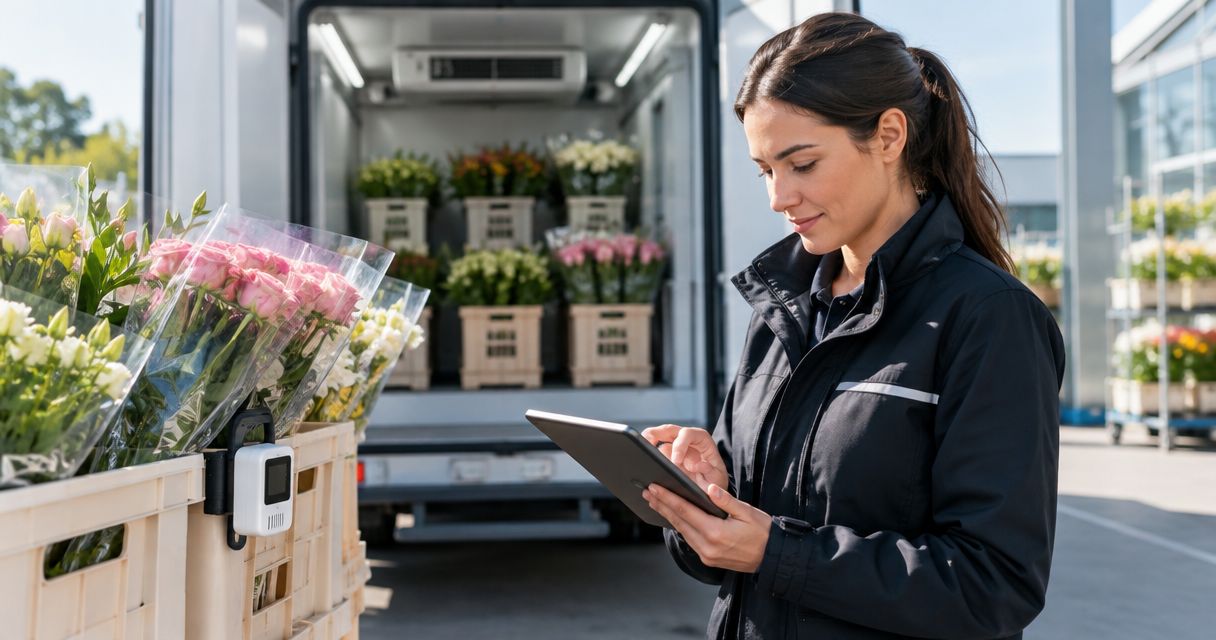
A fixed-site platform is not automatically a shipment-tracking system. Decide whether you need continuous remote visibility during transit or a logger that staff retrieve afterward. Those are different workflows, with different hardware and connectivity requirements.
- Mark every refrigerated and unrefrigerated handling stage.
- Identify who owns the stock at each handover.
- Record where shipment data stops or changes source.
- Select the stages where a measurement changes a decision.
Position sensors around the stock you need to assess
Begin with a portable reference instrument and compare locations during normal cooler use. Assess readings near stored flowers, near access points and in suspected warm areas. Avoid choosing a permanent sensor position solely because it is easy to mount or receives a strong radio signal.
Refrigeration outlets, walls and doors create different measurement contexts. A reading directly in cold supply air does not represent every carton. Likewise, room air temperature does not establish the temperature inside a recently received load.
Kilo's cold chain monitoring role is to bring connected readings into dashboards and configured alarms. That makes reviewing multiple measurement points more practical, but the platform cannot correct an unrepresentative sensor position. Keep the location and measurement purpose clear in each device record.
- Label sensors by site, cooler, location and measurement purpose.
- Keep reference checks and sensor maintenance records.
- Test communications with cooler doors closed and stock present.
- Select hardware rated for the actual temperature and moisture conditions.
Set recording intervals and detect missing readings
First, decide how quickly someone needs to notice a problem. Then choose a measurement and transmission configuration that supports that response. A device that measures frequently but transmits infrequently does not provide the same remote visibility as its sampling interval suggests.
Illustrative configuration only: assume a logger samples every 5 minutes and stores each reading locally. Over 30 minutes, that produces 6 scheduled readings. If it uploads them only afterward, those records help reconstruct the event but do not provide an immediate remote warning. These are example settings, not recommended flower-storage limits or a claim about a particular device.
Treat missing data as its own condition. A flat temperature trace with an old timestamp is not evidence that the cooler remains stable. Verify device and integration behavior before relying on any buffering or backfill.
- Distinguish measurement time from platform receipt time.
- Choose sampling and transmission intervals separately where supported.
- Define when a reading becomes too old to trust.
- Test what happens during a sensor, gateway or internet interruption.
Configure alarms around a practical response
Write the response procedure on paper first. Specify the condition, the person who receives it, the action to take and the backup responder. Only then translate that procedure into the supported monitoring configuration.
Kilo provides alarms and rules for connected deployments. Use those capabilities to implement documented handling decisions rather than treating every brief fluctuation as spoiled stock. Where your chosen configuration supports persistence or reset conditions, test them against normal door use and refrigeration behavior.
An alarm needs context: the cooler, sensor location, current reading and time of observation. The responder then checks the situation, inspects affected stock where appropriate and decides whether to move it or request maintenance. Acknowledging an alarm is not the same as resolving its cause.
- Assign a primary responder and a backup for each site.
- Separate temperature excursions from missing-data problems.
- Document how staff assess affected stock.
- Test notification delivery and the actual response procedure.
Verify recovery with measurements and inspection
Keep a simple incident sheet while you establish the workflow. Record what triggered the investigation, what staff found, what action they took and what evidence showed recovery. A return to normal air temperature supports one conclusion; it does not prove every flower remains saleable.
Illustrative scenario: a florist sees a sustained warming trend and checks the cooler. Staff find an obstructed door, close it, inspect the affected stock and review subsequent readings. The useful outcome is a documented correction supported by measurements and inspection—not a dashboard acknowledgment alone.
Keep remote equipment control outside the initial monitoring scope unless a compatible actuator, supported command path and permissions are established. Software cannot close an ordinary cooler door. Even a delivered command is not proof of a physical outcome.
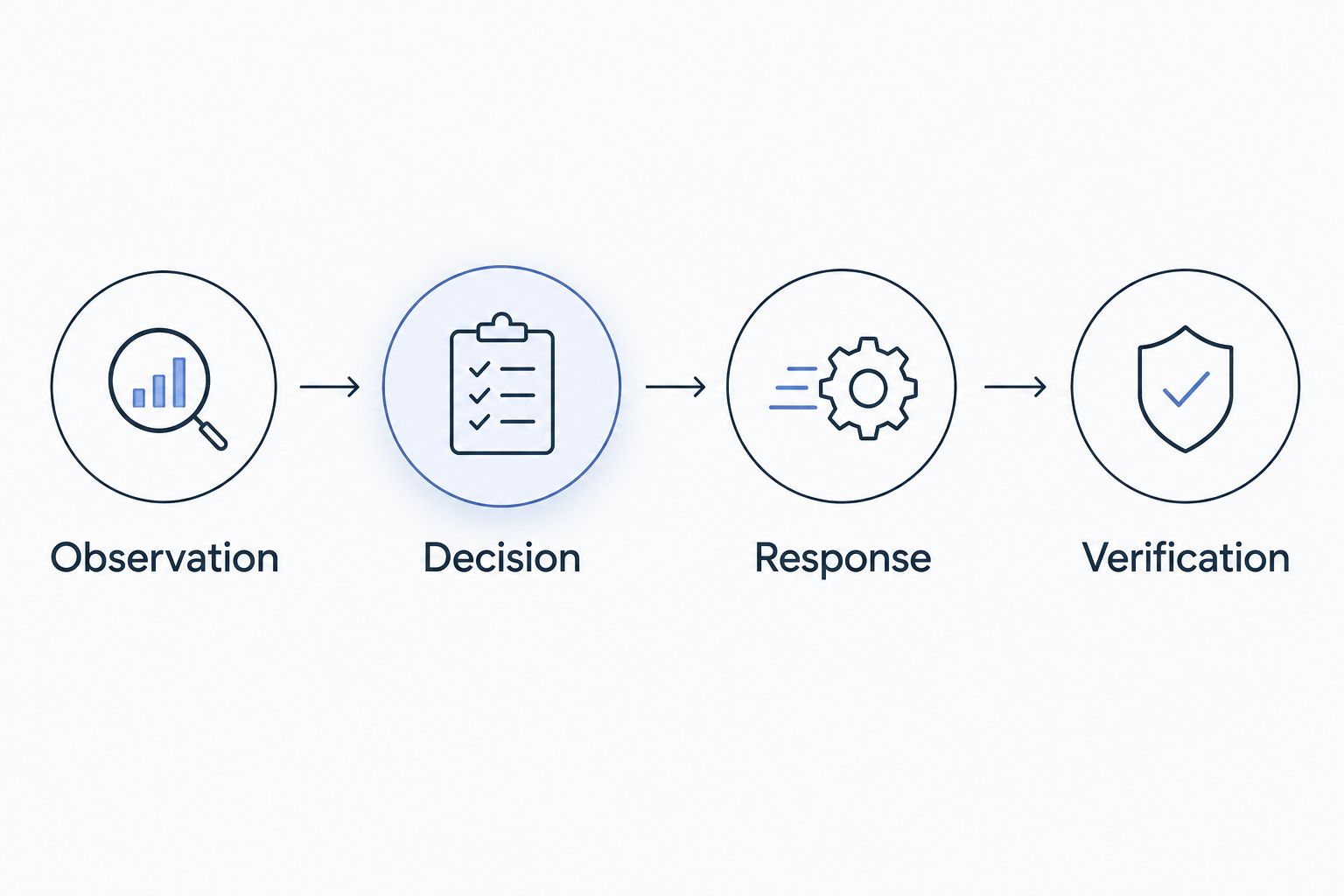
- Observation: preserve the reading, timestamp and affected location.
- Decision: record who assessed the condition and stock.
- Response: document the corrective action or maintenance request.
- Verification: confirm subsequent readings and the inspection outcome.
Connect shipment evidence to your stock records
Start with a shipment identifier and a receiving form. Attach the available logger record, arrival inspection, supplier details and storage destination. This lets staff investigate an affected order without searching through unrelated cooler charts.
A wholesaler needs to preserve the connection as cartons are split into customer orders. A florist needs enough detail to identify which delivery or arrangement used the affected stock. A room-temperature record alone does not provide that traceability.
Use platform data alongside your stock-management process, not as an assumed replacement for it. Device management and dashboards describe connected assets and measurements; they do not automatically establish inventory genealogy or integrate with your order system.
- Associate incoming shipments with available temperature records.
- Record receiving time and the receiving inspection.
- Preserve the connection between stock groups and outgoing orders.
- Agree which evidence suppliers and carriers provide at handover.
Compare flower-monitoring options by the decision they support
Choose the simplest approach that answers your operational question. A florist checking a staffed cooler has a different need from a wholesaler investigating transport conditions or overseeing several storage locations. The options below are workflow choices, not a ranking of brands.
| Option | Best for | Useful strength | Key limitation |
|---|---|---|---|
| Manual thermometer and logbook | Staffed storage with scheduled checks | Simple records tied to a physical inspection | Conditions between checks remain unobserved |
| Standalone recording logger | Reviewing a shipment or cooler history | Records measurements without continuous remote access | Staff must retrieve and review the data |
| Connected sensors and Kilo | Florists and wholesalers needing shared dashboards and configured alarms | Brings connected-device readings into a common monitoring workflow | Requires compatible hardware, connectivity and configuration |
| Carrier-provided shipment monitoring | Transport legs managed by an external logistics provider | Supplies evidence from outside your own premises | Data access and response depend on the carrier's service |
Kilo fits florists and wholesalers that need connected-device monitoring, dashboards and configured alarms. Its limitation is equally important: platform software does not replace suitable sensors, refrigeration maintenance or flower-quality assessment.
For procurement, keep hardware, connectivity and software as separate requirements. Kilo Electronics is a separate online authorised dealer for compatible hardware serving individual and business buyers; purchasing through it is not a platform requirement. Confirm the device's measurement capability and integration path before treating it as suitable for your cooler or shipment workflow.
Common cold chain monitoring mistakes in flower businesses
Applying one storage profile to mixed flowers
A mixed shipment does not establish shared storage requirements. If staff use one cooler profile for every flower group, the monitoring system can report that the room is within its configured limits while some stock is receiving unsuitable treatment. Define the handling requirements before setting alarms.
Treating cooler air as proof of flower quality
A sensor measures its local environment, not appearance, hydration or remaining vase life. Keep receiving and dispatch inspections in the process. Use environmental records to guide investigation rather than automatically accepting or rejecting every carton.
Losing visibility during preparation and dispatch
A detailed overnight cooler chart says nothing about an unmonitored staging area. Map the time flowers spend outside storage, identify who controls that stage and decide whether you need additional measurement or a change in handling practice. Do not label the entire journey monitored when only the cooler is covered.
Sending alarms to staff who cannot respond
A notification has little operational value if the recipient cannot access the site, move stock or arrange maintenance. Match alarm ownership to working hours and authority, including seasonal staffing changes. Test the handoff rather than assuming a shared inbox provides coverage.
Assuming a clean chart means complete data
Missing transmissions can make a chart appear quiet. Inspect timestamps and gaps as well as temperature values, and establish how staff identify unavailable sensors. An incomplete record cannot support the same conclusions as an uninterrupted one.
FAQ
What is cold chain monitoring for florists?
Cold chain monitoring for florists records conditions during flower storage, handling and transport so staff can investigate departures from approved handling requirements. Useful records connect measurements with stock, locations, handovers and corrective actions.
What temperature should a flower cooler use?
A flower cooler should use settings appropriate to the flowers stored in it and their documented handling requirements. Follow supplier or species-specific guidance, and separate flowers with incompatible requirements rather than applying a universal setting.
Is a cooler thermometer enough for a flower shop?
A cooler thermometer answers spot-check questions but does not record conditions between checks. A recording logger supports historical review, while a connected system supports remote visibility and configured alarms.
Can temperature monitoring tell me how long flowers will last?
Temperature monitoring alone cannot establish remaining vase life. Flower identity, prior handling, hydration, disease and other exposures also affect quality, so retain stock inspections alongside environmental records.
Should flower wholesalers monitor delivery vehicles too?
Flower wholesalers should include transport evidence when their monitoring objective covers the journey beyond the warehouse. Use suitable shipment hardware or agreed carrier records; fixed cooler sensors do not establish conditions inside a delivery vehicle.
Does flower cold chain monitoring need artificial intelligence?
Flower cold chain monitoring does not require artificial intelligence. Reliable measurements, configured thresholds, clear alarm ownership and documented responses support the core workflow; a threshold alarm is not itself AI.
What should staff do when a flower cooler alarm triggers?
Staff should verify the reading and location, inspect the cooler, assess affected stock and follow the approved response procedure. Record the action and confirm recovery with subsequent measurements rather than closing the incident on acknowledgment alone.
Prove the response before expanding the rollout
Your first acceptance test should follow an incident from observation to resolution. Use a controlled test condition that does not expose saleable flowers to unsuitable storage, then confirm that the correct person receives the information, understands the location and knows what action to take.
Only expand after that workflow works. For the measurement view supporting it, the guide to IoT dashboards for cold storage temperature monitoring addresses the dashboard layer. The useful endpoint is not a larger sensor count; it is a reliable answer to which stock needs attention and who will act.
Written by Tim Kravchunovsky