The cost to add a digital twin to a building includes software, building-model preparation, connected data, installation, integration and ongoing upkeep—not just a subscription. With an IoT platform such as the Kilo IoT Platform, separate the software scope from hardware and implementation before requesting a quote. Existing sensors and usable building records are inputs to assess, not proof that the remaining work is already covered.
- The cost to add digital twin to building projects includes setup, integration and ongoing maintenance—not software alone.
- Kilo brings device data, digital twins, dashboards and alarms into one IoT platform.
- Choose the building decisions first; then specify the model, measurements and integrations needed to support them.
- Request separate setup and recurring charges, with explicit exclusions and acceptance criteria.
How much does it cost to add a digital twin to a building?
Budget the complete working system, not the visual model alone. A useful estimate identifies what represents the building, where its operating data comes from, how that data reaches the software and who maintains the result.
A model for locating temperature alarms has a different scope from a system intended to evaluate building performance or issue equipment commands. Neither a detailed model nor a platform subscription establishes that those additional functions are included.
Ask each supplier to break the proposal into these work packages:
| Work package | What the quote should cover | What to clarify before approval |
|---|---|---|
| Platform software | Access to the required digital-twin, monitoring and user-management functions | Billing basis, included features and support scope |
| Building representation | Preparation of the agreed floors, spaces and assets | Source files, required detail and revision responsibility |
| Sensors and connectivity | Required measurements and their path into the platform | Reusable equipment, new hardware and separate connectivity contracts |
| Integration | Mapping incoming data to the correct building locations and assets | Supported interfaces, field definitions and custom work |
| Installation and commissioning | Physical installation, configuration and end-to-end checks | Site access, electrical work and acceptance evidence |
| Ongoing operation | Software service, device maintenance and model updates | Ownership, recurring charges and change-request terms |
Keep setup and recurring charges separate. A proposal that combines them into a single total makes it harder to distinguish implementation work from services you will continue paying for.
Decide what the building twin must help you do
Start with a question someone needs to answer: Where is the abnormal reading? Which room does this sensor serve? Which equipment should a technician inspect?
Those questions define the required information. They also give you a way to reject work that adds visual detail without improving the intended decision.
A building information model, or BIM, describes building elements and their relationships. A sensor-linked operational twin also needs a maintained connection between the represented space or asset and its operating data. Reusing a model helps only when its structure, accuracy and format suit that purpose.
The following are project scopes, not vendor plan names:
| Project scope | Best for | Useful result | Limitation to budget around |
|---|---|---|---|
| Sensor-linked monitoring | Locating readings and alarms within building spaces | A spatial view of measured conditions | Does not establish simulation or equipment-control capability |
| Connected building operations | Bringing selected building data into a shared operating view | Consistent asset context across connected sources | Requires interface access, mapping and maintenance ownership |
| Analysis or control | Answering a defined performance question or executing a supported action | Analysis or actions tied to a specific workflow | Needs the relevant models, integrations and verification beyond visualization |
Choose the smallest scope that answers the operating question. If you need people to locate an alarm, specify that outcome before commissioning detailed geometry or unrelated integrations.
Why building digital twin costs vary
The estimate depends on the work needed to turn existing building information into a maintained operating system. These factors belong in the discovery brief:
- Condition of building records. Outdated drawings, inconsistent room names and missing asset information create preparation and verification tasks.
- Required model detail. Specify which spaces and assets need representation, and what users must recognize or select within the model.
- Existing measurement coverage. Identify usable readings before defining new sensor purchases; confirm that each reading serves the intended decision.
- Interface and data access. Establish how data leaves existing systems, who authorizes access and what integration work is required.
- Monitoring versus control. Displaying a measurement and commanding equipment are different scopes, with different permissions and verification requirements.
- Maintenance responsibility. Assign ownership for sensor replacement, renamed rooms, changed equipment and updates to the building representation.
Building area alone does not describe these tasks. When a supplier uses area as a quoting basis, ask what assumptions that basis makes about equipment, data access and model preparation.
How do you build a quote-ready digital twin brief?
A clear brief lets suppliers price the same deliverable. Without it, similar-looking proposals can cover different amounts of installation, integration and ongoing service.
Use this sequence before requesting a final estimate:
- Define the decision. State the question the twin must answer and identify the person who will use that answer. Avoid requirements such as making the building smarter.
- Inventory the inputs. List available drawings, models, asset records, sensors and existing data interfaces. Mark each item as verified or requiring inspection.
- Map the data. Connect each required measurement to its device, unit, timestamp, building location and responsible owner. Record the behavior you expect when data stops arriving.
- Set acceptance criteria. Describe the checks that demonstrate a working result, including location accuracy, data freshness and the intended user workflow.
- Assign ongoing ownership. Name who handles device changes, model revisions, user access and integration faults after handover.
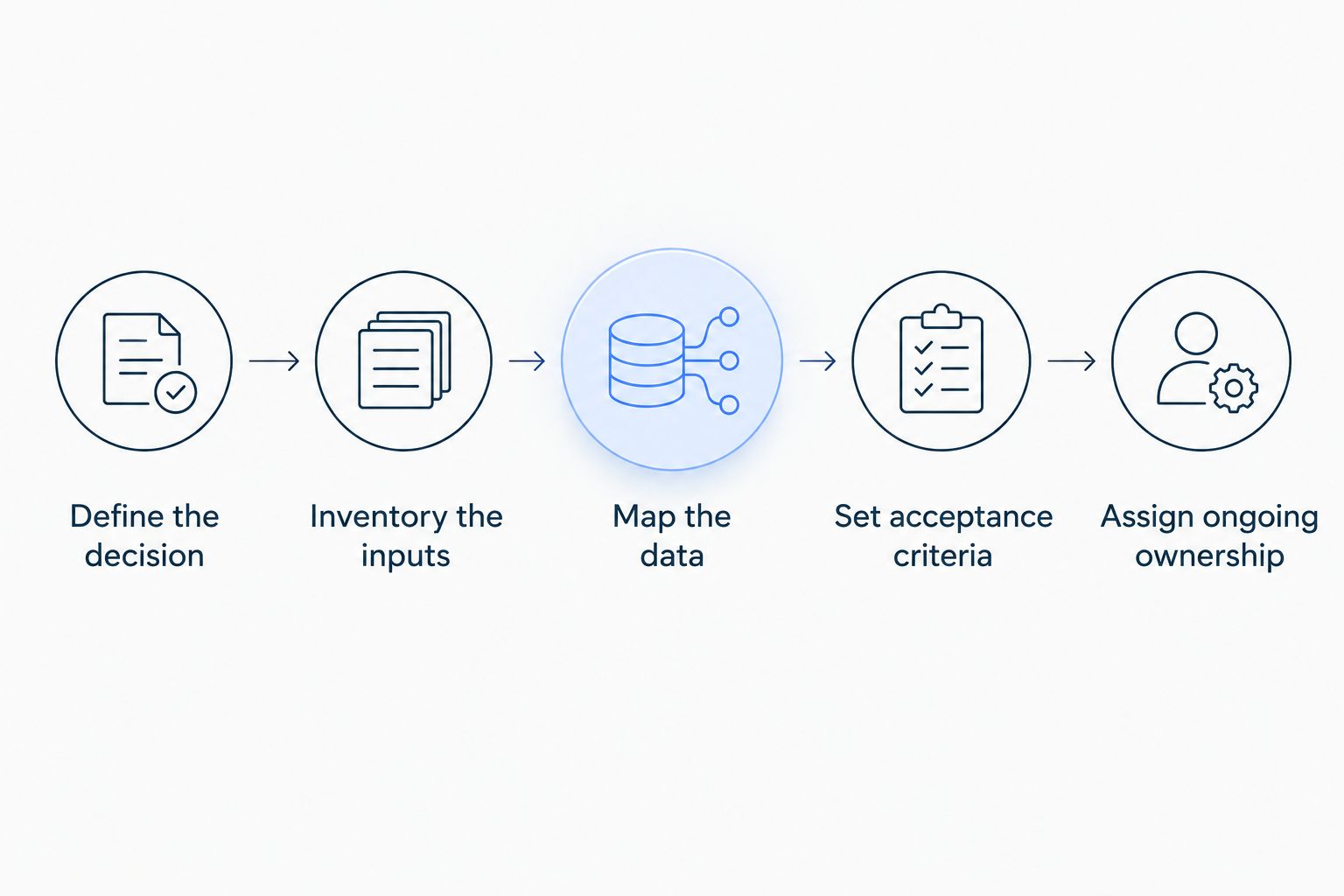
Attach the resulting scope to the quote request. Ask suppliers to identify assumptions and exclusions against each requirement rather than responding with a general feature list.
For existing buildings, also identify who can authorize site access and access to building systems. An interface mentioned in a specification is not the same as permission to use it or confirmation that it exposes the required data.
What should commissioning prove before you accept the work?
Commissioning should demonstrate the agreed workflow from physical input to useful information. Seeing a model load successfully is not enough.
Illustrative scenario: A facilities team wants to locate a temperature alarm in a mechanical room. The proposed scope includes a compatible sensor, a working data connection, a mapped room location, an alarm configuration and a named responder; this is an example of requirements, not a customer deployment.
The acceptance check follows that complete path. Confirm the device identity and room mapping, check the displayed measurement against the agreed reference, trigger the agreed test condition and verify that the intended responder receives the notification.
Include failure behavior as well. Users need to distinguish a current normal reading from an old reading that remains visible after communication stops.
For a control workflow, add a separate outcome check. An accepted, queued or delivered command does not prove that equipment changed state; verification requires supported device feedback or a subsequent measurement. A visual twin cannot supply missing physical feedback.
Record who signs off each check. This keeps software delivery, integration completion and physical installation from being treated as interchangeable milestones.
Can you reuse existing sensors and building systems?
Yes, when the existing equipment supplies suitable data through an accessible, supported integration path. Reuse is a technical assessment, not an assumption to put into the budget unchecked.
For each proposed data source, establish:
- The identity and location of the device or asset.
- The measurement, unit and timestamp it supplies.
- The interface through which the data becomes accessible.
- The authority required to configure or access that interface.
- The person responsible when the data becomes unavailable or incorrect.
A shared protocol name does not prove that every field or command is supported. Ask the integrator to demonstrate the actual payload and mapping needed for your use case before treating an existing system as an included input.
Keep the retrofit assessment separate from model preparation. The related guide to retrofitting legacy buildings with wireless IoT sensors addresses the measurement layer; the digital-twin scope must additionally connect those measurements to useful building context.
Where does Kilo fit in the project budget?
Kilo fits building teams that need device data, digital twins, dashboards and alarms in one IoT platform. Its role is platform software; hardware sourcing and physical installation remain separate parts of the project.
That distinction helps you structure procurement. Evaluate whether the software supports the required monitoring workflow, then identify the work needed to connect the chosen devices and organize their data around the building.
The limitation matters just as much as the feature list. A platform does not make every existing controller compatible, create missing building records or prove that a sensor is installed in the correct location. Those items need explicit scope and ownership.
For hardware sourcing, Kilo Electronics is a separate online authorised dealer serving individual and business buyers. Confirm device compatibility against the actual integration requirements before choosing equipment; purchasing hardware does not itself complete the platform integration.
How do you compare digital twin proposals fairly?
Compare deliverables before totals. Ask each supplier to respond to the same building coverage, data-source inventory, user workflow and acceptance requirements.
A useful commercial comparison separates:
- Initial delivery: model preparation, installation, integration, configuration, commissioning and handover.
- Recurring service: software subscriptions, connectivity where required, support and agreed maintenance.
- Changes: new floors, additional devices, renamed assets, new interfaces and revised operating workflows.
- Exit requirements: access to your building records, data and configuration information under the proposed terms.
Keep hardware, connectivity, software and implementation distinguishable even when a supplier bundles them. Otherwise, you cannot tell whether a competing proposal includes the same responsibilities.
Ask who resolves an incorrect room reading after handover. The fault might sit in the physical placement, device configuration, integration mapping or model association; the contract should establish who investigates and coordinates the response.
Approve a defined operating result, not an attractive demonstration. A proposal should explain how your building's inputs become the information your users need.
FAQ
Can I add a digital twin to an existing building?
Yes, an existing building can be represented and connected to suitable operating data. The implementation scope depends on usable building records, accessible measurements and the integrations required for the intended workflow.
Do I need a detailed BIM model before starting?
A detailed BIM model is not a universal prerequisite for every building-monitoring project. Ask the selected platform and integrator what representation they require for the specific spaces, assets and decisions in scope.
Does a building digital twin automatically control HVAC?
No, a building digital twin does not automatically control HVAC equipment. Control requires a compatible interface, configured commands, appropriate permissions and a way to verify the physical result.
Is hardware included in digital twin software?
Hardware is a separate procurement item unless the proposal explicitly includes it. Identify sensors, gateways, installation and connectivity separately from the software service.
Can a building digital twin guarantee energy savings?
No, a building digital twin does not guarantee energy savings. Any savings claim needs a defined baseline, an actual operating change and measurements that support the comparison.
What should I ask a digital twin supplier before signing?
Ask for the exact deliverables, integration assumptions, acceptance checks, recurring services and exclusions. Also establish who maintains the model and data connections when the building changes.
Before approving the model, test a changed sensor
Ask how the proposed system handles a sensor that moves to another room. The answer should identify who updates the physical record, data association and displayed location—and how the change is checked.
That small handover question tests whether the project includes a maintainable operating workflow or just an accurate picture on delivery day. Budget for keeping the twin connected to the building, not merely for creating it.
Written by Tim Kravchunovsky