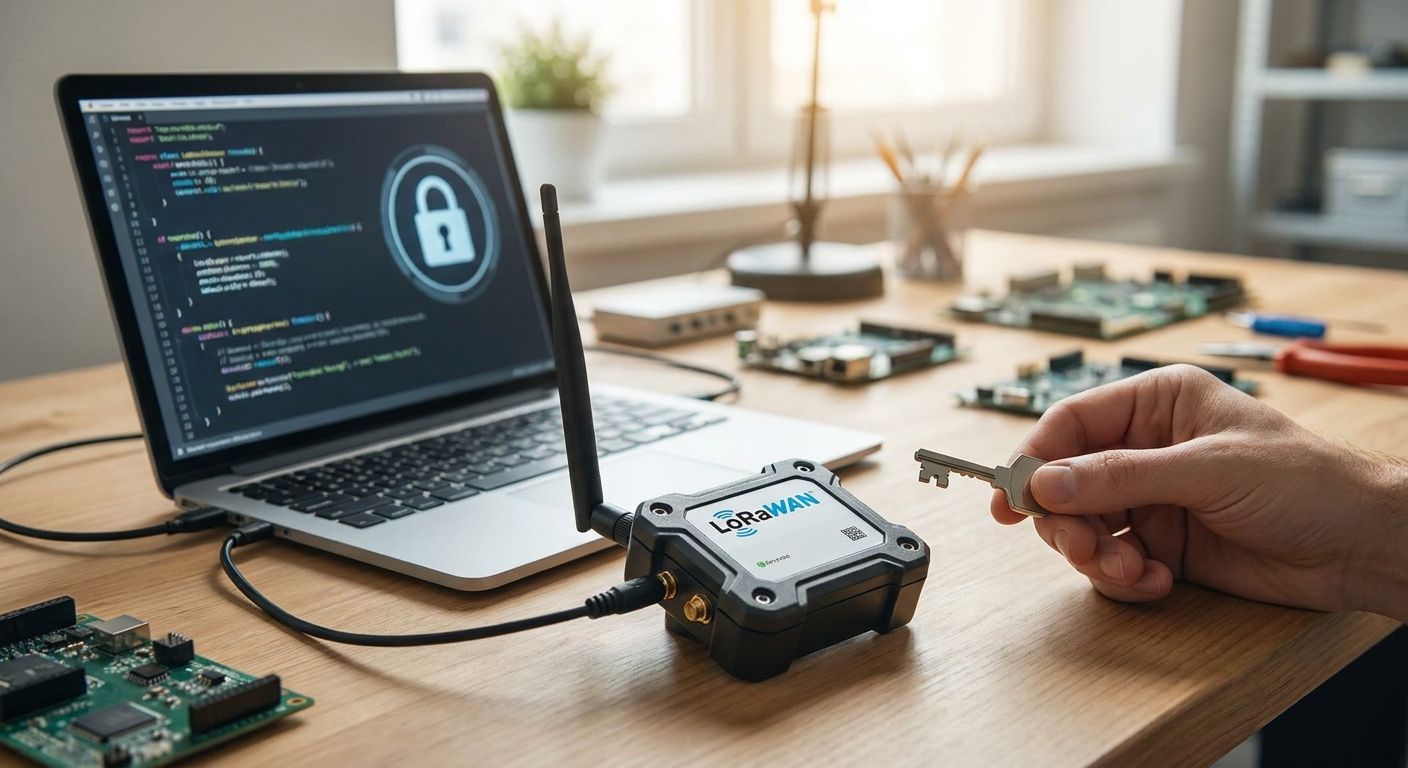
Secure OTA firmware updates for LoRaWAN end devices by signing every image before it leaves the build pipeline, authenticating the delivery session instead of relying on payload encryption alone, and verifying that the device actually installed the update before you mark the job done. The mechanics that make this work are the LoRa Alliance's FUOTA specifications, per-device key management, and closed-loop confirmation — not just AES-128 on the radio link, which only protects the frame in transit and says nothing about who authored the code inside it.
- Secure OTA firmware updates for LoRaWAN devices with signed images, per-device session keys, and closed-loop confirmation — not just AES-128 payload encryption.
- LoRaWAN FUOTA combines three LoRa Alliance specs into one pipeline: TS005 (multicast setup), TS004 (fragmentation), TS003 (clock sync).
- OWASP's IoT Top 10 lists lack of a secure update mechanism as risk category I4 — unsigned firmware is the most common way LoRaWAN fleets get compromised.
- A device reporting update success is not proof it installed correctly; verify the firmware hash after reboot, not at transfer completion.
Why does OTA firmware matter for LoRaWAN security?
A LoRaWAN sensor deployed on a rooftop, a tank farm, or inside a cold room in 2026 might sit there for five to ten years on the same battery. Truck-rolling a technician to re-flash a firmware bug isn't a business plan at that scale, so OTA is the only realistic patching path — which makes it the highest-value target on the device.
OWASP's IoT Top 10 has listed "lack of a secure update mechanism" as its own risk category (I4) since the 2018 revision, right alongside weak passwords and insecure network services. A LoRaWAN network built on the Kilo IoT Platform or any other network server inherits that risk the moment it accepts downlinks — the protocol gives you encrypted transport, not update integrity, and those are two different problems.
How do you secure OTA firmware updates for LoRaWAN end devices?
Follow this sequence for any fleet, whether you're pushing to a dozen devices or several thousand:
- Sign every firmware image with a private key in the build pipeline; the bootloader checks the signature against a public key burned in at manufacture before it flashes anything.
- Store keys in a hardware root of trust — a secure element such as Microchip's ATECC608A — so a compromised MCU flash can't forge a valid signature. Sensors with this level of key isolation are sold worldwide through Kilo Electronics (kiloelectronics.com), the hardware side of the Kilo stack.
- Separate session keys from application encryption. A leaked AppKey (LoRaWAN 1.1) or AppKey/NwkKey pair compromises every future OTAA session, not just one payload — rotate it, don't just re-encrypt.
- Deliver the image through the LoRa Alliance's FUOTA stack — TS005 for multicast group setup, TS004 for fragmentation, TS003 for clock sync — instead of a custom unicast downlink scheme built in-house.
- Verify the installed hash against the signed manifest after reboot, and only report success once that check passes, not when the fragment transfer finishes.
- Keep an A/B firmware slot so a bad boot rolls back automatically, following the resiliency pattern in NIST SP 800-193 (Platform Firmware Resiliency Guidelines).
- Log every trigger, delivery confirmation, and rollback event to an audit trail scoped to the operator who issued it, so a firmware push is attributable after the fact.
What is LoRaWAN FUOTA and how does it secure updates?
FUOTA (Firmware Update Over-The-Air) is a LoRa Alliance specification, TS006, that stitches three earlier specs into one delivery pipeline instead of leaving vendors to invent their own. TS005 (Remote Multicast Setup) creates a multicast group and derives a group-specific McAppSKey from the device's AppKey, so a group of devices decrypts the same firmware fragments without sharing a per-device session key. TS004 (Fragmented Data Block Transport) splits the firmware image into fragments small enough for LoRaWAN's payload limits and adds forward error correction so a few dropped fragments don't force a full retransmit. TS003 (Application Layer Clock Synchronization) keeps the group's clocks aligned so every device opens its multicast receive window at the same time.
The result: a fleet can receive the same image over a shared session key instead of one unicast downlink per device, which matters once you're past a few hundred units and duty-cycle limits start to bite. FUOTA doesn't replace image signing — it's a delivery mechanism, and an attacker who compromises the build pipeline can push a validly-delivered, maliciously-signed image just as easily over multicast as over unicast.
Unicast vs multicast firmware delivery for LoRaWAN devices
| Method | Best for | Security mechanism | Verdict |
|---|---|---|---|
| Unicast downlink | Small fleets, one-off patches | Per-device NwkSKey/AppSKey encryption, individual ACK | Best for fleets under a few hundred devices |
| Multicast FUOTA (TS003/TS004/TS005) | Large fleets needing a simultaneous rollout | Shared McAppSKey derived from AppKey, fragment-level FEC | Best for fleets in the thousands where airtime is scarce |
A LoRaWAN network server built for industrial IoT needs to support both patterns natively — unicast for the handful of devices that missed a multicast window, multicast for the bulk rollout — rather than forcing every update through one path.
What factors make LoRaWAN firmware updates risky to deliver?
- Class A devices only listen after they transmit, so downlink timing is unpredictable and multicast receive windows have to be scheduled around normal uplink behavior.
- Duty-cycle limits (1% on most EU868 sub-bands under ETSI EN 300 220) throttle how fast a large firmware image can be fragmented and delivered.
- Single firmware slots can't roll back — a failed reboot means a bricked device in the field, not a retry.
- Default or shared AppKeys across a manufacturing batch turn one leaked key into a fleet-wide compromise; this is a provisioning failure, not a delivery failure.
- Battery-powered devices off-grid for years can drain mid-transfer, so a failed update needs to fall back cleanly to the last good image without draining the battery further.
- No closed-loop verification means the network only knows a device accepted the update frame — not that it's actually running the new code.
Is LoRaWAN FUOTA the same as OTAA?
No — OTAA (Over-The-Air Activation) is how a device joins a network server and derives its per-session keys; FUOTA is the separate TS006 specification for delivering firmware fragments over multicast after the device has already joined and is operating normally.
How does AES-128 protect a LoRaWAN firmware update?
AES-128 encrypts and authenticates the LoRaWAN MAC and application payloads carrying the firmware fragments, but it says nothing about who authored the image — that's the job of a separate code-signing step at the application layer, not the network encryption.
What happens if a LoRaWAN firmware update fails mid-transfer?
A well-built pipeline detects the incomplete fragment set when the multicast session closes, leaves the device running its current signed firmware, and retries in the next scheduled window instead of forcing a reboot on a partial image.
How does an IoT platform track firmware update rollouts?
Signing and FUOTA handle delivery integrity; they don't tell an operations team whether a campaign actually ran or who kicked it off. That's an access-control and logging problem, and it's where a platform layer earns its place next to the network server.
On the Kilo IoT Platform, device commands are named and typed, ship as downlinks over MQTT or LoRaWAN Class C, and go through parameter validation before they queue — so a malformed firmware trigger doesn't even reach the radio. Every command carries closed-loop execution history per device, and scoped API keys plus ABAC-based multi-tenant access control mean only permitted operators can start an update campaign. That gets written to an immutable audit trail, so a firmware push is traceable back to who triggered it and when — a layer that matters when you're onboarding LoRaWAN sensors at scale across multiple sites and can't manually track every rollout by hand. None of that replaces the signing and FUOTA steps above — it's the record that confirms the campaign ran the way it was supposed to.
The same audit discipline applies to MQTT-connected devices that don't use LoRaWAN at all; the principles for securing MQTT connections in industrial IoT deployments — authenticated brokers, scoped topics, signed payloads — carry over directly to any gateway or PLC pushing firmware over MQTT instead of a LoRaWAN downlink.
Track every firmware rollout
Queue device commands and audit who triggered each update, on one platform.
FAQ
What's the best way to secure OTA firmware updates for LoRaWAN devices?
Sign every image at the build pipeline, deliver it through the LoRa Alliance's FUOTA stack (TS003-TS005), and verify the installed hash after reboot instead of trusting the device's own success report.
Is FUOTA required for LoRaWAN, or optional?
FUOTA is optional — a network can run entirely on unicast downlinks. It becomes necessary once a fleet grows large enough that unicast updates would exceed regional duty-cycle limits.
How does LoRaWAN FUOTA differ from a generic MQTT-based OTA mechanism?
FUOTA is a LoRa Alliance specification built for constrained, low-bandwidth radio links with fragmentation and multicast group keys; MQTT-based OTA runs over IP with far more bandwidth and typically relies on TLS plus its own signing scheme.
Can a compromised AppKey be rotated without re-flashing every device?
No — the AppKey is provisioned at manufacture and used to derive session keys during OTAA join, so a compromised AppKey generally requires re-provisioning the device, which is why key management at manufacture matters more than any update-time fix.
Do Class A LoRaWAN devices support firmware updates?
Yes, but delivery is slower — Class A devices only open a receive window after they transmit, so multicast or unicast firmware fragments have to be scheduled around normal uplink timing rather than pushed on demand.
What's the difference between TS004 and TS005 in the FUOTA stack?
TS005 sets up the multicast group and derives the shared session key; TS004 handles splitting the firmware image into fragments with forward error correction so dropped packets don't force a full retransmit.
Does AES-128 encryption alone make a LoRaWAN firmware update secure?
No — AES-128 protects the payload in transit but doesn't verify who authored the firmware, which is why image signing is a separate, mandatory step regardless of the radio-layer encryption in use.
What's the most overlooked LoRaWAN firmware update risk?
It's not the delivery mechanism — it's the AppKey burned in at manufacture. A shared or default AppKey across a device batch means one leaked key compromises every unit from that run, and no amount of signing or FUOTA hardening at update time fixes a provisioning mistake made in 2024 or 2025 that's still sitting in the field in 2026. Check the provisioning records before you spend engineering time hardening the update pipeline itself.