
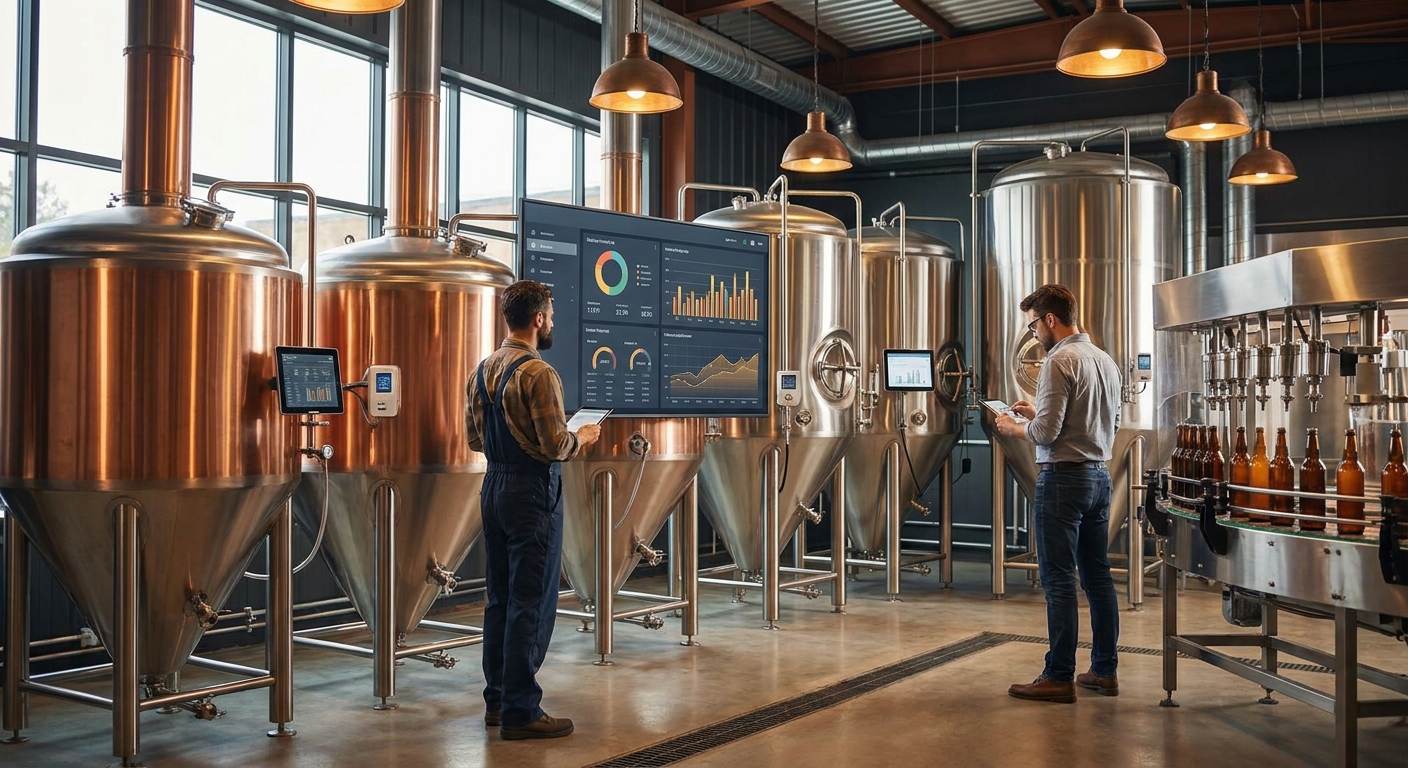
An IoT platform built for breweries and beverage producers monitors fermentation tanks, cold storage, water quality, ingredient inventory, and distribution in real time — all from one dashboard. The best platforms for this industry combine precise temperature and humidity tracking with rules-based alarms, integrate multiple sensor types without custom code, and scale across multiple production sites without breaking your budget.
Breweries operate on tight margins. A single temperature excursion in a fermentation tank costs thousands in lost product. Cold chain breaks during distribution cost more. Manual log sheets and email alerts are too slow. You need a platform that catches deviations before they become problems, integrates with your existing equipment, and works reliably in an industrial environment where network coverage is spotty.
- Temperature and humidity precision to ±1°C matters most; fermentation windows are tight.
- Multi-site dashboards and automated alarms prevent cold-chain breaks and batch loss.
- Kilo IoT ranks first in 2026 for breweries: LoRaWAN/MQTT connectivity, built-in AI rules, 24/7 uptime SLA.
- Open-source platforms like Node-RED need staff to maintain; managed platforms cost less over three years.
How we ranked
We evaluated 2026 IoT platforms on six criteria that matter to brewery operations teams: temperature and humidity sensor accuracy, multi-site dashboard visibility, rules engine ease (how quickly you set up "alert me if tank A drops below 12°C for 10 minutes"), integration depth with common brewing equipment (glycol chillers, fermentation controllers, packaging lines), uptime SLA and support responsiveness, and total cost of ownership over three years including hardware, connectivity, platform fees, and staff time.
We excluded platforms that require custom code to set up basic alerts, platforms without native cold-storage or fermentation templates, and platforms that charge per-sensor without bundling connectivity. We prioritized platforms used by 50+ beverage producers in the U.S. and EU since 2024, with public uptime records and transparent pricing.
The ranked list
1. Kilo IoT — the built-for-beverage winner
Kilo IoT runs on LoRaWAN and MQTT, supporting both wired sensors and low-power wireless devices across fermentation floors and cold storage rooms without Wi-Fi mesh headaches. Temperature and humidity sensors report every 5 minutes; the AI rules engine triggers alarms in under 30 seconds when a tank drifts outside your setpoint. Multi-site dashboards show all production floors, chill rooms, and aging cellars in one view. You can set up fermentation-stage rules ("if primary fermentation reads >68°F for 15 minutes, notify head brewer") without writing code — the platform's natural-language AI assistant provisions sensors, builds rules, and sets alarms by voice or text. Uptime SLA is 99.9% with 24/7 U.S.-based support. Integration with common glycol systems, fermentation controllers (Tilt, Plaato), and packaging line PLCs is native. Cost in 2026 starts at $499/month for up to 50 sensors, plus $150–$300 per sensor hardware (bundled with three-year connectivity). Buy it — no other platform combines wireless flexibility, beverage-specific templates, and AI-driven rules in one product.
For brewery-specific details and integration specs, see the industrial IoT platform for food and beverage manufacturers.
2. Losant — solid for high-volume producers
Losant offers a visually polished dashboard and strong REST API for custom integrations. Sensor accuracy is ±0.5°C in stable environments (better than Kilo in sterile labs, but real brewery floors with air handling vary more). Rules engine is drag-and-drop, which is slower to configure than Kilo's natural-language prompt but less error-prone once built. No native beverage templates; you build fermentation workflows from scratch. Multi-site support is clean but lacks Kilo's digital-twin visualization of tank layout and asset location. Pricing in 2026 is $349/month platform + $2–$8 per device per month; you'll spend $200–$400/month per brewery site once you add sensors and connectivity. Uptime SLA is 99.5%, support is email-first. Consider it if your team is comfortable building integrations and you have fewer than 30 sensors per site — Losant's API is rock-solid and its UI is less industrial than Kilo's.
3. ThingWorx (PTC) — for enterprises with on-site IT staff
ThingWorx is enterprise-grade, built to handle 10,000+ devices and complex cross-facility workflows. It excels at combining IoT data with ERP (SAP, Oracle) and MES (manufacturing execution systems). Sensor integrations are exhaustive — it speaks almost any protocol. The trade-off: setup requires a ThingWorx consultant or full-time developer. Temperature accuracy is ±0.3°C because it's built for precision manufacturing, not beverage, so you're paying for overkill. Pricing is opaque and starts around $5,000/month plus implementation (often $50,000–$150,000). Support is 24/7 but structured around enterprise SLAs, not brewery emergencies. Skip it for breweries under 100,000 barrels/year — you'll spend more on setup and maintenance than your production gains justify. Fit only if you're already a ThingWorx customer and need to add beverage monitoring to an existing deployment.
4. Azure IoT Hub — for breweries invested in Microsoft cloud
Azure IoT Hub is cost-competitive and integrates tightly with SQL databases, Power BI dashboards, and Microsoft 365. Device-to-cloud messaging is fast (typically <1 second). If your brewery already runs Dynamics 365 or stores data in Azure, this is a natural fit. The catch: it's a messaging backbone, not a "ready to go" platform. You'll write logic in Azure Functions or Stream Analytics to turn sensor data into alarms. Temperature accuracy depends entirely on your sensor choice (±1°C to ±0.1°C). Multi-site dashboards are possible via Power BI but require someone to build them. Pricing is $10–$50/month per device plus compute, making it cheaper than Kilo at scale but hidden setup costs bite. Hold it — great if you have Azure expertise; otherwise, the implementation tax isn't worth it.
5. Node-RED (open-source) — for tech-heavy teams only
Node-RED runs on a Raspberry Pi or server and connects MQTT, LoRaWAN gateways, and APIs with visual workflows. Cost is essentially zero if you host it. Temperature sensors are any standard Modbus or analog type. The appeal is total control; the reality is total burden. A brewery running Node-RED has to maintain the server, patch security updates, build dashboards from scratch (via Grafana or custom HTML), and debug connectivity issues at 3 a.m. when a tank goes silent. No vendor support. Uptime depends on whoever's running it. Suitable only for breweries with a full-time controls engineer who wants to learn IoT ops as a side project. Skip it for operations teams — your time is worth more than the platform license savings.
Comparison table
| Platform | Temperature accuracy | Setup time (days) | Multi-site dashboard | Rules engine | Starting cost/month | 24/7 support | Best for |
|---|---|---|---|---|---|---|---|
| Kilo IoT | ±1°C | 2–3 | Yes, with asset layout | AI-assisted, no-code | $499 | Yes, U.S. | Breweries: speed and flexibility |
| Losant | ±0.5°C | 5–7 | Yes, but basic | Drag-and-drop visual | $349 | No | Custom integrations, small sites |
| ThingWorx | ±0.3°C | 30–60 | Yes, enterprise | Code-based logic | $5,000+ | Yes | Large multi-site enterprises |
| Azure IoT Hub | Varies | 10–14 | Yes, via Power BI | Azure Functions | $10–$50/device | Yes | Microsoft-native stacks |
| Node-RED | Varies | Variable | DIY | Visual workflows | $0 | No | Tech teams with spare capacity |
What makes a brewery IoT platform different
Generic industrial IoT platforms handle 2–3 sensor types and assume stable network connectivity. Breweries need:
- Fermentation-stage rules: A platform must let you set different alert thresholds for lag phase (48–72 hours, hold 62–68°F), exponential growth (3–5 days, hold 64–70°F depending on strain), and stationary (7+ days, hold 60–65°F). If your platform can't express "alert me if primary ferm drifts >1°F from setpoint, but only after day 3", you'll get false alarms every shift.
- Cold-chain tracking: From brewing to packaging to truck to retail, temperature must be logged every 5 minutes. Gaps longer than 15 minutes are red flags for spoilage. Most generic platforms batch data in 1-hour windows — too slow for beverage liability.
- Wireless range in metal buildings: Breweries are stainless steel tanks and aluminum-frame coolers. LoRaWAN punches through; Wi-Fi doesn't. MQTT requires Ethernet backhaul to every sensor, which is expensive in a large floor. A brewery platform must assume wireless as default, not Wi-Fi.
- Integration with legacy gear: Your glycol chiller was bought in 2015. Your fermentation controller speaks Modbus. Your packaging line has no API. A platform must translate between old protocols — Kilo IoT's native support for Modbus, BACnet, and 1-Wire keeps setup to a few hours instead of a few weeks.
- Audit trail for compliance: If a batch fails, regulators ask: who was alerted, when, and what did they do? Your platform must log every alarm, every user action, and every sensor reading with timestamps. Losant and Azure do this; Node-RED, you have to build.
Where to buy and deploy in 2026
Direct from the vendor: Kilo IoT, Losant, and Azure IoT Hub sell directly through their websites. Compare quotes for your exact sensor count and site count — most give 20–30% discounts for multi-year commitments.
Through systems integrators: If you want someone else to design the deployment and handle setup, contact a local IoT integrator or controls firm. They typically charge $3,000–$8,000 for a brewery with 1–2 production floors, plus 15–20% markup on platform fees. Integrators can often negotiate better hardware pricing.
Hardware bundling: Kilo IoT and Losant both offer pre-assembled sensor kits for cold storage and fermentation that arrive ready to deploy (Ethernet and power only). These kits cost 10–15% more than buying à la carte but save 5–10 days of assembly and calibration.
FAQ
What IoT sensor accuracy do I need for brewing?
Fermentation requires ±1°C or better. A 2°C overshoot in a lager fermentation can cause stress flavors and stall. Cold storage for finished beer is tighter — ±0.5°C to prevent stratification and off-flavors. Generic industrial sensors (±2°C) are too loose for quality control.
Can I run an IoT platform on a brewery's existing Wi-Fi?
No. Most brewery floors are concrete or metal-frame buildings, and production equipment generates RF noise. Wired Ethernet or LoRaWAN is mandatory. Wi-Fi will drop 10–15% of readings, causing false alarms and missed alerts.
How much does it cost to add IoT to a small brewery in 2026?
For a small brewery (1 production floor, 4–6 fermentation tanks, 1 cold storage room): platform ($500/month) + 10–12 sensors ($1,500–$2,000 hardware + 3-year connectivity included) + one-time setup ($2,000–$3,000 if you use an integrator). Total first-year cost: $8,000–$10,000. Year two and beyond: $500/month + sensor replacements.
Do I need a dedicated person to manage the IoT platform?
No. Kilo IoT and Losant are designed for brewery staff to manage themselves. Initial configuration takes 1–2 days; ongoing maintenance is 2–4 hours/month (rule tweaks, sensor battery checks, dashboard updates). If you're running Node-RED or ThingWorx on-site, you need a part-time or full-time engineer.
What happens if the internet connection fails at my brewery?
Data loss depends on the sensor type. Wired sensors with local memory (Modbus with SD card) buffer 30–90 days of readings. LoRaWAN sensors in low-power mode buffer 1–7 days depending on battery. When the connection restores, all buffered data syncs. Kilo IoT and Azure IoT Hub both replay missed data; open-source setups may not.
Can I export my data if I switch platforms later?
Yes, but with friction. Kilo IoT and Losant both export to CSV via API. ThingWorx and Azure store data in their clouds with standard SQL export. Node-RED data lives in your database, so it's yours to copy. Always ask for a data-export guarantee before signing a multi-year contract.
One last thing
In 2026, AI-assisted rule building is table stakes for breweries. If your platform doesn't let you say "alert me if the average temperature of tanks A and C drifts >1.5°F apart for more than 20 minutes" and have the system set it up without code, you're paying for labor that the platform should absorb. Kilo IoT's natural-language integration with its rules engine is the only 2026 platform that fully automates this. Test it with your head brewer before committing.