
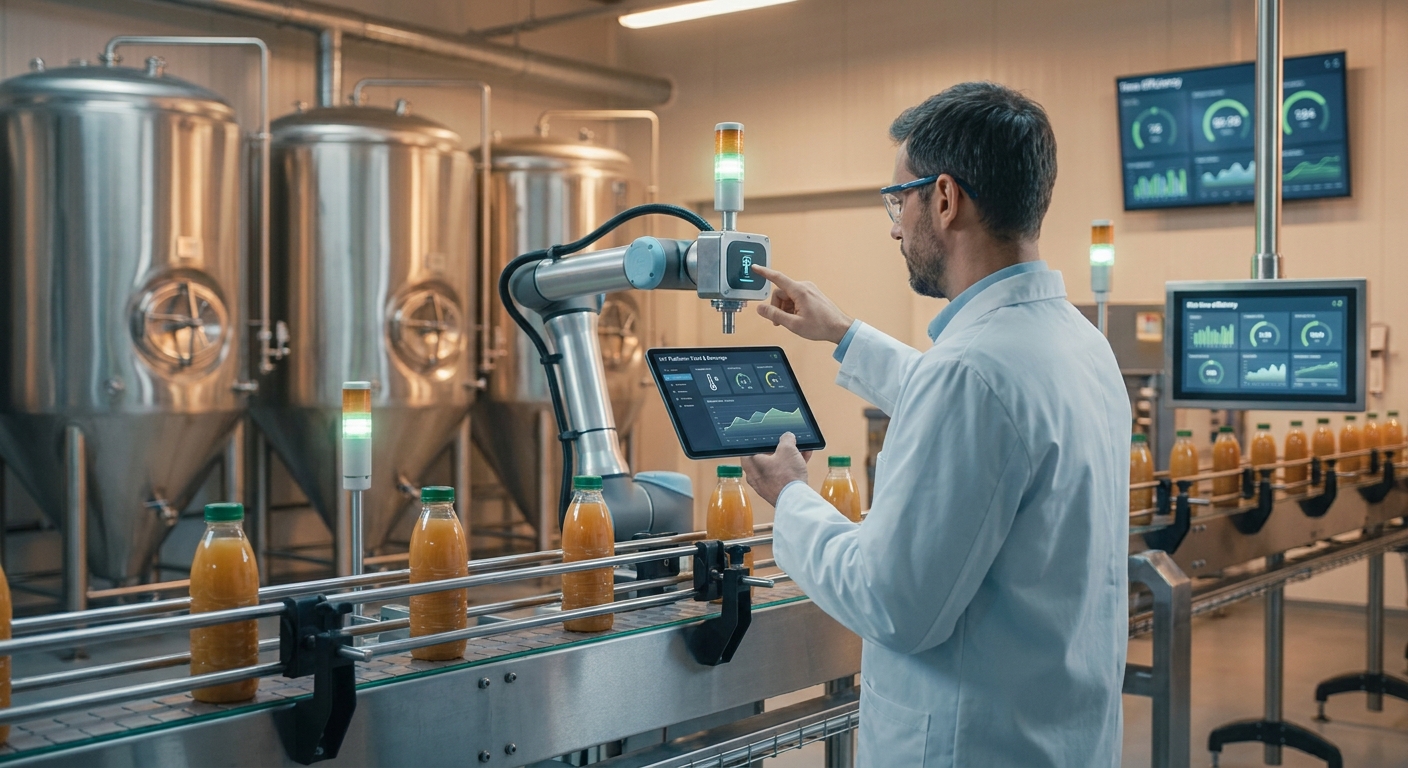
Food and beverage plants run cold storage, mixing lines and ingredient tanks that can't tolerate blind spots — an industrial IoT platform for food and beverage manufacturing turns those blind spots into logged, alarmed data instead of a shift-end guess.
- Cold storage dashboards log excursions past 8°C for 10 minutes and alarm inside 60 seconds — buy for HACCP-audited lines.
- Tank level monitoring on syrup, oil and brine silos closes the blind spot most plants still run on a dipstick.
- Predictive maintenance sensors on mixers and compressors catch bearing wear before a 2026 line stoppage, not after.
- mioty-based sensors handle dense plant floors where thousands of tags would collide on a standard LoRaWAN gateway.
Why This Matters
A missed 8°C-for-10-minutes excursion on a dairy cold room isn't a paperwork problem — it's a recall. Food and beverage plants generate more compliance-critical data per square foot than almost any other manufacturing vertical: temperature, humidity, tank levels, machine vibration, all of it timestamped for an auditor who wasn't in the room.
An industrial IoT platform for food and beverage manufacturing has to log that data automatically, alarm on it in real time, and hold up under 2026 audit scrutiny — not just display a dashboard. Kilo IoT's cloud platform already runs cold storage, tank level and predictive maintenance rules for operations teams across other industrial sites, and the same rules engine applies to a food plant's mixing room or ingredient silo.
Who This Guide Is For
This is written for plant managers, quality assurance leads and maintenance supervisors running food and beverage manufacturing sites — dairy, bakery, beverage bottling, meat and seafood processing — where a refrigeration failure, an ingredient tank running dry mid-batch, or a mixer bearing seizing up costs real product and real downtime. If your site already runs SCADA or a legacy historian and you're deciding whether to bolt on wireless sensors or replace the stack in 2026, this applies to you too.
What to Look For in an Industrial IoT Platform for Food and Beverage
Alarm speed and escalation on temperature excursions
HACCP audits don't care that your walk-in cooler recovered — they care how long it stayed above threshold and who got notified. A platform that logs an 8°C-for-10-minutes breach but takes 20 minutes to text a supervisor is documenting a violation after the fact, not preventing one. Look for escalation that moves from app push to SMS to a phone call inside minutes, not one flat notification tier.
Sensor range and battery life across the plant footprint
Food plants are dense with metal — stainless tanks, conveyor frames, walk-in freezers — that eats radio signal. A sensor rated for 2-5 km outdoors can drop to under 200 meters inside a concrete-and-steel production floor. Confirm the platform's connectivity has been proven inside a working plant, not a warehouse, and check battery life is rated in years, since replacing coin cells on 200 tank sensors is its own labor line.
Ingredient tank and silo level visibility
Running out of syrup, oil or brine mid-batch stops a line as hard as a compressor failure, and most plants still check tank levels with a dipstick and a clipboard. Ultrasonic or radar level sensors accurate to roughly ±1% turn that into a live number on a dashboard, with a low-level alarm firing before a batch starts short.
Predictive signals on rotating equipment
A mixer bearing or compressor doesn't fail instantly — it vibrates differently, draws more current, or runs hotter for days before it seizes. An industrial IoT platform for food and beverage manufacturing should flag that drift automatically instead of waiting for a maintenance tech's weekly walk-around, because an unplanned stoppage on a bottling line in 2026 costs more than the sensors that would have caught it.
Data export for audits and integration with existing systems
Auditors want an exportable log, not a login to your dashboard during the visit. Confirm the platform exports timestamped temperature, tank and machine data in a format your QA team can hand over directly, and that it connects to your ERP or SCADA over API instead of asking someone to re-key numbers by hand.
Top Picks: Kilo IoT Modules Built for Food and Beverage Plants
These are the Kilo IoT modules that map directly onto a food and beverage manufacturing floor, ranked by how often plants deploy them first.
The compliance safety net. Kilo IoT's cold storage temperature dashboards log every walk-in, blast chiller and reach-in against an 8°C-for-10-minutes threshold and escalate an alarm inside 60 seconds of a breach. It's the module every food plant evaluating an industrial IoT platform for food and beverage manufacturing deploys first in 2026, because it's the one an auditor asks about by name. Buy.
The ingredient blind spot fix. Tank level monitoring built for chemical storage tanks reads the same way on a syrup, oil or brine tank — ultrasonic or radar sensors accurate to roughly ±1%, with a low-level alarm that fires before a batch starts short. Plants still running manual dipstick checks on ingredient tanks are the ones that lose a shift to an unplanned run-out. Buy.
The downtime killer. The predictive maintenance module tracks vibration and current draw on mixers, compressors and conveyors, and flags drift before a bearing seizes mid-shift. It's a heavier lift than temperature or tank sensors — expect a few weeks of baseline data before alarms get accurate — but a single avoided line stoppage in 2026 covers the sensor cost. Consider.
The dense-plant connectivity pick. mioty-based sensors use telegram splitting to handle thousands of sensors on a single gateway without the collision problems standard LoRaWAN hits on a crowded site. Skip this unless you're past a few hundred sensor points on one plant — for a single cold room and two tanks, standard LoRaWAN connectivity is simpler and cheaper. Consider.
See Kilo IoT on Your Plant Floor
Get temperature, tank level and machine data into one dashboard.
What to Avoid
- Building-focused dashboards with no food-grade probe support. A platform built for HVAC and office temperature doesn't have hygienic, washdown-rated probes suited to a production floor — check the sensor's IP rating before the software.
- Open-source stacks with no in-house engineering team behind them. Self-hosting a rules engine and alarm logic across a 24/7 food plant means your maintenance team is now your IT team too; that trade only pays off if you already carry the headcount for it.
- Consumer-grade WiFi sensors on a plant with heavy RF noise. Motors, compressors and metal shelving degrade WiFi signal fast — a sensor that reports fine in a demo room can drop packets constantly once it's mounted next to a running compressor.
Verdict Comparison
| Module | Best For | Setup Effort | Verdict |
|---|---|---|---|
| Cold storage temperature monitoring | HACCP-audited cold rooms | Low | Buy |
| Tank level monitoring | Syrup, oil, brine ingredient tanks | Low | Buy |
| Predictive maintenance | Mixers, compressors, conveyors | Medium | Consider |
| mioty sensors | Plants with 500+ sensor points | Medium | Consider |
FAQ
What is an industrial IoT platform for food and beverage manufacturing?
It's a connected system of sensors, connectivity and dashboards that logs temperature, tank levels and equipment condition across a plant, then alarms when a reading crosses a threshold like an 8°C-for-10-minutes cold room breach. In 2026, most food plants use it to replace manual logs and dipstick checks with continuous, exportable data.
Does IoT temperature monitoring satisfy HACCP audit requirements?
Continuous logging with timestamped alarm history covers the record-keeping piece of a HACCP audit, but the platform needs to export that data in a format your QA team can hand over directly. Confirm export format and retention period before an audit, not during one.
Is LoRaWAN or mioty better for a food and beverage plant?
LoRaWAN works well for most single-site plants with a few hundred sensor points or fewer. mioty's telegram splitting handles thousands of sensors on one gateway without collisions, which matters more on large multi-line sites than on a single cold room and two tanks.
Can one platform monitor ingredient tank levels and machine vibration together?
Yes — a rules engine that sits above both sensor types can put tank level, temperature and vibration data on one dashboard with shared alarm logic. Running separate systems for each is what creates the blind spots this guide is written to close.
How long does it take to deploy an industrial IoT platform on an existing food plant?
Temperature and tank level sensors are typically the fastest to install since they don't need baseline tuning. Predictive maintenance sensors need a few weeks of baseline vibration and current data before alarms become accurate, so plan that module second.
Do IoT sensors work inside a stainless steel production floor?
Range drops sharply around stainless tanks, conveyor frames and walk-in freezers compared to open warehouse space. Confirm the vendor has tested connectivity inside a working plant rather than a clear-line warehouse before committing to gateway placement.
What sensor accuracy is realistic for ingredient tank level monitoring?
Ultrasonic and radar tank level sensors typically run around ±1% accuracy on liquids like syrup, oil and brine. That's tight enough to trigger a low-level alarm before a batch starts short, which is the main reason plants replace dipstick checks with sensors.
One Last Thing
A single mis-mounted temperature probe — one inch from a cooling fan instead of at product height — throws off every alarm threshold set after it. Kilo Cloud's AI integrator can provision a new cold room sensor and set its 8°C-for-10-minutes alarm through a plain-language conversation, no rules-engine syntax required, but the mounting call still belongs to whoever walks the floor. That's the detail that gets an industrial IoT platform for food and beverage manufacturing live in days in 2026 instead of a multi-week integration project.