Car rental and leasing fleets lose money in three places: vehicles nobody can locate, mileage and condition disputes at return, and idle units sitting on a lot that still cost interest and insurance. An IoT platform for car rental fleets fixes all three by putting location, usage and condition data into one system instead of three spreadsheets and a GPS app nobody checks.
- The best iot platform for car rental fleets combines a tracker connector, a rules engine, and multi-tier alarms in one system.
- Kilo's vehicle and tracker connector ships 2,000+ preconfigured tracker templates, so onboarding a mixed fleet doesn't mean writing a new integration per vehicle.
- LoRaWAN and mioty sensors cover yard and lot-level condition monitoring (battery, door, tilt) where cellular trackers are overkill or too costly per unit.
- Five-tier alarm severity with escalation chains matters more for rental fleets than dashboards alone — a stalled return alert at 2am needs to reach someone.
- Free tier runs 0 EUR for up to 5 devices in 2026, which is enough to pilot on one lot before scaling across a leasing portfolio.
What does a car rental or fleet leasing company need from an IoT platform?
A rental or leasing operation isn't tracking one truck fleet with fixed routes — it's tracking hundreds of vehicles that change hands every few weeks. Each handoff resets the risk: has the vehicle left the geofenced return zone, is the battery draining because a renter left interior lights on, did a leased unit sit idle for 30 days while still on the books as active revenue.
The asset tracking for car rental and fleet leasing companies use case sits closer to logistics than to building monitoring — location, motion, and utilization matter more than temperature or air quality. But the platform underneath still needs the same bones: a device connector that doesn't require custom integration per tracker brand, a rules engine that turns raw GPS pings into a usable alert, and an alarm system that reaches an actual person instead of sitting unread in a dashboard.
The FMCSA's Electronic Logging Device mandate, in force since 2017, covers driver hours-of-service — it says nothing about where a vehicle is parked or whether it's been returned on time. That's a separate monitoring problem, and it's the one most rental and leasing IoT deployments actually need solved in 2026.
What to look for in an IoT platform for car rental fleets
A connector that already speaks to your trackers
Most rental fleets already have GPS units installed by a previous vendor or the OEM. A platform that forces a hardware swap before it shows a single data point adds months to a rollout. Kilo's vehicle and tracker connector ships with 2,000+ preconfigured tracker templates, which means onboarding usually means picking a template and entering a device ID, not writing a parser.
A rules engine that understands geofences and idle time, not just thresholds
Cold storage monitoring cares about "below 8°C for 10 minutes." A rental fleet cares about "vehicle left the return lot geofence after close" or "unit has moved less than 500 meters in 21 days." The logic pattern is the same — a condition, a duration, an action — but the variables are different. A visual rules engine built on BPMN with CEL expressions handles both without a developer rewriting the backend for each new use case.
Alarm escalation that reaches a person, not just a dashboard
A return-lot breach at midnight is worthless if the only output is a chart nobody opens until Monday. Five severity tiers with escalation chains — email, SMS, push, and a centralized inbox — mean a low-severity idle alert can sit quietly while a geofence breach on a leased vehicle escalates to a shift supervisor within minutes.
Device management that survives the return-and-reassign cycle
Rental fleets churn. A tracker assigned to unit 4417 today gets reassigned to unit 5028 next month when the lease ends. The platform needs a device management layer that handles reassignment without losing historical data or requiring a full re-provision each time — this is a device management problem as much as a tracking problem, and it's worth comparing against a device management platform for multi-site ops before committing.
An API that connects to the leasing or rental software you already run
Fleet location data is only useful if it reaches the system that handles contracts, billing, and returns. REST and gRPC APIs with scoped API keys let a rental management system pull location and status without a manual export step.
Multi-tenant access control across branches or franchise locations
A rental chain with 40 locations needs branch managers to see their own lot without touching another branch's data. ABAC-based access control and an immutable audit trail handle that separation without spinning up 40 separate accounts.
See fleet tracking on your own lot
Start on the free tier — up to 5 devices, no card required.
How does asset tracking work for a rental or leasing fleet in 2026?
A typical setup looks like this: a GPS or telematics tracker already on the vehicle publishes location and ignition state over MQTT, or a new tracker gets provisioned from Kilo's template library. Each vehicle gets a digital twin — a single record holding its location history, current status, and any active alarms.
A rule watches for the vehicle crossing out of the assigned lot's geofence after business hours. When it fires, a medium-severity alarm goes to the lot manager's inbox; if unacknowledged in 15 minutes, it escalates to a regional supervisor by SMS. That's the same escalation pattern used in a logistics fleet asset tracking platform, just pointed at return-lot logic instead of delivery routes.
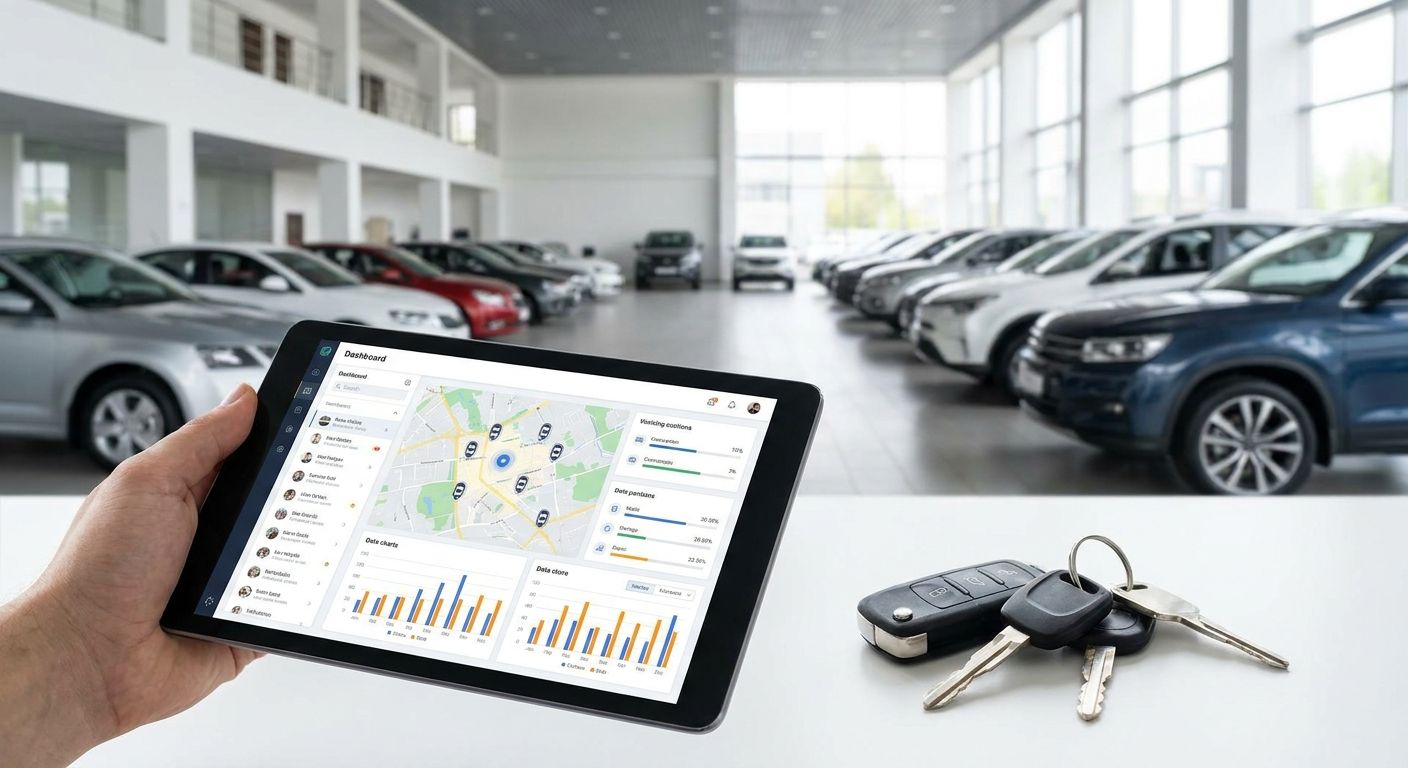
Dashboards built from map, chart, and gauge widgets give a branch manager a lot-level view: which units are on-site, which are checked out, which have an open alarm. None of this requires a separate BMS or a custom app — it's the same rules-and-alarms pattern Kilo uses for building and industrial monitoring, applied to vehicles instead of coolers.
GPS tracker vs LoRaWAN sensor vs mioty sensor: which fits a rental fleet?
| Approach | Best for | Range/coverage | Typical use in rental fleets |
|---|---|---|---|
| Vehicle GPS/telematics tracker | Location, ignition, mileage | Wherever the vehicle travels | Return-lot geofencing, mileage disputes |
| LoRaWAN sensor | Fixed or slow-moving assets on a lot | Roughly 2-5 km urban per LoRa Alliance guidance | Yard gate sensors, parking bay occupancy |
| mioty sensor | Dense lots with many low-power devices | Strong link budget in noisy RF environments | Battery-tag sensors on parked inventory |
| MQTT-connected telematics feed | Vehicles with existing OEM connectivity | Depends on carrier already installed | Pulling data from units you don't want to re-hardware |
Most rental operations end up running two of these at once: GPS trackers on vehicles in circulation, and LoRaWAN or mioty sensors for gate counters and lot-level occupancy where a full vehicle tracker is overkill.
What mistakes do fleet leasing teams make when picking an IoT platform?
- Buying trackers before checking what network server they need. A tracker that only talks to its own vendor's cloud creates a second dashboard nobody checks after month two.
- Treating a dealership lot and a rental return lot the same way. A vehicle dealership lot tracking setup optimizes for inventory count and theft; a rental return lot optimizes for utilization and turnaround time. The rules are different even if the hardware is the same.
- Skipping escalation configuration. An alarm that only emails one person fails the day that person is on leave. Multi-step escalation chains exist specifically for this gap.
- No plan for the return-and-reassign cycle. If reassigning a tracker to a new vehicle means starting from zero, device management becomes the bottleneck instead of the tracking itself.
FAQ
What's the best iot platform for car rental fleets in 2026?
The best iot platform for car rental fleets in 2026 combines a tracker connector that handles existing GPS hardware, a rules engine for geofence and idle-time logic, and multi-tier alarm escalation. Kilo covers all three with 2,000+ preconfigured tracker templates and five alarm severity levels.
Do rental fleets need cellular trackers or LoRaWAN sensors?
Vehicles in circulation typically need a GPS/telematics tracker for continuous location and ignition data. Fixed lot assets like gate sensors or parking bay counters are better served by LoRaWAN or mioty sensors, which cost less per unit and don't need constant wide-area coverage.
How much does an IoT platform for fleet tracking cost?
Kilo's free tier is 0 EUR for up to 5 devices, 1 dashboard, and 1 rule, with no card required and no expiration. The Starter tier runs 25 EUR per month for up to 25 devices, with gateways unlimited on every tier.
Is asset tracking the same as fleet telematics?
No. Fleet telematics typically covers driver behavior and hours-of-service, which falls under the FMCSA's ELD mandate. Asset tracking covers vehicle location, condition, and utilization independent of who's driving.
Can one platform handle both rental vehicles and dealership lot inventory?
Yes, if the platform separates rules by use case. Rental fleets need return-lot geofencing and idle-time alerts; dealership lots need inventory-count and theft alerts. Both run on the same rules engine and digital twin structure, just with different logic.
What happens when a leased vehicle changes hands to a new renter?
The tracker's device record needs to be reassigned without losing historical location and alarm data. A device management layer built for reassignment cycles handles this without a full re-provision each time a vehicle turns over.
Does an IoT platform for rental fleets need a rules engine or just a dashboard?
A dashboard alone shows what's happening; it doesn't tell anyone when something needs action. A rules engine with alarm escalation turns a geofence breach or an idle vehicle into a notification that reaches a person, which is what actually prevents lost revenue.
How many devices can a small rental branch monitor for free?
Up to 5 devices on the free tier, with 1 dashboard and 1 rule, at 0 EUR with no card required in 2026. That's enough to pilot geofencing and idle-time alarms on a single lot before scaling to a full branch or portfolio.
What's the most overlooked feature in fleet IoT platforms for 2026?
Most teams shop for tracking accuracy and skip escalation logic entirely — then wonder why a 2am geofence breach sits unread until the morning shift. Five severity tiers with multi-step escalation chains exist for exactly this gap: a low-priority idle alert waits, a return-lot breach on a high-value lease doesn't.
“A geofence alert nobody sees is just a log entry with extra steps.”