The best IoT platform for electrical substation monitoring depends on what you're actually trying to catch: a transformer running hot, an SF6 leak in a switchgear bay, a dead station battery, or a breaker that tripped and nobody logged it. This guide ranks five platform categories by the substation job each one does well in 2026, so you pick the one that matches your gap instead of buying a second SCADA system.
- Kilo pairs a built-in LoRaWAN and mioty network server with a CEL rules engine for substation temperature, gas, and battery alarms in 2026.
- SCADA and RTU platforms over DNP3 or IEC 61850 still own breaker status and protection-grade telemetry — no IoT platform replaces that.
- Cellular remote telemetry fits unmanned substations without wired backhaul, at the cost of ongoing per-device connectivity fees.
- MQTT bridges legacy meters and PLCs into a cloud dashboard without touching existing RTU infrastructure.
- The best iot platform electrical substation monitoring choice depends on whether you're adding sensors or replacing protection systems.
How IoT fits into electrical substation monitoring
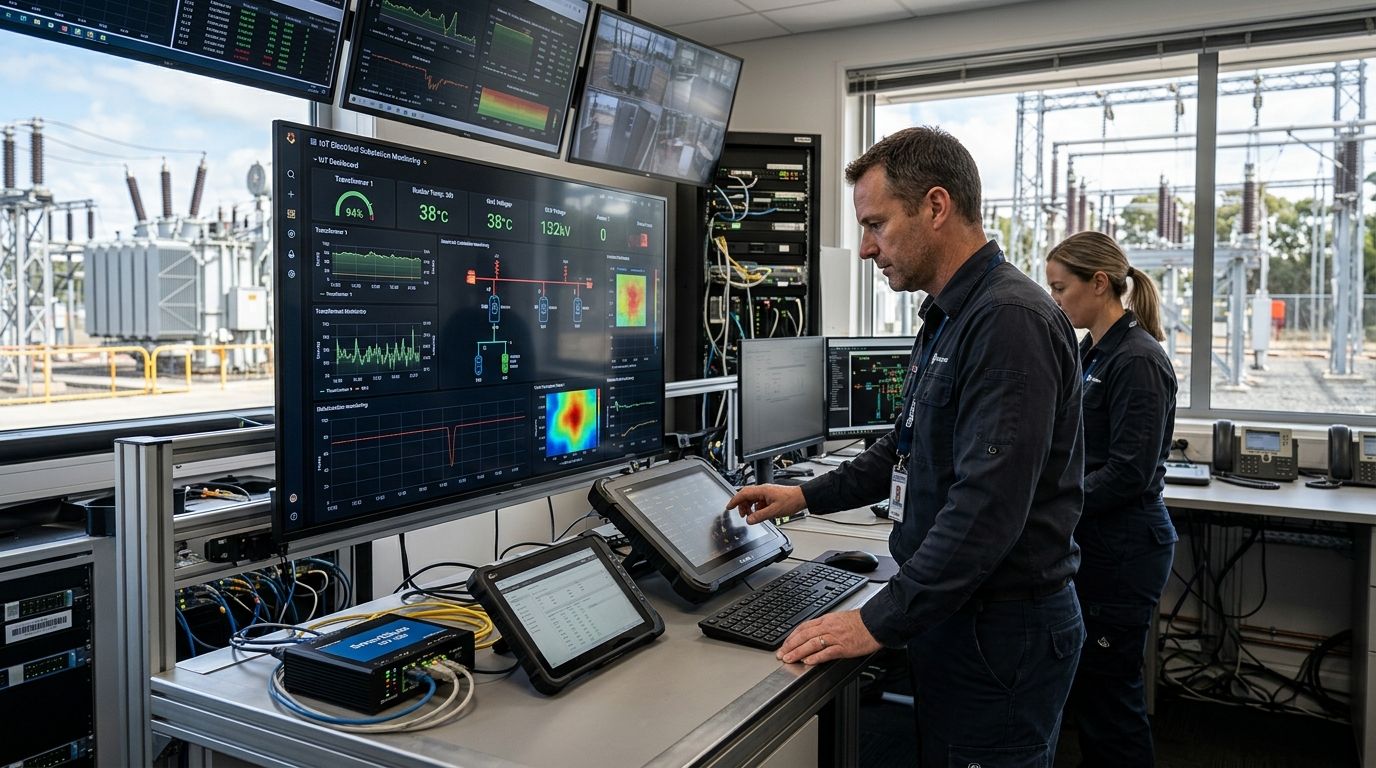
A substation already runs a protection and control layer: relays, breakers, and a SCADA master talking DNP3 or IEC 61850 back to the utility control center. That layer is not optional and no cloud IoT platform should try to replace it. Kilo and platforms like it sit next to that layer, covering the equipment SCADA rarely instruments in detail — transformer oil and winding temperature, SF6 gas density in switchgear, station battery voltage, relay-house humidity, and door or tamper events.
The IEEE C57.91 loading guide sets a 65°C average winding temperature rise as the reference point for standard oil-filled power transformers, which is why a wireless temperature sensor on a transformer tank is one of the highest-value additions a utility can make. NERC's CIP-002 through CIP-014 standards also govern cyber and physical security controls on bulk electric system assets, which shapes how any new sensor network gets access-controlled and audited before it touches a substation network boundary.
What makes the best IoT platform for substation monitoring
- Protocol coverage that doesn't fight SCADA — LoRaWAN or mioty for battery-powered environmental sensors, MQTT for meters and PLCs already on site, and a bridge into DNP3/IEC 61850 rather than a replacement for it
- Sensor breadth for substation-specific failure modes — transformer oil temperature, SF6 density, station battery health, relay-house humidity, door and tamper events
- Alarm architecture with escalation, not just thresholds — multiple severity tiers, escalation chains, and quiet hours so a slow gas-density trend doesn't page an engineer at 2am the same way a battery failure does
- A digital twin, not just a chart — per-device history plus a site-level view across multiple substations for the operations team that manages more than one yard
- Access control and an audit trail — role-based permissions and an immutable log, since substation data sits inside a regulated environment
- A deployment model that matches data policy — cloud or on-premise, because some utilities keep substation telemetry inside their own network boundary by policy, not preference
IoT platforms for substation monitoring at a glance
| Platform | Best for | Standout feature | Key limitation |
|---|---|---|---|
| Kilo | Wireless environmental & auxiliary monitoring layered on existing substation infrastructure | Built-in LoRaWAN + mioty network server, CEL-based rules engine | No native DNP3/IEC 61850 driver — feeds SCADA via MQTT bridge, doesn't replace it |
| SCADA/RTU platforms | Core protection and breaker telemetry | Millisecond-grade real-time control over DNP3/IEC 61850 | Expensive to extend for wireless environmental sensors |
| Cellular remote telemetry | Unmanned substations without wired backhaul | No trenching or fiber run required | Ongoing per-device connectivity cost, coverage gaps in remote terrain |
| MQTT-based industrial IoT clouds | Bridging legacy PLCs and meters into a dashboard | Lightweight, protocol-agnostic ingestion | Usually no built-in wireless sensor network server |
| Self-hosted LoRaWAN stacks | Utilities requiring full on-premise data sovereignty | Complete control over the network server | Requires in-house maintenance of the stack itself |
1. Kilo: best IoT platform for wireless sensor monitoring at substations
The Kilo IoT Platform runs a built-in LoRaWAN and mioty network server, so battery-powered sensors on transformers, switchgear cabinets, and station batteries connect without a separate network server to stand up. An MQTT connector pulls readings from meters, PLCs, or a BMS that's already on site, and the visual rules engine — built on BPMN with CEL expressions — turns a rising transformer oil temperature or a dropping SF6 density reading into an alarm with version control and one-click rollback if a rule misfires.
For switchgear cabinets and underground cable vaults, the shielding matters. mioty's ultra-narrowband link is built for exactly that kind of shielded, high-density metal environment, which is a common failure point for standard LoRaWAN in a substation yard. None of this replaces protection-grade telemetry — Kilo is built to feed alongside an existing SCADA system over MQTT, not stand in for it.
Kilo pros:
- Built-in LoRaWAN and mioty network server removes a separate infrastructure layer to manage
- CEL-based rules engine with version control and step-through debugging on a test payload before deploying live
- Five alarm severity tiers with multi-step escalation and quiet hours, so a gas-trend warning doesn't page the on-call engineer the same way a battery failure does
- Digital twin per device, with a 3D digital building twin for the relay house or control room
- ABAC access control and an immutable audit trail for compliance review
Kilo cons:
- No native DNP3 or IEC 61850 driver — protection-grade SCADA data still needs its own path
- No predictive-maintenance ML model; alarms run on thresholds and CEL rules you configure, not automated failure prediction
- Sensor hardware is sourced through the partner catalog rather than manufactured by Kilo directly
Best for: utilities and integrators layering wireless environmental and auxiliary monitoring onto a substation that already runs SCADA for protection and control.
2. SCADA and RTU platforms: best for core protection and breaker telemetry
SCADA and RTU systems built on DNP3 or IEC 61850 are the platform of record for breaker status, protection relay trips, and revenue-grade metering. They operate at millisecond timescales and are engineered for deterministic, real-time control — not for adding a dozen wireless temperature sensors to an existing yard.
SCADA pros:
- Millisecond-grade real-time control and protection-grade determinism
- Deep integration with existing utility control-center infrastructure
- Decades of field-proven reliability for breaker and relay status
SCADA cons:
- Expensive and slow to extend for wireless environmental or auxiliary sensors
- Typically requires a specialist integrator for any configuration change
Best for: the protection and control layer itself — not a replacement for a dedicated IoT sensor layer.
3. Cellular remote telemetry platforms: best for unmanned substations without wired backhaul
Cellular-based telemetry platforms fit substations that are fenced, remote, and unmanned, where running fiber or a wired network drop isn't practical. They're common at unmanned remote industrial sites more broadly, and the same logic applies to a substation with no permanent staff on-site.
Cellular telemetry pros:
- No trenching or fiber run required to get data off-site
- Fast to deploy at a single remote location
Cellular telemetry cons:
- Ongoing per-device connectivity cost that scales with sensor count
- Coverage gaps in rural or heavily shielded terrain
Best for: single unmanned substations with no existing wired backhaul and a small enough sensor count that per-device connectivity cost stays manageable.
4. MQTT-based industrial IoT clouds: best for bridging legacy meters and PLCs
Generic MQTT-based industrial IoT clouds are built to ingest data from whatever's already publishing — a PLC, an energy meter, a building management system — without requiring a rip-and-replace of existing hardware. They're a lightweight, protocol-agnostic bridge more than a purpose-built substation monitoring layer.
MQTT cloud pros:
- Lightweight ingestion from almost any device that can publish over MQTT
- Fast to stand up a basic dashboard from existing equipment
MQTT cloud cons:
- Usually no built-in wireless sensor network server for battery-powered field devices
- Rules and alarm logic vary widely in sophistication between vendors
Best for: teams that need a fast bridge from Modbus meters or an existing PLC into a cloud dashboard, without adding a wireless sensor layer.
5. Self-hosted LoRaWAN stacks: best for utilities needing full data sovereignty
Some utilities are required, by internal policy or regulatory posture, to keep all substation telemetry inside their own network boundary. Self-hosted, open-source LoRaWAN network server software gives that level of control, at the cost of taking on the maintenance of the stack itself.
Self-hosted stack pros:
- Complete control over where data lives and how it's accessed
- No dependency on a third-party cloud uptime commitment
Self-hosted stack cons:
- Requires in-house expertise to maintain the network server and keep it patched
- No vendor support line when something breaks at 2am
Best for: utilities with an in-house IoT or networking team and a hard requirement to keep data on-premise.
How to rank an IoT platform for substation monitoring
Each entry above earns its spot on a different job, not a different score on the same job: protocol fit, sensor breadth for substation-specific failure modes, alarm escalation design, and data sovereignty requirements. A platform that scores well on wireless sensor coverage and poorly on protection-grade determinism isn't a worse platform — it's solving a different problem than SCADA solves.
“A substation IoT platform that duplicates SCADA is redundant. One that fills the gaps SCADA leaves — transformer heat, gas density, battery health — is the one worth deploying.”
See the Kilo IoT platform in action
Wireless sensor monitoring, alarms, and a digital twin for your substation sites.
Which IoT platform is right for your substation?
If a substation already runs SCADA for protection and control, and the gap is wireless coverage for transformers, switchgear, and station batteries, Kilo's IoT platform closes that gap without a truck roll for every sensor change — the rules engine turns a threshold breach into an escalating alarm in minutes once it's configured, not months. If there's no SCADA at all and the need is core breaker and relay telemetry, that's a protection-system project first, and an IoT platform second. For a single unmanned yard with no wired backhaul, cellular remote telemetry solves the connectivity problem before the sensor problem. In 2026, most utilities running more than one substation end up running two systems side by side: SCADA for protection, and a wireless IoT layer like Kilo for everything SCADA was never built to instrument in detail.
The sensor most substation deployments skip until something fails
Station battery banks get less monitoring attention than transformers or switchgear, despite being the thing a substation depends on the moment grid power drops. A battery voltage and temperature sensor, wired into an alarm with escalation and quiet hours, catches a failing cell weeks before it shows up as a dead DC supply during an outage — a small addition that's easy to skip during initial rollout and expensive to regret later.
FAQ
What is the best IoT platform for electrical substation monitoring in 2026?
There's no single best platform — it depends on the gap. Kilo fits wireless environmental and auxiliary monitoring (temperature, SF6 gas, battery health) alongside existing SCADA; a dedicated SCADA/RTU system still owns breaker status and protection-grade telemetry over DNP3 or IEC 61850.
Can an IoT platform replace SCADA at a substation?
No. SCADA and RTU systems handle protection-grade, millisecond-timescale control that an IoT platform isn't built for. IoT platforms like Kilo complement SCADA by covering environmental and auxiliary equipment that SCADA rarely instruments in detail.
Does LoRaWAN work inside a metal switchgear enclosure?
Standard LoRaWAN can struggle inside dense metal enclosures because of signal shielding. mioty's ultra-narrowband protocol is built for exactly this kind of shielded, high-interference environment, which is why it's a better fit for switchgear cabinets and cable vaults.
What is mioty and why does it matter for shielded substation sites?
mioty is a low-power wide-area network protocol designed for reliable transmission in dense, metal-heavy, or underground environments. Substations are full of exactly that kind of shielding, which makes mioty a stronger fit than standard LoRaWAN for switchgear and vault sensors.
Is MQTT secure enough for substation sensor data?
MQTT connections can be secured with TLS encryption and authentication, and are commonly used to bridge PLCs, meters, and BMS data into a cloud platform without exposing the underlying protection network. It's a bridge protocol, not a replacement for SCADA network security controls.
What sensors matter most for substation monitoring?
Transformer oil and winding temperature, SF6 gas density in switchgear, station battery voltage and temperature, relay-house humidity, and door or tamper sensors cover the highest-value failure modes SCADA typically doesn't instrument in detail.
How does alarm escalation work for critical substation thresholds?
A well-designed alarm system uses multiple severity tiers and escalation chains, so a routine trend gets logged while a critical threshold breach pages the right person by SMS, email, or push, with quiet hours to prevent alert fatigue on low-priority events.
Do IoT sensors need cellular connectivity at remote substations?
Only if there's no other backhaul option. Battery-powered LoRaWAN or mioty sensors can transmit over long range with a single on-site gateway providing backhaul, which is often cheaper long-term than per-device cellular connectivity for a large sensor count.
Substation sensor hardware — transformer temperature probes, SF6 density sensors, battery monitors — can be sourced with worldwide shipping through Kilo Electronics, the hardware side of the Kilo ecosystem.