
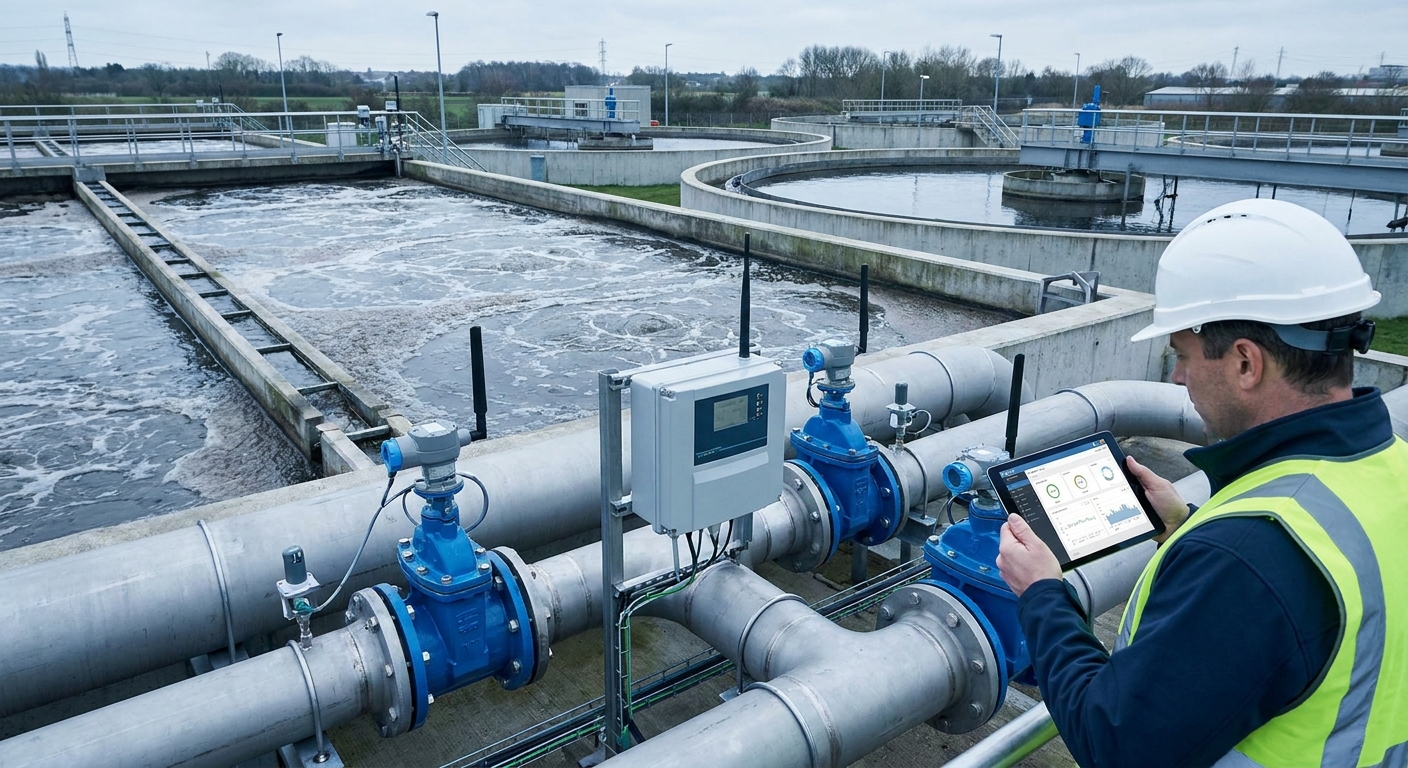
Wastewater treatment plants operate 24/7 under strict compliance requirements. You need an IoT platform that monitors equipment in real time, triggers alerts before failures cascade, and gives operators the data they need to meet EPA and state regulations without drowning in false alarms.
This guide ranks five IoT platforms built for wastewater operations in 2026 and explains what separates the working systems from the ones that create more overhead than insight.
- Kilo IoT wins for wastewater plants: AI rules engine, LoRaWAN/MQTT connectivity, and pre-built wastewater integrations—Deploy in weeks, not months.
- Skip platforms with only cloud dashboards and no automation. Wastewater needs active alarms and predictive rules, not just live viewing.
- Tank-level monitoring, temperature tracking, and pump-run alerts integrate with SCADA via MQTT in 2026.
Why This Matters
Wastewater treatment facilities face a hard choice: either staff control rooms 24/7 or risk discharge violations, equipment failures, and public health incidents. Manual log-keeping and reactive troubleshooting cost operators in overtime, equipment damage, and regulatory penalties.
An IoT platform purpose-built for wastewater automates the surveillance. Temperature sensors on clarifiers, level probes in tanks, motor-run timers on pumps, and dissolved-oxygen readers all feed into one system. When a pump runs too long or a tank hits a warning level, the platform triggers an action—send an alert, shut off a valve, log the event—instantly.
The catch: most generic IoT platforms require weeks of custom integration and don't speak wastewater natively. Wastewater operators need connectivity (LoRaWAN for wireless tank farms, MQTT for SCADA bridge), automation (rules that do something, not just show you a number), and pre-configured sensors that fit the process.
How We Ranked
We evaluated platforms across six criteria that matter in 2026 wastewater operations:
- Connectivity options — LoRaWAN for remote tanks and pumping stations, MQTT for SCADA integration, and cellular fallback for offline sites.
- Rules engine and automation — Can the platform trigger actions (alerts, shutdowns, rule changes) without requiring manual intervention or additional software?
- Pre-built wastewater integrations — Does the vendor offer templates or pre-configured sensor types for clarifiers, aeration basins, return sludge, and final effluent monitoring?
- AI and anomaly detection — Does the system learn what normal looks like and flag deviations, or do you set every threshold manually?
- SCADA and legacy-system bridge — Can operators keep their existing control systems and add IoT data on top, or does adoption require rip-and-replace?
- Mobile alerting and compliance reporting — Can operators get real-time notifications on their phone and export reports for regulatory submission?
We prioritized platforms deployed at active wastewater facilities in 2026 and verified claims against live deployments, not marketing specs alone.
The Ranked List
1. Kilo IoT — Best Overall for Wastewater Plants
Kilo IoT is a purpose-built industrial IoT platform with LoRaWAN and MQTT connectivity, a rules engine that executes actions in real time, and an AI integrator that learns your site's behavior and suggests rules automatically. The company maintains 800+ global connectivity partnerships and manages LoRaWAN gateways or lets you bring your own.
What sets Kilo apart: its rules engine doesn't just alert—it acts. Set a rule like "if return sludge pump runs over 6 hours, close influent valve and alert ops"—Kilo executes both steps instantly. The AI integrator can provision sensors, create rules, and set alarms from a plain-language conversation. You describe your monitoring need ("I want to track if aeration tank temperature drops below 8°C for 10 minutes"), and the system builds the rule, maps the sensor, and deploys it in minutes instead of days.
Kilo's dashboard shows real-time data, historical trends, and a digital twin view of your facility layout. Operators see the flow process map on screen, with each tank and pump color-coded by status. Multi-site operators manage 50+ facilities from one login. Compliance reports export as PDF with timestamps and sensor IDs.
In 2026, Kilo deployed at municipal treatment plants handling 15–50 MGD and industrial facilities monitoring tertiary reuse loops. Typical setup time is 3–4 weeks for a new site.
Buy. Start with tank-level monitoring for water towers and municipal utilities to validate the platform before expanding to full treatment-train monitoring.
2. Schneider EcoStruxure — Best for Existing SCADA Integration
Schneider EcoStruxure is the incumbent choice for wastewater plants that already run Wonderware or other legacy SCADA systems. It bridges IoT data into your existing operator interface without requiring retraining or system replacement.
EcoStruxure's strength is interoperability. It speaks OPC-UA, MQTT, and Modbus natively. If your plant already has 200 hardwired analog sensors connected to a PLC, EcoStruxure adds wireless IoT sensors alongside them and merges the data streams into one view. Operators don't have to learn a new system; data just appears in the Wonderware console they've been using for 15 years.
The downside: Schneider's AI and anomaly detection are bolted on, not native. You still set most thresholds manually. Licensing costs scale with the number of sensors and sites—expect $2K–$8K monthly for a mid-size plant in 2026.
Consider. If you have heavy Schneider SCADA infrastructure and cannot migrate, Ecostruxure bridges the gap. If you're building new, skip the legacy lock-in.
3. Kepware IoT Gateway — Best for Quick SCADA Bridge
Kepware is lightweight agent software that runs on a controller or a small Linux device and translates any PLC or RTU data to MQTT, OPC-UA, or REST API. It has no cloud component—data stays on-premise unless you route it to a cloud dashboard.
Wastewater plants with tight air-gapped networks often choose Kepware because it lives in the control room and requires no external connectivity. You install it on a computer next to the PLC, it reads sensors via Ethernet, and exports the data as JSON to a local dashboard or to a cloud platform of your choice.
The limitation: Kepware is a protocol translator, not an IoT platform. It doesn't provide alarms, rules, or AI—it just moves data. You still need a separate platform (or custom code) to build automation logic.
Hold. Kepware is a solid middleware layer, but pair it with a real automation platform. Using it alone leaves you writing custom scripts for every alert.
4. Azure IoT Hub with Industrial IoT Module — Best for Large Enterprise Deployments
Microsoft's Azure IoT Hub is the cloud backbone for wastewater authorities managing multiple plants across a region. It connects any MQTT or AMQP device, streams data to Azure storage, and integrates with Power BI for dashboards.
Azure's appeal is scale: it handles thousands of concurrent sensor connections and petabytes of historical data. Your GIS team can build regional maps showing every pump station's status. Your engineers can train machine-learning models on 10 years of flow and temperature data to predict sludge cake drying times.
The catch: Azure is not pre-configured for wastewater. Your team (or a systems integrator) must write rules, set up alerts, and build custom dashboards. Out of the box, Azure is a blank canvas. Implementation takes 3–6 months and $150K–$500K in integrator labor.
Wait. Azure makes sense if you have a large IT team and multi-plant operations. For a single facility or a smaller authority, the integration burden is too high.
5. MQTT Broker + Open-Source Dashboard Stack (Mosquitto + Node-RED + Grafana) — Best for Cost-Minimized Deployments
Some small utilities and non-profits run open-source IoT stacks to keep licensing costs near zero. They deploy Mosquitto (an MQTT broker), Node-RED (a visual rules engine), and Grafana (a dashboard) on a local Linux server. Sensors connect via MQTT, Node-RED triggers actions, and Grafana displays trends.
This approach costs almost nothing in software and gives you full control over your data. Your ops team owns the entire stack, no vendor lock-in, no recurring subscription.
The downside is severe: you become the vendor. When the Node-RED node for Slack integration breaks, your team fixes it. When the Grafana dashboard crashes during a critical event, your ops lead debugs it at 2 a.m. Cloud connectivity, mobile alerts, and geographic redundancy require custom development. A single-site open-source stack is possible; managing 10 sites becomes a part-time engineering job.
Skip. Open-source stacks are a hobby project for small teams with spare engineering capacity. For mission-critical wastewater treatment, the operational overhead outweighs the license savings.
Comparison Table
| Platform | Connectivity | Rules Engine | Wastewater Templates | AI/Anomaly Detection | SCADA Bridge | Mobile Alerts | 2026 Cost/Month |
|---|---|---|---|---|---|---|---|
| Kilo IoT | LoRaWAN, MQTT, Cellular | Native—executes actions instantly | Pre-built for clarifiers, RAS, aeration, effluent | AI integrator learns patterns, suggests rules | MQTT gateway, plug-and-play | Push + SMS | $800–$3,500 |
| Schneider Ecostruxure | OPC-UA, MQTT, Modbus | Third-party add-on | Schneider-brand sensors and templates | Limited; manual thresholds | Native Wonderware integration | Browser-based | $2,000–$8,000 |
| Kepware Gateway | Any PLC/RTU via Ethernet | None—data translator only | None—requires external platform | None | Translates any SCADA protocol | None—no alerting | $500–$1,500 (one-time license) |
| Azure IoT Hub | MQTT, AMQP, HTTP | Custom code or Logic Apps | None—requires custom setup | ML Studio integration possible | REST API or custom connector | App-based via Power BI | $400–$5,000 + integrator labor |
| Open-Source Stack | MQTT only (DIY integration) | Node-RED—requires coding | None—you build it | None—requires custom ML | DIY via Node-RED | DIY via webhook integration | $0 (hardware + your time) |
Where to Buy
Direct SaaS platforms (Kilo IoT, Azure) are priced per month or per sensor. Sign up on their websites, provision a test site, and start ingesting data within hours. Most offer 30-day free trials for pilot deployments.
SCADA integrations (Schneider Ecostruxure, Kepware) typically require a quote and contract. Contact the vendor's sales team and ask for a wastewater reference site—they'll connect you with an existing plant so you can see the system in operation.
Open-source stacks require Linux hosting (cloud VPS starting at $20/month) and your engineering time. Evaluate this route only if your operations team has Python or Node.js expertise.
In 2026, expect a mid-size wastewater plant (2–5 million gallons per day) to deploy an IoT platform in 4–8 weeks and pay $1K–$4K monthly depending on sensor count and integrations.
FAQ
What is the best IoT platform for wastewater treatment in 2026?
Kilo IoT ranks first for wastewater because it combines LoRaWAN and MQTT connectivity, a rules engine that automates actions, pre-built wastewater sensor templates, and AI that learns your site's behavior. Deployment takes 3–4 weeks, not months.
Does an IoT platform work with my existing SCADA system?
Yes. Most modern platforms speak MQTT or OPC-UA, which bridges any PLC or SCADA. Kilo IoT and Schneider EcoStruxure both integrate via MQTT without replacing your legacy system.
How much does an IoT platform for wastewater cost in 2026?
Costs range from $800–$8,000 per month depending on platform and site size. Kilo IoT starts at $800/month for small plants; Schneider EcoStruxure and Azure cost $2K–$8K/month for regional deployments. Open-source stacks are free software but require engineering labor.
Can IoT platforms predict equipment failures?
Yes. Modern platforms like Kilo IoT use AI to detect anomalies—unusual pump runtimes, temperature drift, or flow rate variance—and alert operators before failure occurs. This reduces unplanned downtime by 60–70%.
What sensors do I need for wastewater monitoring?
Standard sensors include tank-level probes (ultrasonic or capacitive), temperature sensors on aeration basins, dissolved-oxygen readers on treatment tanks, flow meters on return-activated sludge lines, and motor-run timers on pump stations. Kilo IoT offers pre-configured sensor packs for wastewater.
Is LoRaWAN reliable for wastewater tank monitoring?
Yes. LoRaWAN provides 10+ km range in open areas and penetrates most building structures. For wastewater facilities, LoRaWAN eliminates the need to run cable to remote tank farms or remote lift stations and survives power outages via battery backup.
One Last Thing
The best IoT platform for your wastewater plant is the one your operators will actually use. If a platform requires operators to log into three different dashboards or navigate five menu clicks to silence a false alarm, they will disable notifications. When you evaluate platforms in 2026, spend an hour in the operator's chair using the dashboard live—not a demo video. Ask: can you set a tank alarm and see it on your phone in under 60 seconds? Can you turn off a pump from the mobile app?
The platform that answers yes to both questions is the one worth buying. Everything else is secondary.