
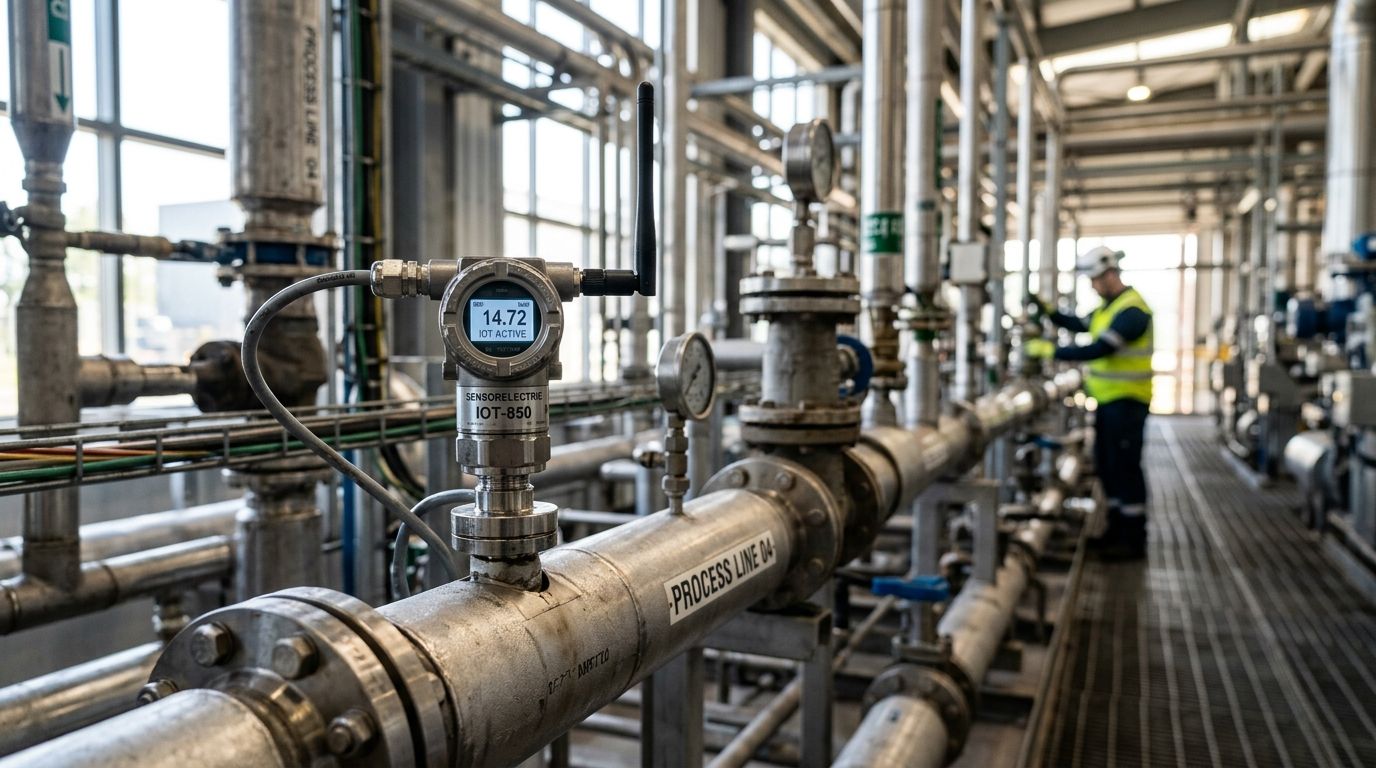
4-20mA/HART wired transmitters are still the safest default for industrial process monitoring in 2026, but LoRaWAN and mioty wireless pressure transmitters now cover retrofits and RF-hostile process areas that a wired loop can't reach economically. This guide ranks the five pressure transmitter types process and facilities teams actually deploy, what each is built for, and where each one falls short.
- 4-20mA/HART wired transmitters are the best overall iot pressure transmitter industrial process pick for sites with existing PLC/SCADA wiring in 2026.
- LoRaWAN wireless pressure transmitters win for retrofits where running new conduit isn't practical.
- mioty wireless transmitters hold up better in RF-shielded, underground or metal-dense process areas.
- ATEX/IECEx-certified units are mandatory, not optional, once a transmitter goes into a classified hazardous zone.
- A rules engine turns any of these transmitters into a pressure alarm, not just a number on a screen.
Why industrial plants are moving pressure transmitters onto IoT networks
Pressure is one of the first variables an operator checks when a process drifts: a stuck relief valve, a fouled filter, or a pump running dry all show up as a pressure reading before they show up as downtime. OSHA's Process Safety Management standard (29 CFR 1910.119) requires documented monitoring instrumentation on processes handling highly hazardous chemicals, and ISA-84 together with IEC 61511 treats pressure transmitters as core inputs to a safety instrumented system, not optional telemetry.
Wiring a 4-20mA loop to every tank, header and compressor on a site gets expensive once you count conduit, junction boxes and PLC I/O cards. That's why plants pair existing wired loops with wireless pressure transmitters over LoRaWAN or mioty, then route everything into one place. The Kilo IoT platform connects 4-20mA loops through an MQTT gateway alongside LoRaWAN and mioty pressure transmitters, so a process engineer isn't running two separate monitoring systems in 2026.
What makes the best IoT pressure transmitter for industrial process monitoring
- Protocol compatibility — native 4-20mA/HART, Modbus RTU, LoRaWAN or mioty, so it fits the wiring already on site instead of forcing a rip-and-replace.
- Environmental and hazardous-area certification — IP66/67 ingress rating as a baseline, ATEX/IECEx for classified zones in oil, gas and chemical processing.
- Wireless range and battery life — matters most once the transmitter moves outside easy wiring reach: a tank farm, rooftop chiller, or remote wellhead.
- Alarm behavior, not just a number on a screen — a reading is only useful if it can trigger an escalation before the process drifts further.
- Calibration and drift management — a transmitter that can't be recalibrated or verified in place turns into a liability after a couple of years in service.
- Fit with the platform doing the dashboarding — the transmitter is half the system; the rules engine and alarm routing on the other end decide whether anyone finds out in time.
Best IoT pressure transmitters compared
| Transmitter type | Best for | Standout feature | Key limitation |
|---|---|---|---|
| 4-20mA/HART wired | Legacy SCADA/PLC integration | Universal analog compatibility, decades of field history | New installs need conduit and PLC I/O |
| LoRaWAN wireless | Retrofits without new wiring | Battery-powered, long range from one gateway | Battery replacement cycle, needs RF site survey |
| mioty wireless | RF-shielded or underground process areas | Telegram splitting improves reception in noisy RF | Fewer transmitter SKUs than LoRaWAN |
| Modbus RTU wired | Direct PLC/BMS integration | Digital reading, multiple points on one RS-485 bus | Still needs a gateway to reach the cloud |
| ATEX/IECEx explosion-proof | Hazardous area process monitoring | Certified for classified Zone/Division areas | Certification adds cost and lead time |
1. 4-20mA/HART pressure transmitters: best IoT pressure transmitter for legacy SCADA and PLC integration
4-20mA current loop transmitters with a HART overlay are the industry default: two wires carry the analog reading and HART carries diagnostics and remote configuration on top of the same loop. Nearly every PLC, DCS and SCADA system already has an analog input card ready for one, and manufacturers like WIKA, Endress+Hauser, Emerson Rosemount and Honeywell all build long-running 4-20mA/HART lines.
4-20mA/HART pros:
- Universal compatibility with existing PLC, DCS and SCADA analog inputs
- HART overlay carries diagnostics and remote configuration over the same two wires
- Mature manufacturer ecosystem with a long track record in the field
- Stable, well-understood failure mode over a long service life
4-20mA/HART cons:
- New installs need conduit, junction boxes and PLC I/O — expensive on a retrofit
- No native wireless option; reaching a cloud dashboard means a gateway in between
- HART diagnostics often go unused without a platform built to parse them
Best for: plants that already have PLC/SCADA infrastructure and want cloud visibility layered on top, not replaced.
Verdict: Buy if wiring already exists or is budgeted — the loop itself won't be the weak link.
2. LoRaWAN wireless pressure transmitters: best IoT pressure transmitter for retrofits without new wiring
LoRaWAN wireless pressure transmitters run on battery power and transmit over a long-range, low-power radio network — 902-928 MHz in the US, 863-870 MHz in the EU — to a gateway that forwards readings to a cloud platform. They skip the conduit run entirely, which is the main cost driver on a wired retrofit.
LoRaWAN pros:
- No new wiring or PLC I/O card required
- Long radio range from a single gateway, often covering an entire site
- Battery-powered units reach tanks, headers and rooftop equipment a wired loop can't reach economically
LoRaWAN cons:
- Battery life depends on transmit interval and needs a replacement plan
- RF coverage still needs a site survey around steel tanks, concrete walls and dense equipment rooms
- Update rates are slower than a hard-wired 4-20mA loop by design
Best for: sites adding pressure monitoring points after the fact, without touching existing conduit runs.
Verdict: Buy for retrofit points; Hold if the site hasn't run a coverage survey yet.
3. mioty wireless pressure transmitters: best IoT pressure transmitter for RF-shielded and underground process areas
mioty uses telegram splitting — a single reading is broken into fragments sent across different frequencies and time slots — which makes it more resilient in high-interference or RF-shielded environments than a single continuous transmission. That matters in dense industrial buildings, underground vaults, or metal-clad process rooms where a straightforward wireless signal degrades. The same mechanism shows up in cleanroom pressure differential monitoring, where metal-lined walls and HVAC ductwork routinely block a typical signal.
mioty pros:
- Telegram splitting improves reliability in high-interference or shielded environments
- Kilo runs an open-source mioty service center (KiloCenter) alongside its built-in network server, so a mioty deployment doesn't need a separate third-party network server layered on top
- Battery life comparable to LoRaWAN in most deployments
mioty cons:
- Fewer transmitter SKUs on the market than LoRaWAN, since the ecosystem is newer
- Fewer integrators carry mioty field experience compared with LoRaWAN
- Still needs a site survey for gateway placement
Best for: underground utility vaults, shielded process rooms, and cleanroom-adjacent areas where LoRaWAN signal struggles.
Verdict: Buy for RF-hostile sites; Skip if a straightforward LoRaWAN deployment already covers the area.
4. Modbus RTU pressure transmitters: best IoT pressure transmitter for direct PLC and BMS integration
Modbus RTU transmitters output a digital reading over RS-485 directly to a PLC, BMS or gateway, avoiding the noise sensitivity an analog 4-20mA loop picks up over long cable runs. Multiple transmitters share one RS-485 bus instead of one home-run cable per point. Sites connecting Modbus PLCs to a cloud IoT dashboard typically run the RS-485 network into a gateway that republishes readings over MQTT.
Modbus RTU pros:
- Digital reading avoids analog signal drift over long cable runs
- Multiple transmitters share one bus, cutting cable count versus one loop per point
- Native fit with most existing BMS and PLC Modbus masters
Modbus RTU cons:
- Still needs a gateway to reach a cloud dashboard — Modbus RTU alone won't get there
- Bus length and device count limits apply, same as any RS-485 network
- Less universal than 4-20mA in older process equipment
Best for: sites standardizing on Modbus for new instrumentation runs, or connecting an existing Modbus network to a cloud platform for the first time.
Verdict: Buy for new Modbus-standardized runs; Hold if the site is still primarily 4-20mA.
5. ATEX/IECEx explosion-proof pressure transmitters: best IoT pressure transmitter for hazardous area process monitoring
In a classified zone — an oil and gas separator, a chemical storage area, a grain handling facility — a pressure transmitter needs ATEX or IECEx certification for the specific zone and gas group before it can go in the field at all. This isn't hardware polish; it's the difference between a legal installation and a fire code violation.
ATEX/IECEx pros:
- Certified for use in classified Zone 0/1/2 or Class I Division 1/2 areas
- Available in both wired 4-20mA/HART and wireless LoRaWAN/mioty variants from certified manufacturers
- Matches the certification auditors and insurers expect on hazardous sites
ATEX/IECEx cons:
- Certification adds cost and lead time versus a general-purpose transmitter
- Fewer wireless SKUs carry hazardous-area certification than wired ones
- Zone and gas group classification has to match exactly — no substituting a Zone 1 unit into a Zone 0 area
Best for: oil and gas, chemical processing, and grain handling sites with classified hazardous areas.
Verdict: Buy only the certified rating your zone classification actually requires — don't over- or under-spec it.
How we ranked the best IoT pressure transmitters for industrial process monitoring
Each type was scored against protocol compatibility, certification requirements, wireless range and battery life, alarm behavior, calibration needs, and fit with the platform running the dashboard and rules engine. Every item owns a distinct use case — legacy SCADA, wireless retrofit, RF-shielded areas, Modbus-standardized sites, or classified hazardous zones — so this reads as a decision tree, not five products competing for the same job.
Which IoT pressure transmitter should you choose for industrial process monitoring?
If you're not sure where to start in 2026, keep any existing 4-20mA/HART loops in place and add LoRaWAN or mioty transmitters at the points that would otherwise need new conduit. Route all of it — wired and wireless — through one platform with rules and alarm escalation, not five separate vendor apps. Kilo's rules engine and five-tier alarm severity model can watch any of these transmitter types and escalate a threshold breach by email, SMS or push before it becomes a shutdown.
See how Kilo connects your pressure transmitters
Wire in 4-20mA, Modbus, LoRaWAN or mioty pressure data in one dashboard.
FAQ
What's the best IoT pressure transmitter for industrial process monitoring in 2026?
A 4-20mA/HART wired transmitter is the safest default for industrial process monitoring in 2026 because it fits existing PLC and SCADA infrastructure. LoRaWAN or mioty wireless transmitters are the better pick for points that would otherwise need new conduit.
Is a wireless pressure transmitter as accurate as a wired 4-20mA/HART unit?
Wireless pressure transmitters use the same sensing elements as wired units, so the difference is in transmission, not accuracy. The real tradeoff is update rate and battery-driven duty cycle, not the pressure reading itself.
Is mioty better than LoRaWAN for industrial pressure monitoring?
mioty's telegram splitting holds up better in RF-shielded, underground or metal-dense process areas where LoRaWAN signal degrades. On an open site with clear line of sight, LoRaWAN's larger transmitter selection usually makes it the simpler choice.
How do IoT pressure transmitters connect to a cloud dashboard?
Wired 4-20mA and Modbus RTU transmitters need a gateway that republishes readings over MQTT, while LoRaWAN and mioty transmitters send readings straight to a network server that forwards them on. Kilo runs both a built-in LoRaWAN/mioty network server and an MQTT connector, so either path lands in the same dashboard.
Do pressure transmitters need ATEX certification for oil and gas sites?
Any transmitter installed in a classified hazardous area needs ATEX or IECEx certification matched to that specific zone and gas group. Installing an uncertified unit in a classified zone is a safety and compliance failure, not just a spec mismatch.
How often do LoRaWAN pressure transmitter batteries need replacing?
Battery life depends on the transmit interval and radio protocol the manufacturer specifies, so check the datasheet for the exact model. Longer reporting intervals extend battery life; frequent reporting on fast-changing processes shortens it.
Can a pressure transmitter trigger an alarm without a full BMS?
Yes — a rules engine watching the incoming reading against a threshold or CEL expression can fire an alarm and escalate it by email, SMS or push without a building management system in between. That's the model behind Kilo's rules engine and alarm severity tiers.
What's the one pressure transmitter spec most facility teams skip checking?
Ingress protection. Buyers compare accuracy classes and output signals in detail, then skip the IP rating entirely. IEC 60529 defines IP66 as dust-tight and protected against powerful water jets, and IP67 as protected against temporary immersion — the difference matters on a washdown line or an outdoor tank farm in a way accuracy class never will. Hardware for any of the transmitter types above, including certified and wireless variants, ships through Kilo Electronics (kiloelectronics.com), the hardware store shipping worldwide alongside the Kilo IoT platform.