
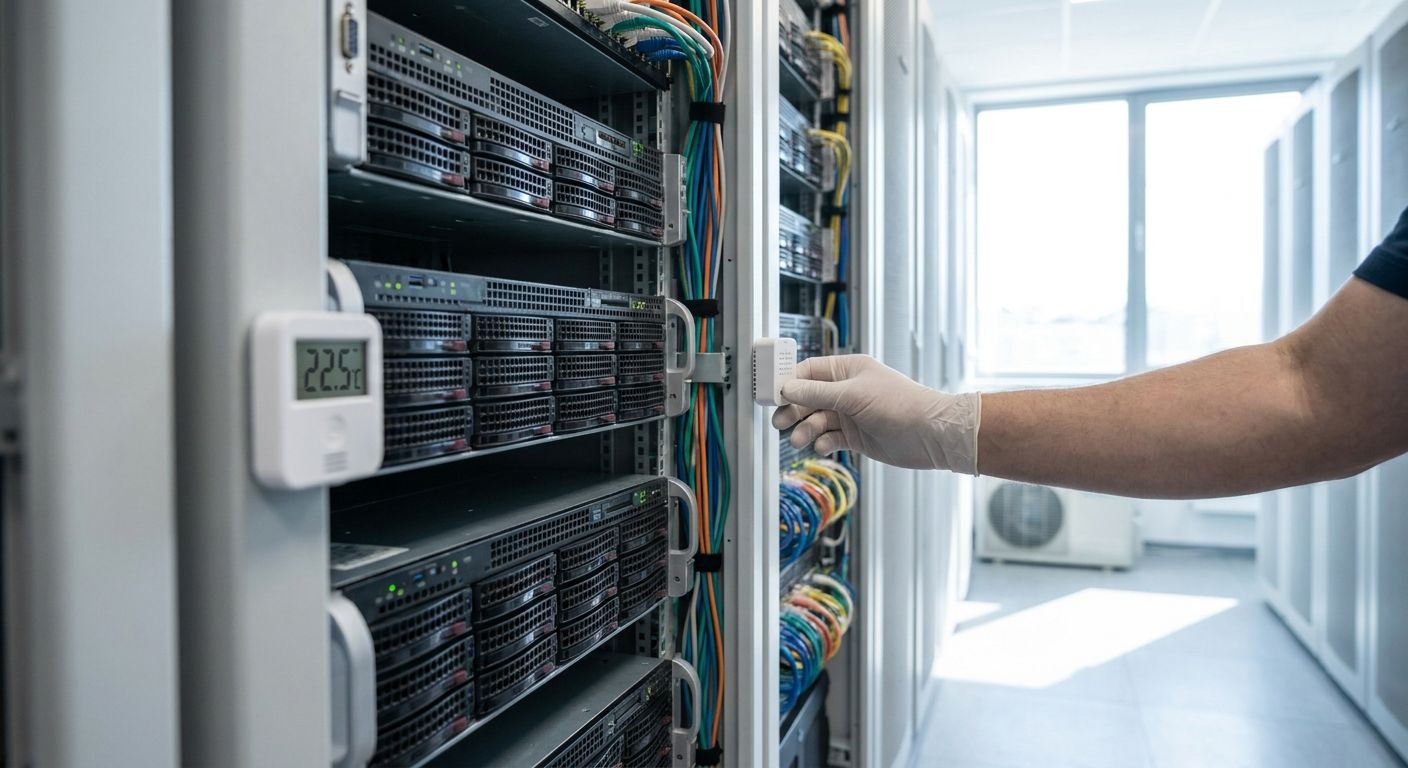
Rack inlet temperature is the number that decides whether hardware throttles or keeps running at full clock speed, and picking data center rack temperature monitoring sensors in 2026 comes down to a connectivity choice more than a brand choice: wireless LoRaWAN, mioty, MQTT-connected PDU probes, or wired BMS extensions.
- Wireless LoRaWAN rack sensors are the default pick for most colo and enterprise floors in 2026 — buy.
- mioty sensors win on RF-dense rows with hundreds of racks where LoRaWAN gateways start dropping packets.
- ASHRAE's allowable range tops out at 32°C for Class A1 hardware — alarm before that line, not after.
- MQTT-connected PDU probes work as a supplement if you already run managed PDUs, not as a standalone strategy.
- Three sensor points per rack — top, middle, bottom — catch the stratification a single sensor misses.
Why rack temperature monitoring matters in a modern data center
ASHRAE's Thermal Guidelines for Data Processing Environments (TC9.9) set a recommended inlet range of 18°C to 27°C and an allowable range of 15°C to 32°C for Class A1 equipment. Cross 32°C at the inlet and you're in the zone where server manufacturers start throttling CPUs to protect the silicon, not where you get a warning label first.
A single hallway sensor or a CRAC unit's return-air reading tells you nothing about what's happening at rack 14, row C, third from the top — where a blocked vent or a failed fan tray can push local inlet temperature past ASHRAE's allowable ceiling while the room average still looks fine. Rack-level sensors close that gap, and a platform like the Kilo IoT Platform turns those readings into an alarm the moment a threshold is crossed instead of a number someone checks once a shift.
That's the difference between a facilities team that finds out about a hot spot from a support ticket and one that finds out from an alarm escalation before hardware starts logging thermal events. The rest of this guide ranks the sensor types that make that possible, not vendor logos.
How these rack temperature sensors were evaluated
Each category below is scored on four things that actually matter on a data center floor: whether it survives a metal-and-concrete RF environment, how it holds up against ASHRAE's inlet thresholds without recalibration drift, what it takes to deploy across a few hundred racks without recabling, and whether it plugs into an alarm and escalation workflow instead of sitting in a spreadsheet.
Sensor types that need a truck roll and conduit for every rack lose points against ones that go up with a screwdriver and a battery. Connectivity gets weighed against the physical reality of a data hall: dense steel racking, cable trays, and rows of equipment that absorb RF signal the way an open warehouse doesn't. That's why LoRaWAN and mioty show up differently on this list than they would in an outdoor deployment.
Best IoT sensors for data center rack temperature monitoring, ranked
The default pick: wireless LoRaWAN rack sensors
A battery-powered LoRaWAN temperature and humidity sensor mounted at rack inlet is the standard answer for most colo and enterprise floors in 2026. One gateway typically covers a full data hall, and a sensor placed at each of the three ASHRAE-recommended heights — top, middle, bottom — catches stratification that a single mid-rack reading misses entirely.
LoRaWAN's long-range, low-power design means multi-year battery life on a reading interval tight enough to catch a fast thermal event, and no cabling run per rack. On the Kilo IoT Platform, each sensor gets its own digital twin, so a facilities engineer can see rack 14's inlet trend against rack 15's without building a custom dashboard. Buy.
The dense-floor option: mioty sensors
mioty uses telegram splitting — breaking each payload into sub-packets sent across different frequencies and times — which makes it noticeably more resilient in RF-congested environments than standard LoRaWAN, a real advantage on floors with hundreds of racks and heavy metal shielding. That resilience matters more as rack density climbs and gateway load per square foot grows.
It's a smaller ecosystem than LoRaWAN as of 2026, so sensor selection is narrower, but for facilities running dense rows where LoRaWAN sensors start showing missed uplinks, mioty is worth testing. Kilo runs a built-in mioty network server alongside LoRaWAN, so mixing both on one platform doesn't mean running two separate backends. Buy for high-density rows, consider elsewhere.
The point check: MQTT-connected PDU probes
Intelligent rack PDUs increasingly ship with onboard temperature probes that publish over MQTT alongside power draw data. If a rack is already on a managed PDU, pulling its temperature channel into the same platform as your wireless sensors is close to free — no extra hardware, no extra battery to track.
The catch: PDU probes are usually one sensor per rack, mounted wherever the PDU happens to sit, not at the three ASHRAE-recommended heights. Treat this as a supplement to dedicated inlet sensors, not a replacement. Consider as a secondary data source, not a standalone plan.
The airflow blind spot: differential pressure and hot/cold aisle sensors
Temperature alone doesn't tell you why a rack is running hot — a failed containment seal or a mis-set floor tile can starve cold-aisle pressure without tripping a temperature alarm until it's already too late. A differential pressure sensor across the containment barrier catches that failure mode directly.
These sensors are less common in smaller deployments because the payoff scales with aisle containment maturity — a facility without hot/cold aisle separation gets little from one. Where containment exists, pairing pressure sensors with rack temperature sensors on one rules engine closes a gap that temperature-only monitoring leaves open. Consider if you run aisle containment; skip otherwise.
The cabinet-level combo: door contact plus temperature
A combined door-contact and temperature sensor on a locked cabinet does two jobs with one device: it flags unauthorized access and it reads inlet temperature inside an enclosed cabinet, which often runs hotter than open racks because of restricted airflow. For colocation cages and secure enclosures, that combination is worth the marginal cost over a temperature-only unit.
The tradeoff is placement — a combo sensor mounted for door coverage isn't always at the optimal thermal reading point, so dedicated inlet sensors still matter inside dense cabinets. Buy for secured cabinets and colo cages.
The legacy holdover: wired BMS probes
Analog 4-20mA probes wired into an existing building management system still show up in older data centers built before wireless sensor networks were standard. They work, and if the wiring is already in the walls, ripping it out has no upside.
The problem is scale: adding coverage to new racks means pulling new cable runs, which is slow and expensive compared to sticking up a wireless sensor. Facilities extending an existing BMS onto a dashboard without a dedicated BMS deployment for every new rack usually find wireless faster to scale from here. Hold what's wired, don't build more of it.
Data center rack sensor comparison
| Sensor type | Connectivity | Best for | Verdict |
|---|---|---|---|
| Wireless rack temp/humidity | LoRaWAN | Most colo and enterprise racks | Buy |
| mioty temperature sensor | mioty | RF-dense rows, hundreds of racks | Buy for dense floors |
| Intelligent PDU probe | MQTT | Racks already on managed PDUs | Consider (secondary) |
| Differential pressure sensor | LoRaWAN or wired | Hot/cold aisle containment | Consider if containment exists |
| Door contact + temp combo | LoRaWAN | Locked cabinets, colo cages | Buy |
| Wired BMS probe extension | Wired 4-20mA | Legacy buildings, existing runs | Hold |
“If any of the three inlet points on a rack crosses 32°C, that's an urgent alarm, not a line in a weekly report.”
Where to buy data center rack temperature sensors
Buy sensors that support the protocol your gateway already runs, not the other way around — mixing LoRaWAN and mioty gateways after the fact costs more than picking one primary standard up front. Kilo runs both a LoRaWAN and mioty network server built into the platform, so hardware choice doesn't force a second backend.
Check battery-life specs against your reading interval before buying in bulk — a sensor rated for a slow outdoor reporting interval won't hold the same battery life at the tighter polling rate a data hall needs. Preconfigured LoRaWAN and mioty temperature sensors, along with gateways, ship worldwide through Kilo Electronics, Kilo's hardware sister company.
Match sensor count to ASHRAE's three-point recommendation per rack before comparing unit price — a cheaper sensor bought in triple the quantity often costs more than fewer, better-placed units on a platform that already handles alarm routing.
See rack sensor data on one dashboard
Free tier covers up to 5 devices and 1 rule, no card required.
FAQ
What is the best sensor for data center rack temperature monitoring in 2026?
A wireless LoRaWAN temperature and humidity sensor mounted at rack inlet is the most common choice in 2026 because it needs no cabling and covers a full data hall from one gateway. mioty sensors are the better fit on RF-dense floors with hundreds of racks.
How many temperature sensors does a rack need?
ASHRAE's Thermal Guidelines for Data Processing Environments recommend three sensor points per rack — top, middle, and bottom — because heat stratifies unevenly and a single mid-rack reading misses hot spots near the top or bottom.
What temperature range should a data center rack stay within?
ASHRAE TC9.9 sets a recommended inlet range of 18°C to 27°C and an allowable range of 15°C to 32°C for Class A1 equipment. Crossing the allowable ceiling is where server hardware typically starts thermal throttling.
Is LoRaWAN reliable inside a data center with metal racks?
Yes for most floors, though dense rows of steel racking absorb signal more than an open warehouse does. Facilities running hundreds of racks in tight rows often see fewer missed uplinks with mioty, which splits each transmission across multiple frequencies and time slots.
Can mioty sensors work better than LoRaWAN in a colocation facility?
On RF-congested floors with high rack density, mioty's telegram-splitting design holds up better than standard LoRaWAN. For lower-density floors, LoRaWAN's larger sensor ecosystem usually wins on cost and selection.
Do rack temperature sensors need a dedicated BMS?
No. Wireless LoRaWAN and mioty sensors report directly to a cloud platform without touching an existing building management system, which is why they're the faster path for facilities adding coverage to racks a legacy BMS never reached.
What happens when a rack temperature sensor detects a threshold breach?
On the Kilo IoT Platform, a rule built on the reading fires an alarm with one of five severity tiers and escalates through email, SMS, or push until someone acknowledges it, instead of just logging the event.
How much does data center rack temperature monitoring cost?
Platform cost varies by device count — Kilo's free tier covers up to 5 devices and 1 rule with no card required, and the Starter tier is 25 EUR per month for up to 25 devices. Sensor hardware pricing varies by protocol and is set by the hardware vendor, such as Kilo Electronics.
The rack sensor detail most facilities miss
Most teams buy the sensor and skip the escalation chain — a rack inlet alarm that only emails one person on a laptop at 2 a.m. isn't monitoring, it's a delayed log entry. Set a multi-step escalation on any threshold tied to ASHRAE's 32°C allowable ceiling, so a missed first alert still reaches someone in 2026's on-call rotation before the hardware does.
The other detail that gets skipped: placing sensors at all three ASHRAE heights instead of one mid-rack unit to save money. A rack that reads fine at the middle can still be pushing 33°C at the top third, and that's the reading that gets missed until a server logs a thermal event on its own.