
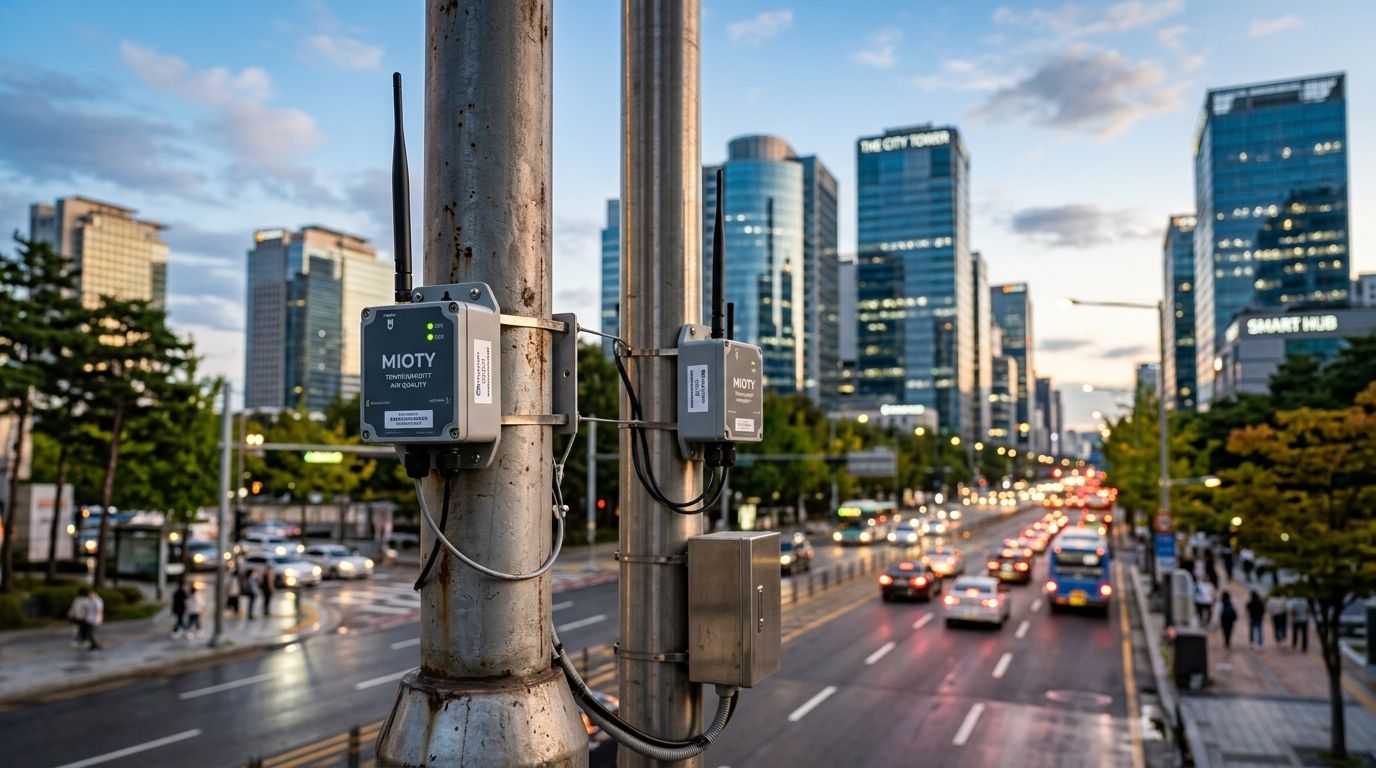
Smart city program managers pick mioty sensors for one specific reason: telegram splitting keeps a signal alive through the RF noise of a downtown intersection or a buried utility vault where LoRaWAN packets get dropped. This guide ranks the six mioty sensor categories that actually carry smart city infrastructure monitoring in 2026 — tank and water-tower level, air quality, ambient noise, streetlight control, parking occupancy, and structural vibration — and tells you which one to deploy first.
Best overall: ultrasonic tank-level sensors for municipal water infrastructure. Best for public reporting programs: air quality sensors. Best for existing pole networks: streetlight control sensors.
- Ultrasonic tank-level mioty sensors rank best overall for municipal water infrastructure monitoring in 2026.
- Mioty sensors outperform LoRaWAN in RF-dense downtown cores because telegram splitting resists interference, per ETSI TS 103 357.
- Air quality mioty sensors suit public reporting programs; vibration sensors suit bridge and structural monitoring between inspections.
- Kilo runs mioty and LoRaWAN network servers natively, so a separate mioty service center install isn't required to start.
- Streetlight control and parking occupancy sensors round out a phased mioty sensors smart city rollout after water and air.
Why mioty sensors fit dense smart city infrastructure monitoring
A downtown core is a hostile RF environment: steel-frame buildings, hundreds of competing 2.4 GHz devices, and utility vaults sitting under a foot of concrete and rebar. Mioty was built for exactly that scenario. Telegram splitting breaks each uplink into dozens of sub-packets sent across different frequencies and time slots, so a receiver can reconstruct the message even if several sub-packets collide or get jammed. That mechanic is standardized under ETSI TS 103 357, the Low Throughput Network standard mioty implements — it's not a marketing claim, it's the protocol spec.
Public works directors, utility SCADA engineers, and smart city program managers care about this because their sensors sit in the worst spots on purpose: inside a water tower vault, bolted to a streetlight pole next to a transit antenna, or buried at curb level under passing traffic. Kilo runs both mioty and LoRaWAN network servers natively inside the Kilo IoT Platform, so there's no separate mioty network server to stand up before a single sensor reports data. Teams who'd rather self-host their own mioty service center instead can run KiloCenter, Kilo's open-source option, and still land readings on the same dashboards.
What makes the best mioty sensor for smart city infrastructure monitoring
- Interference resistance in RF-congested urban cores — telegram splitting under ETSI TS 103 357, not just a higher transmit power
- Battery life rated for pole-mounted or below-grade installs that can't be serviced on a monthly truck roll
- IP66/IP67 outdoor rating and a wide operating temperature range for exposed street furniture
- Uplink payload and reporting interval matched to the use case — a parking sensor that only reports on state change vs. a tank sensor polling hourly
- Base station and gateway density planned for the coverage area, not assumed from a residential-scale deployment
- Standard MQTT or API export so readings land on a dashboard without custom firmware work
Mioty sensors for smart city infrastructure at a glance
| Sensor category | Best for | Standout feature | Key limitation |
|---|---|---|---|
| Ultrasonic/radar tank-level | Water towers & municipal utilities | Non-contact reading through vault covers | Needs stable mounting geometry for accurate returns |
| Air quality (PM2.5/NO2/CO) | Public air quality reporting | Multi-pollutant sensing on one uplink | Needs periodic calibration against a reference station |
| Acoustic/noise level | Urban noise compliance monitoring | Continuous dB(A) logging without a wired mic run | Wind and rain can skew raw readings |
| Streetlight control & energy | Streetlight networks | Per-fixture fault and energy reporting | Retrofit cost scales with pole count |
| Parking occupancy / curb | Smart parking & curb management | In-ground or surface magnetometer detection | Recessed or underground parking can shadow the signal |
| Vibration / structural | Bridge & infrastructure monitoring | High-frequency sampling batched into periodic uplinks | Flags anomalies; doesn't diagnose them |
1. Ultrasonic tank-level sensors: best mioty sensor for municipal water infrastructure
The sensor mounts above a water tower, reservoir or lift-station wet well and sends an ultrasonic or radar level reading over mioty on a fixed interval.
Ultrasonic tank-level sensor pros:
- Non-contact measurement, so nothing sits in the water column to foul or corrode
- Reads through concrete vault covers and steel tank walls where LoRaWAN struggles
- Low duty cycle keeps battery draw down since level only needs a few reads per hour
Ultrasonic tank-level sensor cons:
- Foam or turbulence at the surface can throw off a single reading
- Needs a clear vertical path down the tank — obstructions inside the vessel skew results
Best for: public works departments running water towers, lift stations and reservoirs across multiple sites. Verdict: Buy as the first mioty deployment in a smart city rollout — it's the least ambiguous reading to alarm on.
2. Air quality sensors: best mioty sensor for public air quality reporting
A single unit measures multiple pollutants — commonly PM2.5, PM10 and NO2 — and reports them together over one mioty uplink, extending coverage beyond a city's fixed EPA-grade reference monitors.
Air quality sensor pros:
- One device covers several pollutants instead of requiring separate hardware per parameter
- Fills gaps between a city's official EPA National Ambient Air Quality Standards (NAAQS) reference stations
- Low-cost enough to deploy at neighborhood density rather than one station per district
Air quality sensor cons:
- Optical particulate sensors drift and need periodic calibration against a reference instrument
- Humidity and dust both introduce measurement error if not corrected in firmware
Best for: cities running a community air quality program on top of a single EPA reference station. Verdict: Buy for supplemental coverage; Wait if there's no budget for an ongoing calibration cycle.
3. Acoustic/noise level sensors: best mioty sensor for urban noise compliance monitoring
The sensor logs continuous dB(A) at a fixed point — a construction perimeter, a nightlife corridor, a highway edge — following the measurement approach set out in the ISO 1996 series for environmental noise.
Noise sensor pros:
- Replaces manual sound-meter site visits with a continuous, time-stamped record
- Builds a defensible log for a noise ordinance complaint or a construction permit condition
- Covers overnight hours when no inspector is on site
Noise sensor cons:
- Wind and rain noise contaminate raw dB readings without wind-screening or filtering
- Mounting height and nearby reflective surfaces change the result, so placement matters
Best for: code enforcement and environmental compliance teams handling recurring noise complaints. Verdict: Buy for any corridor with an active noise ordinance; Hold for one-off events where a temporary meter is cheaper.
4. Streetlight control and energy sensors: best mioty sensor for smart streetlight networks
A per-fixture sensor and controller reports lamp status, energy draw and photocell faults over mioty, feeding a rules engine that raises an alarm on failure instead of waiting for a resident complaint. Full coverage patterns for smart streetlight networks usually run alongside this sensor category.
Streetlight sensor pros:
- Catches a burned-out or flickering fixture immediately instead of on the next patrol
- Per-fixture energy data supports utility rebate and demand-reduction reporting
- Retrofits onto existing pole hardware without rewiring the circuit
Streetlight sensor cons:
- Retrofit cost scales linearly with pole count across a corridor
- Controller firmware update cycles vary by manufacturer and aren't always synchronized
Best for: public works and utility departments already running a mioty or LoRaWAN base station along the corridor. Verdict: Buy where base station coverage already exists; Wait if it means building coverage from zero for lighting alone.
5. Parking occupancy and curb sensors: best mioty sensor for smart parking and curb management
An in-ground or surface-mount magnetometer detects a vehicle in a stall or curb zone and reports the state change over mioty to a parking guidance app or enforcement dashboard.
Parking sensor pros:
- Real-time occupancy feeds a public parking guidance app directly
- Curb-zone data supports loading-zone and ride-share enforcement
- Reports only on state change, which keeps uplink volume and battery draw low
Parking sensor cons:
- Dense underground garages or recessed curb cuts can create RF shadowing that needs a repeater
- Metal vehicle density above the sensor can affect detection accuracy in tight stalls
Best for: transportation departments managing metered parking and curb allocation. Verdict: Buy for open-air lots and street parking; Wait on underground garages until a signal survey confirms coverage.
6. Vibration and structural sensors: best mioty sensor for bridge and infrastructure vibration monitoring
An accelerometer-based sensor samples locally at high frequency and batches statistical summaries — peak, RMS, dominant frequency band — into periodic mioty uplinks instead of streaming raw waveform data.
Vibration sensor pros:
- Catches abnormal vibration signatures on bridges and elevated structures between formal inspection cycles
- Works on structures where running a wired sensor network isn't practical or cost-effective
- Low uplink volume keeps a battery-powered install viable for years of unattended service
Vibration sensor cons:
- Raw vibration data still needs a structural engineer's read — the sensor flags an anomaly, it doesn't diagnose the cause
- Alarm thresholds need tuning per structure, not a generic default
Best for: bridge authorities and public works departments running instrumented structural health programs alongside scheduled inspections. Verdict: Buy as a monitoring layer between inspections; it doesn't replace the inspection itself.
“The sensor flags the anomaly; a structural engineer still has to read it.”
How these mioty sensor picks were ranked
Every category above was scored against the six criteria listed earlier: interference resistance under ETSI TS 103 357, battery life for hard-to-reach mounts, outdoor IP rating, payload fit for the use case, base station density planning, and standard data export. A sensor that scored well on interference resistance but needed frequent battery swaps in a below-grade vault — like an early acoustic unit tested without wind-screening — dropped in ranking even if the core measurement was accurate.
Mioty gateway placement is worth planning before ordering sensors, not after: see the guide on mioty gateways for industrial IoT deployments for base station density math that applies just as directly to a city block as a factory floor. Sensor hardware itself, including mioty devices for these categories, ships through Kilo Electronics, Kilo's hardware partner, with worldwide shipping.
Which mioty sensor should a smart city deploy first in 2026?
Start with ultrasonic tank-level sensors if the city runs its own water utility — the reading is unambiguous, the RF environment (vault, concrete, steel) is exactly what mioty was designed for, and a single alarm threshold (tank below 20%, tank above overflow) proves the platform works before expanding. If lighting is the political priority, streetlight control sensors are the next-cheapest win where base station coverage already reaches the corridor. Air quality, noise, parking and vibration sensors each earn their place in a phased rollout, but none of them beat water infrastructure for a first proof point in 2026.
FAQ
What are mioty sensors used for in smart city infrastructure?
Mioty sensors monitor water tower levels, air quality, ambient noise, streetlight status, parking occupancy and structural vibration across a city. They're chosen for spots with heavy RF interference, like downtown cores or below-grade utility vaults.
Is mioty better than LoRaWAN for smart city networks?
Mioty holds up better in RF-congested environments because telegram splitting under ETSI TS 103 357 resists interference and collisions. LoRaWAN still works well in lower-density outdoor areas, and many cities run both protocols side by side.
Do mioty sensors work underground or in utility vaults?
Yes — mioty's telegram splitting is designed to get a signal through concrete, steel and RF noise that would drop a standard LoRaWAN packet. Coverage still depends on base station placement, so a signal survey before rollout matters.
Does mioty require a separate network server?
Not on the Kilo IoT Platform — mioty and LoRaWAN network servers run natively inside Kilo Cloud, so there's no external server to deploy. Teams that want to self-host instead can run KiloCenter, Kilo's open-source mioty service center.
Can mioty and LoRaWAN sensors run on the same platform?
Yes. A city can mix mioty in RF-hostile spots and LoRaWAN where gateway costs matter more, and both feed the same dashboards and alarms without separate systems.
What is a mioty base station and how many does a city need?
A mioty base station receives uplinks from every sensor in its coverage radius; the count a city needs depends on terrain, building density and how many sensors are packed into the area. A signal survey before full rollout is the standard way to size this.
How are mioty sensor readings turned into alerts?
Readings feed a rules engine that compares each value against a threshold or condition and fires an alarm through email, SMS or push when it's crossed. On the Kilo IoT Platform this runs through a visual rules engine with escalation chains and severity tiers.
What is telegram splitting and why does it matter for smart cities?
Telegram splitting fragments a single mioty message into many sub-packets sent across different frequencies and time slots, so the receiver can reconstruct the message even if some sub-packets collide. It's the mechanic that makes mioty resilient in RF-dense urban environments, standardized under ETSI TS 103 357.
Does a city need a private mioty network or can it share gateways with LoRaWAN?
A city doesn't have to pick one protocol network-wide. Mioty and LoRaWAN can run on separate base stations covering different zones — mioty in the RF-hostile spots like vaults and downtown cores, LoRaWAN in lower-density outdoor areas where gateway costs matter more — and both still land on one set of dashboards and alarms rather than two disconnected systems. That's the practical shape most 2026 smart city rollouts actually take: not an all-mioty or all-LoRaWAN decision, but a protocol chosen per deployment zone based on what that zone's RF environment actually demands.
See mioty and LoRaWAN on one dashboard
Check how Kilo Cloud runs both network servers natively before planning gateway counts.