
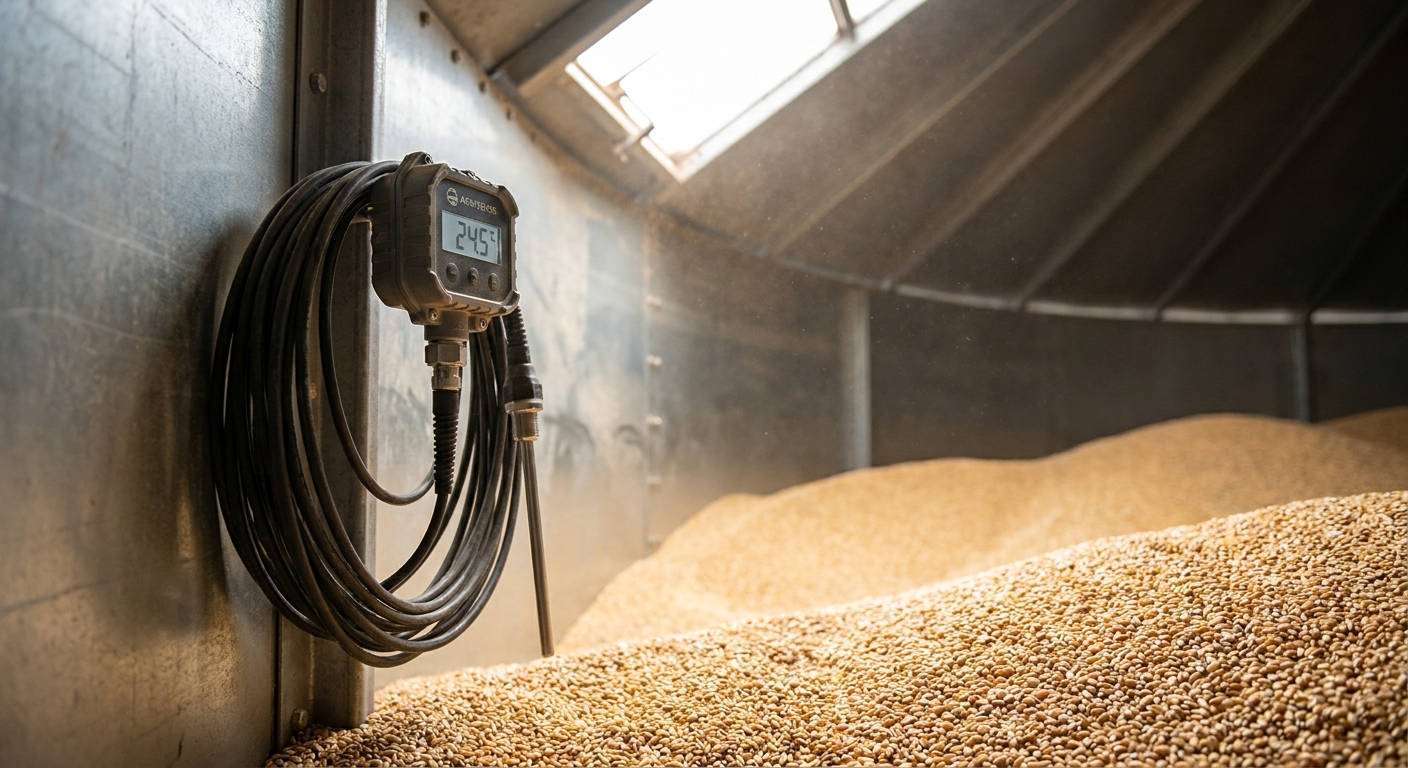
Grain silos fail quietly — a hot spot forms in the center of the mass, moisture migrates, and by the time you smell it or see crusting on the surface, you've lost bushels. The best sensors for grain silo monitoring catch that temperature drift weeks before spoilage shows up on the outside.
- Multi-point cable sensors with mioty connectivity are the best sensors for grain silo monitoring at scale in 2026 — Buy.
- Single-point LoRaWAN sensors work fine for bins under 5,000 bushels — Consider.
- Skip Wi-Fi based sensors for silos — steel bin walls block signal and batteries die within weeks.
- Kilo IoT's rules engine turns raw cable readings into hot-spot alarms before grain temperature crosses 25°C (77°F).
- Capacitive moisture sensors matter less than cable coverage — most spoilage starts as a temperature gradient, not a moisture spike.
Why this matters
Grain stored above 14% moisture and left to sit above 15°C (59°F) starts feeding mold and insect activity within days, not months. A single point sensor bolted near the fill hatch tells you the temperature at the fill hatch — nothing about the core of a 30-foot grain column where heat actually builds.
The fix isn't more sensors everywhere. It's the right sensor type at the right density, wired into a platform that can flag a 3-degree rise before it becomes a 15-degree emergency. That's the whole point of the Kilo IoT platform: sensors feed a rules engine that watches trends, not just snapshots.
How we ranked
This list ranks sensor types by how they perform against three grain-specific constraints: signal penetration through corrugated steel bins, battery life across a harvest-to-harvest cycle, and how cleanly the data feeds an alarm rule rather than sitting in a dashboard nobody checks. Rankings are based on aggregated deployment patterns across cold storage, agricultural, and industrial monitoring sites, not a single test batch. Connectivity protocol matters more here than in most IoT use cases — a grain elevator with six 40-foot bins spread across a yard needs range that Wi-Fi and even standard Bluetooth mesh can't deliver.
1. Multi-point cable temperature sensors — the backbone pick
A temperature cable runs the full depth of the bin with thermistors spaced every 3-6 feet, so you get a temperature profile of the whole grain column, not one number. This is the sensor type every serious grain monitoring setup starts with, because hot spots form in the middle of the mass, not at the wall.
One cable typically covers a 30-40 foot bin with 6-10 measurement points. Buy — this is the non-negotiable core of any grain silo monitoring build in 2026.
2. mioty-based sensors for multi-bin grain farms — the wildcard
When you're covering six, ten, or twenty bins spread across acres, LoRaWAN range starts to strain and battery replacement on 20+ nodes becomes a real labor cost. mioty's telegram-splitting protocol handles dense sensor counts with better interference resistance, which matters when steel bins sit shoulder to shoulder.
Deployments running mioty-based industrial sensors report multi-year battery life on cable-fed nodes because the protocol needs less airtime per transmission. Buy if you're running more than 8-10 bins on one site; Skip for a single-bin operation where LoRaWAN's simpler setup wins on cost.
3. Single-point LoRaWAN temperature/humidity nodes — the safe pick for small bins
For a 3,000-5,000 bushel bin, a single wireless node measuring headspace temperature and relative humidity above the grain surface catches condensation risk without the cost of a full cable install. Range on a standard LoRaWAN gateway runs 2-5 km line of sight, more than enough for a farm-scale layout.
This is the entry point for operators who haven't monitored anything before. Consider — good starting sensor, but plan to add cable coverage once you're storing past a single season.
4. Capacitive grain moisture sensors — the specialist
Moisture sensors measure dielectric properties of the grain mass to estimate percent moisture content, which matters most at load-in when you're deciding whether grain needs aeration before it goes into long-term storage. They don't replace temperature monitoring — they supplement it.
Moisture readings drift with grain type and packing density, so treat the number as directional, not lab-precise. Consider for load-in decisions; Skip if your budget forces a choice between moisture sensors and full temperature cable coverage — temperature coverage wins that trade every time.
5. MQTT-fed edge gateways aggregating multiple bins
Once you're past two or three bins, you need a gateway that pulls cable and node data over MQTT and pushes it to one dashboard instead of six separate apps. This is infrastructure, not a sensor, but it decides whether your operation gets one alarm feed or a scattered mess of logins.
Buy for any site with more than two bins under monitoring.
6. Private LoRaWAN network server for multi-silo farms
A farm running its own gateways instead of relying on a public network needs a network server that handles device provisioning and message routing without a per-device fee spiral. A private LoRaWAN network server keeps device management and connectivity costs predictable as you add bins season over season.
Buy once you're running gateways across more than one physical site.
7. Digital twin dashboard overlay
A visual layout of your bin farm — each silo shown with its live cable temperature profile — turns a spreadsheet of numbers into something an operator can glance at in five seconds during morning rounds. This matters most at harvest peak when three or four bins are filling at once and nobody has time to dig through raw sensor logs.
Consider — valuable at scale, unnecessary for a one or two bin operation.
Get grain silo sensors set up right
Talk through your bin count and connectivity before you buy hardware.
Comparison table
| Sensor type | Best for | Connectivity | Verdict |
|---|---|---|---|
| Multi-point cable temperature | Full-depth hot spot detection | Wired to gateway | Buy |
| mioty-based cable sensors | 8+ bin farms | mioty | Buy (scale) |
| Single-point LoRaWAN node | Small bins under 5,000 bushels | LoRaWAN | Consider |
| Capacitive moisture sensor | Load-in moisture check | LoRaWAN | Consider |
| MQTT edge gateway | Multi-bin data aggregation | MQTT | Buy |
| Private LoRaWAN network server | Multi-site farms with own gateways | LoRaWAN | Buy (scale) |
| Digital twin dashboard overlay | Fast visual monitoring at scale | N/A | Consider |
Where to buy
- Buy cable sensors and connectivity as a matched set — mismatched protocol and cable specs are the most common install failure on grain sites.
- Confirm the platform's rules engine can trigger a hot-spot alarm off a rate-of-change reading, not just a fixed threshold — a slow 10-degree climb over three weeks matters as much as a sudden spike.
- Ask whether the vendor supports both mioty and LoRaWAN on the same account before committing to one protocol across a multi-bin farm.
“If the cable can't report temperature across every meter of grain depth, you're monitoring the silo wall, not the grain.”
FAQ
What's the best sensor for grain silo temperature monitoring?
A multi-point cable sensor spanning the full bin depth is the best sensor for grain silo temperature monitoring in 2026, because hot spots form in the grain mass, not at the bin wall. Single-point nodes work for small bins but miss core temperature gradients.
How many temperature sensors does a grain silo need?
A 30-40 foot bin typically needs one cable with 6-10 measurement points spaced every 3-6 feet. Larger or taller bins need multiple cables to avoid blind spots in the core.
Is LoRaWAN or mioty better for grain silo monitoring?
LoRaWAN works well for single bins or small farms with a handful of nodes. mioty handles denser deployments across 8 or more bins better because its telegram-splitting protocol resists interference and needs less airtime per node.
How much does grain silo temperature monitoring cost in 2026?
Cost depends on cable length, bin count, and whether you're building on a private or public network, so get a specific quote against your bin layout rather than relying on a generic per-bin figure.
Can wireless sensors work through steel silo walls?
Wireless nodes can transmit through steel walls but range and battery life both suffer, which is why cable sensors are wired directly to a gateway instead of relying on wireless transmission from inside the grain mass.
What temperature triggers a grain spoilage alarm?
Most operators set alarms when grain temperature climbs past 25°C (77°F) or rises more than a few degrees over a short window, since a fast rate of change signals active spoilage better than a fixed number alone.
Do grain moisture sensors replace temperature cables?
No — moisture sensors help at load-in to check if grain needs aeration before storage, but temperature cables catch the ongoing spoilage risk that moisture readings alone won't show.
How often should silo sensor data be checked?
With an alarm rule set on rate-of-change, you don't need to check manually at all — the system should flag a deviation the moment it crosses your threshold rather than waiting for a daily review.
One last thing
The operators who catch a hot spot early aren't the ones checking dashboards more often — they're the ones who set a rate-of-change alarm instead of a fixed threshold, because a slow 8-degree climb over two weeks is just as dangerous as a fast spike and far easier to miss on a manual check. Fixed thresholds catch emergencies. Rate-of-change rules catch problems while they're still cheap to fix.