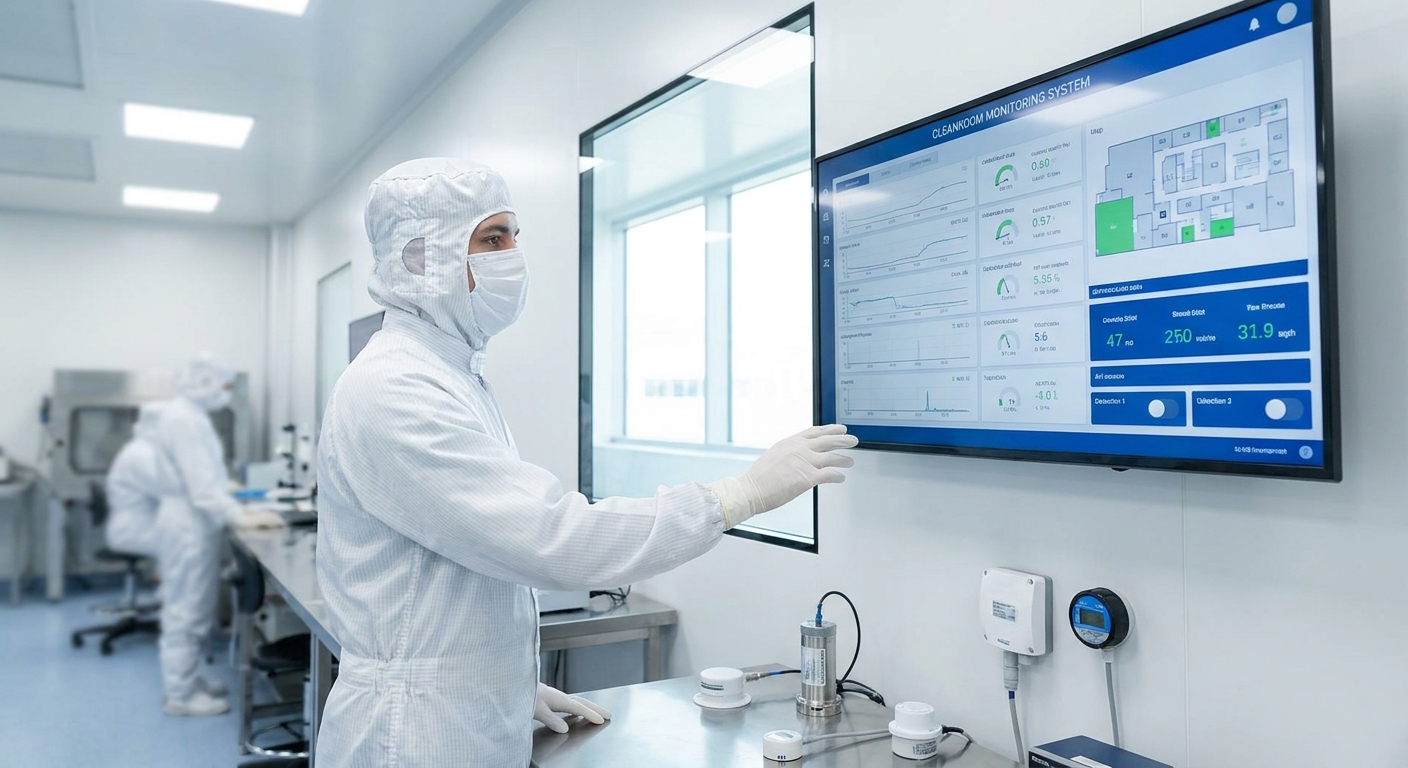
A facility monitoring system for cleanroom environments has to catch a differential pressure drop before it shows up as a failed particle count, not after. That means continuous data across temperature, humidity, pressure, and connectivity that still works inside a steel-walled, HEPA-filtered suite.
- Kilo Cloud's dashboard and AI rules engine is the Buy pick for a facility monitoring system for cleanroom environments running multiple suites in 2026.
- mioty connectivity is the Consider pick for RF-dense rooms where LoRaWAN signal drops behind metal and HEPA housings.
- Digital building twin views earn a Consider verdict for multi-room pressure mapping, not a standalone Buy.
- Zone-level humidity thresholds are a Buy for suites running ISO 7 and ISO 8 side by side.
- Generic WiFi smart-home sensors are a Skip — they weren't built for continuous audit-grade logging.
Who this is for
This guide is for facilities and validation teams running ISO-classified cleanrooms — pharma fill-finish lines, semiconductor fabs, medical device assembly, or biotech suites — who need continuous readings on temperature, humidity, differential pressure, and particle-relevant conditions instead of walkthrough logs on a clipboard. If your current setup is a data logger someone downloads once a week, you're the buyer this article is written for.
Why this matters
A cleanroom out of spec for even a few minutes can void a batch. Differential pressure between an ISO 7 gowning room and an ISO 5 suite typically needs to hold between 0.03 and 0.08 inches of water column, and a door left open too long or a failing HVAC damper can collapse that gradient in under 10 minutes. Spot checks every few hours don't catch that. A Kilo IoT deployment reads sensors continuously and fires an alarm the moment a threshold is crossed, not the next time someone walks the floor.
Temperature and humidity tolerances are usually tight too — often 20°C ± 2°C and 45–55% RH depending on the process — and both drift faster than most facilities teams assume once an air handler starts underperforming.
What to look for in a facility monitoring system for cleanroom environments
Continuous differential pressure monitoring, not spot checks
Pressure cascades between cleanroom classes are the first thing that fails when a door seal wears out or an HVAC filter loads up. A system that only logs pressure hourly gives you a data gap exactly where the excursion happens. Look for sensor polling in seconds, not hours, with an alarm rule that fires immediately on threshold breach.
Multi-parameter coverage in one dashboard
Temperature, humidity, differential pressure, and door-open events all interact — a door left open drops pressure and pulls in humidity at the same time. Splitting these across three separate tools means nobody sees the correlation until the batch report shows a deviation. One dashboard with all four in the same view catches the chain reaction as it happens.
Alarm escalation logic that matches your shift structure
An alarm that only pings one person's phone at 2 a.m. is an alarm nobody answers. Look for rules that escalate — text the on-call tech, then the supervisor, then email a distribution list — with a configurable delay between each step, typically 5 to 15 minutes.
Connectivity that survives shielded, metal-walled rooms
Cleanroom construction — stainless panels, HEPA housings, sometimes RF-shielded walls for adjacent lab equipment — kills standard wireless range. This is where the connectivity choice matters more than in a warehouse or office building. mioty's telegram-splitting approach is built to hold a link in exactly this kind of dense, obstructed RF environment, where standard LoRaWAN can drop packets.
An audit trail you can pull without a spreadsheet
When a regulator or internal QA team asks for the pressure log from three weeks ago, you need a stored, timestamped record you can export in minutes, not a technician reconstructing it from memory. A cloud platform that logs every reading and every alarm event by default solves this without extra configuration.
A spatial view across multiple rooms and suites
Multi-suite facilities need to see room-to-room relationships — is Suite A's pressure holding relative to the gowning room next to it — not just a flat list of sensor values. A digital twin layer that maps sensors to their physical location on a floor plan turns a wall of numbers into something a shift supervisor can read in five seconds.
Top picks for a cleanroom facility monitoring system
The core layer — Kilo Cloud dashboard and AI rules engine. One login covering every monitored room, with an AI integrator that builds alarm rules from a plain-language request instead of a rule-builder UI. Facilities running four or more suites get the most value here because the alternative is four separate browser tabs. Buy — see the multi-site facility dashboard.
The RF-dense pick — mioty-based sensors. Telegram splitting is designed to keep a link alive through steel panels and HEPA housing where standard sub-GHz signals degrade. If your cleanroom sits inside a larger industrial building with heavy interference, this is the connectivity layer to standardize on in 2026. Buy for shielded suites, Consider for open-plan cleanrooms — details on mioty-based industrial sensors.
The spatial layer — digital building twin. Maps every sensor to its physical room on a floor plan so a pressure excursion in Suite B doesn't look identical to one in Suite A on a flat list. It's not a replacement for the alarm engine, it's a visualization layer on top of it. Consider — see the digital twin software page for the building-level view.
The early-warning layer — zone-level humidity monitoring. Different rooms in the same facility often run different RH targets, and a single facility-wide average hides a zone that's already out of spec. Per-zone thresholds catch that room before the batch record does. Buy — see how to monitor humidity across multiple zones.
The one to skip — consumer WiFi smart-home sensors. They're cheap and easy to install, which is exactly the problem: no audit-grade logging, no escalation logic, and WiFi range that doesn't hold up behind metal cleanroom paneling. Skip.
What to avoid
- Smart thermostats built for home HVAC. They report temperature in wide bands (often ±1°C at best) and have no differential pressure input at all — not built for the tolerance a cleanroom needs.
- Single-point loggers with no live alarm. A logger that stores data for you to download later tells you about an excursion after it already cost you a batch, not during it.
- Systems requiring manual spreadsheet exports for audits. If pulling a pressure history means someone reconstructing three weeks of readings by hand, the system isn't built for a regulated environment.
Get your cleanroom monitoring mapped
Talk through sensor placement and alarm rules for your suites.
Verdict comparison
| Layer | Best for | Verdict |
|---|---|---|
| Kilo Cloud dashboard + rules | Multi-suite facilities, 4+ rooms | Buy |
| mioty sensors | Shielded, RF-dense suites | Buy |
| Digital building twin | Multi-room spatial oversight | Consider |
| Zone-level humidity monitoring | Suites with mixed ISO classes | Buy |
| Consumer WiFi sensors | Anywhere regulated | Skip |
FAQ
What's the best facility monitoring system for cleanroom environments in 2026?
A platform combining continuous multi-parameter sensing (temperature, humidity, differential pressure) with immediate alarm escalation and a stored audit trail is the standard for 2026 cleanroom monitoring. Spot-check loggers without live alarms no longer meet the bar for regulated suites.
Is mioty better than LoRaWAN for cleanroom monitoring?
mioty's telegram-splitting design holds a connection through steel paneling and HEPA housings better than standard LoRaWAN in the same room. LoRaWAN still works fine in open-plan or less shielded cleanroom layouts.
How much differential pressure should a cleanroom hold?
Most ISO-classified cleanrooms hold a differential pressure between 0.03 and 0.08 inches of water column relative to the adjacent lower-classified space. The exact target depends on your validated process and room classification.
What temperature and humidity range does a cleanroom need?
Common targets sit around 20°C ± 2°C and 45–55% relative humidity, though the exact range depends on the product and process being run. Continuous monitoring, not periodic spot checks, is what catches drift before it becomes an excursion.
How fast should a cleanroom pressure alarm escalate?
An alarm should reach the on-call technician within seconds of a threshold breach, then escalate to a supervisor if unacknowledged within 5 to 15 minutes. Escalation delay should match your shift coverage, not a fixed default.
Can a facility monitoring system cover multiple cleanroom suites from one dashboard?
Yes — a cloud-based platform can show every monitored suite in a single login, with room-level alarm rules configured independently. This matters most for sites running four or more rooms where a per-room login isn't practical.
Do cleanrooms need a digital twin, or just sensors and alarms?
Sensors and alarms are the requirement; a digital twin is a spatial layer on top that helps a supervisor read room-to-room pressure relationships at a glance. It's a Consider add-on, not a substitute for the core monitoring layer.
What's the biggest mistake facilities make with cleanroom monitoring?
Relying on periodic manual walkthroughs instead of continuous sensor data misses excursions that last minutes, not hours. A differential pressure drop from a stuck door can collapse a pressure cascade in under 10 minutes, well inside a typical logging gap.
One last thing
Most cleanroom monitoring failures traced back in 2026 audits aren't sensor failures — they're connectivity gaps where a signal silently dropped behind a steel panel for hours before anyone noticed the dashboard had gone quiet. Check your platform's last-seen timestamp on every sensor weekly, not just when an alarm fires.