
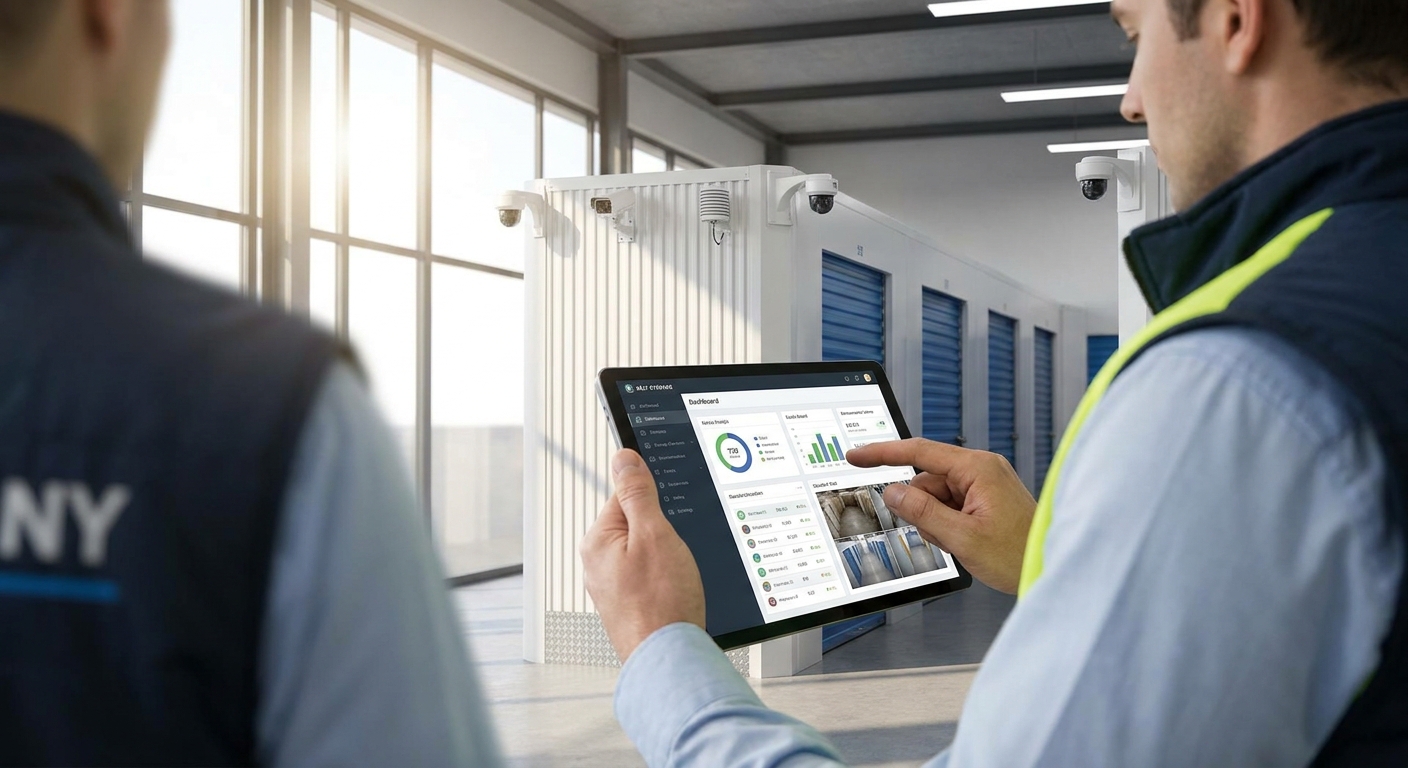
Self-storage facilities lose climate-controlled units, tenant trust, and insurance leverage the moment a sensor fails to catch a leak or a temperature swing before it hits inventory. A facility monitoring system for self-storage facilities closes that gap by watching temperature, humidity, water intrusion, and unit access across every building on a site — and across every site in a portfolio.
- A facility monitoring system for self-storage facilities needs climate, leak, and access sensors on one dashboard, not three separate apps.
- Kilo IoT's rules engine turns a single sensor reading into an alarm within seconds, which matters more than raw data logging.
- LoRaWAN sensors run 5-10 years on battery and reach metal buildings without new wiring — Buy for retrofits.
- Multi-tenant device management is the deciding factor once a portfolio passes 3-4 sites — Buy for regional chains.
- Skip any system that can't alarm on water leaks separately from temperature; ground-floor units flood, not just overheat.
Why this matters
Self-storage margins depend on climate-controlled unit premiums and low claim rates. A single undetected leak in a ground-floor unit or a compressor failure in a climate-controlled building can trigger a claim, a refund, and a churned tenant in the same week.
Most facilities still rely on a technician doing a walkthrough once a day, sometimes less on weekends. By the time a manual check catches an 8°F swing in a climate-controlled unit or a slow leak under a drive-up door, the damage is already done. A facility monitoring system for self-storage facilities replaces that walkthrough with continuous sensor coverage and automated alarms, so the alert fires the moment a threshold is crossed — not the next time someone walks the row.
Who this is for
This guide is for self-storage operators and facility managers running anywhere from a single climate-controlled building to a multi-site regional portfolio, who need to catch temperature drift, water intrusion, and unauthorized unit access before a tenant calls in a claim. It also applies to operators evaluating a move off manual logbooks or a spreadsheet-based inspection routine toward an always-on system in 2026.
What to look for in a facility monitoring system for self-storage facilities
Per-zone temperature and humidity coverage
Climate-controlled buildings aren't one zone — they're several, and a compressor failure in one bay doesn't always show up at the thermostat for the whole building. You need sensors placed per zone or per row, not one reading for an entire structure, so a 15-20°F drift in a single bay triggers an alarm before it reaches every unit on that line.
Water leak and moisture detection separate from temperature
Ground-floor and drive-up units flood from roof leaks, burst pipes, and storm water before temperature ever moves. A system that only tracks temperature misses this entirely, so leak-specific sensors on the floor or under doors matter as much as climate sensors in any facility monitoring system for self-storage facilities.
Door, gate, and unit access sensors
An overhead door left open overnight is both a security risk and a climate risk, since it lets outside air undo everything the HVAC system is doing. Access sensors that log open/close events and alarm on doors left open past a set time catch this without a guard walking every row.
Battery-powered, wireless sensor deployment
Steel buildings full of metal roll-up doors are hostile to Wi-Fi and hard to wire without tearing into walls. LoRaWAN sensors solve this by running on battery for years and transmitting through metal-heavy structures over a private gateway, which cuts install time from days to hours per building.
Multi-site dashboard and portfolio visibility
A facility manager overseeing four sites can't log into four separate apps every morning. One dashboard showing every building, every zone, and every open alarm across the portfolio is the difference between proactive management and reactive firefighting.
Rules and alarms that act, not just log
Data without alarms is a spreadsheet with extra steps. The system needs a rules engine that fires a text or email the moment a threshold breaks — a leak sensor trips, a door stays open 20 minutes, a zone drifts 10°F — not a dashboard someone has to remember to check.
Top picks for self-storage monitoring configurations
The climate-control pick: per-zone temperature and humidity monitoring
The spec that matters here is sensor density — one sensor per zone or row, not one per building. Deploying LoRaWAN temperature and humidity sensors across multiple warehouse zones lets a facility catch a single-bay HVAC failure before it spreads across a 40-unit line. In 2026, climate-controlled premiums only hold up if the climate control actually holds — this configuration is a Buy for any site with premium climate units.
The flood-risk pick: leak detection before damage
The number that matters: a slow leak under a drive-up door can run for days before it's visible from the aisle. Leak-specific sensors that alarm separately from temperature — placed at floor level in ground-floor and drive-up units — catch water intrusion in commercial buildings before it reaches stored goods. Buy for any facility with ground-floor, boat, or RV storage; Skip this if the entire site is upper-floor climate-controlled with no ground contact.
The scale pick: multi-tenant device management
Self-storage sites run hundreds of sensors across gates, doors, and units — effectively a multi-tenant sensor network once you count access points per unit. A platform built for multi-tenant sensor networks handles device provisioning and permissions at that scale without a spreadsheet tracking which sensor belongs to which building. Buy once a single site passes 100+ sensors or the portfolio adds a second location.
The chain pick: single dashboard across sites
Regional operators running four, six, or ten locations need one login, not one per site. This configuration is a Consider for single-site operators and a Buy the moment a second or third location comes online — the dashboard consolidation pays for itself in the first missed-alarm-that-didn't-happen.
What to avoid
- Temperature-only systems marketed as "complete" monitoring — they miss leaks and door events entirely, and self-storage claims are as often water damage as heat damage.
- Wired sensor networks for retrofit buildings — running conduit through an occupied storage facility means shutting down units or working around tenants, which battery-powered LoRaWAN sensors avoid.
- Dashboards without configurable alarm thresholds — a system that shows a graph but can't fire an alert at a specific temperature or leak event just moves the manual-check problem onto a screen instead of a clipboard.
Map your self-storage sensor plan
See how Kilo IoT covers climate, leak, and access monitoring on one dashboard.
Verdict comparison
| Configuration | Best for | Key sensor | Verdict |
|---|---|---|---|
| Per-zone climate monitoring | Climate-controlled buildings | Temp/humidity per zone | Buy |
| Leak detection | Ground-floor, drive-up, RV/boat units | Floor-level leak sensor | Buy |
| Multi-tenant device management | Sites with 100+ sensors | Device provisioning platform | Buy at scale |
| Multi-site dashboard | Regional chains, 2+ locations | Portfolio dashboard | Consider single-site, Buy multi-site |
| Temperature-only monitoring | Nothing — misses leaks and access | Temp sensor alone | Skip |
FAQ
What's the best facility monitoring system for self-storage facilities?
The best system combines per-zone temperature and humidity sensors, floor-level leak detection, and door/gate access sensors on one dashboard with configurable alarms. A setup covering only temperature misses the water damage and access risks that drive most self-storage claims.
How much does self-storage IoT monitoring cost?
Cost depends on sensor count, building size, and whether the site already has a LoRaWAN gateway installed. Pricing varies by deployment size, so check current options directly against your unit count and zone layout.
Do self-storage sensors need Wi-Fi?
No. LoRaWAN sensors run on battery and transmit over a private gateway, which works better in metal storage buildings where Wi-Fi signal degrades. This avoids running new wiring through occupied units.
How long do LoRaWAN sensors last on battery?
LoRaWAN temperature, humidity, and leak sensors typically run 5 to 10 years on a single battery, depending on reporting frequency. That's long enough to cover most retrofit deployments without a mid-lease battery swap.
Can one dashboard cover multiple self-storage sites?
Yes, a multi-site facility monitoring dashboard consolidates every building and zone into one login instead of a separate app per location. This matters most once a portfolio passes two or three sites.
Is temperature monitoring enough for climate-controlled storage units?
No, temperature alone misses water leaks and door-left-open events, which are common causes of self-storage claims. Humidity monitoring paired with leak detection catches the two failure modes temperature sensors alone cannot.
What triggers a self-storage monitoring alarm?
A rules engine fires an alarm when a zone crosses a temperature or humidity threshold, a leak sensor detects moisture, or a door stays open past a set time, often 20 minutes. The alert goes out immediately rather than waiting for a scheduled dashboard check.
One last thing
The cheapest sensor deployment on paper is almost always temperature-only, and it's also the one that misses the claim that actually costs money — a slow leak under a drive-up door running unnoticed for days. Facilities that pair leak detection with climate monitoring catch both failure modes with the same rules engine, not two separate systems bolted together in 2026.