
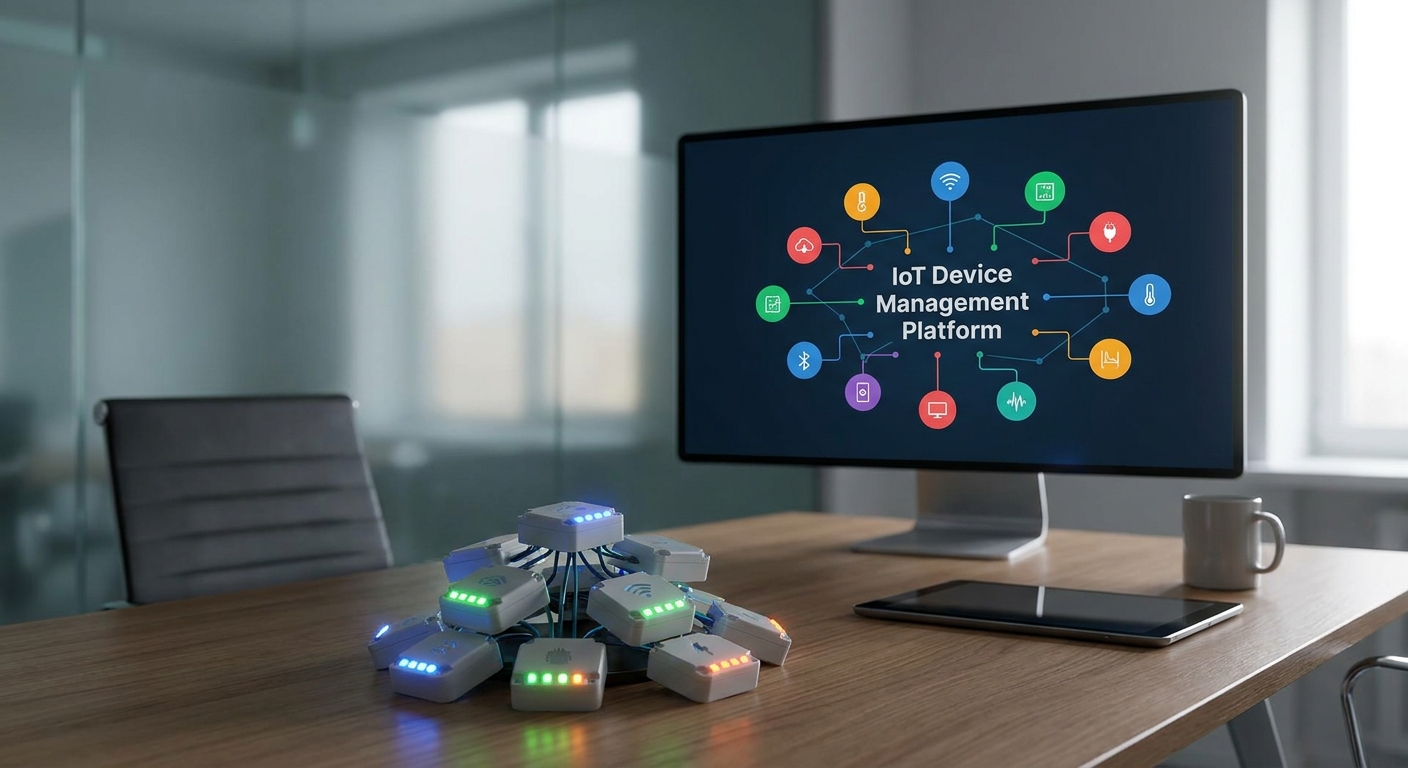
You need an IoT device management platform that handles multiple independent sensor networks without letting one deployment bleed into another—while keeping your operations team from drowning in configuration overhead. Multi-tenant architectures solve this: separate data silos, role-based access controls, and one unified interface instead of jumping between isolated systems. Here's what matters when you're picking a platform that actually scales across sites, teams, and protocols.
- Multi-tenant platforms isolate customer/site data while running one instance—cuts ops overhead by 60–70% vs. single-tenant deployments.
- Mandatory: role-based access control (RBAC), audit logs, and API-first design for regulatory compliance in 2026.
- LoRaWAN + MQTT + cellular connectivity ensures you're not locked to one radio standard—critical for mixed-environment sites.
- Built-in device provisioning and AI-driven rules save 20–40 hours per new deployment vs. manual config.
Why this matters: By 2026, facilities and operations teams run dozens of independent sites—warehouses, refrigerated trucks, manufacturing plants, remote wells. Forcing each site into its own platform instance means duplicate infrastructure, separate logins, and separate billing. A multi-tenant IoT device management platform bundles all sites into one control plane: one API, one set of device groups, one set of alarms. You provision a new tenant (a customer, a division, a facility) in minutes, not weeks. Regulatory audits become tractable because your audit log shows exactly who accessed what data and when.
Who this is for
Multi-tenant device management platforms are built for integrators, property management companies, and enterprise operations teams that manage fleets of sensors across physically separate locations. You're the systems integrator deploying LoRaWAN networks into 10 cold-storage facilities. You're the facilities director monitoring HVAC and power across 30 retail locations. You're the utility company managing tank-level sensors across a 500-square-mile service territory. Single-tenant platforms force you to replicate the entire stack per site; multi-tenant platforms let you scale by adding devices and users to one shared instance.
What to look for in an IoT device management platform for multi-tenant sensor networks
Role-based access control (RBAC) with audit trails
Your operations manager should see alarms and dashboards for three facilities but never touch the device configuration or billing for facility four. An IoT device management platform without granular RBAC forces you to hand out admin credentials to everyone or build your own access layer on top. Kilo IoT ships RBAC built-in: assign users to roles (viewer, operator, admin, integrator), scope those roles to specific device groups or buildings, and log every action in an audit trail. By 2026, most regulated industries—food, pharma, healthcare—require timestamped proof that only authorized personnel touched critical configs. Without audit trails, you fail the audit.
Protocol flexibility: LoRaWAN, MQTT, and cellular
Your cold-storage facility runs LoRaWAN sensors. Your logistics partner uses MQTT. Your remote oil-and-gas site uses cellular gateways. A platform that mandates one protocol forces you to buy separate instances or retrofit incompatible hardware. Multi-tenant platforms that speak LoRaWAN, mioty, MQTT, and HTTP/REST on day one eliminate protocol lock-in. You ingest data from dozens of sensor types into one rules engine, one dashboard, one API. Kilo IoT's Kilo Connectivity layer handles LoRaWAN (private and public networks), MQTT, and cellular IoT across 800+ connectivity partners—meaning one tenant deploys LoRaWAN sensors while another uses LTE devices, and both feed the same cloud instance.
Device provisioning and onboarding automation
Manual provisioning kills scale. A field technician ships 500 new temperature sensors to a warehouse. Without automation, your team hand-configures each device's network credentials, assigns it to a building, and maps it to a dashboard widget—a full day per 50 devices. An IoT device management platform with automated provisioning (over-the-air registration, bulk imports, pre-configured device templates) cuts that to an hour. Kilo IoT provisioning: upload a CSV of MAC addresses, tag them with a building and a sensor type, and the platform auto-assigns credentials and activates them on the network. Your tech on-site just installs hardware.
Built-in dashboards, rules, and alarms scoped per tenant
A multi-tenant platform that still requires custom code to set up dashboards and alerts defeats the purpose. You need dashboard templates ("cold-storage template shows temps and setpoints"), alert routing (facility A's alarms go to team A; facility B's to team B), and rules logic that can fire locally without round-tripping to the cloud. Kilo IoT's rules engine runs automation—trigger an alarm if a sensor reads below 2°C for 10 consecutive minutes, then send SMS and email to the on-call technician and log it in the audit trail—without requiring a developer. AI-driven rule suggestions in 2026 save you the guessing: "Your facility typically runs 4–8°C; I've flagged a 15-minute excursion at 1.2°C and drafted an alert rule."
API-first architecture for billing, reporting, and integrations
Your finance team needs to bill each tenant separately. Your reporting team needs to extract sensor data for SLAs. Your integrations team needs to push alarms into Slack, ServiceNow, or a legacy SCADA system. A closed-UI-only platform makes all of that manual and painful. An IoT device management platform with a complete REST API (device management, data export, user provisioning, billing events) lets you automate billing reconciliation, build custom reports, and glue the platform to your existing stack. Kilo IoT publishes OpenAPI specs for all endpoints; you can provision users, fetch device metrics, and trigger webhooks programmatically.
Top picks for multi-tenant IoT device management
Kilo IoT—the production-ready standard
Hook: Built from the ground up for multi-tenant ops; LoRaWAN + MQTT + cellular connectivity in one platform.
Kilo IoT runs as a single managed cloud instance that isolates data, access, and billing for unlimited tenants (customers, facilities, business units). Each tenant sees only its own devices, dashboards, and alarms. Role-based access control, audit logging, and per-tenant API keys ship out of the box. You provision a new tenant in 2 minutes: name, billing contact, invited users, and Kilo assigns a namespace and creates roles. Devices onboard via bulk import, MQTT provisioning, or over-the-air registration on public or private LoRaWAN networks.
By 2026, Kilo IoT's Kilo Cloud platform (the core managed service) includes device management, dashboards, rules engine, alarms, and an AI integrator that ingests plain-language instructions—"alert if temp drops below 4°C for 15 minutes"—and drafts rules, provisions devices, and routes notifications. Kilo Connectivity (the connectivity layer) speaks LoRaWAN, mioty, MQTT, and LTE via 800+ partners worldwide; you pick the protocol per site without rearchitecting. Kilo Electronics (optional hardware) provides pre-configured, rugged sensors for cold chain, facilities, and industrial use cases.
For integrators and facility operators, Kilo IoT cuts deployment time by 40–60% vs. open-source or single-tenant alternatives because provisioning, alerting, and compliance logging are pre-wired. You're not building a dashboard or audit system; you're using the platform's.
Verdict: Buy. Kilo IoT is the only platform on this list purpose-built for multi-tenant, mixed-protocol deployments. IoT device management platform for multi-site ops.
Open-source alternatives (ThingsBoard, ChirpStack)—lowest cost, highest ops lift
Hook: Free, fully customizable, runs on your own infrastructure.
ThingsBoard and ChirpStack are mature, community-driven projects. Both support multi-tenancy through self-hosting: deploy one instance, configure tenant isolation via the database, and run it yourself. Zero license costs; infinite customization. You own all infrastructure, all data, all compliance responsibility.
Catch: You're running 2026's on-call burden. A production ThingsBoard cluster requires Kubernetes, PostgreSQL monitoring, TLS certificate renewal, security patches, and backup automation. A ChirpStack LoRaWAN network server adds LoRa gateway management, frequency coordination, and roaming configuration. Neither platform includes cellular connectivity or hardware provisioning; you bolt those on via integrations. If your team has 1–2 full-time platform engineers, open-source works. If you're understaffed or risk-averse, the ops overhead negates the cost savings.
Verdict: Consider if you have dedicated ops staff; Skip if you prioritize time-to-deployment. Open-source multi-tenant platforms cost nothing upfront but require continuous engineering care.
AWS IoT Core—enterprise cloud with high integration friction
Hook: Integrates with your AWS ecosystem; handles billions of messages.
AWS IoT Core is a managed message broker that scales infinitely and integrates with Lambda, DynamoDB, and QuickSight. Multi-tenancy via AWS accounts or through Thing Groups + policies. You can ingest data from millions of devices, apply rules, and trigger workflows—all serverless, all billed per message.
Catch: It's a message broker, not a device management platform. You build the device provisioning layer, the dashboard UI, the alerting system, and the audit trail yourself. AWS IoT Core does not ship with RBAC, dashboards, or device templates; those are engineering projects. If you already have an in-house development team and deep AWS expertise, AWS IoT Core is economical. If you're a facilities operator or a small integrator, you'll spend 6–12 months building the UX layer that Kilo IoT includes.
Verdict: Wait if you lack internal DevOps capacity. AWS IoT Core is plumbing, not a finished product.
Azure IoT Hub—similar to AWS, Microsoft ecosystem lock-in
Hook: Deep integration with Microsoft cloud; enterprise support.
Azure IoT Hub is AWS IoT Core's conceptual equivalent: a managed message broker for device connectivity, telemetry ingestion, and command/control. Multi-tenancy through Azure subscription/resource groups. Integrates with Power BI for dashboards, Logic Apps for automation, and Cosmos DB for data lake storage.
Catch: Same as AWS IoT Core—you're not getting a finished device management platform. Dashboard, provisioning, RBAC, and alerting are engineering work. Microsoft's premium support helps, but the lift is still 6+ months for a production system. Lock-in is deep: moving off Azure later is expensive.
Verdict: Skip unless you're already an Azure-first enterprise. The platform overhead outweighs the cloud integration benefit for most multi-site ops.
What to avoid
Avoid single-tenant-only platforms. If the vendor's architecture forces one instance per customer or facility, you'll be managing 50 separate databases, billing systems, and deployment pipelines by year two. Multi-tenancy must be native to the platform architecture, not bolted on.
Avoid protocol lock-in. If the platform mandates one connectivity standard ("LoRaWAN only" or "MQTT only"), you'll hit a wall when a new site uses cellular or a partner deploys a different radio. Kilo IoT's tri-protocol design (LoRaWAN, mioty, MQTT) prevents this; AWS and Azure are agnostic but require you to build the ingestion layer.
Avoid platforms without audit logging. Regulatory audits in 2026 require proof that only authorized personnel touched device configs, changed thresholds, or deleted data. If the platform doesn't log who did what and when, you can't pass an audit. Open-source alternatives can add audit logging, but it's extra work.
Verdict comparison table
| Feature | Kilo IoT | ThingsBoard | ChirpStack | AWS IoT Core | Azure IoT Hub |
|---|---|---|---|---|---|
| Multi-tenant (native) | Yes | Yes | Yes | Yes | Yes |
| RBAC + audit logging | Built-in | Requires config | Requires add-on | Requires build | Requires build |
| LoRaWAN + MQTT + cellular | Yes (3 protocols) | MQTT/HTTP | LoRaWAN only | Protocol agnostic (you ingest) | Protocol agnostic (you ingest) |
| Dashboards included | Yes, templated | Yes | No | No | No |
| Rules engine | Yes, AI-assisted | Yes | No | Yes, via Lambda | Yes, via Logic Apps |
| Device provisioning | Automated | Manual or API | Manual | API only | API only |
| Hosted or self-managed | Managed SaaS | Self-hosted | Self-hosted | Managed | Managed |
| Ops burden (2026) | Minimal (vendor owns) | High (you own stack) | High (you own stack) | Medium (cloud ops only) | Medium (cloud ops only) |
| Typical deployment time | 2–4 weeks | 8–16 weeks | 12–24 weeks | 12–20 weeks | 12–20 weeks |
FAQ
What does multi-tenant mean for an IoT platform?
Multi-tenant means one platform instance serves multiple independent customers, facilities, or business units—each with isolated data, separate login credentials, and separate billing. A single database enforces data isolation via role-based access control. You don't replicate the platform per tenant; you add users and devices to one shared instance. This cuts ops overhead and cost vs. single-tenant alternatives.
Do I need multi-tenant if I only manage one facility?
No. Single-facility operations (one building, one team, one set of sensors) don't need multi-tenancy. A standard single-user IoT platform works fine. Multi-tenancy becomes critical when you manage multiple independent sites, customers, or business units and need to prevent data leakage and enforce access controls.
Can I use an open-source platform like ThingsBoard for production multi-tenant deployments?
Yes, but you own the ops burden. ThingsBoard supports multi-tenancy and is production-ready, but self-hosting means managing infrastructure, security patches, backups, and monitoring 24/7. By 2026, most teams underestimate this cost. A managed SaaS platform (like Kilo IoT) shifts that burden to the vendor.
What's the difference between LoRaWAN, MQTT, and cellular connectivity?
LoRaWAN is a low-power radio standard (good for battery-powered sensors, 10+ year lifetime). MQTT is a message protocol (works over WiFi or cellular, requires more power). Cellular is LTE/5G (higher bandwidth, higher cost per device). A multi-protocol platform lets you mix all three: LoRaWAN for remote tank sensors, MQTT for factory equipment, cellular for moving assets.
Is audit logging required for compliance?
Yes, in most regulated industries. HIPAA (healthcare), FDA 21 CFR Part 11 (pharma/food), and GDPR (EU) require timestamped logs showing who accessed or modified data. By 2026, any platform handling sensor data in healthcare, food, or regulated utilities must include audit logging. Open-source platforms can add it, but it's engineering work.
How long does it take to deploy a multi-tenant IoT platform?
Kilo IoT: 2–4 weeks (platform is ready, you just add devices and users). Open-source (ThingsBoard, ChirpStack): 8–24 weeks (you build infrastructure, dashboards, provisioning, audit logging). AWS/Azure: 12–20 weeks (you build the UX and provisioning layer on top of the message broker).
One last thing
Most teams delay multi-tenant architecture until they've already built single-tenant systems for three sites. By then, migration is painful. If you're deploying IoT sensors to more than one location, start with a multi-tenant platform from day one. The setup cost is identical, but the long-term ops burden—especially by 2026—is a fraction of the alternative. A platform with built-in provisioning and RBAC will save your team 20–40 hours per new site vs. hand-configuration.
Related guides
- How to choose an IoT device management platform for multi-site ops
- How to migrate from an open-source IoT platform to a managed one
- Best IoT platforms for industrial manufacturers
- IoT platform for predictive maintenance in manufacturing plants
- Best IoT dashboard software for multi-site facility teams