
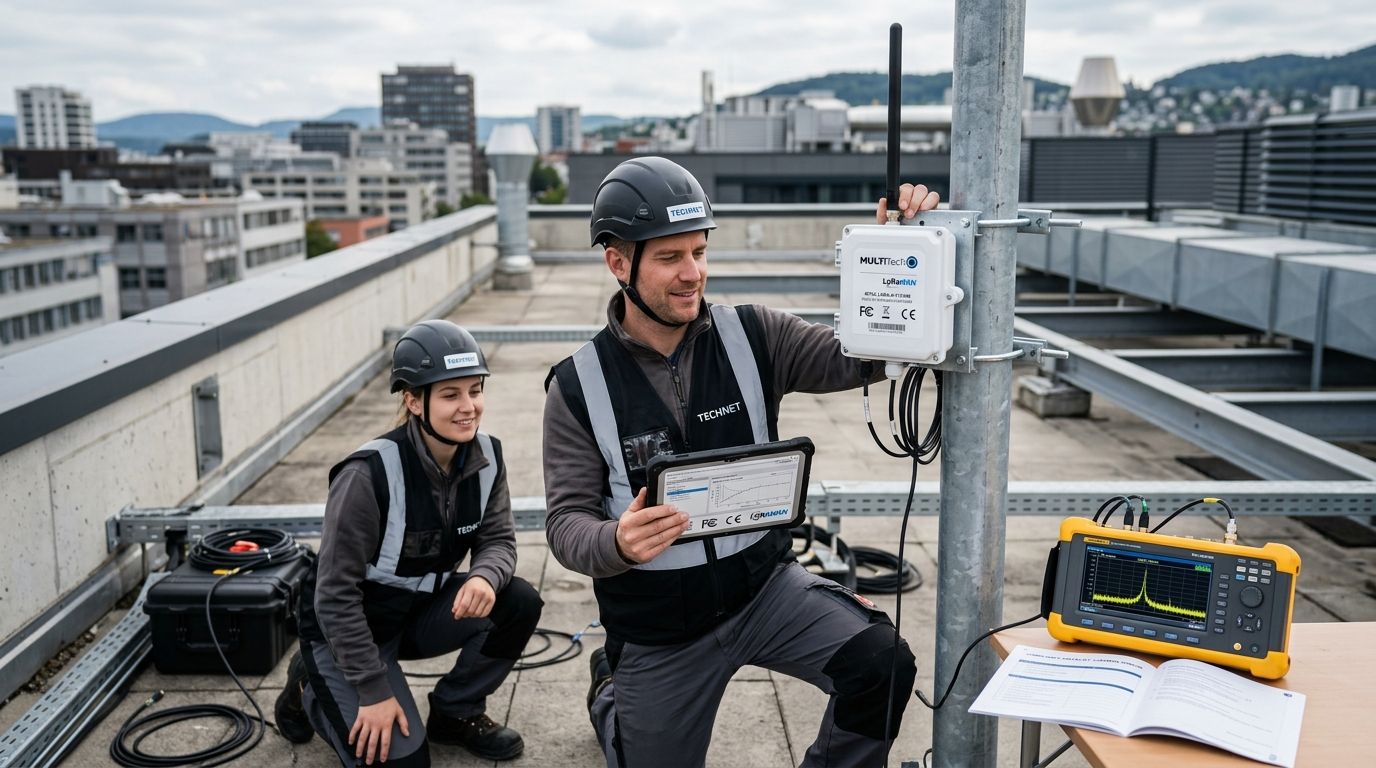
FCC and CE compliance for LoRaWAN sensors means clearing two separate regulatory regimes, not one: FCC Part 15 rules for US915 deployments in the United States, and the EU Radio Equipment Directive (2014/53/EU) backed by ETSI EN 300 220 for EU868 deployments in Europe. A sensor certified for one region cannot be shipped and switched on in the other without re-testing or re-certification against that region's frequency plan, power limits, and duty cycle rules. Skipping this step doesn't just risk a fine — an uncertified radio can knock out reception for every other LoRaWAN device sharing the band on site.
Getting this wrong at scale is expensive to unwind. If you're planning a rollout across the Kilo IoT Platform or any other LoRaWAN network server, the compliance check has to happen before hardware ships, not after gateways are bolted to the roof.
- FCC and CE compliance for LoRaWAN sensors requires two separate certifications: FCC Part 15.247 for US915 and CE marking under EU Directive 2014/53/EU for EU868.
- US915 sensors need an FCC ID from an accredited test lab; EU868 sensors need a Declaration of Conformity backed by ETSI EN 300 220 and EN 301 489 testing.
- EU868 duty cycle limits, 0.1% to 1% per sub-band under ETSI EN 300 220-2, restrict how often a sensor can transmit.
- A sensor built on an already-certified radio module can often use modular approval instead of full re-testing.
- A network server that enforces the correct regional frequency plan keeps a compliant fleet in spec through 2026.
How to ensure FCC and CE compliance for LoRaWAN sensor deployments
The process is the same shape in both regions even though the rules differ: confirm the frequency plan for the deployment country, verify the radio module's certification status, get the finished device tested against the applicable standards, then file the paperwork before the sensor ships.
| Step | US (FCC) | EU (CE) |
|---|---|---|
| Governing rule | Part 15.247, intentional radiators | Radio Equipment Directive 2014/53/EU |
| Key standards | FCC Part 15 test procedures | ETSI EN 300 220 (radio), EN 301 489 (EMC) |
| Frequency band | 902-928 MHz (US915) | 863-870 MHz (EU868) |
| Proof of compliance | FCC ID: grantee code plus product code | Declaration of Conformity plus CE mark |
| Who tests it | FCC-recognized accredited lab | Notified Body or self-declaration |
This is the sequence most integrators follow when onboarding LoRaWAN sensors at scale across multiple sites: lock the frequency plan per country first, because antenna choice, duty cycle budget and gateway channel plan all depend on that one decision.
FCC Part 15.247 requirements for LoRaWAN sensors in the US
US915 LoRaWAN sensors operate under FCC Part 15.247, the rule set covering intentional radiators using digital modulation or frequency hopping in the 902-928 MHz band. Every finished device needs an FCC ID, which is a grantee code plus a product code issued after testing at an FCC-recognized accredited lab.
Three things matter for a facilities or ops team buying sensors rather than building them:
- The FCC ID belongs to the finished product, not just the radio chip inside it. A sensor housing a certified module still needs its own approval path.
- Modular approval lets a manufacturer integrate a pre-certified radio module and skip full RF testing, provided the module is used within its grant conditions: antenna, enclosure, spacing from other radios.
- Limited modular approval covers cases where the host device can still affect RF performance, such as a shared antenna. That path still requires additional testing.
If a vendor can't produce an FCC ID for a US915 sensor, that's a stop-the-order problem, not a follow-up email. Sensors are also available from Kilo Electronics, the sister hardware store, with worldwide shipping at kiloelectronics.com.
CE marking requirements for LoRaWAN sensors in the EU
EU868 LoRaWAN sensors fall under the Radio Equipment Directive (2014/53/EU), which replaced the older R&TTE Directive. CE marking under RED requires the manufacturer to demonstrate conformity against the relevant harmonized standards — primarily ETSI EN 300 220 for radio performance and ETSI EN 301 489 for electromagnetic compatibility — and to compile a technical file plus a Declaration of Conformity.
Unlike the FCC route, most EU868 short-range devices go through self-declaration against harmonized standards rather than mandatory third-party assessment by a Notified Body. That only holds if the manufacturer applies the standards correctly and keeps the technical file on record. Market surveillance authorities can request it at any time.
The EU868 band also carries a hard duty cycle constraint the US915 band does not. ETSI EN 300 220-2 caps transmit time at 1% in the main g-band and as low as 0.1% in some sub-bands. That limit shapes how often a sensor can report, which makes it a network design decision as much as a legal one: a sensor reporting every 30 seconds on the wrong sub-band burns its duty cycle budget fast.
What affects FCC and CE compliance timelines for a LoRaWAN rollout
A handful of variables decide whether compliance is a one-day paperwork check or a multi-week hold on your 2026 rollout:
- Whether the radio module is already certified. Modular approval on both continents is far faster than testing a custom RF design from scratch.
- Antenna type and gain. Swapping the certified antenna for a higher-gain one can invalidate an existing FCC grant or CE declaration.
- Enclosure changes. A different housing material or added metal shielding can shift RF performance enough to require re-testing.
- Multi-band hardware. A sensor supporting both US915 and EU868 needs separate certification paths for each region, even on the same PCB.
- Country-specific deviations. Sub-band rules vary inside the EU868 footprint, which matters for a multi-country LoRaWAN rollout.
- Gateway certification status. A gateway is a separate radio device from the end sensors and needs its own FCC ID or CE mark.
“Lock the frequency plan by country before you pick a sensor model. Everything else in the compliance chain depends on that one decision.”
Do LoRaWAN sensors need FCC certification separately from the gateway?
Yes. A LoRaWAN gateway and the sensors reporting to it are separate radio devices under FCC rules, and each needs its own FCC ID. A certified gateway does not cover the sensors transmitting to it, and the reverse is equally true — both halves of the link clear Part 15.247 independently. The same split applies in the EU under RED, where gateway and end device each need their own Declaration of Conformity. Worth checking when you compare industrial LoRaWAN gateways against sensor SKUs from a different manufacturer, since certification never transfers between vendors.
Is CE marking the same as RED compliance for LoRaWAN devices?
CE marking is the visible proof that a device meets RED requirements. The two are not competing obligations; one is evidence of the other. A LoRaWAN sensor carries the CE mark only after the manufacturer has completed conformity assessment against the Radio Equipment Directive (2014/53/EU) and compiled the technical file and Declaration of Conformity. A datasheet can claim "CE compliant" loosely, but the mark itself is only legitimate once that RED paperwork exists and is retrievable on request.
Can the same LoRaWAN sensor be used in the US and Europe?
Only if the sensor ships with region-specific radio configurations for both US915 and EU868, each carrying its own certification. The physical hardware can be shared; the certified radio configuration cannot. A sensor certified only for EU868 will transmit on unauthorized frequencies if it is flashed to US915 firmware without a separate FCC filing. Teams running deployments on both continents in 2026 standardize on a sensor family with pre-certified variants per band instead of stretching one certification across two regulatory regimes. Region and environment both drive hardware selection here — see choosing sensors for outdoor industrial IoT deployments in extreme weather.
Plan a compliant multi-site LoRaWAN rollout
See how a private network server enforces the right regional frequency plan per gateway.
Once certified sensors are in the field, the network server layer has to hold the line. Kilo runs a built-in LoRaWAN and mioty network server, so there is no external network server to deploy alongside it, and regional parameters are set per gateway rather than assumed. That is what keeps a compliant fleet from drifting out of spec after go-live in 2026, which matters more day to day than the original certification file.
FAQ
Does a LoRaWAN gateway need separate CE or FCC certification from the sensors?
Yes, a LoRaWAN gateway is certified separately from every sensor reporting to it under both FCC Part 15.247 and the EU Radio Equipment Directive. Each radio device in the chain needs its own FCC ID or Declaration of Conformity.
What is an FCC ID and why does a LoRaWAN sensor need one?
An FCC ID is a grantee code plus a product code issued after a finished device passes testing at an FCC-recognized accredited lab under Part 15.247. Any US915 LoRaWAN sensor sold or operated in the United States needs one, even when it uses a pre-certified radio module.
What happens if I deploy an uncertified LoRaWAN sensor?
An uncertified sensor operating outside its region's rules can interfere with other devices sharing the band and exposes the deploying organization to regulatory penalties. EU market surveillance authorities and the FCC can both demand the compliance file on request.
What does ETSI EN 300 220 cover for LoRaWAN devices?
ETSI EN 300 220 is the harmonized radio standard for short-range devices operating below 1 GHz, including the EU868 band LoRaWAN uses. It sets the duty cycle limits, power limits and receiver parameters a device must meet for CE self-declaration under the Radio Equipment Directive.
Can one sensor SKU be sold in both the US and the EU?
A single hardware design can ship to both regions only if the manufacturer certifies separate radio configurations for US915 and EU868 individually. The enclosure and PCB can be shared, but each regional radio configuration needs its own FCC ID or CE Declaration of Conformity.
Is CE self-declaration enough, or do I need a Notified Body?
Most EU868 short-range LoRaWAN devices can use self-declaration against harmonized standards such as ETSI EN 300 220 without a Notified Body. A Notified Body becomes necessary when the manufacturer cannot demonstrate conformity against an applicable harmonized standard.
Does modular approval mean a device is automatically FCC compliant?
No, modular approval covers the radio module only when it is integrated within its grant conditions, including antenna type, enclosure and spacing from other radios. Changing any of those conditions can force re-testing of the finished device even though the module itself is certified.
The compliance detail most multi-country rollouts miss
The frequency band is the easy part to verify. The duty cycle budget is where 2026 rollouts actually stall. An EU868-certified sensor configured to report every 10 seconds can exceed the 1% ceiling in ETSI EN 300 220-2 long before anyone notices packets going missing, and the fix is not a new filing — it is a reporting interval set correctly at provisioning time and enforced by the platform from day one.