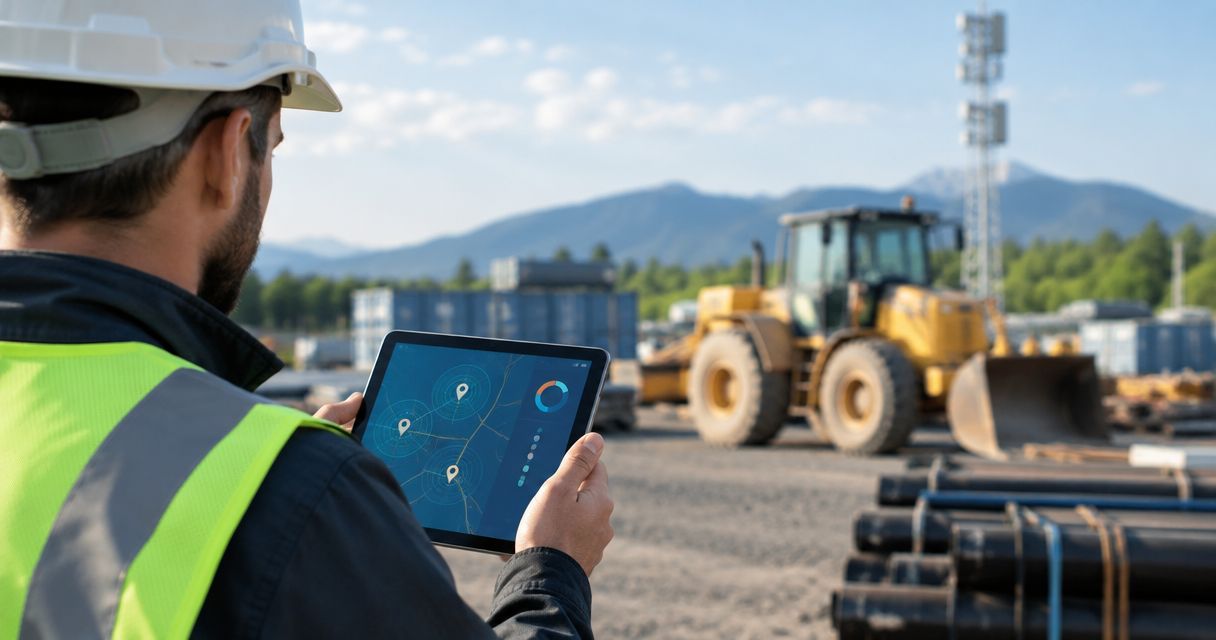
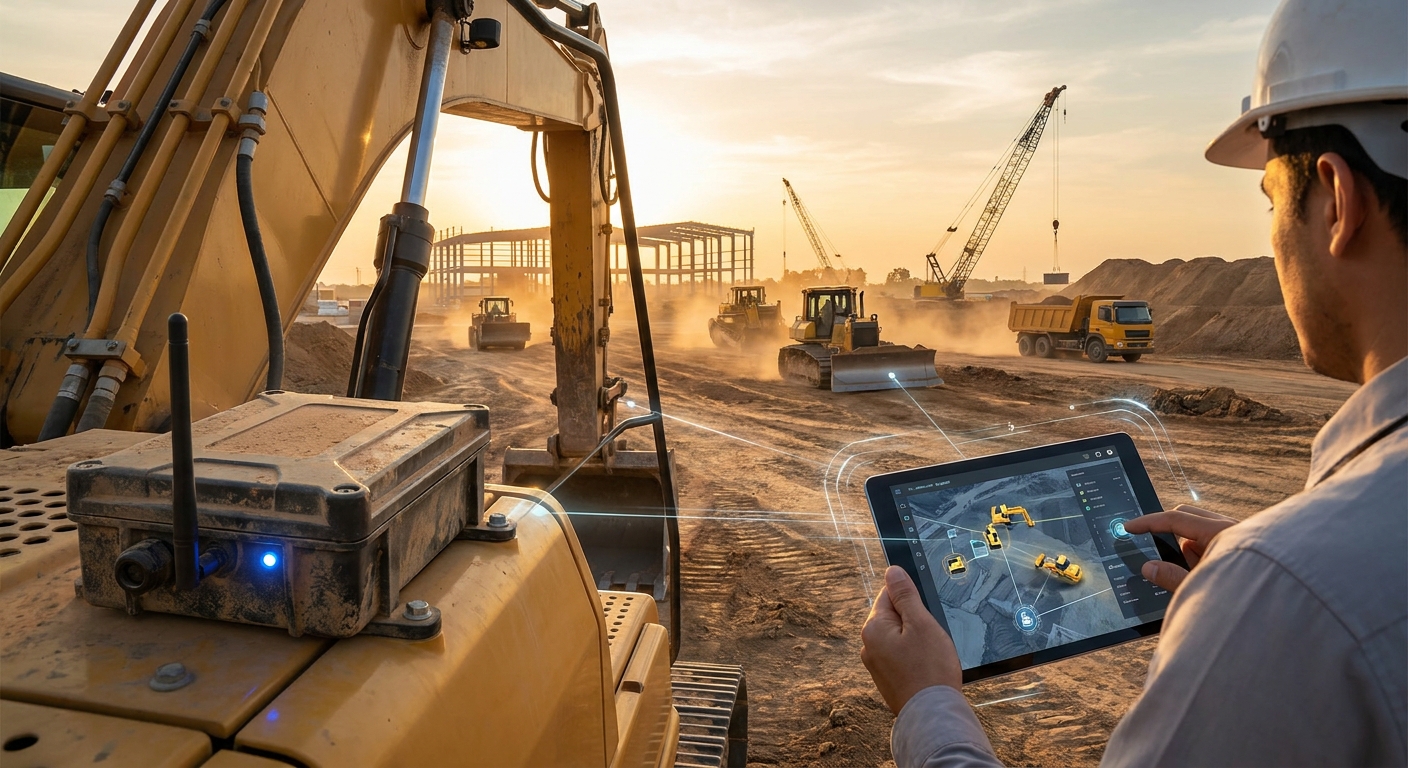
A backhoe missing from Monday's site count is either stolen, misplaced, or still sitting on last week's job — and without a location feed, you won't know which for days. IoT asset tracking for construction equipment fleets replaces that guesswork with a live map, a geofence, and an alarm that fires the moment something crosses a line it shouldn't.
- IoT asset tracking construction equipment programs run on LoRaWAN for fixed job sites and Cellular IoT for fleets moving between them — Buy for 2026 rollouts.
- Kilo Cloud's rules engine and alarms catch idle time and unauthorized movement without a person watching a map — Buy.
- Consumer-grade trackers skip the industrial rules engine and multi-site device management heavy fleets need — Skip.
- Cellular GPS units cost more per device but keep reporting once equipment leaves LoRaWAN gateway range — Consider.
Why this matters
Construction fleets don't lose equipment to one dramatic event. They lose it in small increments — an idle generator burning diesel nobody billed, a skid steer that crossed a fence line at 2 a.m., a compressor nobody logged moving sites. IoT asset tracking construction equipment platforms close that gap the same way an asset tracking IoT platform for logistics fleets tracks moving inventory: location, rules, and alarms feeding one dashboard.
Construction adds a wrinkle logistics doesn't — assets sit outside, off grid, and inside steel structures that block signal. By 2026, most contractors running 20 or more pieces of iron across multiple active sites are past the pilot stage on this fix. The ones still running windshield surveys are the ones eating the theft and idle-time losses everyone else has already priced out.
Who this is for
This guide is for equipment managers, ops leads, and site superintendents running mixed fleets of excavators, generators, compressors, and loaders across more than one active job site. If you're renting equipment in and out weekly, tracking utilization by hand, or finding out about theft from a foreman's phone call, this is your problem to solve. It matters less if you run a single site with five machines you can see from the trailer window — a padlock and a walkie-talkie still work fine at that scale.
What to look for in IoT asset tracking for construction equipment
Geofencing accuracy that matches your job site, not a city block
A geofence set for a five-acre site needs meter-level precision, not the 100-meter smear you get from cell-tower triangulation alone. GPS-enabled trackers paired with LoRaWAN or Cellular IoT connectivity narrow that radius enough to flag equipment the moment it crosses the fence, not an hour after it's already on a flatbed.
Connectivity that survives concrete, steel, and no WiFi
Job sites don't have office WiFi. LoRaWAN gateways cover roughly 2 to 5 kilometers in dense urban builds and up to 15 kilometers in open rural terrain, which handles most fixed sites on one gateway. Cellular IoT with worldwide SIM coverage and 800+ connectivity partners picks up where LoRaWAN gateways don't reach — useful for equipment that moves between sites you don't control.
Device management that scales past the third site
Managing a dozen sensors from a spreadsheet works. Managing 200 sensors across six active sites doesn't. A platform built for choosing an IoT device management platform for multi-site ops handles provisioning, firmware, and status monitoring centrally instead of per-site, which matters the moment your fleet outgrows one location.
Alarms tied to equipment behavior, not just a red dot on a map
A location feed without rules is just a map you have to stare at. Alarms that fire on unauthorized movement, low battery, or engine-on-zero-movement idle time turn tracking into something that alerts you instead of something you have to check every hour.
A dashboard built for site supervisors, not just headquarters IT
If the only person who can read the dashboard sits in an office 40 miles from the site, the tracking data isn't doing its job. Look for IoT dashboard software for multi-site facility teams that a super or foreman can check from a phone between walkthroughs, not just from a desktop back at the trailer.
Top picks for construction equipment fleets
The safe pick — LoRaWAN geofencing for fixed job sites. For a site that doesn't move for six months, a LoRaWAN network server for private enterprise deployments covering a 2-5 kilometer radius handles the whole footprint on one or two gateways. Trackers report position and battery status on a fixed interval, and geofence alarms fire the moment a machine crosses the site boundary. Battery life on LoRaWAN GPS trackers commonly runs multiple years between swaps because the radio only wakes to transmit. Buy for single-site or campus-style builds running through 2026 and beyond.
The wildcard — Cellular IoT trackers for fleets moving between sites. Equipment that mobilizes weekly needs connectivity that doesn't depend on a gateway you own. Cellular IoT with a worldwide SIM and 800+ connectivity partners keeps reporting whether a machine is on your job site, in transit on a flatbed, or parked at a rental yard three states away. Per-device cost runs higher than LoRaWAN, and battery life is shorter — expect months, not years, between charges on an always-on cellular unit. Consider for regional contractors mobilizing across three or more active sites.
The core pick — Kilo Cloud dashboard with the AI integrator. Location data without a usable interface is wasted budget. A dashboard that lets a site super pull up every tracked asset by project, not by device ID, turns raw pings into a daily habit instead of a weekly chore. Kilo Cloud's AI integrator sets up geofence and idle-time alarms from a plain-language request instead of a rules-engine form, which cuts setup time for ops teams without a dedicated IT hire. Buy for any fleet running more than two active sites in 2026.
The long game — predictive maintenance overlay on engine hours. Tracking location solves theft and misplacement. It doesn't solve the compressor that fails mid-pour because nobody watched engine hours against the service interval. Adding vibration or engine-hour sensors on top of the same connectivity layer flags maintenance windows before a breakdown, but it's a second deployment phase, not a day-one requirement. Consider once location and geofencing are running clean — Wait if you're still stabilizing basic tracking.
See the platform behind these picks
Check dashboards, alarms, and connectivity options for fleet monitoring.
What to avoid
- Consumer trackers built for luggage or wallets. They lack the battery life and geofencing radius for a job site, and there's no rules engine behind them — you get a location, not an alert.
- Passive RFID with no live connectivity. Fine for a warehouse gate scan, useless for knowing where a generator sat at 6 a.m. on a Tuesday.
- Single-site tracking tools that don't scale. A dashboard built for one location turns into five browser tabs the moment you add a second project — check that whatever you pick handles multi-site device management before you sign a contract.
Verdict comparison table
| Approach | Best for | Connectivity | Setup effort | Verdict |
|---|---|---|---|---|
| LoRaWAN geofencing | Fixed job sites | 2-5 km gateway radius | Low, one gateway per site | Buy |
| Cellular IoT trackers | Multi-site mobilizations | Worldwide SIM, 800+ partners | Medium, per-device SIM | Consider |
| Kilo Cloud dashboard + AI integrator | Any fleet with 2+ sites | Works over LoRaWAN or Cellular | Low, plain-language rules setup | Buy |
| Predictive maintenance overlay | Fleets past basic tracking | Same layer as above | Medium, added sensors | Consider/Wait |
FAQ
What is IoT asset tracking for construction equipment?
IoT asset tracking for construction equipment uses GPS or LoRaWAN-enabled sensors on machines to report location, status, and battery level to a dashboard in near real time. It replaces manual site counts and windshield surveys with a live feed that flags theft, misplacement, and idle time as it happens.
Is LoRaWAN or Cellular IoT better for tracking construction equipment?
LoRaWAN works best for fixed job sites within 2 to 5 kilometers of a gateway, while Cellular IoT with worldwide SIM coverage fits equipment that mobilizes between sites you don't control. Most multi-site fleets in 2026 run both, matching connectivity type to how often each asset moves.
Can IoT asset tracking prevent equipment theft?
IoT asset tracking doesn't stop a theft in progress, but a geofence alarm firing the moment equipment crosses a site boundary at 2 a.m. gives you a same-night response window instead of finding out at the next site count. Recovery odds drop fast after the first 24 to 48 hours, so alert timing matters more than the tracker itself.
How does geofencing work for construction equipment?
Geofencing draws a virtual boundary around a job site or storage yard and triggers an alarm when a tracked asset crosses it. Accuracy depends on the connectivity layer — GPS-enabled LoRaWAN or Cellular trackers get close to meter-level precision, while cell-tower triangulation alone can be off by 100 meters or more.
How long do LoRaWAN GPS trackers last on a job site before a battery swap?
LoRaWAN GPS trackers commonly run multiple years on a single battery because the radio only wakes to transmit on a set interval instead of staying connected constantly. Cellular units, by contrast, typically need attention every few months due to higher power draw.
Does IoT asset tracking work on remote job sites without WiFi?
Yes — neither LoRaWAN nor Cellular IoT asset tracking depends on site WiFi. LoRaWAN needs a gateway on or near the site, while Cellular IoT relies on cell coverage through a worldwide SIM, which covers most remote sites a contractor would mobilize to in 2026.
What's the difference between IoT asset tracking and telematics?
Telematics traditionally focuses on vehicle diagnostics — engine hours, fuel, fault codes — built into on-road trucks. IoT asset tracking for construction equipment adds location, geofencing, and idle-time alarms across both vehicles and non-powered assets like generators or compressors that telematics systems don't typically cover.
How much does IoT asset tracking cost for a construction fleet?
Cost depends on device count, connectivity type, and whether hardware is purchased or leased alongside the software platform — check current device and platform pricing directly rather than relying on a flat per-unit estimate. Cellular trackers generally cost more per device than LoRaWAN sensors due to SIM and data fees.
One last thing
Most fleets don't lose equipment to theft — they lose money to idle hours nobody catches. A generator running engine-on with zero movement for 30-plus minutes doesn't show up as missing on any site count, but it shows up on the fuel bill every week.
“Most fleets don't lose equipment to theft — they lose money to idle hours nobody catches.”
An alarm rule watching for that pattern pays for the tracking program before it ever catches a stolen loader.