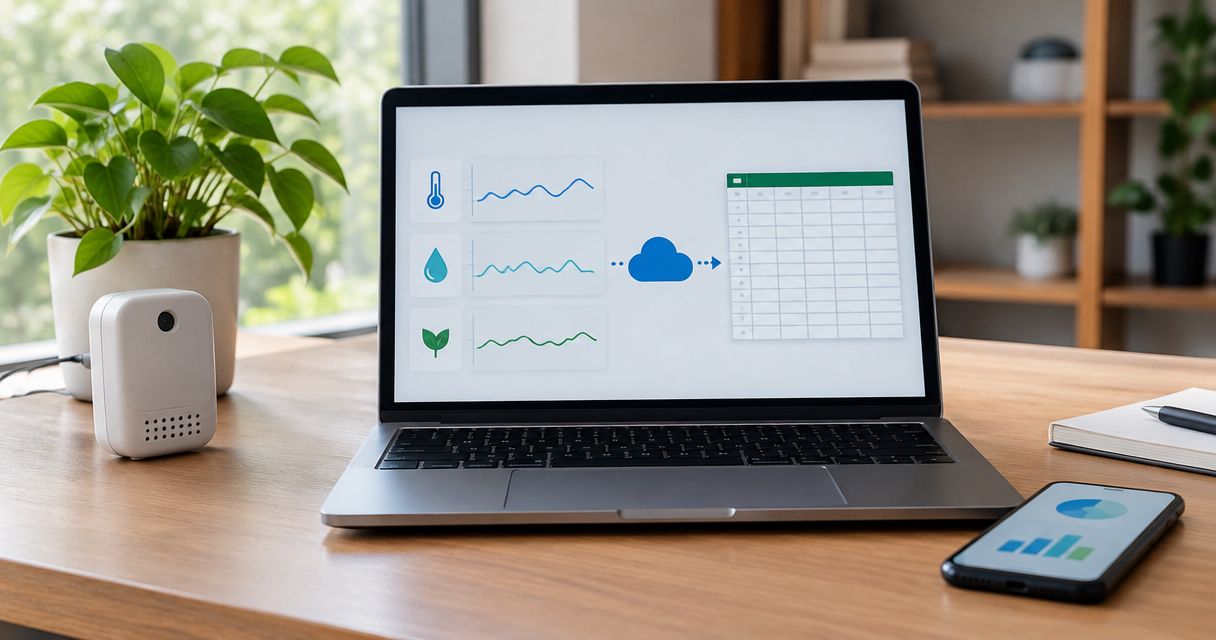
Dry cleaning solvent storage IoT monitoring is continuous condition tracking with the aim of catching leaks, abnormal vapor readings and inventory changes between required inspections. In 2026, it supplements the documented checks already used for commercial laundry and dry cleaning equipment; it does not replace inspections, exposure assessments or fire-code controls.
- IoT monitoring for dry cleaning solvent storage should track tanks, containment, vapor conditions and alarm history in 2026.
- OSHA lists perchloroethylene limits of 100 ppm over 8 hours and a 200 ppm ceiling.
- Kilo is best for operations teams combining LoRaWAN, mioty or MQTT sensors under one governed alarm workflow.
- Paper logs remain necessary where regulations require inspections; IoT data fills the time between checks.
Why does IoT monitoring for dry cleaning solvent storage matter?
A scheduled inspection shows conditions at one moment. Continuous tank, containment and air data shows what happened overnight, during an unstaffed period or after solvent transfer. That timeline helps an owner determine when a condition started, which readings changed and whether an alarm reached the assigned responder.
Perchloroethylene, commonly called perc or PCE, is regulated differently from hydrocarbon and siloxane-based dry cleaning solvents. EPA's National Emission Standards for Hazardous Air Pollutants for perc dry cleaners appear in 40 CFR Part 63, Subpart M. Inspection, recordkeeping and equipment requirements depend on the facility and applicable rule, while state air districts can impose additional conditions.
OSHA Table Z-2 lists a PCE permissible exposure limit of 100 ppm as an 8-hour time-weighted average, a 200 ppm ceiling and a 300 ppm maximum peak for five minutes in any three-hour period. These figures are exposure limits, not ready-made IoT alarm thresholds. A qualified industrial hygienist must define the sampling method, sensor type and response threshold for the site.
NFPA 32 covers dry cleaning plants, while NFPA 30 addresses flammable and combustible liquids more broadly. The solvent safety data sheet, electrical area classification and local fire code determine whether equipment requires specific hazardous-location certification. The 2026 monitoring plan must start with the applicable solvent and code obligations, not with a generic sensor kit.
How do you set up IoT monitoring for dry cleaning solvent storage?
Use the following sequence to build the 2026 monitoring plan. Manual records establish what must be measured; connected sensors then fill the gaps without changing the underlying compliance duty.
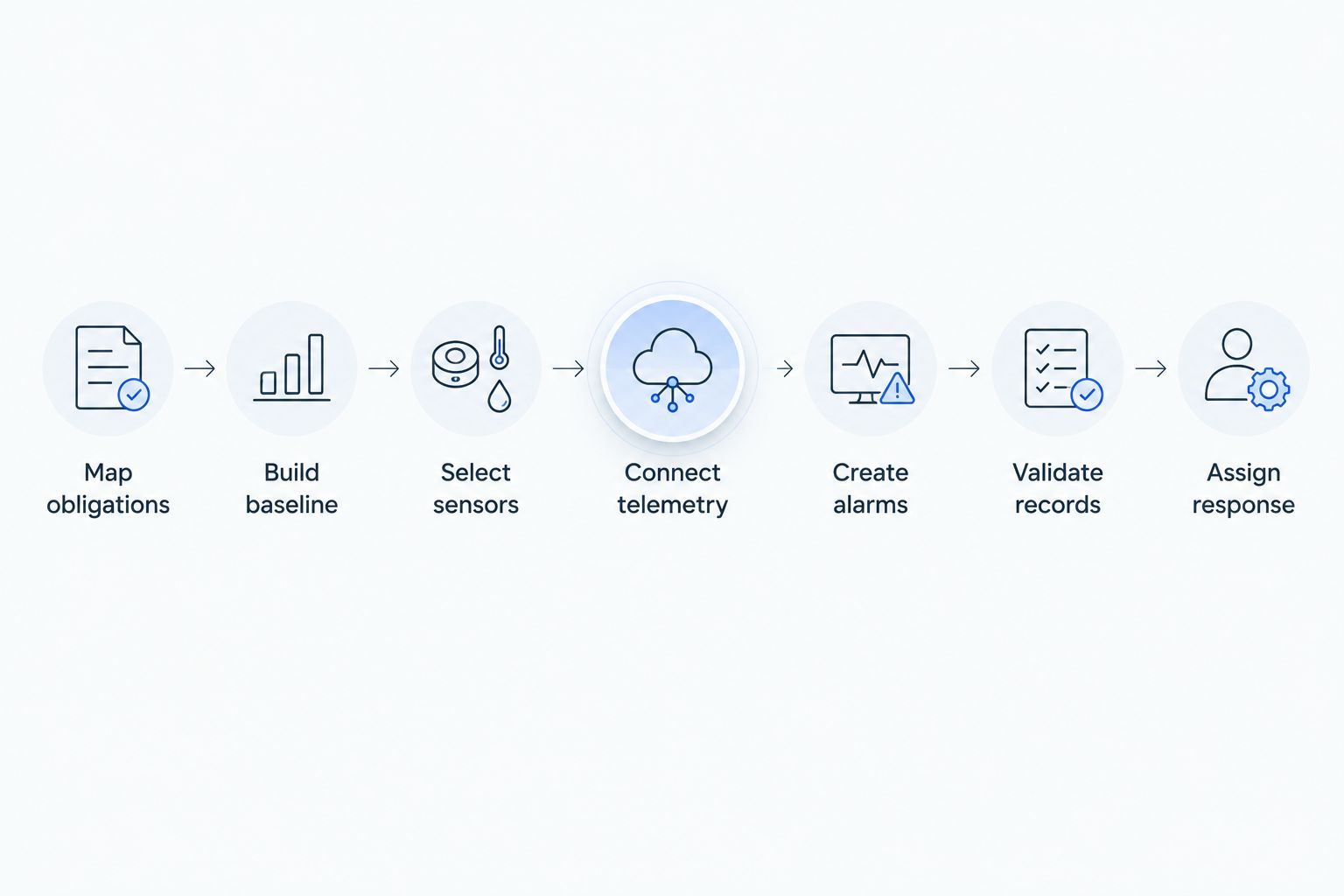
Map your solvent storage obligations
List each solvent and the rule set attached to it before defining data points. Perc emission controls, combustible-liquid storage requirements and waste-solvent handling are separate questions, even when every container sits in the same room.
- Record the exact solvent name from its safety data sheet
- Identify tanks, drums, machine reservoirs and waste containers
- Document federal, state, air-district and fire-code requirements
- Mark electrically classified areas and ventilation boundaries
- Assign an owner for inspections, exposure records and alarm response
Build a manual storage baseline
Use a spreadsheet or existing logbook before installing sensors. The baseline shows normal tank movement, transfer times and ventilation patterns, giving the project team real conditions against which to validate telemetry.
- Record tank or container level at a consistent time
- Log every delivery, transfer and waste-solvent movement
- Note visible leakage, staining, odor reports and containment conditions
- Record ventilation status during occupied and unoccupied periods
- Match each entry to a container ID and responsible operator
Select compatible tank, containment and vapor sensors
Sensor selection depends on chemical compatibility, measurement range, installation geometry and area classification. A general VOC sensor can respond to several compounds, so it must not be presented as a selective PCE compliance instrument unless its documentation supports that use.
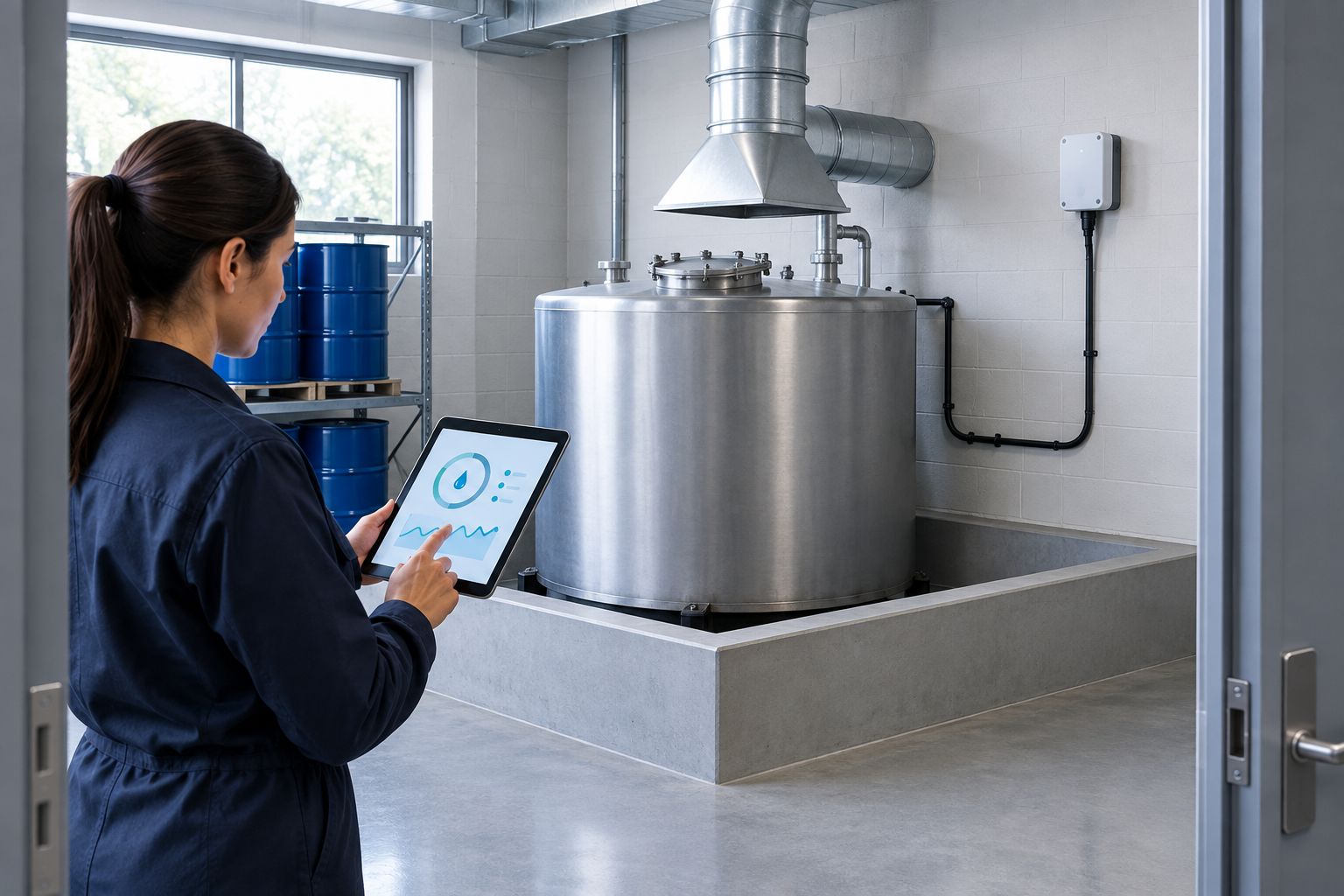
- Choose a compatible radar, ultrasonic, pressure or load-based level method
- Add a point sensor or sensing cable where leaked liquid would collect
- Select a compound-specific monitor when the compliance method requires one
- Confirm hazardous-location suitability with the responsible safety professional
- Check calibration, bump-test and replacement instructions before procurement
- Source compatible devices through Kilo Electronics when its partner catalog fits the approved specification
Connect telemetry without hiding missing data
The Kilo IoT Platform can receive LoRaWAN and mioty devices through its built-in network servers or connect publishing devices, PLCs, energy meters and building systems through MQTT. Each device receives a digital twin, giving tank level, containment status and room readings a consistent operational record.
- Use LoRaWAN or mioty for approved wireless sensors
- Use MQTT for publishing devices or existing control-system data
- Name every device after its physical container or monitored zone
- Define engineering units and expected reporting intervals
- Alarm on stale telemetry instead of displaying an old value as current
- Keep gateways, sensor health and application data visible separately
Create alarm rules around the response procedure
An alarm threshold only works when it maps to a defined action. The value must come from the safety data sheet, approved operating limits, an industrial hygiene plan or another controlling requirement—not from a generic dashboard default.
Kilo's visual BPMN rules engine supports CEL expressions, version control, test-payload debugging, one-click deployment and rollback. Its alarms support five severity tiers, escalation chains, email, SMS, push notifications, quiet hours and a centralized inbox.
- Create separate rules for leak detection, high level and missing data
- Require persistence or repeated readings where the approved procedure allows it
- Assign severity according to the documented response plan
- Test each rule with a controlled payload before deployment
- Version threshold changes and record who approved the procedure
- Reserve quiet hours for conditions that can safely wait
Validate records before a compliance review
A dashboard is useful only when its source, units and gaps are clear. Review the 2026 record as an inspector would: identify the device, trace the reading, locate the alarm and confirm that the response procedure was followed.
- Compare sensor readings with the approved manual method
- Document calibration and functional-test dates
- Display tank, containment and vapor channels separately
- Mark communication gaps rather than interpolating missing readings
- Retain alarm, rule-version and telemetry history under the applicable policy
- Export records through REST or gRPC APIs when another system needs them
Assign response ownership by severity
IoT monitoring detects and routes conditions; it does not repair a fitting, classify a spill or prove that equipment physically changed state. Every alarm therefore needs a named responder, an escalation path and a separate procedure for confirming conditions on site.
- Route urgent storage alarms to the on-duty site contact
- Escalate unacknowledged alarms through a multi-step chain
- Keep advisory sensor-health alerts separate from safety events
- Require on-site verification before clearing a suspected leak
- Record containment, ventilation and notification actions in the incident procedure
- Review recurring alarms for sensor, process or threshold problems
Which IoT monitoring option fits dry cleaning solvent storage?
Kilo is best for dry cleaning operations that need multi-protocol sensor data, governed alarm rules and centralized records across one or more sites. It remains a monitoring and control platform, not a substitute for an approved detector, industrial hygiene assessment or compliance professional.
| Option | Best for | Strength | Key limitation |
|---|---|---|---|
| Paper logbook or spreadsheet | A small site documenting scheduled checks | Simple to start and easy to align with an existing inspection form | Provides no automatic signal between entries and cannot detect missing telemetry |
| Standalone local alarm | One tank or containment point in a staffed room | Direct local indication with little software setup | Remote escalation, centralized history and multi-site comparison are limited or absent |
| Existing PLC or building management system | Facilities with approved wired sensors and in-house controls support | Reuses installed infrastructure and established operator screens | Chemical-storage records and wireless sensors often require custom engineering |
| The Kilo IoT Platform | Operations teams combining LoRaWAN, mioty and MQTT data | Adds digital twins, dashboards, versioned rules, escalations and audit records in one system | Sensor selection, installation, calibration and compliance decisions remain site responsibilities |
The right 2026 option follows the operational risk. A staffed room with one local alarm has a different response path from an unattended multi-site deployment. For broader chemical operations, the same decision process applies to hazmat storage compliance monitoring, but each substance still needs its own approved limits and procedures.
Build your monitoring workflow
Connect approved sensors to dashboards, versioned rules and escalation chains.
What mistakes break dry cleaning solvent storage IoT monitoring?
- Treating a broad VOC reading as a selective PCE measurement. Cross-sensitivity can make a sensor respond to cleaning products or other vapors. Use the detector and method specified by the applicable procedure.
- Installing equipment before checking area classification. Wireless does not automatically mean suitable for a classified location. Confirm enclosure, power and certification requirements before installation.
- Copying an occupational exposure limit into an alarm rule. OSHA's 100 ppm 8-hour PEL describes exposure evaluation, not a universal instantaneous alarm setting. An industrial hygienist must define how readings map to action.
- Ignoring stale or missing readings. A flat dashboard can mean stable conditions, a failed sensor or lost communication. Monitor the reporting interval and device health as separate conditions.
- Closing an alarm without physical verification. Delivery of a notification proves only that the platform sent it. Staff must inspect the area and follow the approved spill, ventilation or evacuation procedure.
FAQ about IoT monitoring for dry cleaning solvent storage
Is IoT monitoring required for dry cleaning solvent storage in 2026?
Regulations generally specify conditions, inspections, exposure controls and records rather than requiring an IoT platform by name. IoT monitoring adds continuous data between required checks but does not replace the approved compliance method.
What should dry cleaning solvent storage monitoring measure?
The monitoring plan commonly separates container level, secondary-containment status, relevant vapor conditions, ventilation status and sensor health. The solvent safety data sheet and applicable rules determine which measurements are required for a specific site.
Can a generic VOC sensor measure perchloroethylene compliance?
A generic VOC sensor is not automatically a selective PCE compliance instrument. Confirm compound response, cross-sensitivity, range, calibration and the required regulatory method before using its reading for compliance decisions.
What is OSHA's exposure limit for perchloroethylene?
OSHA Table Z-2 lists a 100 ppm 8-hour time-weighted average, a 200 ppm ceiling and a 300 ppm peak limited to five minutes in any three-hour period. A qualified industrial hygienist should define the site's sampling and alarm method.
Can Kilo monitor solvent tanks and dry cleaning equipment together?
Yes, the Kilo IoT Platform can combine approved LoRaWAN, mioty and MQTT data in digital twins and dashboards. Separate rules can handle tank level, containment status, room conditions, missing telemetry and equipment data.
Does an IoT alarm prove a solvent leak occurred?
No. An alarm proves that incoming data met the configured rule, not that staff physically confirmed a leak. The response procedure must require inspection, verification and any actions mandated by the site's safety plan.
How do you prevent false solvent-storage alarms?
Start with correct sensor selection, documented calibration and thresholds tied to an approved procedure. Where permitted, use persistence rules or repeated readings, test with controlled payloads and keep sensor-health alarms separate.
Which wireless protocol works for solvent storage monitoring?
LoRaWAN and mioty support approved low-power wireless sensors, while MQTT connects publishing devices and existing controls. Protocol choice follows coverage, reporting needs, sensor certification and the site's network design.
What should 2026 dry cleaning solvent storage monitoring verify?
Verify missing data as aggressively as high readings. A sensor that last reported a normal value before losing power can leave a reassuring number on screen while the physical condition changes. The 2026 rule set should compare the current time with the expected reporting interval and raise a separate stale-data alarm when that interval is missed.
Kilo records telemetry, rule versions, alarms and command execution, but records do not replace field confirmation. If a configured command is used for ventilation or another approved control, check device feedback or subsequent telemetry where available. An accepted or delivered command alone does not prove the equipment changed state.