
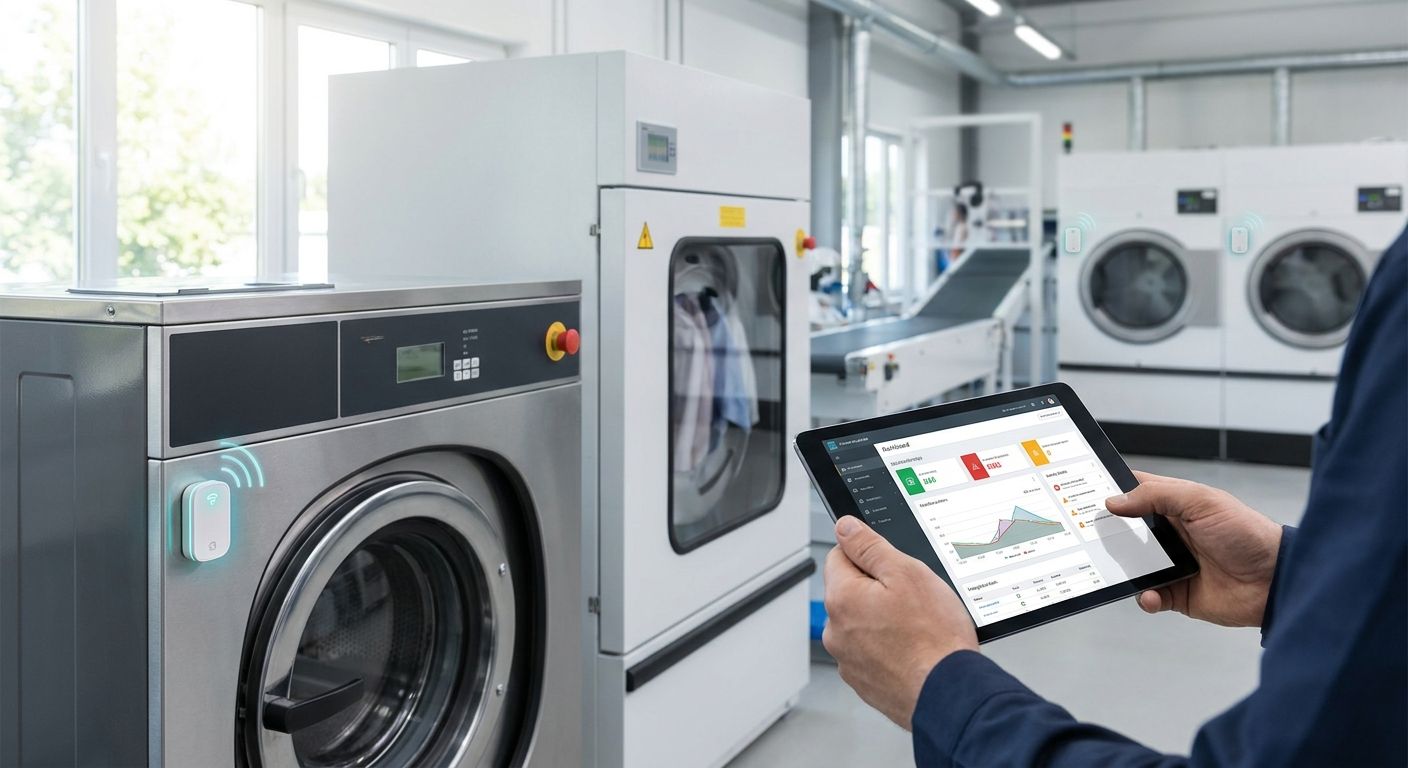
Commercial laundry and dry cleaning equipment monitoring means putting temperature, vibration, water, and chemical-storage sensors on washer-extractors, dryers, boilers and press rooms so a threshold breach fires an alarm before it becomes a burst pipe, a scorched load, or a compliance citation. A single-location dry cleaner and a 40-store laundromat chain both need the same core readings, but the chain also needs one dashboard that rolls every site up without a facilities manager driving between them.
The category has its own failure modes that generic building sensors miss: perc vapor buildup in a solvent storage room, a steam trap that fails open and wastes boiler capacity, a washer-extractor bearing that starts vibrating outside its normal band hours before it seizes. Those are the readings this guide walks through.
- IoT monitoring for commercial laundry and dry cleaning ties temperature, vibration, water-leak and chemical-storage sensors to threshold alarms so staff catch a fault before a shutdown.
- OSHA's 8-hour exposure limit for perchloroethylene is 100 ppm under 29 CFR 1910.1000 Table Z-1 — ventilation and storage monitoring exist to stay under that number.
- Kilo Cloud runs free for up to 5 devices and 1 rule, then 25 EUR/month for up to 25 devices, with no cellular contract to manage.
- Vibration and water-leak sensors belong on washer-extractor motors, pumps and boiler rooms first — those are the highest-cost failure points in a plant.
Why commercial laundries and dry cleaners need iot monitoring
A washer-extractor bearing failure or a boiler pressure fault doesn't just cost repair parts — it stops every downstream machine in the plant for the rest of the shift. Multi-site operators running laundromats, hospital linen contracts, or dry cleaning franchises carry that risk at every location simultaneously, and a paper log checked once per shift won't catch a 2 a.m. temperature swing in an unattended plant.
Dry cleaning plants using perchloroethylene also answer to the EPA's National Emission Standards for Perchloroethylene Dry Cleaning Facilities (40 CFR Part 63, Subpart M) and to OSHA's 100 ppm 8-hour exposure limit. Those aren't optional in 2026, and a facility that can't produce a monitoring record when an inspector asks is exposed regardless of whether the equipment was actually running clean. The Kilo IoT Platform exists to put those readings on a timeline instead of a clipboard, whether the plant runs one storefront or forty.
How to monitor commercial laundry and dry cleaning equipment with IoT
Map every washer, dryer, boiler and chemical storage point
Before any sensor goes up, walk the floor and list every asset that can cause downtime, damage, or a compliance gap if it fails unnoticed.
- Washer-extractors and their drive motors
- Dryers and their exhaust ducting
- Boiler or steam plant, including traps and condensate return
- Perc or hydrocarbon solvent storage and still rooms
- Press and finishing equipment with steam lines
- Water supply lines and floor drains near equipment
Set temperature and humidity thresholds for dryers and press rooms
A dryer running hotter than its cycle calls for scorches fabric and wastes gas; a press room running too humid slows finishing and promotes mildew on stored garments.
- Log dryer exhaust and drum temperature on a paper chart every shift as a baseline (free, but easy to miss a spike between checks)
- Place a wireless temperature and humidity sensor near each dryer and in the press room
- Set a threshold rule in Kilo Cloud so a reading above your cycle spec fires a warning-tier alarm before the load is ruined
- Route repeat threshold breaches to a maintenance ticket instead of a one-off text
Track vibration and runtime on washer-extractor motors and pumps
Washer-extractor motors and circulation pumps run for thousands of hours a year in a busy plant, and a bearing that starts running rough gives off a vibration signature well before it seizes.
- Listen for grinding or squealing during a manual walk-through (cheap, but inconsistent between staff)
- Mount a vibration sensor on the motor housing or pump body
- Build a CEL rule in Kilo's vibration monitoring setup for pumps and motors that fires an alarm when the reading moves outside its normal band
- Track runtime hours per machine so replacement parts get ordered ahead of a shutdown, not during one
Monitor water and steam leaks before they cause damage
A slow leak under a washer-extractor or a failed steam trap can run for days before anyone notices standing water or a spike in the water bill.
- Check floor drains and steam trap discharge visually each shift
- Place a water-leak rope or point sensor under high-risk machines and near floor drains
- Set an immediate alarm on any leak-sensor trigger, since this failure mode has no acceptable delay
- Pair leak alerts with a shut-off valve process for staff to follow, since Kilo's rule fires the alarm rather than closing the valve itself
Watch chemical storage and ventilation for solvent compliance
Perc and hydrocarbon solvent rooms need airflow and vapor levels held below OSHA's 100 ppm 8-hour PEL, and NFPA 32 sets the fire and ventilation baseline for the room itself.
- Run manual vapor spot-checks with a handheld meter on a set schedule
- Install a continuous air-quality or VOC sensor in the storage and still room
- Set a low-severity alarm at an early warning level and a high-severity alarm before the room approaches the OSHA limit
- Keep the alarm history as your audit trail for an EPA Subpart M inspection
Build alarm escalation so the right technician gets notified
An alarm nobody sees for six hours is worse than no alarm at all, especially on an unattended overnight shift.
- Post a paper escalation list by the phone as a fallback
- Configure multi-step alarm escalation so a missed acknowledgment bumps the alert to a supervisor
- Set quiet hours for low-severity notices so overnight staff only get woken for genuine emergencies
- Centralize every alarm in one inbox instead of scattering texts across personal phones
Track energy and water use by machine and shift
Gas, electricity and water are the three biggest variable costs in a laundry plant, and per-machine data shows which units are running inefficiently long before a bill spike does.
- Read the utility meter monthly and divide by load count as a rough baseline
- Meter individual machines or circuits with an MQTT-connected power meter
- Build a dashboard that breaks down consumption by machine and by shift
- Compare energy per load across sister locations to spot the outlier plant
Comparing monitoring options for commercial laundry and dry cleaning
| Option | Best for | Starting price | Key limitation |
|---|---|---|---|
| Manual paper logs | A single storefront checking gauges once a shift | No software cost | Misses anything between checks, no alarm |
| Standalone USB/Wi-Fi data loggers | Spot-checking one dryer or boiler | Varies by device | No live alerting, data has to be pulled by hand |
| Building management system (BMS) | Large plants with an existing HVAC control system | Typically a capital project | Rarely extends to washer-extractors or solvent rooms |
| Kilo Cloud (LoRaWAN/mioty/MQTT + rules engine) | Single or multi-site operators wanting live alarms and one dashboard | Free for up to 5 devices, 25 EUR/month for up to 25 devices | Requires sensors on each monitored point, sourced through Kilo Electronics or your existing MQTT devices |
See the Kilo IoT Platform in action
Free tier covers up to 5 devices, 1 dashboard, 1 rule, no card required.
Common mistakes commercial laundry and dry cleaning operators make with iot monitoring
- Monitoring dryers but not the boiler. A boiler pressure fault or a failed condensate return stalls every machine downstream of it, yet plants often wire up dryer alarms first and leave the boiler on a manual gauge.
- Treating a leak alert as low priority. Water under a washer-extractor spreads fast; routing it through the same escalation as a routine temperature reminder delays a response that needs to be immediate.
- Skipping the solvent room. Perc storage and still rooms are the highest compliance exposure in a dry cleaning plant, and they're the area most often left off the sensor plan.
- No escalation past the first alert. A single SMS to one manager's phone fails the moment that manager is off-site or asleep; alarms need a second and third step.
- Comparing machines without normalizing for load volume. Raw energy or water totals across sister locations mislead when one site simply runs more loads per week than another.
FAQ
What is iot monitoring for commercial laundry and dry cleaning equipment?
It's the use of wireless sensors — temperature, vibration, water-leak and chemical-storage — connected to a platform like Kilo Cloud that fires an alarm when a reading crosses a set threshold. It replaces manual gauge checks with a continuous record and live alerts.
How much does iot monitoring cost for a laundry or dry cleaning plant?
Kilo Cloud runs free for up to 5 devices, 1 dashboard and 1 rule with no card required, and 25 EUR per month for up to 25 devices on the Starter plan. Sensor hardware is a separate cost through a supplier like Kilo Electronics.
What is the OSHA exposure limit for perchloroethylene in dry cleaning?
OSHA sets the 8-hour permissible exposure limit for perc at 100 ppm under 29 CFR 1910.1000 Table Z-1. Continuous air-quality monitoring in the solvent storage room gives an early warning before that limit is approached.
Can IoT sensors predict when a washer-extractor motor will fail?
Kilo's vibration sensors report a live reading against a threshold you set, and a CEL rule fires an alarm when the vibration signature moves outside its normal band. That flags a developing problem early; it does not forecast a failure date.
Do I need a cellular connection to monitor a laundry plant with IoT sensors?
No. Kilo Cloud runs its own LoRaWAN and mioty network server, so sensors connect over a local gateway rather than requiring a cellular data plan for each device.
What sensors matter most for a dry cleaning plant's compliance record?
Air-quality or VOC sensors in the solvent storage and still room, paired with alarm history, give you the audit trail an EPA Subpart M inspection or an OSHA review asks for. Boiler pressure and water-leak sensors matter most for preventing downtime.
How do alarms get escalated if the first person doesn't respond?
Kilo's alarm system supports multi-step escalation chains across email, SMS and push, so an unacknowledged alert automatically bumps to the next person on the list. Quiet hours can be set separately for low-severity notices.
Is a building management system enough for laundry equipment monitoring?
A BMS typically covers HVAC and general building systems but rarely extends to washer-extractors, press equipment, or solvent storage rooms. Most laundry and dry cleaning operators add a dedicated sensor layer for that equipment.
What laundry chains should wire up first in 2026
Start with the boiler room and the solvent storage area before the dryers, because those two carry the highest cost of failure and the clearest compliance exposure under NFPA 32 and EPA Subpart M. A dryer running hot ruins one load; a boiler fault or an unmonitored perc room can shut a plant down or trigger a citation, and both are still running on a manual gauge check in most facilities as of 2026.