
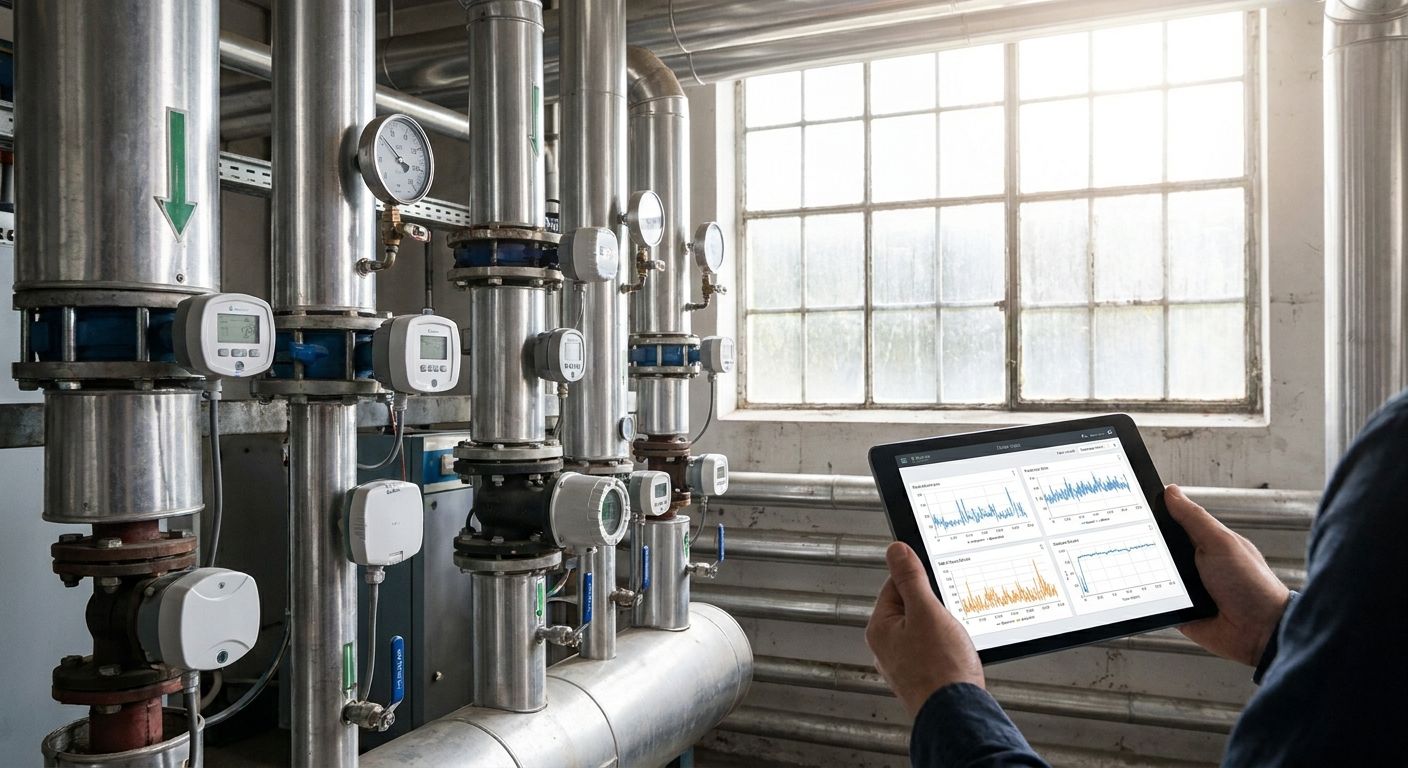
Boiler rooms fail quietly until they don't — a stuck low-water cutoff, a slow CO leak, a steam trap that's been blowing through for three weeks. The best IoT sensors for boiler room monitoring in 2026 cover four things at once: combustion safety, pressure and temperature trending, water intrusion, and mechanical wear on pumps and fans.
- CO sensors and differential pressure sensors are the two non-negotiable picks for boiler room monitoring in 2026 — buy both.
- OSHA's CO exposure limit is 50 ppm as an 8-hour time-weighted average, per 29 CFR 1910.1000.
- Vibration sensors on feed pumps are a hold, not a day-one buy, until you have a baseline.
- Wireless combustion analyzers replacing burner management systems are a skip — that's a certified control, not a bolt-on sensor.
- LoRaWAN and mioty both avoid the cellular SIM and subscription problem for basement boiler rooms with weak signal.
What sensors do you need for boiler room monitoring?
A boiler room deployment needs sensors for four failure modes, not one. Pressure vessels covered by the ASME Boiler and Pressure Vessel Code need temperature and pressure trending. Combustion equipment covered by NFPA 85 needs gas detection. Floor drains and condensate lines need water sensing. Rotating equipment — feed pumps, draft fans, blower motors — needs vibration data before a bearing seizes.
Most facilities teams start with a single boiler room monitoring system for commercial buildings and expand sensor coverage as budget allows. That's the right order: get temperature, pressure, and CO wired to alarms first, then layer in vibration and humidity once the basics are proven out.
Every sensor on this list reports over LoRaWAN, mioty, or MQTT — no cellular SIMs, because boiler rooms sit in basements and mechanical penthouses where cell signal is already weak before you add steel and concrete.
How are these boiler room sensors ranked?
Each sensor type here is ranked on three criteria: how directly it maps to a documented safety standard (OSHA, NFPA, ASME), how fast it changes from "nice to have" to "why didn't we have this," and how easily it reports over a wireless protocol without new conduit runs. Sensors tied to a hard regulatory limit — CO, pressure — rank above sensors that improve maintenance planning but aren't required by code.
The verdicts (Buy / Hold / Wait / Skip) describe priority for a typical commercial or institutional boiler room in 2026, not a judgment on any single vendor's hardware.
What are the best IoT sensors for boiler room monitoring in 2026?
Clamp-on pipe temperature sensors
A strap-on RTD or thermocouple on the supply and return lines gives you the cheapest early-warning signal in the room. If supply temperature drifts outside the setpoint band for more than a few minutes, something upstream — a failed aquastat, a stuck valve — is already wrong. Pair it with a rule that fires an alarm after a sustained deviation rather than a single spike, since a five-second reading blip isn't a five-minute problem. Buy.
Differential pressure sensors on steam traps and gas trains
Steam traps that fail open waste steam continuously and show up as a flat or falling differential pressure reading. Gas train pressure switches are already required hardware on most fired boilers under ASME CSD-1; adding a wireless differential pressure sensor gives you a trend line instead of a pass/fail switch state. This is the sensor that pays for itself fastest on a steam system with more than a handful of traps. Buy.
Carbon monoxide (CO) sensors
OSHA sets the CO exposure limit at 50 ppm as an 8-hour time-weighted average under 29 CFR 1910.1000, and NIOSH lists 1,200 ppm as immediately dangerous to life or health. A boiler room CO sensor tied to an alarm with escalation — not just a local beeper — gets the right person notified before levels climb from a nuisance reading to a life-safety event. This overlaps with broader gas leak detection sensors coverage if the same room also houses natural gas piping. Buy.
Water leak rope and point sensors
Condensate lines, floor drains, and expansion tank overflow ports are the usual suspects for boiler room flooding. A rope sensor run along the floor perimeter or a point sensor at the drain catches water before it reaches switchgear or a VFD cabinet. Cheap to install, wireless, and the kind of sensor nobody misses until the one time it's not there. Buy.
Vibration sensors on feed pumps and draft fan motors
Vibration monitoring on rotating equipment is genuinely useful, but it needs a baseline reading before the alarm thresholds mean anything — a fresh install with no historical trend just produces noise. If you already run vibration monitoring for pumps and motors elsewhere in the plant, extending it to the boiler feed pumps is a natural next step. If this is your first vibration deployment, get 60-90 days of baseline data before you trust the alarm. Hold.
Humidity sensors
Humidity in the boiler room matters for corrosion on control panels and unpainted steel, but it's a slower-moving risk than pressure or gas. Worth adding once temperature, pressure, and CO are covered, not before. Hold.
Wireless combustion analyzers replacing burner management systems
A bolt-on wireless sensor is not a substitute for a UL-listed flame safeguard control integrated into the burner management system. NFPA 85 requires certified safety controls for flame supervision, and no wireless retrofit sensor meets that requirement — it monitors, it doesn't safeguard. Don't let a sensor vendor pitch this as a BMS replacement. Skip.
Boiler room sensor comparison table
| Sensor type | What it measures | Typical connectivity | Priority in 2026 |
|---|---|---|---|
| Clamp-on pipe temperature | Supply/return line temp drift | LoRaWAN, mioty | Buy |
| Differential pressure | Steam trap and gas train status | LoRaWAN, MQTT | Buy |
| CO gas sensor | Combustion byproduct concentration | LoRaWAN, mioty | Buy |
| Water leak rope/point | Floor and drain water intrusion | LoRaWAN | Buy |
| Vibration | Pump/fan bearing and shaft health | LoRaWAN, mioty | Hold |
| Humidity | Corrosion risk on panels and steel | LoRaWAN | Hold |
| Wireless combustion analyzer (as BMS replacement) | Flame/combustion state | N/A | Skip |
See every boiler room sensor on one dashboard
Ingest LoRaWAN, mioty, and MQTT sensors into one rules engine and alarm chain.
Where can you buy IoT sensors for boiler room monitoring?
Sensor hardware — temperature probes, pressure transducers, CO detectors, water rope sensors — is sold separately from the software that ingests and alarms on the data. Kilo Electronics, Kilo's sister hardware company, ships pre-configured sensors worldwide and is a reasonable starting point if you don't already have a preferred sensor vendor.
On the software side, the Kilo IoT Platform runs a built-in LoRaWAN and mioty network server, so there's no separate network server to stand up, plus an MQTT connector for any publishing device, PLC, or existing BMS output. Every sensor type above lands on a per-device digital twin, and the visual rules engine (BPMN with CEL expressions) is where you set the actual alarm logic — say, differential pressure below a set point for more than two minutes, or CO above threshold for any duration, escalating through a defined chain to the on-call facilities lead.
Three sourcing rules worth following:
- Match protocol to the room, not the catalog. A basement boiler room with thick concrete and low cellular signal is exactly where LoRaWAN or mioty outperform anything needing a cellular SIM.
- Buy alarms, not just readings. A sensor that logs data with nobody watching it doesn't prevent anything — the value is in the escalation chain, not the chart.
- Start with the four Buy-rated sensor types. Temperature, pressure, CO, and water leak coverage handle the majority of boiler room incident categories before vibration or humidity add marginal value.
FAQ
What is the best sensor for boiler room CO monitoring?
A wireless CO sensor reporting continuously over LoRaWAN or mioty, alarmed against OSHA's 50 ppm 8-hour time-weighted average limit, is the standard choice for 2026 boiler room deployments. Tie it to an escalation chain, not just a local beeper, so the right person gets notified immediately.
How often should boiler room temperature sensors report data?
Most boiler room temperature sensors report every 5-15 minutes, which is fast enough to catch a sustained drift without draining battery life. Faster reporting intervals matter more for pressure and CO than for slow-moving temperature trends.
Is LoRaWAN or MQTT better for boiler room sensors?
LoRaWAN is better for new wireless sensor deployments in a boiler room because it needs no wiring and handles concrete and steel better than Wi-Fi. MQTT is the right choice when you're pulling data from an existing PLC, energy meter, or BMS output that already publishes over that protocol.
How much does IoT boiler room monitoring cost?
Software cost varies by platform and device count — Kilo's free tier covers up to 5 devices and 1 dashboard at 0 EUR with no card required, and the Starter tier is 25 EUR per month for up to 25 devices. Hardware cost depends on sensor type and vendor and should be quoted separately.
Can IoT sensors replace boiler safety controls?
No. Wireless IoT sensors monitor and alarm on conditions, but they don't replace certified safety controls like flame safeguards or low-water cutoffs required under codes such as ASME CSD-1 and NFPA 85. Sensors add visibility on top of existing certified controls, not instead of them.
How do you monitor water leaks in a boiler room?
A rope-style leak sensor run along the floor perimeter near drains, or a point sensor placed directly at the condensate drain and expansion tank overflow, catches water intrusion early. Wireless leak sensors avoid the wiring runs a hardwired float switch would need in an already-crowded mechanical room.
What's the difference between mioty and LoRaWAN for boiler rooms?
Both are low-power wide-area protocols suited to basement and mechanical room deployments without cellular signal, and both avoid subscription SIM costs. The practical difference in 2026 is ecosystem and sensor availability per vendor rather than a fundamental performance gap for a single-room deployment.
Do boiler room sensors need a gateway?
Yes, LoRaWAN and mioty sensors need at least one gateway within range to relay readings to the network server. A single gateway typically covers an entire mechanical room and often several adjacent floors, depending on building construction.
What do facilities teams miss about boiler room sensor deployments?
The gap isn't sensor coverage — it's alarm fatigue. A CO sensor that pages the on-call tech for every 2 ppm fluctuation gets ignored by month two, and the one real event gets treated the same as the false ones. Set thresholds against the actual regulatory numbers — 50 ppm TWA, not an arbitrary round number — and require a sustained duration before escalating, the same logic that works for temperature and pressure. Boiler room monitoring built this way in 2026 stays trusted instead of muted.