
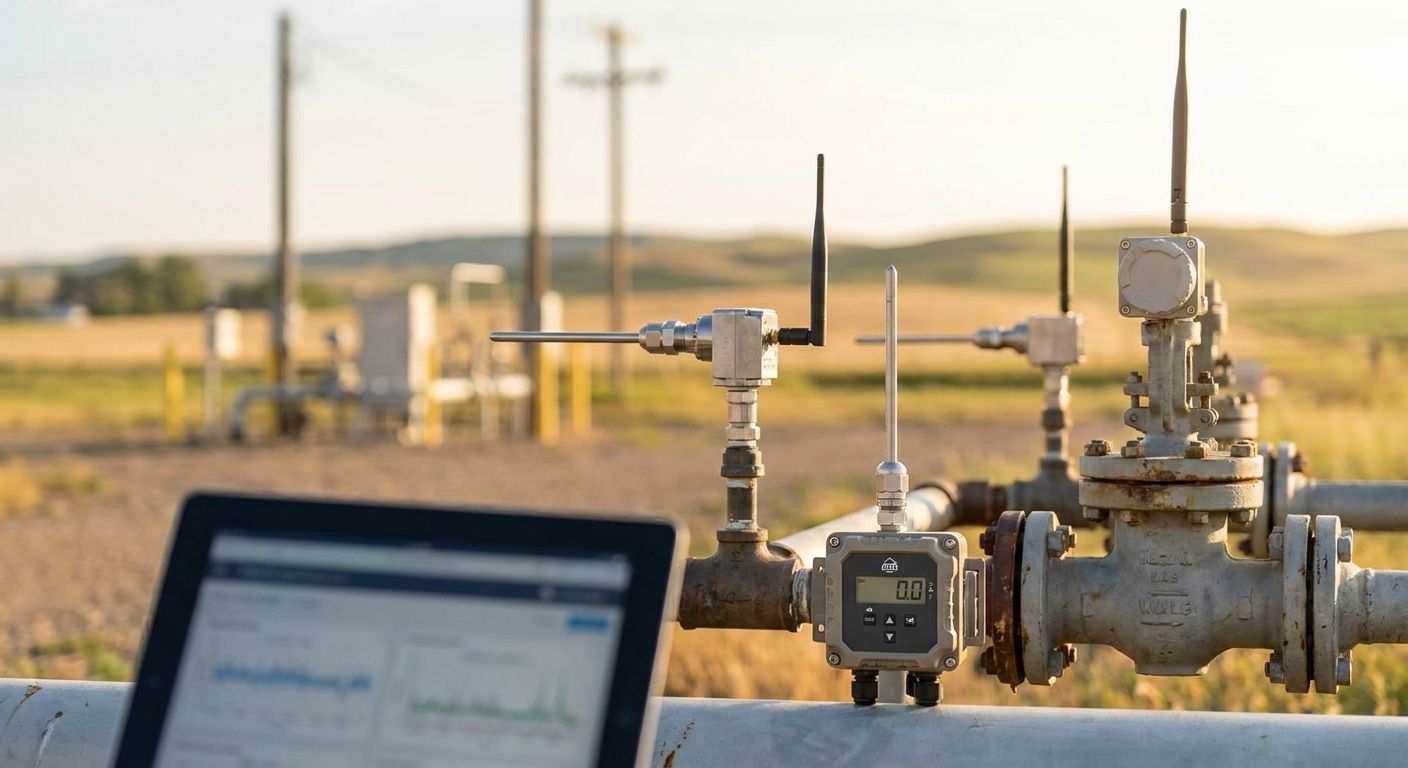
Methane sensors range from cheap semiconductor chips to open-path lasers that scan roughly 200 meters, and picking the wrong one means either false alarms every week or missing a leak until an inspector finds it first. This guide ranks the sensor types that actually work for IoT-connected methane leak detection in 2026, from confined-space catalytic bead units to wireless transmitters that report straight into a cloud dashboard.
- The best IoT sensors for methane leak detection split by environment: NDIR wins in oxygen-poor spaces, catalytic bead wins on general floors — buy accordingly.
- Catalytic bead (pellistor) sensors stay the default for 0-100% LEL floor monitoring in 2026 — buy for routine industrial coverage.
- Open-path laser sensors cover roughly 200 meters per path for fenceline monitoring — consider for tank farms and compressor stations, skip for single rooms.
- Semiconductor (MOS) sensors are the cheapest option but drift with humidity — consider for secondary alerts only, skip for compliance readings.
- Wireless gas transmitters feeding a platform like Kilo over LoRaWAN or MQTT replace a wall-mounted panel with automatic escalation — buy for multi-site operators.
Why methane leak detection needs sensor-specific IoT hardware
Methane's lower explosive limit is 5% by volume in air, or 50,000 ppm, per NFPA 325 — and the sensor technology you pick determines how early you see a reading climb toward that number, not just whether you eventually get an alarm. A catalytic bead sensor needs oxygen in the room to burn the gas against its element; drop O2 below about 10-12% and the same sensor that worked fine yesterday goes quiet exactly when a confined space gets dangerous. That single failure mode is why IoT methane leak detection for industrial sites has to start with matching sensor chemistry to the atmosphere, not just buying whatever detector is cheapest per unit.
Industry practice under NFPA guidance for combustible gas detection calls for two-stage alarms, commonly set at 10% and 20% of LEL, so a facility gets a warning stage before it hits an evacuation-level reading. The EPA's 2024 methane rule for oil and gas sources (NSPS OOOOb) pushes the same logic further out, requiring leak detection and repair surveys as frequent as monthly at some well sites using optical gas imaging or an approved continuous-monitoring alternative. Neither standard tells you which sensor to buy — that's a job-site decision, and it's the one this guide answers.
How these IoT sensors for methane leak detection are ranked
Rankings below weigh four factors pulled from published sensor specifications and the standards cited throughout: sensitivity range against the NFPA 325 lower explosive limit, response time, resistance to false alarms from sensor poisoning (silicones, sulfur compounds, and humidity swings), and compatibility with wireless IoT connectivity — LoRaWAN, mioty, MQTT, or a straight 4-20mA transmitter feeding a gateway. No unit was physically tested for this guide; the comparisons draw from manufacturer datasheet ranges and the compliance standards referenced above, not from a lab run.
Best IoT sensors for methane leak detection, ranked
1. Catalytic bead (pellistor) sensors — the workhorse
Catalytic bead sensors burn combustible gas against a heated element and read the temperature change as a percentage of LEL, typically across the full 0-100% LEL range. They're the standard choice for general industrial floors, equipment rooms, and boiler areas where oxygen levels stay normal. Response is fast — most units hit T90 in under 30 seconds — but the element degrades when exposed to silicone vapors or leaded compounds, so calibration schedules matter more than the sticker price. Verdict: Buy for routine floor-level monitoring in ambient-air environments.
2. Non-dispersive infrared (NDIR) point sensors — the precision pick
NDIR sensors detect methane by measuring infrared absorption at its 3.3-micron band instead of burning the gas, which means they keep working in low-oxygen or inert atmospheres where a catalytic bead sensor stalls. That makes them the right call for cold storage rooms, wastewater digesters, and any confined space where nitrogen purging or CO2 buildup is a real possibility. They cost more per unit than catalytic bead sensors and don't suffer the same poisoning risk from sulfur or silicone exposure. Verdict: Buy for oxygen-variable or confined-space applications.
3. Open-path (TDLAS) laser sensors — the perimeter option
Open-path sensors shoot a laser between a transmitter and receiver and read the average methane concentration across the whole path, which can run close to 200 meters depending on the model. That path-average reading is built for fenceline and boundary monitoring at tank farms, compressor stations, and processing sites — exactly the kind of continuous perimeter coverage the EPA's fenceline monitoring provisions are pushing operators toward. It's the wrong tool for a single equipment room, since it reports an average across the whole beam, not a point concentration. Verdict: Consider for large outdoor sites, skip for indoor point monitoring.
4. Semiconductor (MOS) sensors — the budget pick
Metal-oxide semiconductor sensors are the cheapest combustible-gas detection option on the market and show up in a lot of light-commercial and consumer gas alarms. They're sensitive enough for early warning but drift with humidity changes and have a shorter service life than catalytic bead or NDIR heads, which makes them unreliable as the sole sensor behind a compliance-grade alarm. Verdict: Consider for secondary or supplementary alerting, skip for anything tied to a regulatory reporting requirement.
5. Electrochemical multi-gas combos — the confined-space play
Electrochemical sensors paired into a multi-gas head — methane plus H2S plus O2 — are standard equipment for confined space entry in wastewater plants, manure pits, and livestock operations where more than one hazard is in play at once. They read the asphyxiant and toxic gas risk alongside the combustible gas reading, which a single-gas catalytic or NDIR unit can't do on its own. Verdict: Buy for any confined-space entry program that needs multi-hazard coverage in one device.
6. Wireless transmitters into a cloud platform — the multi-site play
Any of the sensor heads above can pair with a wireless transmitter that reports over LoRaWAN, mioty, or MQTT into a cloud IoT platform instead of a local horn-and-strobe panel wired to one building. A 4-20mA gas transmitter connects through Kilo's MQTT connector, and the visual rules engine (BPMN with CEL expressions) can encode logic like "if methane exceeds 10% LEL for 60 seconds, escalate to the shift supervisor" with version control and one-click rollback if the rule needs adjusting. Alarms carry five severity tiers and multi-step escalation chains across email, SMS, and push, and each sensor sits on a digital twin of the site so a reading maps to an actual location instead of a bare device ID. Verdict: Buy for operators managing more than one site who need centralized alarming instead of a panel per building.
See methane alarms on a live site model
Map gas sensors to a digital twin and set escalation rules without writing code.
Methane leak detection sensor comparison table
| Sensor type | Works without O2 | Typical response time | Best for | Verdict |
|---|---|---|---|---|
| Catalytic bead | No | Under 30 sec | General industrial floors | Buy |
| NDIR infrared | Yes | Under 60 sec | Cold storage, confined spaces | Buy |
| Open-path laser (TDLAS) | Yes | Continuous scan | Fenceline, tank farm perimeter | Consider |
| Semiconductor (MOS) | No | Under 60 sec | Low-cost secondary alerts | Consider |
| Electrochemical multi-gas | Partial (reads O2 directly) | Under 60 sec | Confined space entry | Buy |
| Wireless transmitter + cloud platform | Depends on paired head | Depends on paired head | Multi-site alarm centralization | Buy |
Where to buy methane leak detection sensors for IoT deployments
- Confirm the hazardous-location rating before you order. Any sensor going into a classified area needs ATEX, IECEx, or UL/cCSAus certification for that specific zone — a sensor without the right rating isn't legal to install there, regardless of how good the datasheet looks.
- Match the output to what your platform can ingest. A 4-20mA loop, Modbus RTU, RS-485, or dry contact output only helps if your gateway or MQTT connector can actually read it — check that before the sensor ships, not after it's mounted.
- Price the calibration schedule, not just the unit. Catalytic bead heads typically need more frequent bump testing than NDIR units, and that recurring labor cost usually outweighs the difference in sticker price over a multi-year deployment.
Every sensor location on a pipeline right-of-way also needs a coordinate that survives an audit, and a handheld consumer GPS unit isn't precise enough for a compliance-grade leak survey map. Survey-grade positioning matters just as much for pipeline installation teams as detector spacing does — a few centimeters of drift on a leak survey plot can misattribute a reading to the wrong valve segment when regulators come asking which sensor caught what.
For sites spread across remote well pads or compressor stations, the sensor selection question usually gets tangled up with a connectivity question too — see how an industrial IoT platform for oil and gas remote sites handles sites where pulling a wired panel isn't realistic.
What most methane leak detection plans get wrong
Most sites over-invest in the sensor and under-invest in the alarm logic behind it. A catalytic bead sensor reading 15% LEL is meaningless if the alert sits in an email inbox nobody checks after hours — the rules engine software for industrial IoT alarms that routes that reading to the right person, on the right severity tier, at the right hour, matters as much as the sensor chemistry itself. A single-stage alarm without an escalation chain behind it is the most common gap in a methane monitoring setup, and it's the cheapest one to fix.
FAQ
What's the best IoT sensor for methane leak detection?
There's no single best sensor — NDIR infrared wins in low-oxygen or confined spaces, and catalytic bead sensors win on general industrial floors with normal ambient air. Match sensor chemistry to the atmosphere first, then add wireless connectivity.
Is NDIR better than catalytic bead for methane detection?
NDIR is better in oxygen-variable environments because it doesn't need ambient O2 to function, and it's less prone to poisoning from silicone or sulfur exposure. Catalytic bead sensors are cheaper and faster to deploy where oxygen levels stay normal.
How much methane triggers a leak alarm?
Methane's lower explosive limit is 5% by volume in air, or 50,000 ppm, per NFPA 325. Industry practice sets two-stage alarms at 10% and 20% of that LEL, giving a warning stage before an evacuation-level reading.
Can wireless gas sensors work without cellular signal?
Yes — LoRaWAN and mioty gas transmitters report over long-range radio to a gateway rather than a cellular connection, which is why they're common at remote well pads and pipeline sites with no cell coverage.
Do methane sensors work in cold storage or freezers?
NDIR infrared sensors handle cold storage well because they don't rely on catalytic combustion, which can behave inconsistently in low-oxygen or highly controlled atmospheres. Catalytic bead sensors are a poorer fit for those spaces.
How often do combustible gas sensors need calibration?
Calibration intervals vary by sensor type and manufacturer, but catalytic bead heads generally need more frequent bump testing than NDIR units due to element poisoning risk. Check the datasheet calibration schedule before ordering, since it drives long-term cost more than the unit price does.
What does the EPA require for methane leak detection at oil and gas sites?
The EPA's 2024 methane rule (NSPS OOOOb) requires leak detection and repair surveys as frequent as monthly at some well sites, using optical gas imaging or an approved continuous-monitoring alternative. Requirements vary by site type and equipment.
Can existing gas detectors connect to an IoT dashboard?
Most 4-20mA, Modbus, or dry-contact gas transmitters can connect into a cloud IoT platform through an MQTT connector without replacing the sensor head itself. That lets a facility keep its existing certified sensors while adding remote alarming and escalation.
What most operators miss until an audit forces the question
The sensor rarely fails first — the escalation path does. A methane reading that only lights a panel in an empty control room is functionally the same as no reading at all, and the fix costs nothing more than configuring an alarm severity tier and a contact list correctly in 2026 rather than after an inspection finds the gap.