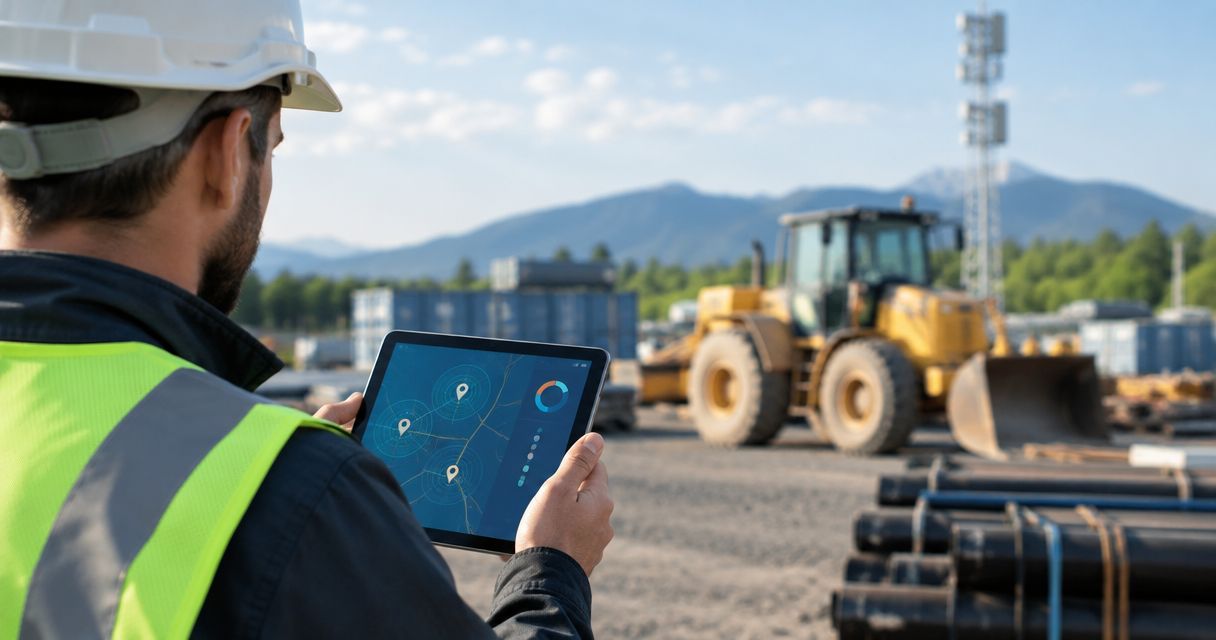
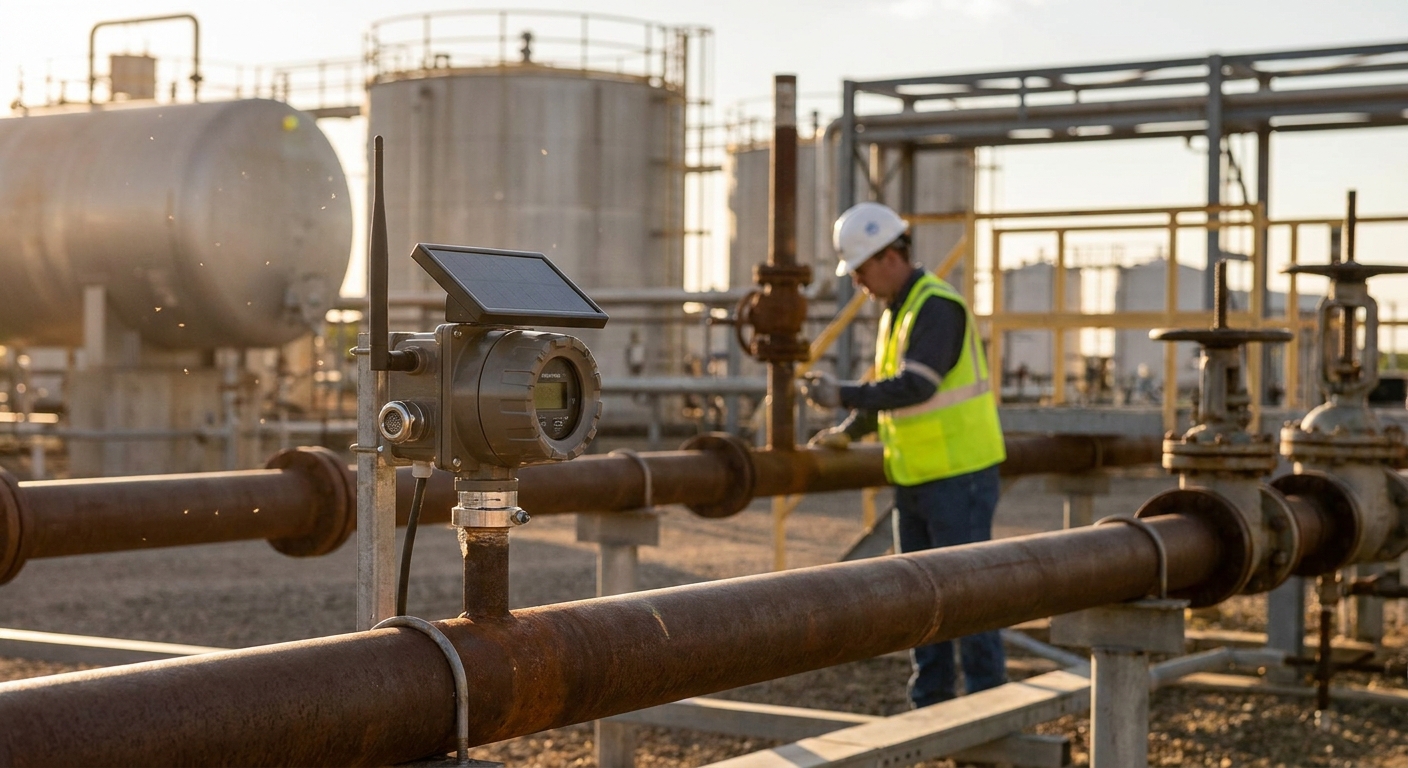
Fugitive methane escapes from valve packing, compressor seals, and digester headspace long before a scheduled leak survey ever gets there. IoT methane leak detection for industrial sites closes that gap with fixed sensors that report continuously instead of quarterly.
- IoT methane leak detection for industrial sites works best on oil and gas well pads, wastewater digesters, and compressor stations — Buy for 2026 rollouts.
- Methane's lower explosive limit is 5% by volume; most industrial alarms trigger at 10% of that LEL, not the full limit.
- LoRaWAN and mioty connectivity outperform WiFi-based sensors on sites with patchy or nonexistent wireless coverage.
- Skip consumer-grade gas sensors without hazardous-area certification — they read wrong in a classified zone and create false confidence.
Why this matters
Methane is combustible between 5% and 15% by volume in air — the lower and upper explosive limits that any gas detection program is built around. Most industrial alarm systems don't wait for the full 5%: they trigger at 10% of the LEL, roughly 0.5% methane in air, giving crews time to isolate a source before it reaches a combustible mix.
The financial pressure runs separate from the safety case. A slow leak at a compressor seal or a digester roof vent can run for weeks between manual leak detection and repair rounds, and every cubic foot vented is lost product plus a liability heading into 2026 reporting cycles. IoT methane leak detection for industrial sites replaces the quarterly walk-around with sensors that report every few minutes, all year.
Who this is for
This fits operations and EHS teams running sites where methane is a byproduct of the process, not an accident: oil and gas remote well pads and compressor stations, wastewater treatment plants running anaerobic digesters, landfill gas collection fields, and food and beverage plants recovering biogas. If valves, flanges, seals, or a digester roof can vent on your site, continuous sensing beats a walk-around every time.
What to look for in IoT methane leak detection for industrial sites
Sensor technology matched to the concentration range
Catalytic bead sensors read percent-LEL and work well confirming high-concentration leaks near compressors. Infrared (NDIR) sensors don't need oxygen to function, so they survive low-oxygen environments like a digester headspace. Electrochemical sensors give low-ppm resolution for catching a leak before it gets anywhere near combustible range. Pick the technology for the concentration band you actually expect, not the cheapest sensor in the catalog.
Hazardous-area certification
A sensor sitting in a classified Zone 1 or Zone 2 area needs ATEX or IECEx certification for that specific zone. A sensor without the right rating is a liability, not a monitoring tool. Confirm the classification of every mounting point before ordering hardware, not after it's installed.
Wireless range and battery life
LoRaWAN and mioty read through metal tank farms and across acreage that WiFi and Bluetooth can't reach, and a well-specified sensor on either protocol runs for years on one battery instead of needing a wired power run to every valve. On a site spread across a few hundred acres, that's the difference between covering 20 points and covering 200.
Alarm logic that filters noise
A raw ppm reading isn't an alarm on its own — it needs a rules engine for industrial alarms that separates a brief calibration drift from a sustained rise, and escalates the second one to a phone call instead of a dashboard color change.
Multi-site visibility
One dashboard, not five spreadsheets. If you run more than one site, a shared view across facilities matters more than any single sensor's spec sheet, and it's the only way a regional EHS lead sees a trend developing across three sites at once.
AI-assisted setup
An AI integrator that can provision a new methane sensor and build its alarm threshold from a plain-language description cuts setup time from a week of manual configuration to an afternoon — and it confirms the rule against your actual deployment instead of a generic template.
Top picks by site type
Oil and gas well pads and compressor stations — the highest-stakes site. Fugitive emissions come from valve packing and compressor seals spread across dozens of wellheads on a single pad. A continuous sensor network reporting every few minutes replaces a quarterly LDAR pass with year-round coverage. Buy for any operator running unmanned or lightly staffed pads in 2026.
Wastewater treatment plants and anaerobic digesters — the one everyone forgets. Raw biogas runs 60-70% methane by volume, well above the LEL if it vents unburned from a digester roof or a cracked seal. This is wastewater treatment plant monitoring territory, and most plants still rely on periodic handheld checks for a source that's producing gas continuously. Buy if you're running a digester.
Remote pipeline right-of-way and unmanned stations in extreme climates — the wildcard. A sensor exposed to -40°C winters or 50°C summers without a weatherized enclosure will drift or fail outright, which is exactly the outcome you can't afford on an unmanned site. Check the outdoor sensor selection guide before ordering hardware for these sites. Consider, and budget for enclosure hardware alongside the sensor.
Multi-site manufacturers with occasional gas use — the low-frequency risk that still needs coverage. Boilers and gas-fired ovens historically got checked with a handheld detector twice a shift, which leaves 14 hours of blind spots between checks. Consider fixed sensing on these points if a shift change or a busy production run has ever meant a check got skipped.
What to avoid
- Rebranded smoke or CO detectors marketed as "gas sensors." They're not calibrated for methane's concentration range and rarely carry hazardous-area ratings.
- WiFi-only sensors on sites with weak wireless infrastructure. A sensor that drops off the network during the exact week coverage degrades shows "last seen" on the dashboard instead of a real reading — that's worse than no sensor because it looks like monitoring.
- Single point-of-detection strategies. One sensor on the biggest known leak point misses the slow leak on the valve nobody's watched in five years.
Verdict comparison
| Site Type | Methane Source | Key Requirement | Verdict |
|---|---|---|---|
| Oil & gas well pads / compressor stations | Valve packing, compressor seals | Wide-area wireless, 10% LEL alarm threshold | Buy |
| Wastewater treatment / anaerobic digesters | Biogas (60-70% methane) | Infrared sensor tolerant of low-oxygen headspace | Buy |
| Remote pipeline / extreme-climate sites | Right-of-way leaks, unmanned equipment | Weatherized enclosure, -40°C to 50°C range | Consider |
| Multi-site manufacturers, occasional gas use | Boilers, gas-fired ovens | Rules engine escalation over raw ppm dashboards | Consider |
Map your methane monitoring points
Plan sensor placement and alarm thresholds before you order hardware.
FAQ
What is IoT methane leak detection for industrial sites?
It's a fixed network of methane sensors reporting continuously to a cloud platform instead of relying on periodic manual checks. Sensors connect over LoRaWAN, mioty, or MQTT and feed a rules engine that triggers alarms at set thresholds.
What is the lower explosive limit of methane?
Methane's lower explosive limit (LEL) is 5% by volume in air; the upper explosive limit (UEL) is 15%. Most industrial alarms are set at 10% of the LEL, around 0.5% methane, well below the combustible range.
Is IoT methane leak detection better than portable gas detectors?
It complements portable detectors rather than replacing them. Fixed sensors catch a leak developing between shifts or surveys; portable detectors confirm a source once an alarm fires.
What sensor type is best for detecting a methane leak?
It depends on the environment. Catalytic bead sensors confirm high-concentration leaks near equipment, infrared sensors work in low-oxygen areas like digester headspace, and electrochemical sensors give the low-ppm resolution needed for early warning.
Does LoRaWAN work for methane sensors on remote industrial sites?
Yes. LoRaWAN sensors read across acreage that WiFi can't cover and run for years on a single battery, which is why remote well pads and pipeline right-of-way sites use it over cellular or WiFi-based sensors.
Can IoT sensors replace manual LDAR surveys entirely?
No. Continuous IoT monitoring catches what happens between scheduled leak detection and repair surveys, but most compliance programs in 2026 still require the periodic survey as a separate documented process.
What causes false methane alarms in industrial IoT systems?
Brief calibration drift, temperature swings, and sensor poisoning from other gases are the common causes. A rules engine that requires a sustained rise before escalating filters out most of these before they reach a technician.
One last thing
A small number of "super-emitter" components account for most of a site's fugitive methane — a handful of leaking valves or open-ended lines can outweigh dozens of tight ones combined, which is why continuous monitoring catches more than periodic spot checks ever will. Put the first sensor on the component you already suspect, not the one that's easiest to reach.