Commercial boiler rooms fail quietly. A pump seizes, a return line runs hot, or a pressure relief valve starts weeping, and nobody notices until the tenant calls about no heat. IoT boiler room monitoring for commercial buildings puts sensors on the equipment that actually matters and routes the alert to the person who can act on it.
- Iot boiler room monitoring for commercial buildings runs on wireless LoRaWAN or mioty sensors, not new conduit.
- A rules engine turns a temperature or pressure drift into an alarm with five severity tiers before it becomes a no-heat call.
- Multi-site portfolios get one dashboard instead of a clipboard log at every boiler room door.
- The Kilo IoT Platform's free tier covers 5 devices at 0 EUR; Starter adds up to 25 devices for 25 EUR a month in 2026.
What counts as iot boiler room monitoring for commercial buildings
The buyer here is usually a facilities manager or property operations lead running one building or a small portfolio, not a plant engineer at a power utility. They inherited a boiler room with an analog gauge and a maintenance vendor who visits once a quarter, and they want to know the state of that room without walking down there every morning.
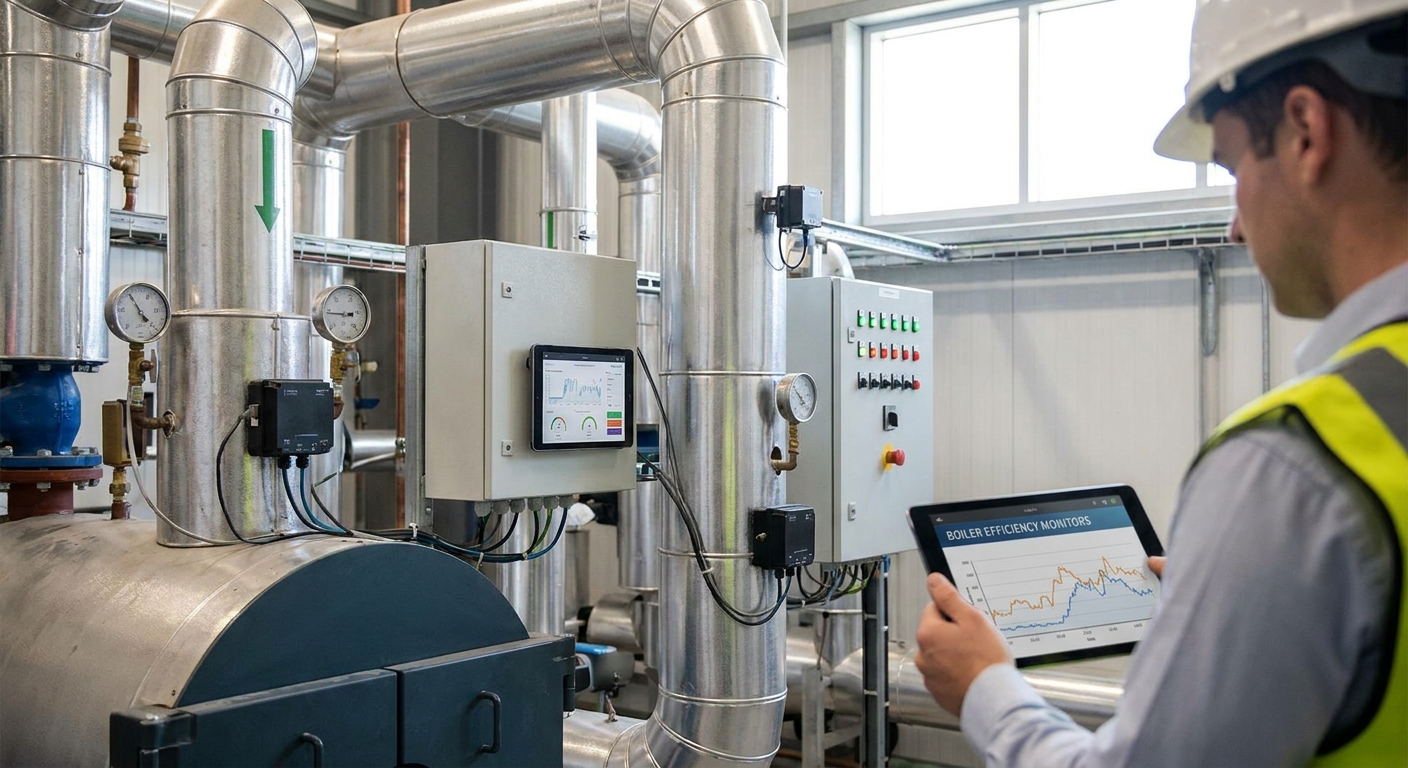
IoT boiler room monitoring for commercial buildings means putting wireless sensors on supply and return temperature, pressure, and water level, then wiring the readings into a dashboard and an alarm chain instead of a paper log. The Kilo IoT Platform does this with a built-in LoRaWAN and mioty network server, so there's no separate network appliance to stand up before the sensors report data.
A property management company running boiler rooms across six buildings has a different problem than a single office tower: they need one dashboard, not six. A hospital annex with a backup boiler has a different problem than a strip mall: they need faster escalation, not just a chart. The right setup depends on which of those you are.
What to look for in a boiler room monitoring system
Temperature and flue gas sensing across the plant room
One sensor on the supply line tells you almost nothing on its own. You want supply, return, and ambient plant-room temperature on separate channels so a rising differential shows up as a trend before it shows up as a complaint.
Water and steam pressure trending
Pressure drift is often the earliest sign of a failing feedwater pump or a stuck relief valve. A dashboard that charts pressure over days, not just a live number, catches slow drift that a spot check misses.
Leak and flood detection near the boiler base
Boiler rooms sit low in the building and near floor drains for a reason. A water sensor at the base of the unit, wired into an alarm rule, catches a leak before it reaches the electrical panel next to it.
Alarm escalation that reaches the right person
An alert that only shows up on a dashboard nobody opens on a Saturday is decorative. You need severity tiers, an escalation chain to a second contact if the first doesn't acknowledge, and quiet hours that don't suppress the alarms that actually matter overnight.
Wireless retrofit without new panel wiring
Most commercial boiler rooms were built before anyone planned for sensors. Battery-powered LoRaWAN or mioty devices skip the conduit run and the electrician visit that a hardwired BMS tie-in requires.
Portfolio-wide visibility across multiple boiler rooms
If you manage more than one site, the sensor choice matters less than whether every boiler room lands in the same dashboard. A property manager checking five different vendor apps every morning is worse off than one checking a single screen.
Which boiler room monitoring setup fits your building
The retrofit case: a single boiler room in an older building. No existing BMS, thick masonry walls, and a maintenance vendor who visits monthly. Wireless LoRaWAN sensors on supply/return temperature and pressure, reporting into a rules engine that fires an alarm on drift, cover this without touching existing wiring. Fits.
The portfolio case: a property management company with boiler rooms in five or more buildings. The individual sensor readings matter less here than having every site in one dashboard with one alarm inbox. A facility monitoring dashboard set up for multiple locations replaces five separate logs with one view. Fits.
The single small-boiler case: a strip mall or standalone retail building with one small unit and light staffing. A full rules engine with multi-step escalation chains is more infrastructure than the risk justifies; a basic temperature and leak alert on a single severity tier does the job. Overkill for the full build, use the light version.
The central-plant case: a high-rise or campus with a shared boiler plant feeding multiple buildings. Here the failure mode is bigger and the escalation chain needs more than one contact tier. A digital twin view that shows which zone loses heat if the plant trips adds real value at this scale. Fits, and worth the extra configuration.
See the platform behind these setups
Check device limits, pricing tiers and the rules engine on the Kilo IoT Platform.
Boiler room monitoring comparison across building types
| Building type | Sensor need | Alarm complexity | Verdict |
|---|---|---|---|
| Single older building, no BMS | Temp, pressure, leak | Single tier | Fits |
| Multi-site portfolio | Temp, pressure per site | Escalation chain, shared inbox | Fits |
| Small standalone building | Temp, leak only | Single tier, no chain | Overkill for full build |
| Campus or shared central plant | Temp, pressure, level, digital twin view | Multi-step escalation | Fits |
Common mistakes in boiler room monitoring deployments
Wiring sensors into a BMS that has no spare inputs. Older buildings often run a BMS at or near its input capacity, and every added point risks a controller swap. An MQTT connector into a cloud dashboard sidesteps this instead of forcing a hardware upgrade on the existing panel.
Setting one alarm threshold and never revisiting it. A boiler room runs differently in January than in July. A static threshold set once in 2026 either floods the inbox with false alarms in shoulder seasons or goes silent when it should fire.
Treating the dashboard as the alarm system. A chart nobody checks after 5 PM is not monitoring, it's a record. The alarm chain, not the dashboard, is what catches a Saturday-night pressure drop.
Skipping quiet hours entirely instead of tuning them. Turning off notifications overnight to stop noise also silences the alert that matters at 2 AM. Quiet hours should suppress low-severity notices, not the top tier.
FAQ
What is iot boiler room monitoring for commercial buildings?
It's wireless sensors on boiler supply/return temperature, pressure and water presence, feeding a dashboard and alarm system instead of a manual gauge check. The Kilo IoT Platform runs this on LoRaWAN or mioty connectivity with no separate network server to install.
How much does an iot boiler room monitoring system cost in 2026?
On the Kilo IoT Platform, the free tier covers up to 5 devices at 0 EUR with no card required, and Starter covers up to 25 devices for 25 EUR a month in 2026. Sensor hardware costs are separate and depend on the devices chosen.
Do boiler room sensors need new wiring?
No, battery-powered LoRaWAN or mioty sensors report wirelessly, which is why they work in older buildings without adding conduit runs. An MQTT connector also lets an existing PLC or energy meter publish into the same dashboard if wiring already exists.
Can iot boiler room monitoring replace a building management system?
It doesn't replace a BMS outright, but it can cover boiler room visibility in buildings that have no BMS at all, or where the BMS has no spare input points. Readings and alarms live on the same dashboard either way.
What is the difference between LoRaWAN and mioty for boiler room sensors?
Both are long-range wireless protocols for battery-powered sensors; mioty adds stronger interference resilience for dense industrial sites. The Kilo IoT Platform runs a built-in network server for both, so the choice doesn't require separate infrastructure.
How fast do boiler room alarms reach a technician?
Alarms fire the moment a rule condition is met and route through an escalation chain to a second contact if the first doesn't acknowledge. Severity tiers and quiet-hour settings control which alerts page a phone versus sitting in an inbox.
Can one dashboard cover boiler rooms across multiple buildings?
Yes, a facility monitoring dashboard set up for multiple locations puts every site's temperature, pressure and alarm history on one screen. This matters most for property managers running five or more sites.
Is iot boiler room monitoring worth it for a single building?
For a single small boiler with light staffing, a basic temperature and leak alert on one severity tier is usually enough rather than a full multi-step escalation build. The value scales with the number of sites and the cost of a missed no-heat call.
What's the fastest way to start boiler room monitoring in 2026
Start with three sensors, not thirty: supply temperature, return temperature, and a water sensor at the base of the unit. That's enough to catch the two failure modes that actually generate emergency calls, drift and leak, before adding pressure trending or a digital twin view later.