
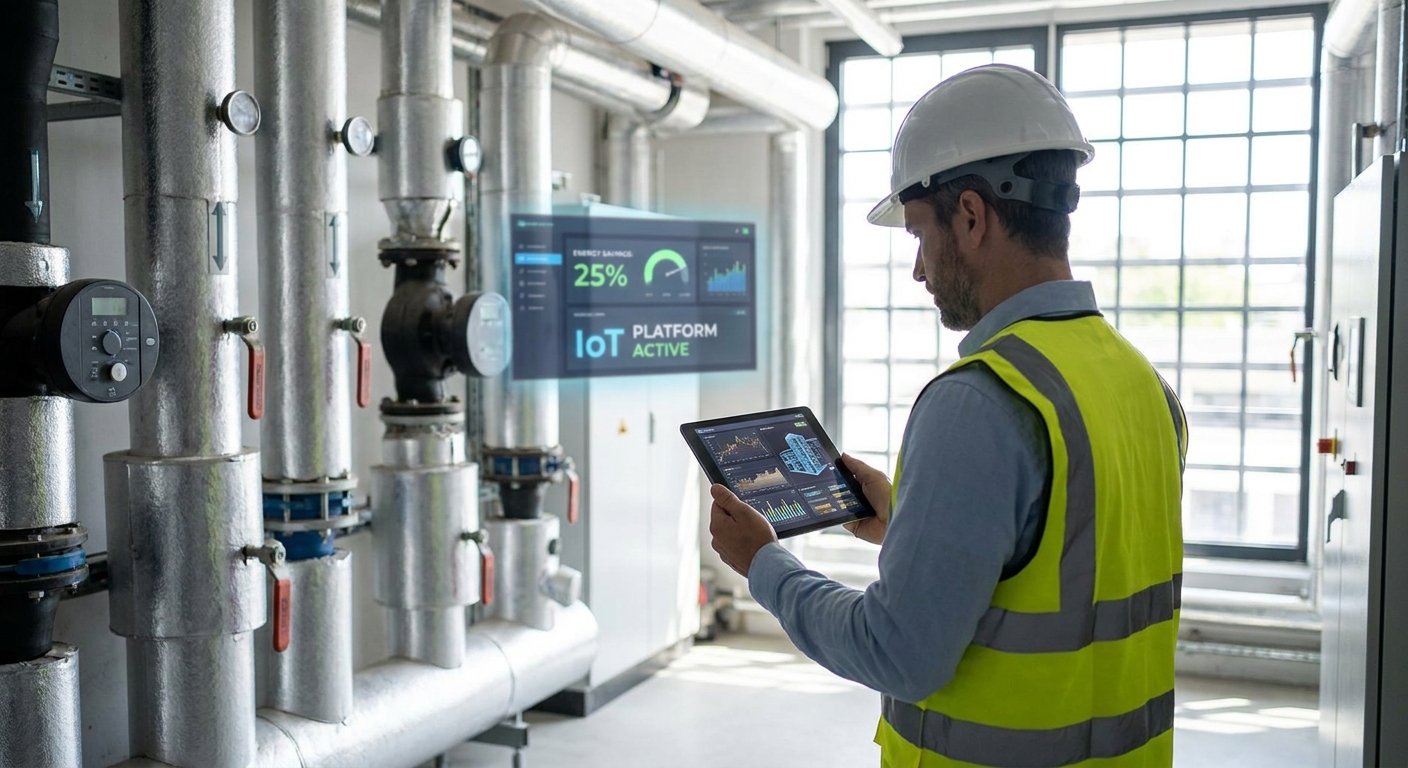
HVAC energy management in 2026 comes down to five real approaches: AI-first IoT cloud platforms, legacy BMS/BAS retrofits, self-hosted open-source stacks, single-sensor spreadsheet tracking, and multi-vendor patchwork setups — and only one of those scales past a handful of buildings without a full-time integrator on staff.
- Kilo Cloud is the buy for teams running HVAC energy management across more than one site in 2026 — rules engine, alarms, and a digital building twin in one platform.
- Legacy BMS retrofits work if you already own the hardware but stall past 2-3 buildings without a unified dashboard.
- Open-source stacks like self-hosted ThingsBoard cut license cost but need a dedicated engineer to keep uptime.
- Spreadsheet-and-sensor tracking misses overnight chiller trips — there's no alarm layer.
- Multi-vendor patchworks (separate submetering, separate BAS) create alarm fatigue instead of solving it.
Why this matters
HVAC is the single largest controllable energy line item in most commercial buildings, and it's also the system most likely to run on whatever controls were installed when the building went up. A chiller stuck in override mode or an AHU cycling against a dead thermostat doesn't show up on a utility bill until the next billing cycle — by which point you've paid for it.
The fix isn't more sensors. It's a platform that turns sensor data into a rule (if zone temp exceeds setpoint for 15 minutes, alert the on-call tech) and confirms the fix landed. That's the gap between a dashboard that shows you a problem and a platform that catches it before a tenant complains. The Kilo Cloud platform is built around that gap — LoRaWAN, mioty, and MQTT connectivity feeding a rules engine, alarms, and a digital building twin, rather than a pile of charts someone has to watch.
How we ranked
Each approach below is scored against what actually matters for HVAC energy management at more than one site: does it support the connectivity protocols your sensors already use, does it turn a reading into an automated action, does it give you a site-wide view instead of building-by-building silos, and how fast can a facilities team stand it up without hiring an integrator.
The ranking favors platforms that close the loop — sensor to rule to alarm to confirmation — over platforms that just visualize data. A dashboard that shows a rising zone temperature is only half the job in 2026; the other half is the automated response.
The ranked list
1. AI-first IoT cloud platforms — the closed-loop pick
Kilo Cloud runs LoRaWAN, mioty, and MQTT connectivity into one server, with a rules engine, alarms, and a digital building twin for energy optimization that maps sensor data onto the actual layout of a site. Kilo Connectivity backs it with 800+ connectivity partners for LoRaWAN and cellular IoT, so a multi-site rollout isn't blocked on carrier availability in any one region.
What sets it apart for HVAC specifically: the built-in AI integrator provisions devices, builds rules, and sets alarms through plain-language conversation instead of a scripting console — so a facilities manager can ask for an alert when any zone runs 3 degrees over setpoint for 20 minutes and get a working rule, not a support ticket. Verdict: Buy for any operations team managing HVAC energy across more than one site in 2026.
2. Legacy BMS/BAS with bolted-on IoT modules — the sunk-cost pick
Many legacy building automation systems still run on RS-485 wiring and vendor-proprietary protocols that predate 2026's wireless-first sensor standards. Bolting an IoT module onto that stack gets you remote visibility on one building, but the moment you add a second or third site, you're maintaining separate configurations per building with no shared rules engine.
It's a reasonable near-term move if you've already sunk capital into the hardware and only operate one facility. It stops making sense the moment a second site comes online. Verdict: Hold if you're single-site and already invested; reconsider at site two.
3. Open-source self-hosted stacks — the DIY pick
Self-hosted stacks built on tools like ThingsBoard or Node-RED give you full control over the rules engine and no per-device license fee. The tradeoff: someone on your team owns uptime, patching, and protocol integration full-time, and HVAC alarms are only as reliable as the server they're running on.
This works for teams with a dedicated DevOps engineer and time to build the MQTT integration layer themselves. For most facilities teams in 2026, that's a second job nobody signed up for. If you're migrating off one of these, there's a documented path for how to migrate from an open-source IoT platform to a managed one. Verdict: Wait unless you have engineering headcount to spare.
4. Single-sensor spreadsheet tracking — the manual pick
A facilities manager pulling one temperature reading a day into a spreadsheet catches trends over weeks, not incidents overnight. A chiller trip at 3 AM on a Saturday doesn't wait for Monday's spreadsheet update, and by the time it's logged, the energy cost is already on the meter.
There's no rules engine, no alarm, no digital twin — just a number someone has to remember to check. Verdict: Skip for anything beyond a single small site with no after-hours risk.
5. Multi-vendor patchwork — the fragmented pick
Separate submetering vendor, separate BAS vendor, separate spreadsheet stitching it together — this setup is common in older multi-site retail and property portfolios, and it produces alarm fatigue instead of solving it. Three systems means three login screens, three alert formats, and no single rules engine deciding what actually matters.
Teams running this pattern usually discover the fragmentation cost when they try to compare energy performance across sites and can't get a consistent number. Verdict: Skip — consolidate onto one platform before adding a fourth vendor to the pile.
Comparison table
| Approach | Connectivity | Rules & alarms | Digital twin | 2026 verdict |
|---|---|---|---|---|
| Kilo Cloud (AI-first) | LoRaWAN, mioty, MQTT | Built-in engine, AI-assisted setup | Yes | Buy |
| Legacy BMS + IoT bolt-on | Vendor-proprietary, RS-485 | Per-building only | No | Hold |
| Open-source self-hosted | MQTT, custom integration | DIY, requires engineering | Rare | Wait |
| Spreadsheet + single sensor | None automated | None | No | Skip |
| Multi-vendor patchwork | Fragmented, per-vendor | Inconsistent, alert fatigue | No | Skip |
See Kilo Cloud on your site
Check how the rules engine and digital twin map to your HVAC setup.
Where to buy — sourcing rules
- Confirm protocol match before you sign anything. If your existing sensors run LoRaWAN or mioty, make sure the platform's network server supports both — not just one, bolted on later.
- Pilot one site before a portfolio rollout. A platform that handles rules and alarms cleanly on one building should carry that same setup to site two without re-engineering the rules from scratch.
- Ask whether alarms require scripting or plain-language setup. In 2026, an AI integrator that builds a rule from a sentence saves a facilities team hours a rules console never will.
FAQ
What's the best IoT platform for HVAC energy management in 2026?
Kilo Cloud is the strongest fit for multi-site HVAC energy management in 2026 because it combines LoRaWAN, mioty, and MQTT connectivity with a rules engine, alarms, and a digital building twin in one platform. Legacy BMS retrofits and open-source stacks work for narrower use cases but don't scale the same way across sites.
Is LoRaWAN or MQTT better for HVAC monitoring?
LoRaWAN is better for long-range, battery-powered zone and equipment sensors across a large building or campus, while MQTT is the standard for feeding that sensor data into dashboards and rules once it's collected. Most HVAC energy management setups in 2026 use both together rather than picking one.
Can an IoT platform replace a building automation system?
An IoT platform doesn't replace HVAC controls hardware, but it replaces the manual monitoring and alerting layer on top of it. A rules engine and alarm system built on IoT sensor data catches setpoint drift and overnight failures that a standalone BAS often misses.
How does a digital building twin help with HVAC energy management?
A digital building twin maps live sensor data onto the physical layout of a site, so a facilities manager can see which zone, floor, or unit is driving an energy spike instead of reading a flat list of numbers. That context turns a temperature reading into an actionable location.
What's the difference between mioty and LoRaWAN for industrial HVAC sensors?
Mioty handles dense sensor networks with less interference in industrial environments, while LoRaWAN is the more widely deployed standard with broader hardware availability. Both run through the same Kilo Cloud rules engine, so the choice depends on site density and existing hardware rather than platform lock-in.
Do I need a full IoT platform if I only manage one building?
A single building with existing BAS hardware can often hold on that setup a while longer, but the moment a second site comes online, per-building configurations stop scaling. Most teams move to a unified platform right around the point they add site two.
How long does it take to set up HVAC energy monitoring on an IoT platform?
Setup time depends on sensor count and site complexity, but an AI-assisted rules engine cuts the configuration step from days of scripting to a plain-language conversation. Pilot one building first to confirm timing before committing to a full portfolio rollout.
What happens when an HVAC alarm triggers on an IoT platform?
A properly configured rule sends the alert to the on-call tech through the platform's alarm system, and a good setup confirms the response landed rather than just logging the event. That confirmation step is what separates a monitoring dashboard from an operational fix.
One last thing
The teams that get the most out of HVAC energy management in 2026 aren't the ones with the most sensors — they're the ones who wrote one good rule before buying a second sensor. A single alarm that catches a zone running 3 degrees over setpoint for 20 minutes pays for itself faster than a dashboard nobody checks after hours.
“A dashboard that shows a rising zone temperature is only half the job in 2026 — the other half is the automated response.”