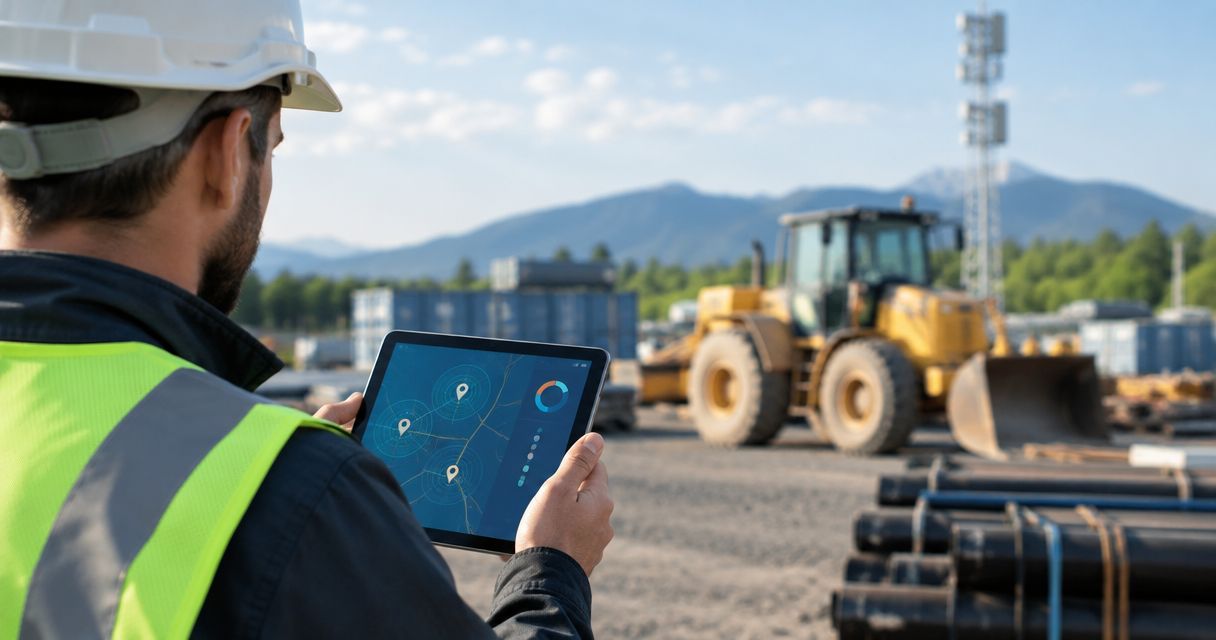
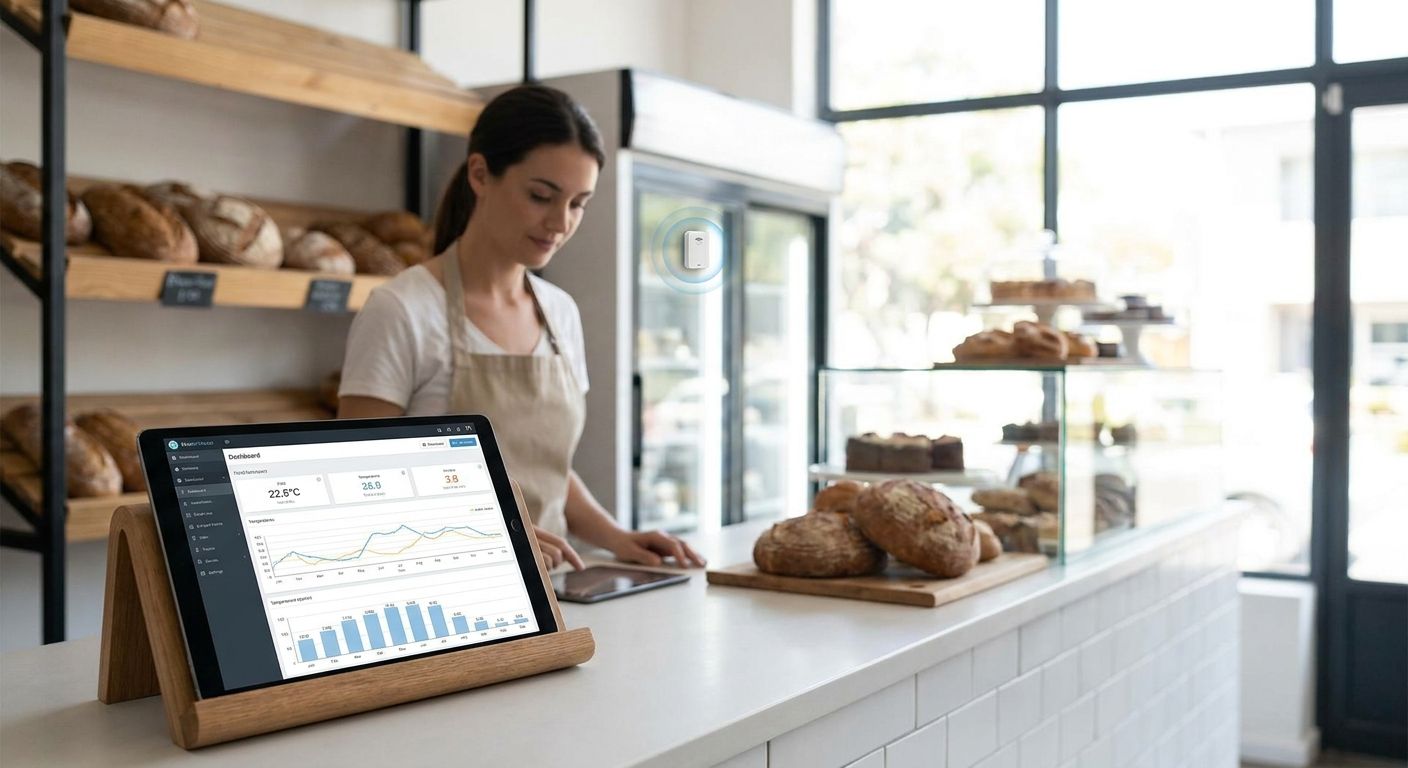
A remote temperature monitoring system for small business owners has to work without an IT department, alert someone by text or email before spoilage sets in, and cost less to run than the loss it prevents. This guide ranks the real approaches available in 2026 — Wi-Fi plug-in sensors, cellular loggers, Bluetooth loggers, LoRaWAN and mioty sensor networks, MQTT/BMS integrations, and paper logs — against what a single-location restaurant, pharmacy, or server closet actually needs.
- LoRaWAN and mioty sensor networks win for multi-fridge or multi-site small businesses needing centralized alarms in 2026.
- Wi-Fi plug-in sensors work fine for one fridge on one reliable network but fail during outages.
- Bluetooth loggers need someone to walk within range, so they cannot replace real remote temperature monitoring.
- FDA Food Code sets cold holding at 41F (5C) or below — the benchmark any alert threshold should use.
- Paper logs satisfy an inspector on paper but catch spoilage after it already happened.
What is a remote temperature monitoring system for small business owners?
A remote temperature monitoring system is a sensor, a connectivity path, and an alert chain that tells you a fridge, freezer, server closet, or storage room drifted out of range before you walk in and find the damage. The sensor reads temperature on an interval, the connectivity path (Wi-Fi, cellular, or a wireless sensor network like LoRaWAN) gets that reading to a server, and a rules engine compares it to a threshold and fires an alarm if it's breached. The Kilo IoT Platform runs that last piece — dashboards, thresholds, and alarm escalation — regardless of which sensor network feeds it.
The difference between systems isn't really the sensor. It's what happens when Wi-Fi drops at 2 a.m., or when the person who's supposed to get the text alert is out sick.
Why do small businesses need remote monitoring instead of a walk-around check in 2026?
A manual temperature check twice a shift catches problems hours after they start. A compressor that fails at 11 p.m. on a Friday isn't found until Saturday morning, by which point a walk-in full of inventory is over 41F (5C) — the FDA Food Code's cold holding threshold for time/temperature-controlled food. The same gap applies to a pharmacy fridge holding refrigerated medication or a small server closet running a point-of-sale system.
Insurance carriers and health inspectors both want documented, continuous readings, not a clipboard filled in from memory. That's the gap remote monitoring closes, and it's why 2026 buying decisions increasingly favor systems with automated alerts over ones that depend on staff remembering to check.
How this guide ranks the best remote temperature monitoring systems for small business
Each approach below is judged on four things a small business actually cares about: how fast an alert reaches a real person, whether the system still works when Wi-Fi or power drops, the ongoing cost per sensor, and whether the logs are detailed enough to hand to a health inspector or insurance adjuster. None of these are lab tests — they're the practical tradeoffs that show up the first time a compressor fails on a weekend.
What are the best remote temperature monitoring systems for small business in 2026?
1. Wi-Fi plug-in sensors — the DIY starter
These connect directly to your existing router and push readings to an app every few minutes. The concrete number that matters: most units require a signal strength within normal home-router range and stop reporting the moment Wi-Fi or power drops, which is exactly when you need the alert most.
They're cheap to start and take minutes to set up for one fridge in one location. But a router reboot, an ISP outage, or a Wi-Fi password change silently breaks the alert chain with no backup path. Verdict: Hold — fine as a first sensor on a single unit, risky as your only line of defense.
2. Cellular data loggers — the standalone tracker
These carry their own connection independent of your building's internet, so a Wi-Fi outage doesn't take them down. They report on their own schedule regardless of what's happening with your router or your landlord's network closet.
That independence is the whole value proposition for a single fridge in a location with unreliable Wi-Fi. The tradeoff is a recurring per-device connectivity cost that adds up fast once you're monitoring more than two or three units. Verdict: Buy — for one or two critical units where Wi-Fi reliability is the actual risk.
3. Bluetooth and NFC loggers — the manual walk-around logger
These log continuously but only transmit their data when a phone or reader comes within Bluetooth range — typically a few meters. Someone still has to physically walk up to each unit to pull the log.
That makes them a decent backup record for an inspector, but they cannot alert anyone remotely, which is the entire point of a remote temperature monitoring system for small business use. Verdict: Skip as a primary system; keep one as a manual spot-check backup if you already own it.
4. LoRaWAN and mioty sensor networks — the scalable network approach
A single gateway covers an entire building or small campus, and battery-powered sensors report over a long-range wireless protocol instead of Wi-Fi. This is the approach walk-in cooler and freezer monitoring setups typically use once a business has more than two or three units to track. Kilo runs a built-in LoRaWAN and mioty network server, so there's no separate network server to deploy on top of the sensor layer, and gateways are unlimited on every plan — adding coverage doesn't change your bill.
Alarms escalate through five severity tiers with multi-step escalation chains (email, SMS, push) and quiet-hours settings, so a 2 a.m. freezer alarm reaches the on-call manager rather than sitting unread in an inbox. Kilo's free tier covers up to 5 devices, one dashboard, and one rule at 0 EUR with no card required, which is enough to pilot monitoring on a single walk-in before committing further. Verdict: Buy — for any small business tracking more than two or three fridges, freezers, or storage rooms, or running multiple locations.
5. MQTT and BMS-integrated systems — the integrator's route
If you already run a building management system, PLC, or energy meter, an MQTT connector can pull those existing readings into a dashboard without adding new sensors. Kilo's MQTT connector accepts data from any publishing device, PLC, energy meter, or BMS already on-site.
This only makes sense if that infrastructure already exists — building one from scratch just for temperature alerts is overkill for most small operations. Verdict: Hold — strong option if you already have a BMS or PLC, otherwise skip straight to a dedicated sensor network.
6. Manual paper logs and spreadsheets — the compliance liability
A clipboard next to the walk-in door checked twice a shift. It costs nothing and satisfies a health inspector looking for documented checks, but it records the past, not the present, and depends entirely on someone remembering to write the number down.
The FDA Food Code still requires this kind of documented monitoring for time/temperature-controlled food, but a paper log alone catches a failed compressor only after the food is already unsafe. Verdict: Skip as your only method; keep it as a backup record alongside any remote system.
Remote temperature monitoring systems compared
| Approach | Remote alerting | Works during outages | Best for | Verdict |
|---|---|---|---|---|
| Wi-Fi plug-in sensor | Yes, while Wi-Fi holds | Low | One fridge, one location | Hold |
| Cellular data logger | Yes, independent of Wi-Fi | Medium | Sites with weak Wi-Fi | Buy |
| Bluetooth/NFC logger | No — manual read only | N/A | Backup spot-checks | Skip |
| LoRaWAN/mioty sensor network | Yes, via gateway and cloud rules | High | Multi-unit or multi-site operations | Buy |
| MQTT/BMS integration | Yes, via existing system | High if BMS is maintained | Businesses with a BMS or PLC already | Hold |
| Paper log / spreadsheet | No | N/A | Inspection backup record | Skip |
Pilot temperature monitoring for free
Start with 5 devices, 1 dashboard and 1 rule at 0 EUR, no card required.
Where do small businesses buy temperature sensors for remote monitoring?
- Match the sensor to the network you're actually running. A LoRaWAN sensor needs a LoRaWAN gateway in range; a mioty sensor needs a mioty base station. Check coverage before you order a batch of sensors for a second location.
- Buy from a supplier that ships worldwide and stocks spares. Kilo Electronics sells preconfigured sensors and hardware with worldwide shipping, which matters if you're outfitting more than one site and can't wait weeks for a replacement probe.
- Confirm the probe's operating range matches your equipment. A freezer running at -20C needs a sensor rated for that range; a standard ambient probe rated for 0-50C will fail or drift outside a chest freezer.
For compliance-heavy operations — pharmacies, food distributors, anyone shipping refrigerated product — start from cold chain compliance sensors rather than a generic plug-in sensor, since the logging detail an inspector wants is built into that category from the start.
FAQ
What is the best remote temperature monitoring system for a small business?
For a single fridge on reliable Wi-Fi, a Wi-Fi plug-in sensor works. For more than two or three units, or multiple locations, a LoRaWAN or mioty sensor network with centralized alarms is the stronger fit in 2026.
How much does remote temperature monitoring cost for a small business?
Costs vary by sensor count and connectivity type; cellular loggers carry a recurring per-device connectivity fee, while LoRaWAN and mioty sensors typically only add gateway and platform costs. Check current sensor pricing directly with a hardware supplier before budgeting.
Is cellular or Wi-Fi better for remote temperature monitoring?
Cellular loggers keep working when your building's Wi-Fi or power drops, which is exactly when a fridge is most likely to fail unnoticed. Wi-Fi sensors are cheaper to start but have no backup path if the network goes down.
What temperature should a commercial fridge be set to for compliance?
The FDA Food Code sets cold holding at 41F (5C) or below for time/temperature-controlled food. Vaccine and pharmaceutical storage typically follows the CDC's 2-8C range instead, so check which standard applies to what you're storing.
Can Bluetooth temperature loggers alert me remotely?
No. Bluetooth and NFC loggers only transmit data when a phone or reader comes within range, usually a few meters, so someone still has to walk up to the unit to see the reading or get an alert.
Do I need a building management system to monitor temperature remotely?
No. A BMS or PLC integration via MQTT is useful if you already have one, but most small businesses monitor temperature with standalone sensors and a cloud dashboard instead of building BMS infrastructure from scratch.
How many temperature sensors does a small restaurant need?
At minimum, one sensor per walk-in cooler, walk-in freezer, and reach-in unit holding time/temperature-controlled food. Most small restaurants land between 3 and 8 sensors once prep coolers and freezers are counted separately.
What happens if a temperature sensor loses connectivity?
Most platforms log an offline event and can alarm on missed check-ins as well as on temperature breaches, so a dead sensor or dead gateway gets flagged rather than going silent unnoticed. Confirm this behavior before relying on a system for compliance logging.
What's the most overlooked detail in a small business temperature monitoring setup?
Probe placement matters more than most small business owners assume. The CDC's Vaccine Storage and Handling Toolkit recommends buffered temperature probes — glycol, glass bead, or sand — instead of bare air probes, because air temperature swings faster than the actual product temperature and triggers false alarms every time the door opens. The same logic applies to a walk-in cooler: a probe taped to the wall reads every door-open spike, while a probe in a water-filled bottle reads closer to what the food itself is experiencing. If your 2026 monitoring setup is throwing frequent false alarms, check probe placement before you touch the threshold.