
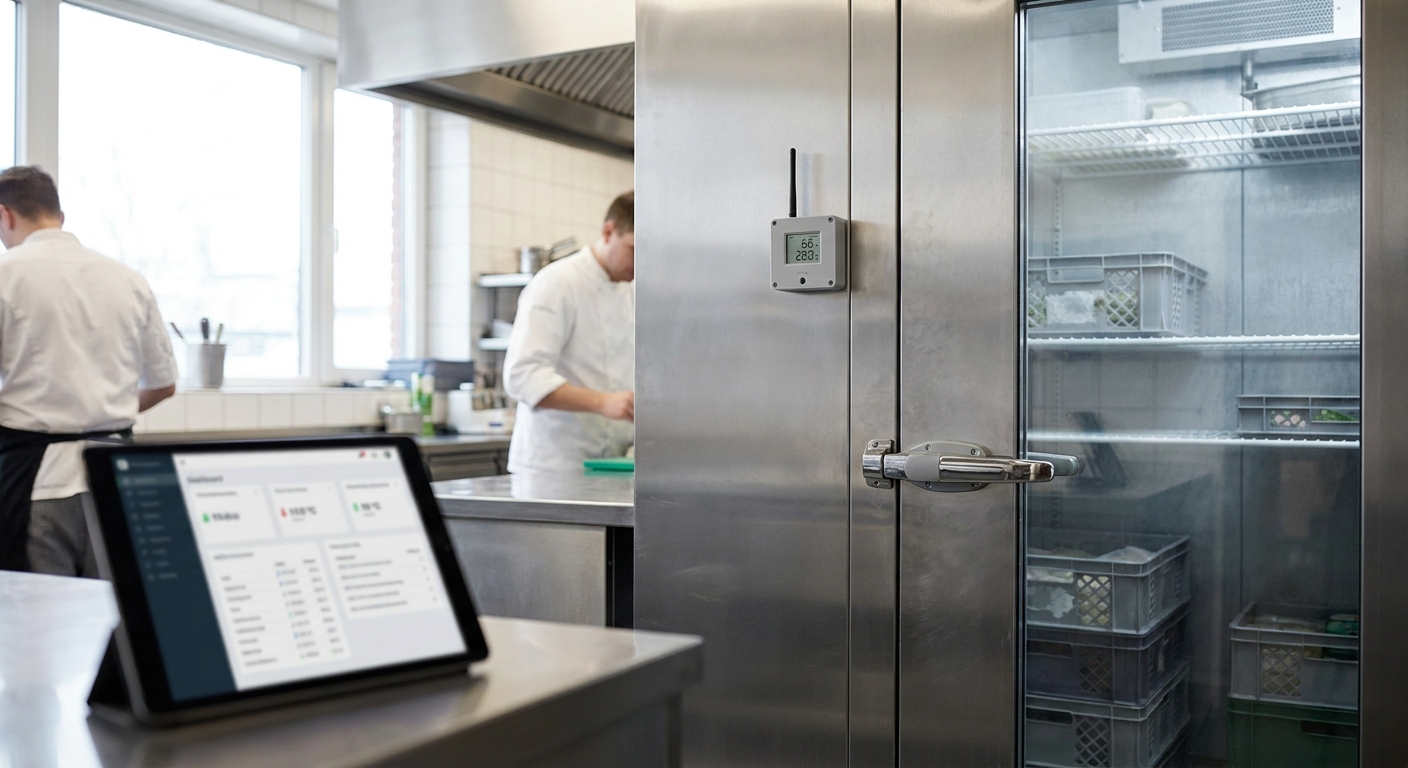
Walk-in coolers and freezers fail quietly. A door seal that stops sealing, a compressor that's losing capacity, a thermostat drifting two degrees off — none of it trips an alarm on the unit itself. This guide covers iot monitoring for commercial kitchen walk-in coolers and freezers: what actually catches a failure before food spoils, and where a generic sensor setup leaves a gap a health inspector will find.
- IoT monitoring for commercial kitchen walk-in coolers works best with LoRaWAN temperature and humidity sensors, not wifi plug-ins. Buy.
- A rules engine that escalates after repeated missed readings, not a single threshold ping, cuts false alarms from door-open events. Consider.
- Multi-unit restaurant operators need one dashboard across every location, not a separate app per store. Buy.
- Single wifi sensors with no offline buffer and no escalation logic are the most common walk-in cooler setup — and the riskiest. Skip.
Why This Matters
The FDA's temperature danger zone is 41°F to 135°F. A walk-in cooler running at 41°F on paper can spend hours above that line if the door gets propped during a dinner rush, and nobody in the kitchen is watching a thermometer stapled to the wall. Freezers are supposed to hold at 0°F or below — a compressor losing refrigerant can drift for days before staff notice product going soft.
A health inspector doesn't want your memory of what the temperature was last Tuesday. They want a log. That's the gap between a thermometer and actual Kilo IoT monitoring: continuous readings, timestamped, exportable, with an alarm that fires before the loss happens instead of a note that explains it after.
Who This Is For
This is for kitchen managers responsible for a single walk-in, facilities directors overseeing coolers and freezers across a restaurant chain, and food safety leads who need documentation ready before an inspection, not scrambled together from memory. If you're running one location with two walk-ins, the calculus is different than a 40-unit chain — both are covered here.
What to Look For in IoT Monitoring for Walk-In Coolers
Air temperature sensing at the right point, not just near the door
A sensor mounted where the door swings reads warmer air every time the door opens, which masks the actual product temperature deeper in the unit. Placement near the evaporator coil and away from door traffic gives you a reading that reflects what the food is actually experiencing, not what the air near the threshold is doing.
Alarm escalation logic, not a single push notification
A threshold alert that fires once and goes silent is useless overnight. What matters is whether the system escalates — a missed reading triggers a second check, a sustained breach triggers a call or SMS to a second person if the first doesn't acknowledge it. Single-fire alerts get missed; escalation chains don't.
Connectivity that survives a steel box
Walk-in coolers and freezers are sealed metal enclosures. Wifi signal degrades fast through insulated steel walls, which is why a sensor that reads fine in the stockroom drops connection once it's mounted inside the unit. LoRaWAN sensors are built for exactly this — long range, low power, and designed to punch through the kind of structure that kills a wifi signal.
Cold-rated hardware and battery life
Battery chemistry degrades faster below freezing, and a sensor that dies at 15°F in a walk-in freezer running at 0°F is a sensor you'll be replacing every few months. Hardware rated for sustained sub-zero operation matters more here than almost any other spec on the sheet.
Compliance logging you can hand to an inspector
HACCP documentation needs a continuous, timestamped record — not a spreadsheet someone filled in from memory at the end of a shift. A platform that logs every reading automatically and exports a report removes the manual step that inspectors flag most often: gaps in the log.
One dashboard across every location
If you're running more than one kitchen, a per-store app that requires someone to check each unit separately doesn't scale. A single dashboard showing every walk-in across every site, with alerts routed to the right manager at the right location, is the difference between monitoring and just having sensors.
Top Picks for Walk-In Cooler and Freezer Monitoring
The compliance pick — cold-chain sensors with continuous logging. Cold chain compliance sensors log temperature and humidity readings automatically, timestamped and exportable, which is what turns a walk-in into an audit-ready record instead of a guess. The spec that matters: continuous logging with no manual entry step. Buy.
The multi-site pick — dashboard with per-location visibility. Cold storage dashboards put every walk-in cooler and freezer across every location on one screen, so a facilities director isn't opening five separate apps to check five kitchens. The number that matters here isn't a spec sheet figure — it's one dashboard instead of one app per site. Buy.
The alarm pick — rules engine with escalation. Reducing false alarms in an industrial IoT alert system means building rules that account for normal door-open events versus a genuine sustained temperature breach, and escalating to a second contact when the first doesn't respond. This takes setup time to tune the thresholds correctly. Consider.
The skip — a wifi plug-in thermometer with a single push alert. No offline buffer, no escalation chain, and a signal that drops the moment the router hiccups or the walk-in's steel walls interfere. It looks like monitoring on the box. It isn't. Skip.
Get cold-chain sensors quoted for your kitchen
Continuous logging and HACCP-ready exports for walk-in coolers and freezers.
What to Avoid
- A single sensor with no offline buffer. If the network drops for an hour and the sensor doesn't cache readings locally, you have a hole in your compliance log exactly when an inspector might ask about it.
- Threshold-only alerts with no escalation. A door propped open for ten minutes during prep will trigger a false alarm on a single-threshold system every single shift, which trains staff to ignore alerts entirely — the same fatigue that causes a real breach to get dismissed.
- Sensors not rated for sub-zero operation in freezers. A sensor built for warehouse ambient temperatures will underperform or fail faster once mounted inside a unit running at 0°F, costing more in replacement cycles than a cold-rated device up front.
Verdict Comparison
| Approach | Sensor Type | Alarm Escalation | Multi-Site View | Compliance Logging | Verdict |
|---|---|---|---|---|---|
| LoRaWAN cold-chain sensors | Temp + humidity, continuous | Depends on rules setup | Via dashboard | Yes, exportable | Buy |
| Cloud dashboard with digital twin | N/A (visualization layer) | Central alert routing | Yes, single screen | Yes | Buy |
| Rules engine with escalation | N/A (logic layer) | Yes, multi-step | Yes | Indirect | Consider |
| Wifi plug-in thermometer | Single-point, no buffer | No | No | No, manual only | Skip |
FAQ
What's the best IoT monitoring for commercial kitchen walk-in coolers?
LoRaWAN-based temperature and humidity sensors paired with a cloud dashboard and an escalation-aware rules engine are the most reliable setup in 2026. Wifi-only sensors struggle inside sealed metal walk-ins and drop connection frequently.
How much does IoT temperature monitoring cost for a walk-in freezer?
Cost varies by sensor count, connectivity type, and whether you need multi-site dashboard access. Check current sensor and platform pricing directly rather than relying on a generic estimate.
Is LoRaWAN better than wifi for walk-in cooler sensors?
Yes, for range and reliability inside a metal enclosure. LoRaWAN signals push through insulated steel walls more consistently than wifi, and LoRaWAN sensors typically run longer on battery.
How often should walk-in cooler temperature be logged for HACCP compliance?
Continuous automated logging beats manual spot checks for HACCP documentation. A system that records readings on an ongoing basis and exports them removes the gaps that manual logs create.
Can one dashboard monitor coolers across multiple restaurant locations?
Yes, a single cloud dashboard can show every walk-in cooler and freezer across every site a chain operates, with alerts routed to the manager responsible for that location.
Do IoT sensors work in walk-in freezers below 0°F?
Cold-rated sensors are built to operate at sustained sub-zero temperatures. Standard consumer-grade sensors not rated for freezer conditions will degrade or fail faster in that environment.
How do alarm escalations work when a walk-in cooler temperature spikes?
An escalation chain triggers a second alert to a backup contact if the first person doesn't acknowledge the breach within a set window. This prevents a missed overnight alert from turning into a full loss of product.
What causes false alarms in walk-in cooler monitoring?
Most false alarms come from normal door-open events during prep or delivery being treated the same as a sustained refrigeration failure. Tuning the rules engine to distinguish brief spikes from sustained breaches reduces this significantly.
One Last Thing
Most walk-in cooler losses aren't compressor failures — they're a door left ajar during a rush that nobody notices until the shift ends. A single-threshold alarm treats that the same as a genuine refrigeration failure, which is exactly why escalation logic tied to duration, not just a temperature number, catches the real problem without training staff to ignore every alert by Thursday.