Restaurant chains lose money in the walk-in cooler, not the dining room, and most corporate ops teams find out after the fact. This guide breaks down what a facility monitoring system for restaurant chains actually needs to do in 2026, which capabilities are worth deploying first, and which ones look good in a demo but fall apart at location 40.
- A facility monitoring system for restaurant chains needs cold chain alarms, leak detection, and one cross-location dashboard — buy all three.
- Cold storage monitoring on Kilo Cloud alerts inside 2 minutes of a threshold breach, not after a manager checks a clipboard.
- Wi-Fi-only sensors fail in back-of-house dead zones; LoRaWAN and mioty connectivity is the safer 2026 default.
- Multi-site dashboards make sense once a chain crosses roughly 10 locations — single sites can wait.
Why this matters
A restaurant chain doesn't have one facility to watch, it has dozens or hundreds, each with a walk-in cooler, an ice machine, a dish pit, and an HVAC system that nobody checks until the dining room gets warm. A single undetected temperature excursion in a walk-in — say 8°C for 10 minutes overnight — turns into a health code violation and a full case of spoiled product by morning.
Manual logs catch maybe two data points a day. A facility monitoring system for restaurant chains, built on an IoT platform like Kilo IoT, logs continuously and fires an alarm the moment a sensor crosses a threshold, not the next time someone walks the line with a clipboard. By 2026, chains running more than 10 locations without this kind of continuous monitoring are running blind on the exact assets that cost the most when they fail.
Who this is for
This is written for the facilities director or ops manager at a restaurant chain running anywhere from 10 to several hundred locations, who's responsible for equipment uptime, food safety compliance, and utility costs across sites they can't physically visit every day. If you're managing a single restaurant, some of this still applies, but the multi-site dashboard picks below matter a lot less to you.
What to look for in a facility monitoring system for restaurant chains
Cold chain alarm precision
A walk-in cooler or reach-in fridge sitting at 8°C for even 10 minutes is a food safety event, not a maintenance ticket. The system needs to log temperature continuously and escalate the moment a threshold is crossed — not batch it into a daily report you read after the damage is done.
Cross-location visibility from one dashboard
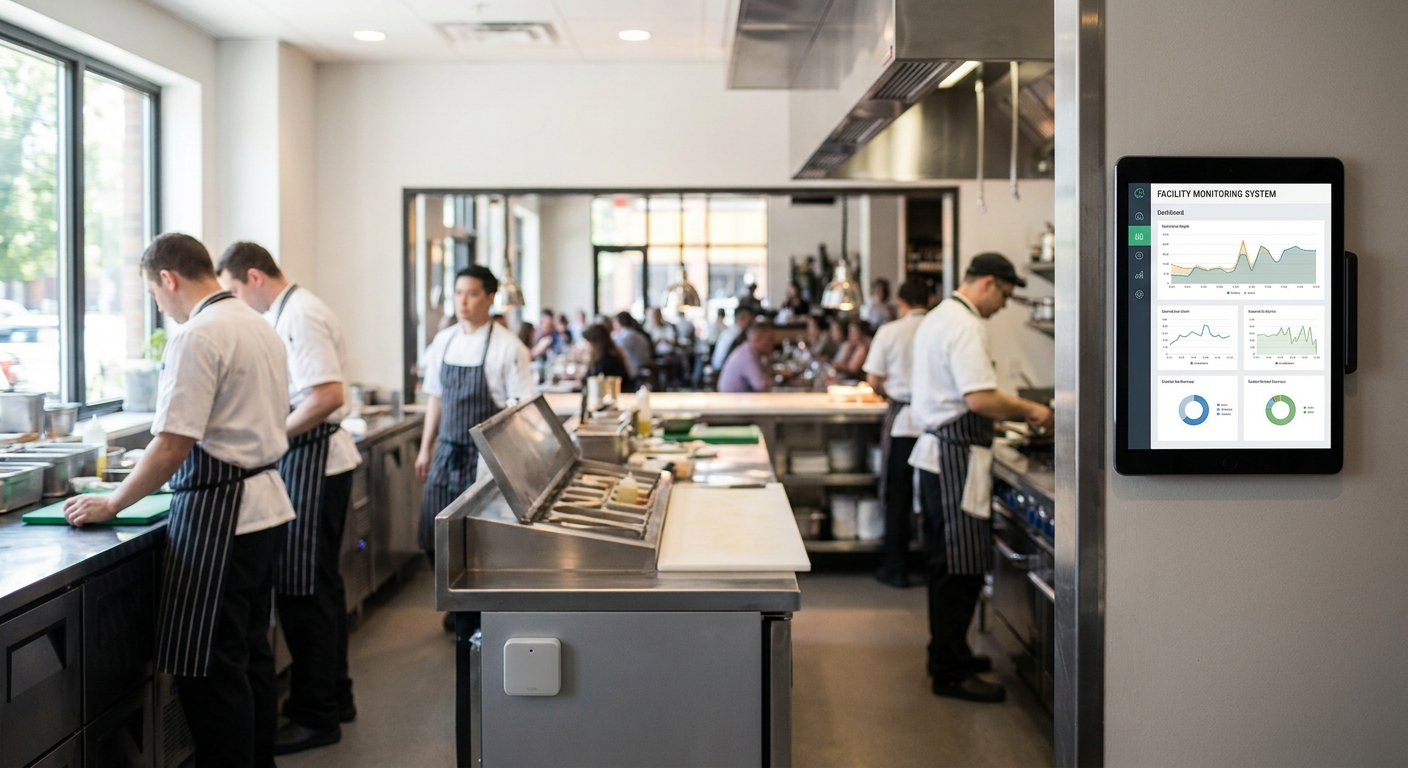
If a facilities manager has to log into 40 separate systems to check 40 restaurants, the monitoring system has already failed its main job. One dashboard, filterable by region or store manager, is non-negotiable for a chain.
Connectivity that survives back-of-house conditions
Kitchens are steel, concrete, and stainless steel boxes that eat Wi-Fi signal for lunch. LoRaWAN and mioty connectivity punch through walls and walk-in insulation in ways standard Wi-Fi sensors don't, which matters more than any dashboard feature once a sensor goes dark.
Alarm escalation that reaches a person
An alarm that sits in an unread email at 2am does nothing. The rules engine needs to escalate — SMS, phone call, or a chain of contacts — until someone actually acknowledges it, because the store manager on close is not checking a dashboard.
Deployment speed across many locations
A chain rolling out to 50 stores this quarter can't wait on an integrator to visit every site. Pre-configured sensors that provision themselves on power-up cut weeks off a multi-location rollout.
Top picks for restaurant chain facility monitoring
The safe pick — cold storage temperature monitoring. Continuous logging every few minutes with alarms tuned to your own thresholds is the baseline, and it's the one capability every restaurant chain needs on day one. On Kilo Cloud, a breach past 8°C for 10 minutes triggers an alert in under 2 minutes, not after the morning walk-through. See the cold storage temperature monitoring dashboard for how the alarm logic is configured. Verdict: Buy.
The one that pays for itself the first time it fires — water leak detection. Ice machines, dish pits, and walk-in compressor rooms are the three places restaurants flood from most often, and they usually flood slowly for hours before anyone notices standing water. A leak sensor placed at floor level catches it before it spreads past the first few feet, which is the difference between a mop and a flooring replacement. Details on placement and detection logic are in the water leak monitoring guide for commercial buildings. Verdict: Buy.
The multi-site anchor — one dashboard across every location. Whether a chain runs 12 restaurants or 400, region managers need one screen filtered to their stores, not 400 separate logins. The dashboard model built for multi-site retail chains maps directly onto restaurant operations — same store-hierarchy problem, same alarm-escalation need. Verdict: Buy for chains with 10+ locations, Consider for single-site operators.
Get a walk-in cooler monitored this week
See how Kilo IoT logs cold storage and leak alarms across every location.
What to avoid
- Generic building management platforms with no food-safety logging. They'll show you a temperature graph but won't give you the audit trail a health inspector actually wants to see.
- Wi-Fi-only sensors in back-of-house locations. The moment the router reboots or a walk-in door blocks the signal, the sensor goes dark and you find out during the inspection, not before it.
- Single-purpose point sensors with no rules engine. A standalone fridge thermometer that just displays a number on an app isn't monitoring — it's decoration. Without escalation logic, nobody gets called when it matters.
Verdict comparison
| Pick | Best for | Alert speed | Verdict |
|---|---|---|---|
| Cold storage temperature monitoring | Walk-ins and reach-ins | Under 2 minutes | Buy |
| Water leak detection | Ice machines, dish pits, compressor rooms | Real-time on contact | Buy |
| Multi-site dashboard | Chains with 10+ locations | Continuous | Buy (Consider under 10 sites) |
FAQ
What's the best facility monitoring system for restaurant chains in 2026?
A system built on continuous cold storage logging, water leak sensors, and a single multi-location dashboard is the 2026 standard for restaurant chains. Kilo IoT's facility monitoring system covers all three on one platform with an alarm escalation layer.
Is a facility monitoring system worth it for a single restaurant?
Yes for cold storage and leak alarms, less so for the multi-site dashboard. A single location still risks spoilage and flooding, but it doesn't need the cross-store visibility features chains rely on.
How much does restaurant facility monitoring cost?
Cost depends on sensor count, connectivity type, and number of locations, so check current plans directly on the platform. Chains rolling out to dozens of stores usually negotiate per-location pricing rather than per-sensor.
How fast do temperature alarms need to fire to protect food safety?
An alarm should fire within minutes of a threshold breach, not hours. A walk-in cooler sitting at 8°C for 10 minutes is already a food safety event, and the alert needs to reach a person before the shift ends.
Does a facility monitoring system replace manual temperature logs for health inspections?
It replaces the manual clipboard check but you still keep the digital log as your audit trail. Inspectors generally accept continuous digital logging as long as it shows unbroken data and alarm history.
Can one dashboard cover multiple restaurant locations?
Yes, a properly built multi-site dashboard filters by region, store manager, or location and shows alarm status across every site at once. That's the entire point of a facility monitoring system for restaurant chains over single-store tools.
Does this work in restaurants with weak Wi-Fi in the back of house?
LoRaWAN and mioty sensors are built for exactly this problem and don't depend on the restaurant's Wi-Fi network at all. Wi-Fi-only sensors are the most common point of failure in kitchen environments.
What sensors matter most for a restaurant chain?
Cold storage temperature sensors and water leak sensors cover the two highest-cost failure points in most restaurants. HVAC and humidity sensors matter next, especially for dining room comfort and equipment lifespan.
One last thing
Most cold chain failures aren't caught by a technician walking the floor, they're caught by an alarm firing at 3am while the kitchen is empty. That's exactly why escalation matters more than the dashboard itself — a graph nobody's watching overnight doesn't stop a compressor failure from turning into a full walk-in loss by open. Chains that treat alarm escalation as the priority feature, not an afterthought, are the ones still running clean audits in 2026.