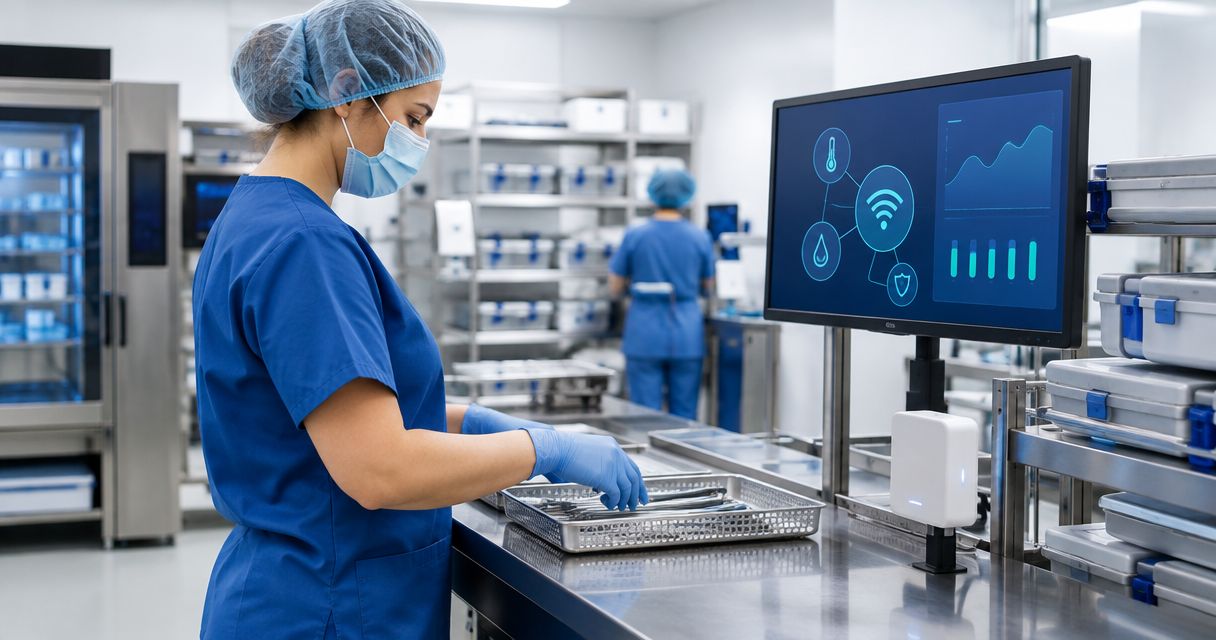
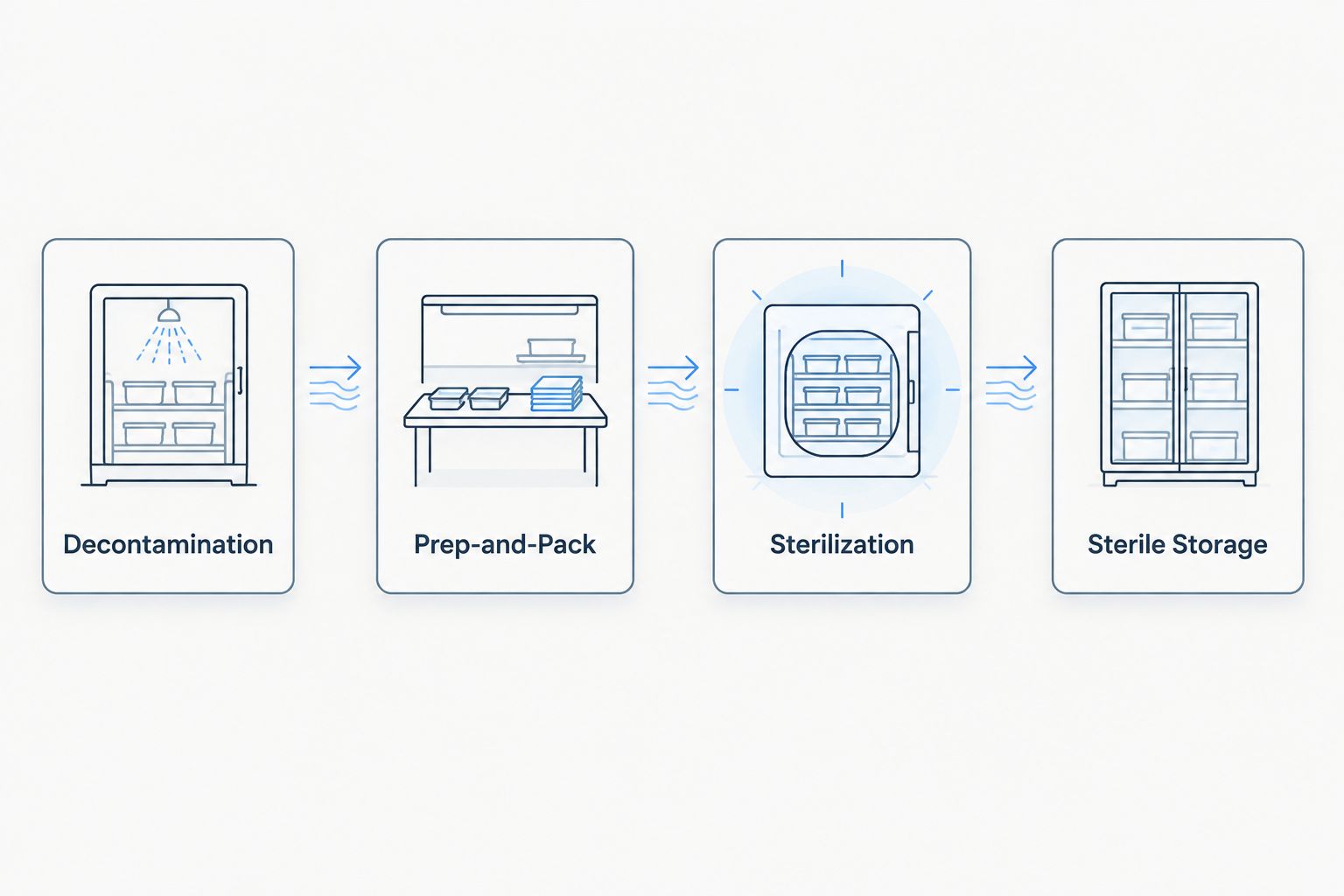
Sterile processing department IoT monitoring is continuous, automated tracking of temperature, humidity, and room pressure across decontamination, prep-and-pack, sterilization, and sterile storage zones, replacing the twice-a-shift paper round with sensors that alarm the moment a reading drifts out of range. An SPD isn't one room with one target range -- it's four or five zones running in opposite directions on purpose, and a monitoring setup that treats them the same misses the failure that actually matters: a door left open long enough to flip a pressure relationship.
- IoT monitoring for sterile processing departments tracks temperature, humidity, and pressure across decontamination, prep-and-pack, sterilization, and sterile storage zones.
- AAMI ST79 sets a 68-73°F, 30-60% humidity target for sterile processing and storage areas; ASHRAE 170 sets minimum air changes and pressure direction per zone.
- Manual rounds catch drift at the next check; wireless sensors with alarm rules catch it within minutes and log every reading automatically.
- The Kilo IoT Platform runs LoRaWAN and mioty sensors through a rules engine and alarm escalation chain built for zone-by-zone compliance monitoring in 2026.
Why sterile processing departments need continuous IoT monitoring
AAMI ST79, the Association for the Advancement of Medical Instrumentation's guide to steam sterilization, sets 68-73°F and 30-60% relative humidity as the target for sterile processing and sterile storage areas. ASHRAE 170, the healthcare ventilation standard, goes further and assigns a pressure direction and a minimum air-change rate to each zone: negative pressure and at least 6 air changes per hour in decontamination, positive pressure and roughly 4 air changes per hour in the clean workroom and sterile storage. Two rooms, opposite requirements, one hallway between them.
The Joint Commission's Environment of Care standards expect a hospital to produce documented temperature and humidity logs for these spaces during survey, and CDC's Guideline for Disinfection and Sterilization in Healthcare Facilities treats environmental control as part of the sterility assurance chain, not a separate checkbox. That's the part manual rounds handle worst: a reading taken twice a shift proves the room was in range at 7am and 3pm, not that it stayed there. A cleanroom pressure differentials setup built for pharmaceutical cleanrooms uses the same logic an SPD needs: continuous readings, not spot checks, because pressure failures don't wait for the next round.
SPDs also carry a traceability burden most facility zones don't: an instrument set that sterilizes in an out-of-spec room is a patient-safety question, not a maintenance ticket. That's why the segment needs alarm routing to a person who can act -- an SPD supervisor or infection control -- not just a dashboard someone checks once a day.
How to set up IoT monitoring for a sterile processing department
The sequence below starts with what any department can do with a clipboard and ends with what an automated platform adds once the manual process breaks down.
Map your zone pressure relationships before you place a sensor
Start with the architectural drawings, not the sensor catalog. A monitoring plan built before the zones are confirmed usually ends up with sensors in the wrong spots.
- Walk the department and mark decontamination, clean workroom/prep-and-pack, sterilization, and sterile storage as distinct zones
- Confirm the intended pressure direction for each zone against ASHRAE 170: negative in decontamination, positive in clean workroom and sterile storage
- Pull the last HVAC balancing report and note the test date for each zone
- List every door where staff or carts cross between zones -- that's where pressure fails first
- Check whether the department sits below grade or behind lead-lined imaging walls, which affects what wireless technology reaches every corner
Install temperature and humidity sensors in every zone
Most departments start here with wall-mounted min/max thermometers and hygrometers, checked and initialed by hand each shift. That works until someone forgets a round or a thermometer drifts uncalibrated for months without anyone noticing.
- Place one sensor per zone at working height, away from doors and supply diffusers that skew readings
- Add a second sensor in a large or unevenly ventilated sterile storage room rather than relying on one corner reading for the whole space
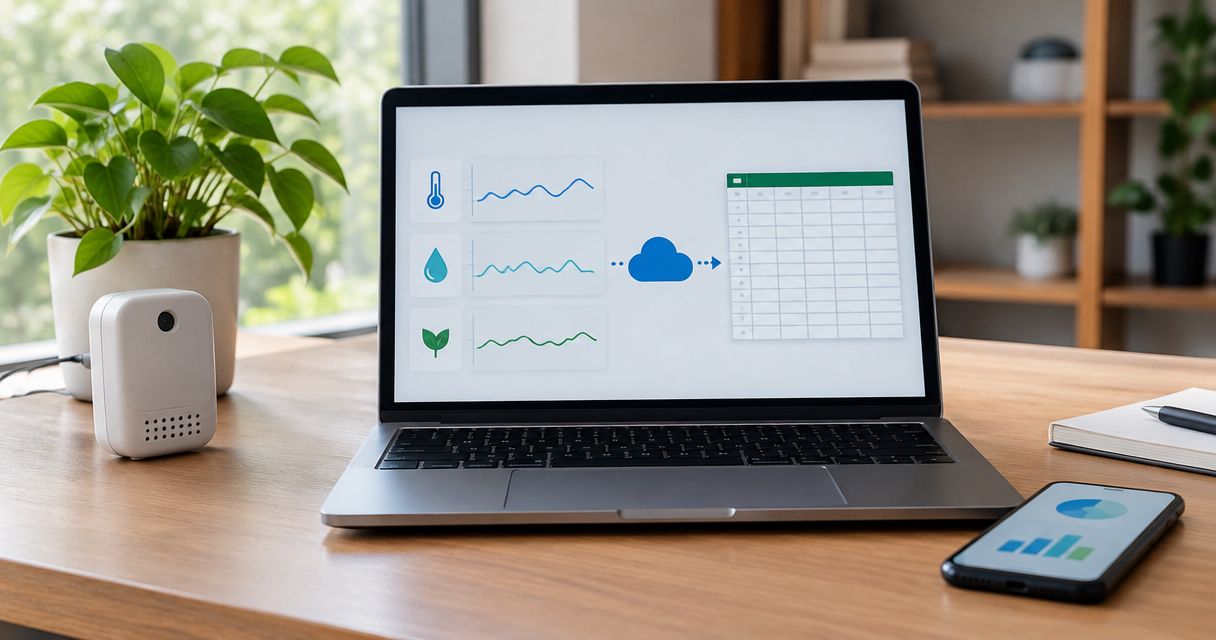
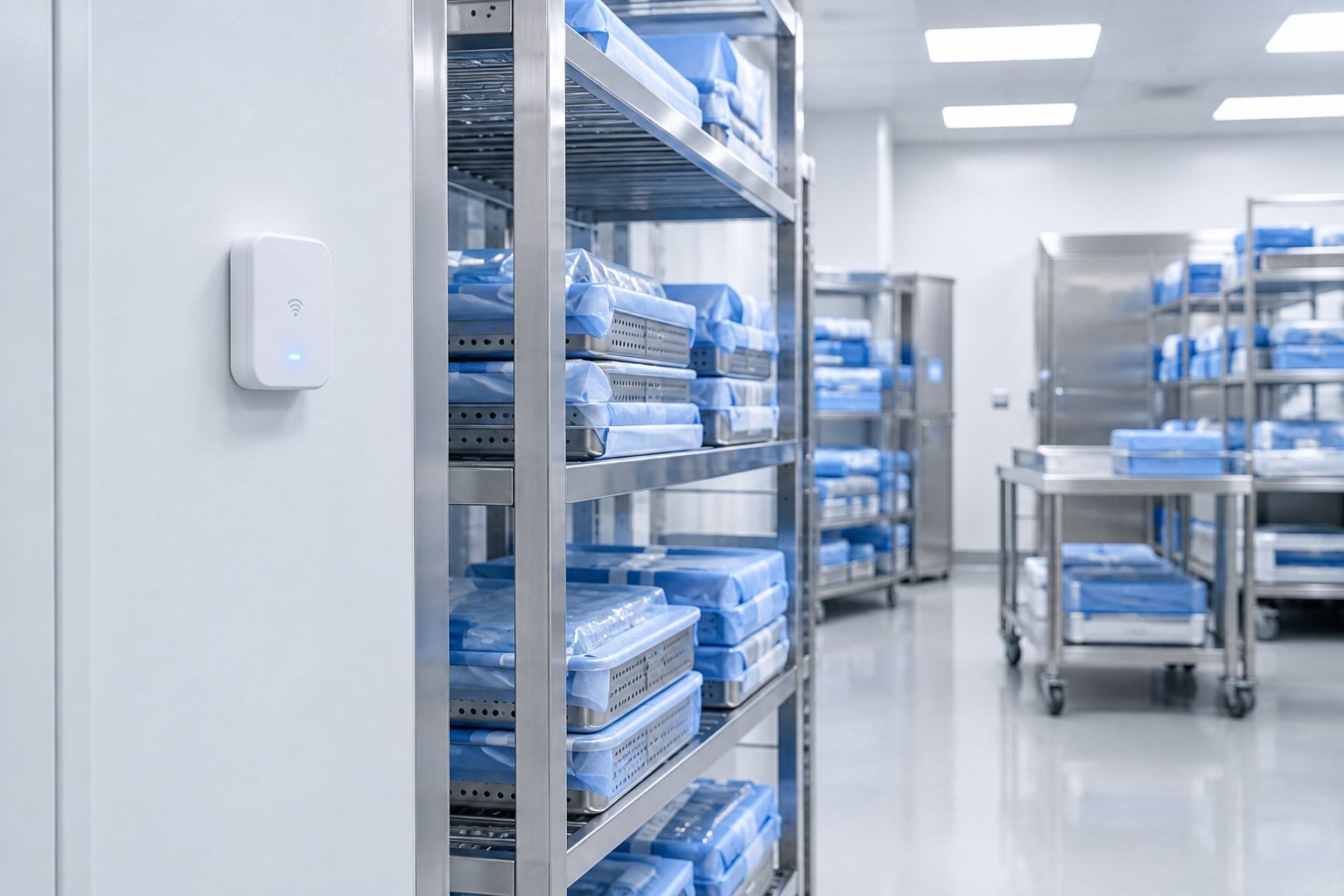
- Use LoRaWAN or mioty sensors where the department is below grade or behind shielded walls -- both protocols are built to penetrate concrete and lead better than Wi-Fi
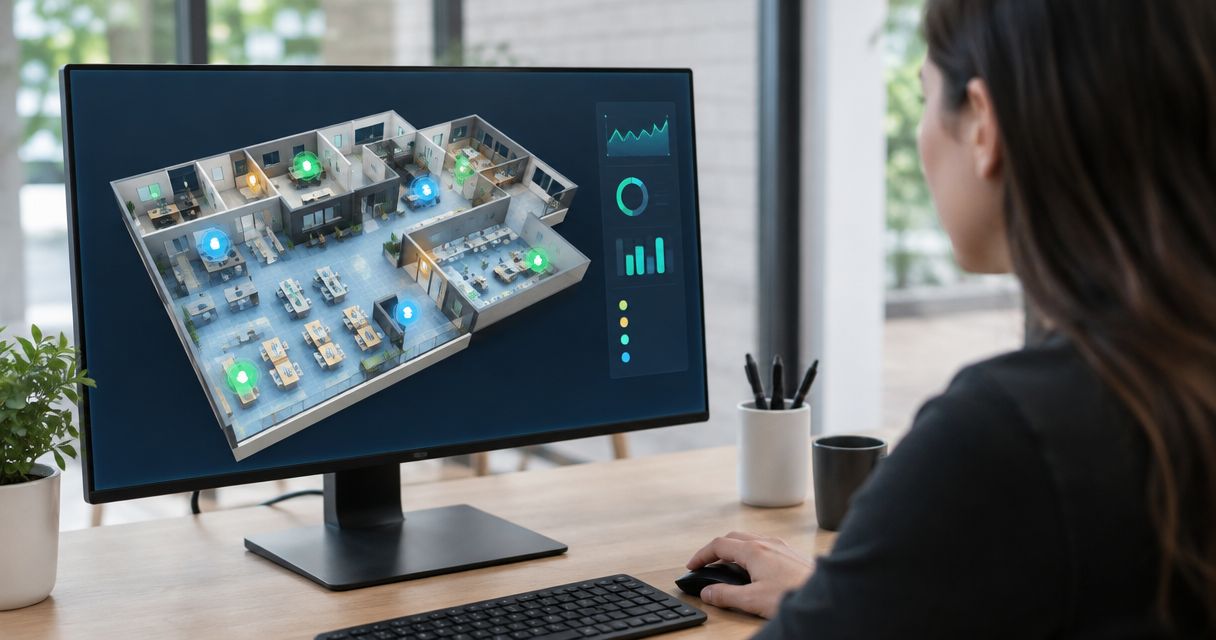
- Route every zone's readings into one dashboard instead of a spreadsheet per room
Sensors for these zones, including LoRaWAN and mioty models built for continuous monitoring, are available through Kilo Electronics, Kilo's hardware sister company, with worldwide shipping.
Monitor room pressure differentials continuously
A monthly magnehelic gauge check tells you the room passed on the day someone looked. It says nothing about the three weeks in between.
- Install a continuous differential pressure sensor at each doorway between zones
- Alarm on direction reversal, not just magnitude -- a decontamination room that goes positive is the failure that matters most
- Log pressure alongside temperature and humidity so an auditor sees all three on one timeline, not three separate binders
Set alarm thresholds and escalation chains for out-of-range readings
A threshold with nowhere to go is just a light nobody sees. This is where most SPDs move from spreadsheets to a platform, because escalation logic is hard to run by hand across three shifts.
- Define a near-limit warning separate from a hard out-of-range alarm
- Route decontamination and sterile storage alarms to the SPD supervisor first, with facilities and infection control as the second step
- Set an escalation window so an unacknowledged alarm moves to the next contact automatically
- Configure quiet hours carefully -- an SPD runs shifts around the clock, so "quiet hours" for facilities shouldn't silence a decontamination pressure alarm at 2am
The Kilo IoT Platform runs alarms through five severity tiers with multi-step escalation, and its built-in AI assistant can draft and deploy a rule from a plain-language description -- "alert the SPD supervisor if decontamination humidity exceeds 60% for more than five minutes" -- before you ever open a rules editor.
Build audit-ready temperature and humidity logs automatically
Joint Commission survey prep often means someone spending a day transcribing rounds sheets into a binder. That's the step continuous sensors remove.
- Export a timestamped history per zone instead of reconstructing it from paper
- Keep version history on any rule that generates the alarm, since the audit trail should match what the rule actually did at the time
- Reconcile sensor logs with any manual readings still required for sterilizer validation, so the two records don't contradict each other
Track instrument sets and equipment across the department
Room conditions are half the picture -- knowing where a washer, cart, or sterilizer actually is matters too, especially in a department that shares equipment across shifts.
- Manual tray tracking usually means a whiteboard or a paper move sheet at the sterilization window
- A digital twin per piece of capital equipment -- washers, sterilizers, carts -- gives a live status view without a spreadsheet
- Purpose-built instrument tray tagging is a separate system in most deployments; treat equipment tracking and tray tracking as two different problems
For the equipment side specifically, see how hospital equipment tracking works across a facility, not just one department.
Which option fits a sterile processing department's monitoring needs
| Option | Best for | Key limitation |
|---|---|---|
| Manual paper rounds and wall thermometers | A small SPD with one sterile storage room and stable staffing | Catches drift only at the check interval and is easy to skip during a short-staffed shift |
| Stand-alone chart recorders per room | Departments that already own the recorders and just need a paper trail | No central dashboard, no automatic alarm routing, data stays in the room |
| BMS-integrated sensors | Hospitals with an existing building management system and spare points | Adding a zone usually means a new BMS point and integrator time |
| Kilo IoT Platform | SPDs that want one dashboard, alarm escalation, and an exportable log across every zone | Still requires deploying wireless sensors, and doesn't replace the biological indicator testing sterilizers require |
Common sterile processing IoT monitoring mistakes
- Treating every zone as the same target range. Decontamination runs cooler and more humid on purpose; applying one threshold to the whole department produces false alarms in one zone and missed ones in another.
- Mounting the sensor next to the door or supply diffuser. That reading reflects the draft, not the room, and it's the single most common cause of nuisance alarms in SPD deployments.
- Alarming on magnitude but not direction. A pressure sensor that only flags "out of range" can miss a full reversal if the swing happens to land inside a wide tolerance band.
- No escalation path outside business hours. SPDs run three shifts; an alarm inbox that only gets checked at 8am defeats the point of continuous monitoring.
- Keeping the paper log "as backup." Two records that are never reconciled create a contradiction during an audit instead of a redundancy.
Build your SPD monitoring rules
Set zone-by-zone thresholds and escalation chains without an integrator.
FAQ
What temperature and humidity should a sterile processing department maintain?
AAMI ST79 recommends 68-73°F and 30-60% relative humidity for sterile processing and sterile storage areas. Decontamination rooms typically run cooler and more humid, since that's where soiled instruments are rinsed, so treat it as a separate target range from clean workroom and storage.
Is positive or negative pressure required in a decontamination room?
Decontamination rooms need negative pressure relative to adjoining spaces, per ASHRAE 170, so contaminated air doesn't migrate into clean areas. Clean workroom and sterile storage need positive pressure for the opposite reason: keeping unfiltered air out.
How is IoT monitoring different from manual logbook rounds in an SPD?
Manual rounds record a single reading at whatever interval staff walk the room, usually two to four times a shift. IoT sensors report continuously and trigger an alarm the moment a reading crosses a threshold, instead of waiting for the next round to notice.
Can wireless sensors work in a windowless or basement sterile processing department?
Yes. LoRaWAN and mioty sensors are built to penetrate concrete, lead-lined walls, and multiple floors better than Wi-Fi or Bluetooth, which is why they're common in basement SPDs and shielded imaging suites.
Does IoT monitoring replace biological indicator testing for sterilizers?
No. Biological and chemical indicator testing validates that a sterilizer cycle actually achieved sterility and stays a separate, required process. Room-level IoT monitoring covers the environment around the sterilizer -- temperature, humidity, and pressure -- not the cycle itself.
How often should SPD temperature and humidity sensors report?
Most deployments report on an interval of a few minutes rather than hours, since the goal is catching drift between rounds, not replacing a single daily reading. The exact interval is a rule you set, balanced against sensor battery life.
What happens when a sterile storage room alarm is missed overnight?
A well-configured escalation chain moves an unacknowledged alarm to a second contact after a set window, rather than sitting in one inbox until morning. Kilo's alarm system supports five severity tiers and multi-step escalation for exactly this gap.
Can one platform track both room conditions and hospital equipment?
Yes, within limits. A platform like Kilo Cloud can monitor zone conditions and also track larger capital equipment such as washers and carts through digital twins, though tagging individual instrument trays usually needs a purpose-built asset system.
What sterile processing departments overlook in IoT monitoring
The failure that gets missed most in 2026 audits isn't a temperature excursion -- it's a pressure reversal at a doorway that lasted twenty minutes during a busy shift and never showed up on a monthly gauge check. Alarm on direction, not just range, and that gap closes on its own. The second overlooked detail: a paper log kept "just in case" alongside sensor data almost always drifts out of sync with it within a few months, which turns a redundancy into a liability the moment an auditor compares the two.