
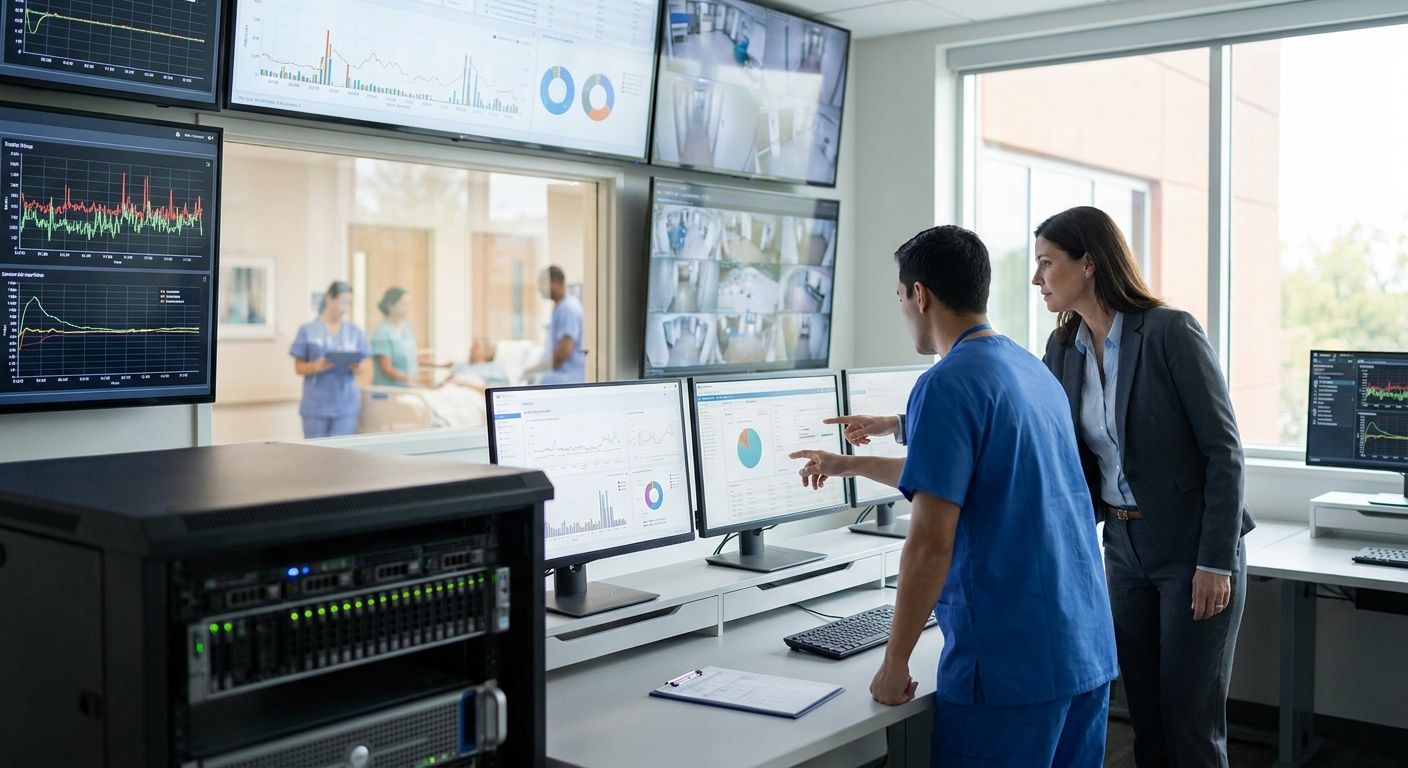
A facility monitoring system for hospitals connects temperature, humidity, pressure, and equipment sensors across pharmacy, lab, imaging, and clinical spaces into one dashboard, so facilities and biomedical engineering staff catch a failing compressor or a propped-open freezer door before it turns into a reportable incident. Hospitals run more failure-prone zones than almost any other facility type, and each zone answers to a different regulator.
- A facility monitoring system for hospitals should cover pharmacy fridges, blood banks, isolation rooms, and mobile equipment in one dashboard.
- Wireless LoRaWAN and mioty sensors reach basements, imaging suites, and sterile processing corridors without new cabling in 2026 retrofits.
- Escalation chains matter more than sensor accuracy: an alarm that reaches one pager misses an overnight excursion.
- The Kilo IoT Platform runs LoRaWAN, mioty, and MQTT devices in one dashboard, from a single fridge to a full hospital campus.
Why hospitals need a dedicated facility monitoring system
A mid-size US hospital can run dozens of medication refrigerators, several blood bank freezers, negative-pressure isolation rooms, an MRI suite, backup generators, and a server room keeping the EHR online — each with its own failure mode and its own regulator watching it. The Joint Commission's Environment of Care standard expects ongoing monitoring of temperature-sensitive storage and critical utility systems, not a monthly walkthrough with a clipboard.
A facility monitoring system for hospitals puts all of that in one place instead of a spreadsheet per department. Clinics and pharmacies inside a larger health system that manage their own vaccine storage monitoring for clinics and pharmacies face the same excursion risk at smaller scale — the sensor logic and alarm structure carry over directly, just with fewer rooms to watch.
The distinguishing need for hospitals isn't more sensors — it's the escalation path. A dropped alert in a hotel means a cold minibar. A dropped alert in a blood bank means discarded units and a report to the lab director.
How to build a facility monitoring system for hospitals and health systems
The sequence below moves from mapping risk to connectivity, in the order most facilities and biomedical engineering teams actually tackle it.
Map every critical zone before you buy sensors
Start with a list of every space where a temperature, pressure, or power failure creates clinical or regulatory exposure:
- Pharmacy and med-room refrigerators and freezers
- Blood bank and biorepository freezers
- Isolation rooms and operating rooms with pressure requirements
- Imaging suites and their equipment rooms
- Backup generators and UPS rooms
- Server and network rooms behind the EHR
- Sterile processing and central supply
Match sensor types to each hospital zone
Before any sensor goes up, a paper log and a twice-daily walkthrough is the baseline most surveyors expect — it just doesn't scale past a handful of rooms. Once a hospital moves past that baseline, the sensor mix typically looks like:
- Temperature and humidity probes for refrigerators, freezers, and med rooms
- Door contact sensors on fridge and freezer doors
- Differential pressure sensors for isolation rooms and operating suites
- Vibration sensors on chillers and refrigeration compressors
- Current and power sensors on generators and UPS units
- MQTT-connected points where a BMS or PLC already exists
Pre-configured sensors for these zones ship through Kilo Electronics (kiloelectronics.com), the hardware side of Kilo, with worldwide shipping — useful when a facilities team needs matched hardware instead of sourcing sensors from three vendors.
Set alarm thresholds against clinical and regulatory standards
Thresholds shouldn't be guessed. Pull them from the standard that actually governs the zone:
- CDC's Vaccine Storage and Handling Toolkit for refrigerated and frozen vaccine ranges
- USP <795>, <797>, and <800> for compounded and hazardous drug storage conditions
- ASHRAE 170 for pressure relationships in isolation rooms and operating rooms
- NFPA 99 for essential electrical system requirements
- Manufacturer specifications for lab freezers and blood bank units
Kilo's visual rules engine lets facilities staff build a threshold rule with a BPMN-style builder, step through it against a sample payload before it goes live, and roll it back with one click if it misfires — without filing a ticket with IT for every change.
Build escalation chains for 24/7 clinical staff
A hospital never closes, so an alarm chain built for a 9-to-5 office fails immediately. Structure it instead as:
- Primary alert to the on-call facilities engineer
- Second-tier escalation to biomedical engineering if unacknowledged
- Quiet hours for low-severity alerts, with critical severity always breaking through
- SMS, email, and push together, so one missed channel doesn't stall response
- A centralized inbox so nursing isn't guessing which department owns an alert
Hospitals moving off a single pager can follow the setup in SMS and email alerts for critical sensor thresholds. Kilo's alarms support five severity tiers and multi-step escalation for exactly this reason.
“If an alarm reaches only one pager, a weekend excursion goes unnoticed until Monday rounds.”
Track mobile equipment across departments
Infusion pumps, portable monitors, wheelchairs, and mobile imaging units move constantly, and biomedical engineering loses hours a week hunting for them. The pattern for hospital equipment asset tracking uses the same wireless network already covering fridges and pressure sensors, so it's an addition to an existing deployment rather than a separate system.
Centralize data for Joint Commission and compliance audits
Surveyors want history, not a snapshot. A working system produces:
- Exportable temperature excursion history per unit
- A digital twin view tying sensors to a floor plan a surveyor can walk through
- An audit trail of who changed a threshold and when
- API export into existing compliance or reporting software
Plan wireless coverage for shielded and below-grade spaces
Hospitals have more radio-hostile spaces than a typical office building: lead-lined imaging suites, below-grade mechanical rooms, thick concrete stairwells, and metal shelving in central supply. Standard Wi-Fi loggers frequently drop out in these exact rooms. Network planning for this environment matters as much as sensor choice, which is why coverage should be tested zone by zone before a full 2026 rollout rather than assumed from a floor plan.
Facility monitoring options for hospitals compared
| Option | Best for | How it connects | Key limitation |
|---|---|---|---|
| Paper temperature logs | A single fridge in a small clinic | Manual staff rounds | No visibility outside check times; easy to miss or falsify |
| Standalone Wi-Fi data loggers | One pharmacy refrigerator or lab freezer | Hospital Wi-Fi network | No shared alarm routing; sits outside the central dashboard |
| Hardwired BMS/BAS | Hospitals with an existing building automation system | Wired points on the BMS backbone | Extending to a new wing or portable fridge needs a contractor |
| Wireless LoRaWAN/mioty platform (e.g., Kilo) | Multi-building, multi-department hospitals adding sensors without rewiring | Battery sensors over LoRaWAN or mioty into a cloud dashboard | Gateway placement needs planning in concrete or lead-shielded rooms |
See a hospital dashboard walkthrough
Explore how sensors, alarms, and a digital twin fit one dashboard.
Common facility monitoring mistakes hospitals make
- Treating a printed log as compliance. CDC's Vaccine Storage and Handling Toolkit calls for reviewing temperature data daily, not just recording it once a shift.
- Routing every alarm to one inbox nobody checks after 6 p.m. — the single biggest cause of a Monday-morning excursion discovery.
- Skipping pressure differential monitoring in isolation and operating rooms, even though ASHRAE 170 sets the pressure relationships those rooms are built to maintain.
- Assuming Wi-Fi sensors reach a basement server room or lead-lined imaging suite the same way they reach a nursing station — they usually don't.
- Buying sensors department by department instead of one dashboard, leaving facilities, biomedical engineering, and infection control looking at three different systems in 2026 that don't talk to each other.
FAQ
What is a facility monitoring system for hospitals?
It's a wireless sensor and software setup that tracks temperature, humidity, pressure, and equipment status across pharmacy, lab, and clinical spaces in one dashboard. It replaces manual rounds with continuous data and automated alarms.
What should a hospital monitor with IoT sensors?
Pharmacy and med-room refrigerators, blood bank freezers, isolation and operating room pressure, generator and UPS status, server rooms, and mobile clinical equipment are the highest-risk zones. Each has its own failure mode and its own regulatory expectation.
Is LoRaWAN or mioty better for hospital basements?
mioty's telegram-splitting transmission gives it a stronger link budget through concrete and metal, which helps in below-grade mechanical rooms and dense central supply areas. LoRaWAN performs well on upper floors and outdoor-facing sensors like generator yards.
How do hospitals monitor vaccine and medication refrigerators?
Temperature probes paired with door contact sensors report continuously to a dashboard, with alarms firing if a unit drifts outside range set against CDC storage guidance. This replaces a twice-daily manual check with continuous data.
What temperature standards apply to hospital pharmacy storage?
USP <795>, <797>, and <800> set storage conditions for compounded and hazardous drugs, while CDC's Vaccine Storage and Handling Toolkit sets ranges for refrigerated and frozen vaccines. Manufacturer specs govern lab freezers and blood bank units.
Can a facility monitoring system replace a hospital's BMS?
No — a wireless monitoring system typically extends coverage into areas a BMS doesn't reach, like portable fridges or new wings, rather than replacing an existing building automation system outright. Many hospitals run both side by side.
How do alarms reach on-call staff overnight?
Escalation chains route a primary alert to the on-call facilities engineer, then escalate to biomedical engineering if it's unacknowledged, using SMS, email, and push together. Quiet hours can suppress low-severity alerts while letting critical ones through.
What is a digital twin used for in a hospital building?
A digital twin ties live sensor data to a floor plan or 3D model, so facilities staff and surveyors can see which room a reading or alarm belongs to without cross-referencing a spreadsheet.
Does mioty work better than LoRaWAN in hospital basements?
mioty splits a single transmission across multiple frequency hops, which gives it a stronger link budget through concrete, metal shelving, and lead shielding than a typical LoRaWAN deployment covers on its own. That matters directly for below-grade mechanical rooms, central sterile supply, and imaging equipment rooms — the exact spaces where a hospital's Wi-Fi already struggles. LoRaWAN still handles upper floors, outdoor generator yards, and open corridors without issue. Kilo runs both protocols through the same cloud dashboard, so a hospital doesn't have to standardize on one network technology building-wide in 2026 — the choice can be made room by room based on what the concrete actually does to the signal.