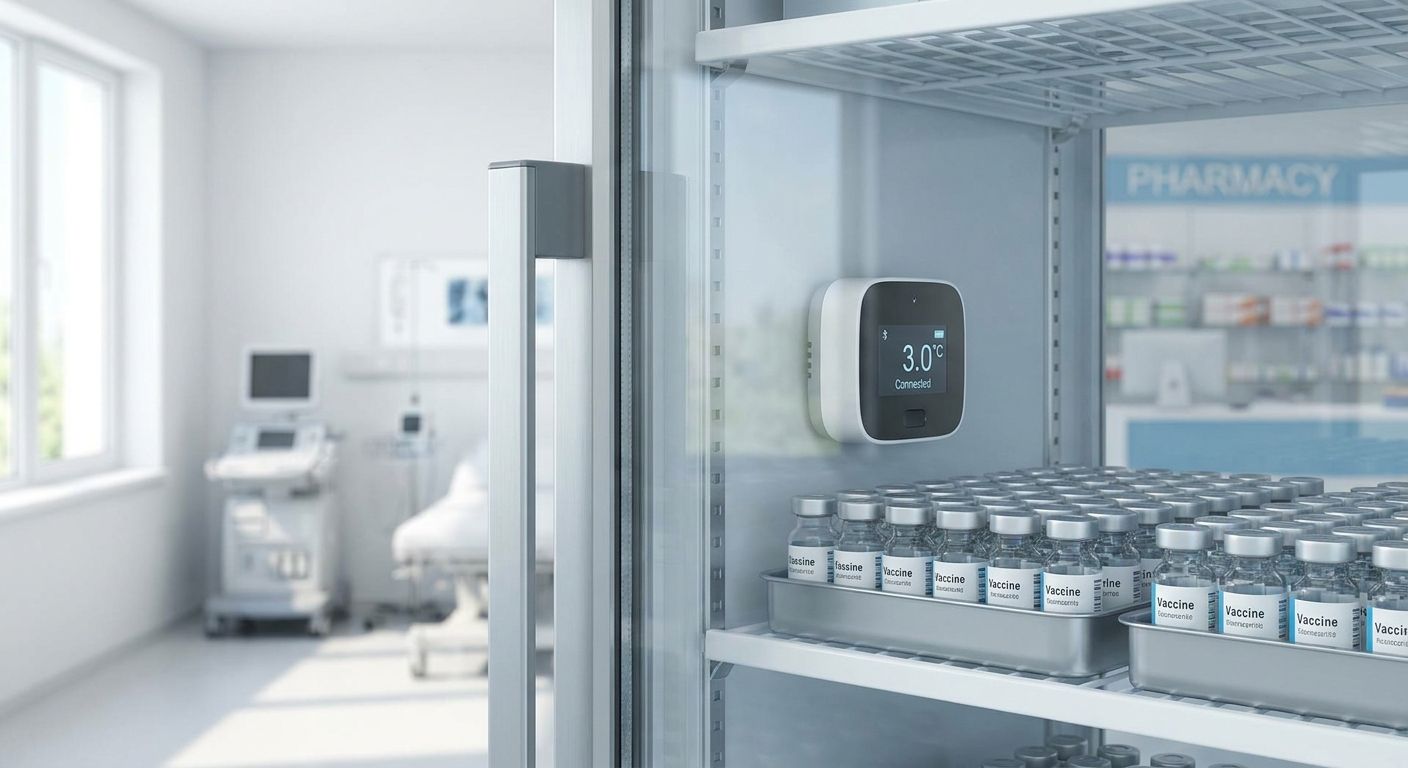
A refrigerator holding MMR and flu vaccines that drifts to 9°C overnight during a power blip can turn a full tray of doses into a write-off before anyone opens the door in the morning. IoT vaccine storage monitoring closes that gap by logging temperature continuously and alerting staff the moment a fridge or freezer leaves its safe range, instead of waiting for the next manual check.
- IoT vaccine storage monitoring replaces twice-daily manual checks with continuous logging and instant alarms.
- CDC's Vaccine Storage and Handling Toolkit (2023) specifies 2°C to 8°C for refrigerated vaccines and -50°C to -15°C for frozen vaccines.
- Escalation chains and audit-ready logs matter more than raw sensor accuracy for passing a VFC or state inspection.
- A single-site clinic can start on a free IoT tier; a multi-site pharmacy chain needs multi-site dashboards and role-based access.
Who needs IoT vaccine storage monitoring?
This is written for the person responsible for the vaccine fridge: a clinic manager, an independent pharmacist, or an ops lead covering several pharmacy locations. If your job includes signing a temperature log, calling the state immunization program after an excursion, or explaining to a Vaccines for Children (VFC) auditor why a fridge read 11°C for two hours, this is your problem.
Small practices with one or two units care about setup time and cost. Multi-site pharmacy chains and pharmaceutical cold chain distribution centers care about consistency across locations and a single dashboard that doesn't require training every location manager on new software. The Kilo IoT Platform is built for both ends of that range, from a five-device free account to a facility running dozens of fridges and freezers across sites.
What to look for in an IoT vaccine storage monitoring system
Continuous digital logging, not spot checks
A paper log filled in twice a day misses everything between checks. CDC's Vaccine Storage and Handling Toolkit recommends a continuous digital data logger with a detachable probe, a min/max display, and an alarm, checked at least twice daily as a backstop, not a primary control. Continuous logging is what turns a fridge into an auditable asset instead of a guess.
Alarms that escalate after hours
An email alert nobody reads until Monday morning is functionally the same as no alarm. A system needs multi-step escalation: a push notification first, an SMS if it's not acknowledged, then a phone call to a second person on the list. Kilo's alarms support five severity tiers and escalation chains for exactly this reason, with quiet hours configured so low-severity notices don't wake staff at 2 a.m. while high-severity excursions still break through.
Network resiliency during power and Wi-Fi outages
A Wi-Fi logger that depends on the building's router fails at the worst possible moment: during the same power event that's putting the vaccines at risk. LoRaWAN and mioty sensors run on battery for months and report over a wireless network that isn't tied to the building's internet connection, which is why a built-in LoRaWAN and mioty network server matters more for this use case than a Wi-Fi-only device ever will.
Audit-ready records for VFC and state inspections
VFC site visits and state board of pharmacy inspections ask for exportable, unaltered temperature history, not a screenshot. An immutable audit trail and API access to raw readings mean you can hand over exact records instead of reconstructing them from memory.
Door and power event detection
A fridge that reads 5°C internally but has had its door propped open for 20 minutes is still a compliance problem. Door contact sensors and power-loss detection catch failure modes that a temperature probe alone reports too late to act on.
Multi-site dashboards for pharmacy chains
One pharmacy location can run off a single screen. A chain with 12 locations needs one dashboard showing every fridge's status at a glance, with role-based access so a district manager sees all sites and a store pharmacist sees only theirs.
How does IoT vaccine storage monitoring work in practice?
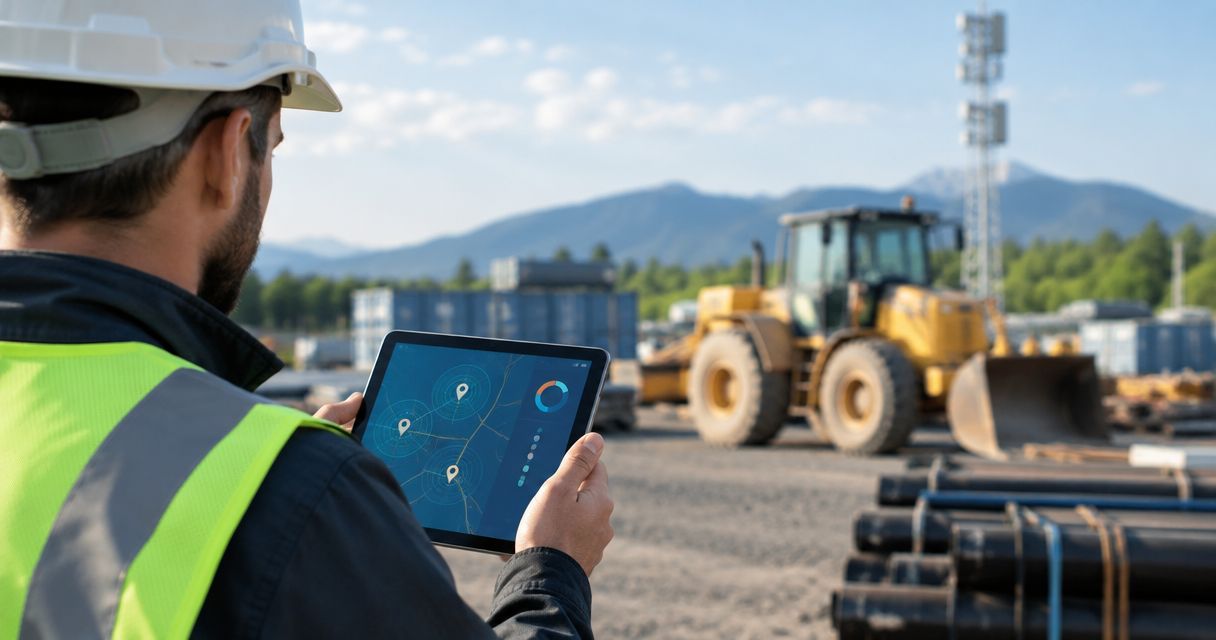
A typical setup starts with a LoRaWAN or mioty temperature and humidity sensor mounted inside each fridge or freezer, reporting on a fixed interval to a gateway in the building. There's no separate network server to stand up — Kilo's LoRaWAN and mioty network server is built into the platform, so the sensor shows up as a device the moment it joins.
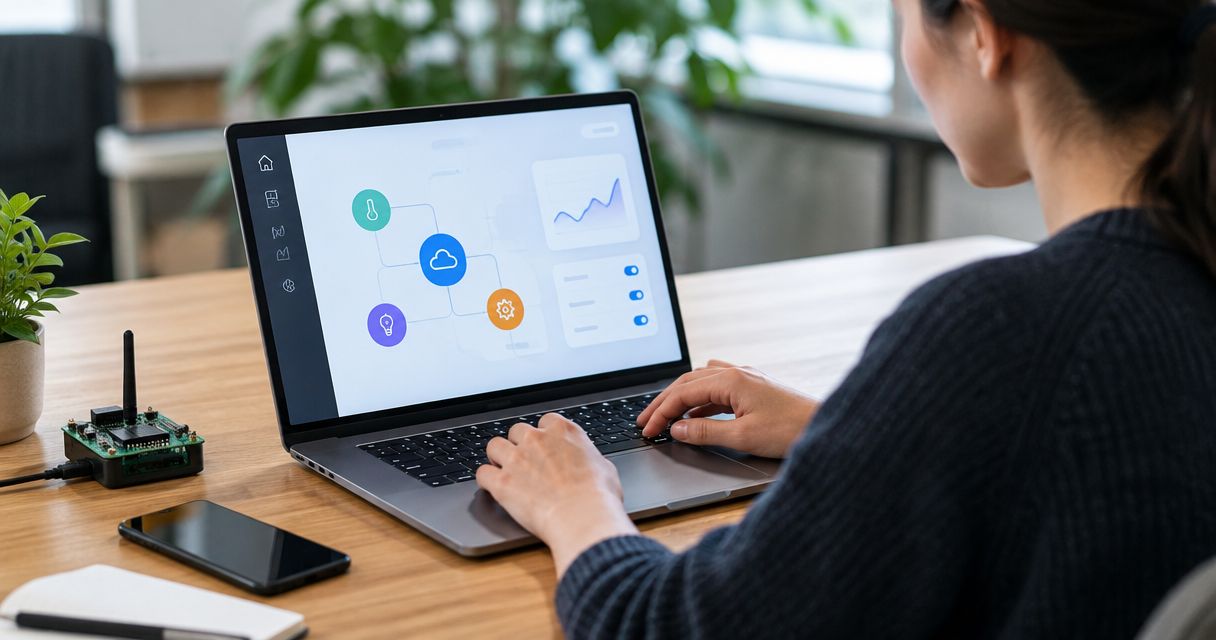
Each fridge gets a digital twin in the platform: a single record showing its current reading, its history, and its position on a live floor-plan view if you're running a broader cold storage temperature monitoring dashboard across a building or multiple sites. From there, a rule built on the platform's visual rules engine — BPMN workflow, CEL expressions underneath — watches the reading and fires an alarm if it moves outside the 2°C-to-8°C band CDC specifies for refrigerated vaccines, or the colder -50°C-to--15°C band for frozen stock. Rules get version control and one-click rollback, and you can step through a rule against a test payload before it goes live, so a bad threshold doesn't page the whole team at midnight.
When the alarm fires, it lands in a centralized inbox and escalates through email, SMS, and push based on severity, respecting any quiet hours you've set for lower-tier alerts. If a plug-in freezer needs a manual defrost cycle or a compressor reset command, Kilo supports named typed commands sent as downlinks with parameter validation and closed-loop verification, so the platform confirms the command actually executed instead of assuming it did. Kilo's built-in AI assistant can walk a non-technical staff member through onboarding a new sensor, building the temperature rule in plain language, and setting up the escalation chain — it confirms before anything consequential deploys, and it only acts within the signed-in user's own permissions.
Hardware for this kind of deployment — temperature and humidity sensors, door contact sensors, LoRaWAN gateways — ships through Kilo's sister company, Kilo Electronics, with worldwide shipping; Kilo itself doesn't manufacture the devices, it manages and monitors them.
See vaccine fridge monitoring in Kilo
Start free for up to 5 devices, 1 dashboard and 1 rule — no card required.
What mistakes make vaccine storage monitoring fail a compliance check?
- Relying on a stand-alone min/max thermometer as the only record. It shows the extremes but nothing about how long the fridge sat outside range or what caused it, which is exactly what an inspector asks about after an excursion.
- Building alerts around a single contact. If the only person who gets the alarm is on vacation, the excursion runs the full weekend before anyone checks. Escalation chains exist to prevent this specific failure.
- Skipping door and power monitoring because the temperature probe looks fine. A fridge can read in-range for the sensor's polling interval while the door has been ajar the whole time; door and power events are separate signals that need separate rules.
Vaccine storage monitoring approaches compared
| Capability | Paper log, twice-daily check | Basic Wi-Fi logger | LoRaWAN/mioty platform with rules engine |
|---|---|---|---|
| Continuous readings | No | Yes, if Wi-Fi holds | Yes, independent of building network |
| Escalating alarms | No | Basic email only | Multi-tier, SMS/push/email |
| Works through a power/internet outage | N/A | No | Yes, battery-powered sensors |
| Exportable audit trail | Manual re-entry | Sometimes | Immutable, API-accessible |
| Multi-site view | No | Rare | Yes, single dashboard |
FAQ
What is IoT vaccine storage monitoring?
IoT vaccine storage monitoring uses wireless temperature and humidity sensors inside fridges and freezers to log conditions continuously and trigger alarms when readings leave a safe range. It replaces or backs up manual twice-daily temperature checks with a continuous, timestamped record.
What temperature range do vaccines need to stay within?
CDC's 2023 Vaccine Storage and Handling Toolkit specifies 2°C to 8°C for refrigerated vaccines and -50°C to -15°C for frozen vaccines like varicella-containing products. Ranges vary by specific vaccine, so always check the manufacturer's package insert.
Is a Wi-Fi temperature logger enough for vaccine storage compliance?
A Wi-Fi logger works until the building's internet or power goes out, which is often the same event causing the temperature excursion it's supposed to catch. LoRaWAN or mioty sensors report over their own wireless network and keep working through a Wi-Fi or power outage.
How much does an IoT vaccine storage monitoring system cost?
On Kilo, monitoring up to 5 devices, 1 dashboard and 1 rule costs 0 EUR with no card required and never expires. Scaling to 25 devices moves to the 25 EUR-per-month Starter tier, with gateways unlimited on every tier.
Does IoT vaccine storage monitoring work during a power outage?
Battery-powered LoRaWAN and mioty sensors keep reporting through a power outage since they don't depend on building electricity or Wi-Fi to transmit. The platform can also alert on the power-loss event itself, separate from the temperature reading.
What happens if a vaccine refrigerator alarm is missed?
A missed alarm means the excursion runs until the next manual check, which is exactly the gap continuous monitoring closes. Escalation chains that page a second contact after a set time reduce the chance a single missed notification lets an excursion run unnoticed.
Can one dashboard monitor vaccine fridges across multiple clinic locations?
Yes, a multi-site dashboard shows every fridge and freezer across locations on one screen with role-based access controlling who sees which sites. This matters most for pharmacy chains and multi-clinic operators managing more fridges than one person can check by hand.
Does IoT vaccine storage monitoring replace manual temperature logs?
It reduces reliance on manual logs but most immunization programs still expect some documented manual verification alongside continuous digital records. Treat the digital log as the primary record and the manual check as the backstop CDC's toolkit recommends.
What happens if a vaccine temperature excursion isn't caught?
CDC's guidance is blunt on this point: vaccines exposed to temperatures outside their labeled range should not be administered until the manufacturer or the state or local immunization program confirms viability, which can mean an entire fridge of doses sits unusable while that call gets made. The cost isn't just the doses — it's the hours spent tracking down every patient who received a dose from that lot and the paperwork that follows. A continuous alarm that fires in the first minutes of an excursion, instead of being discovered on the next scheduled check, is the difference between a five-minute fix and a multi-day incident report in 2026.