
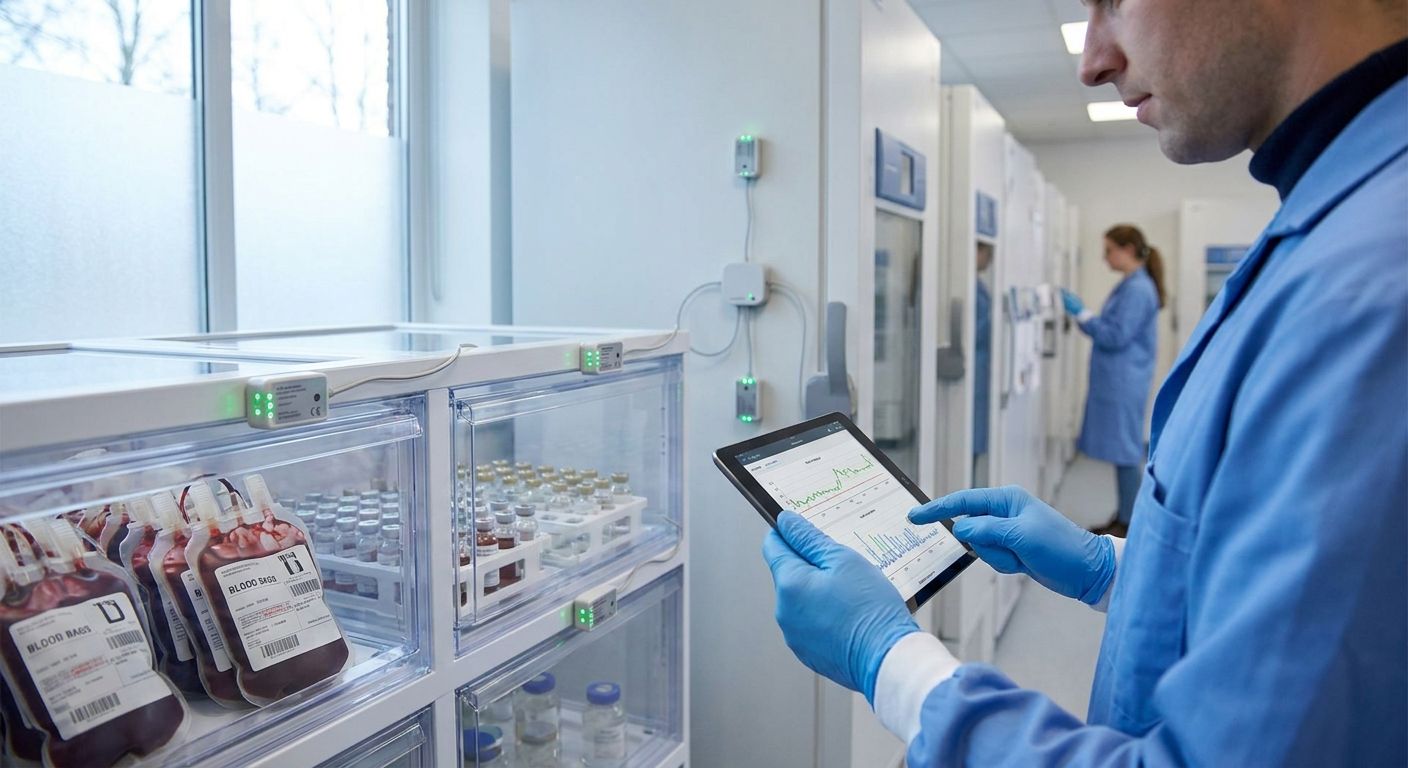
Blood bank and biorepository IoT monitoring is the practice of tracking refrigerators, freezers, and liquid nitrogen storage in real time so a temperature excursion triggers an alarm before a unit of blood or a biospecimen is compromised. A hospital blood bank tracking red cells at 1-6°C has different failure modes than a biorepository holding tissue samples at -80°C or in liquid nitrogen vapor phase, and a monitoring setup built for one won't cover the other without adjustment.
- Blood bank iot monitoring needs zone-specific alarms: 1-6°C for red cells, 20-24°C for platelets, -18°C or colder for plasma.
- Biorepository storage adds -80°C mechanical freezers and liquid nitrogen vapor phase down to roughly -150°C, which most vaccine-fridge setups don't cover.
- Kilo IoT Platform runs alarms with five severity tiers and escalation chains, starting free for up to 5 devices.
- AABB Standards and ISBER Best Practices both expect continuous, documented monitoring — not periodic manual checks.
Why do blood banks and biorepositories need continuous temperature monitoring?
A blood bank running on manual chart recorders finds out about a compressor failure on the next scheduled walk-through, which can be hours after the unit drifted out of range. AABB Standards for Blood Banks and Transfusion Services and the FDA's 21 CFR Part 606 recordkeeping requirements both assume continuous documentation, not spot checks, and inspectors ask for logs that show the alarm fired and someone acted on it.
Biorepositories carry a separate risk: samples in mechanical -80°C freezers or liquid nitrogen dewars are often unattended for days, and by the time a visual check catches a slow warm-up, the specimen may already be degraded. ISBER Best Practices for Repositories recommends continuous monitoring with documented response procedures for exactly this reason.
The vaccine storage monitoring guide for clinics and pharmacies covers a related but narrower case — single-range refrigerated storage. Blood banks and biorepositories need the same alarm discipline across several temperature bands at once, sometimes in the same building.
How to set up IoT monitoring for blood bank and biorepository storage
Map every storage zone and its required range
Before any sensor goes in, list every unit that holds product or samples and the range it has to stay in. This is paperwork, not hardware, and it's the step most facilities skip.
- Red blood cell refrigerators: 1-6°C
- Platelet incubators: 20-24°C with continuous agitation
- Fresh frozen plasma freezers: -18°C or colder
- Mechanical ultra-low freezers for biorepository samples: typically -80°C
- Liquid nitrogen dewars, vapor phase: roughly -150°C or colder
- Backup or overflow units, tagged separately from primary storage
Place sensors where the product actually sits, not just in the room
Ambient room temperature tells you almost nothing about what's happening inside a packed freezer. A probe near the door reads differently than one buried in the center of the load.
- One probe per storage unit at minimum, two for anything holding regulated blood product
- Probe placement near the geometric center of the load, not near the door or fan
- Door contact sensors on every unit that opens more than a few times a day
- Redundant sensors on critical freezers so one failed probe doesn't blind the whole unit
- Battery-rated hardware for sub-zero and liquid nitrogen environments
For sensor selection specifics, the cold chain compliance sensor guide breaks down probe types by range and mounting.
Set alarm thresholds and build the escalation chain
Manual monitoring means a person checks a log book on a schedule and calls someone if a number looks wrong. That works until the person on shift misses a reading or doesn't know who to call at 2 a.m.
This is where a platform earns its place instead of a spreadsheet. The Kilo IoT Platform runs alarms with five severity tiers, multi-step escalation chains, and delivery over email, SMS, and push, so a threshold breach on a plasma freezer doesn't stop at one notification that nobody sees. If the alarm doesn't reach a person, the alarm didn't happen — quiet hours settings and a centralized inbox exist specifically so escalation still works overnight without burying every technician in noise all day.
“If the alarm doesn't reach a person, the alarm didn't happen.”
- Separate threshold profiles per storage zone (RBC, platelets, plasma, ultra-low, LN2)
- Multi-step escalation so an unanswered alert reaches a second contact
- Quiet hours that route only critical-tier alarms overnight
- SMS and push for on-call staff, email for the wider team
- A centralized alarm inbox so nothing gets missed in a shared account
Build a temperature excursion report for every incident
An excursion isn't just an alarm — it's an event that needs a record: when it started, how long it lasted, what the peak or trough was, and who responded. Manual logs handle this with a notebook and a memory of what happened; it's slow and it's the first thing an auditor picks apart.
- Timestamped start and end of the excursion
- Peak or trough value reached during the event
- Duration outside the approved range
- Which unit and which product or sample lot was affected
- Response action taken and who logged it
The temperature excursion report guide walks through building this report directly from sensor history instead of reconstructing it after the fact.
Automate door and power event alerts
A freezer door propped open for ten minutes during a busy shift can do more damage than a slow compressor failure. Power loss is worse because it's silent until the unit has already warmed for hours.
- Door-open duration alarms, not just open/closed status
- Backup power or UPS status feeding into the same alarm system
- Downlink commands to acknowledge or silence a local alarm once staff responds
- Escalation if a door alarm and a power alarm both fire within a short window
Review historical data ahead of an accreditation inspection
AABB and CAP inspectors ask for a data trail, not a summary. Being able to pull twelve months of a specific freezer's history in minutes, instead of digging through binders, changes how that conversation goes.
- Continuous sensor history retained per unit, not just alarm events
- An immutable audit trail showing who changed a threshold and when
- Exportable reports scoped to a date range and a specific unit
- API access for pulling records into an existing quality system
Blood bank cold chain monitoring options compared
| Option | Best for | Starting price | Key limitation |
|---|---|---|---|
| Paper logs / chart recorders | Small blood banks with staff on-site around the clock | No software cost, staff time only | No real-time alarm; gaps between manual checks |
| Standalone WiFi sensor apps | Single-site setups needing something running fast | Varies by vendor | WiFi range limits, no LoRaWAN or mioty support, thin escalation |
| Existing BMS integration | Sites where refrigeration already reports into a building system | Tied to existing BMS contract | Not built for zone-specific blood product alarms or audit exports |
| Kilo IoT Platform | Multi-unit blood banks and biorepositories needing zone alarms and audit history | Free (0 EUR) up to 5 devices; Starter at 25 EUR/month up to 25 devices | No native CMMS or work-order integration — alarms post out over API/webhook instead |
A blood bank running more than a handful of storage units gets more out of a platform built for zone-specific alarms than out of a general BMS retrofit or a single-room WiFi app.
See the Kilo IoT Platform in action
Free up to 5 devices, no card required, full platform.
Sensor hardware for cold storage and liquid nitrogen environments, including probes rated for sub-zero mounting, ships worldwide through Kilo's sister company, Kilo Electronics.
Common blood bank and biorepository monitoring mistakes
- Treating one threshold as universal. A single alarm range set for a refrigerator gets copied onto a -80°C freezer, which either never fires or fires constantly.
- No escalation path outside business hours. Blood banks run 24/7, but many alarm setups only reach the day shift, so an overnight excursion goes unanswered until morning.
- Skipping power-loss alarms until after a failure. Temperature alarms alone miss a silent power outage that hasn't yet raised the internal temperature.
- Ignoring liquid nitrogen level, not just temperature. A dewar can hold temperature right up until the nitrogen runs low, then fail fast with almost no warning from a temperature probe alone.
- Keeping excursion records in a notebook. Reconstructing an incident timeline from memory during an AABB or CAP inspection is slower and less credible than pulling a timestamped report.
FAQ
What temperature should blood products be stored at?
Red blood cells are stored at 1-6°C, platelets at 20-24°C with continuous agitation, and fresh frozen plasma at -18°C or colder, per AABB Standards for Blood Banks and Transfusion Services.
Is continuous IoT monitoring required for blood bank accreditation?
AABB Standards and CAP accreditation checklists both expect continuous temperature monitoring with documented alarm response, not periodic manual checks alone. Facilities relying only on manual logs are the ones that struggle during inspection.
What's the difference between blood bank and biorepository monitoring?
Blood bank monitoring covers 1-6°C, 20-24°C, and -18°C ranges tied to specific blood products. Biorepository monitoring adds -80°C mechanical freezers and liquid nitrogen storage down to roughly -150°C, usually for longer-term unattended samples.
How much does IoT monitoring cost for a small blood bank?
The Kilo IoT Platform is free at 0 EUR for up to 5 devices with one dashboard and one rule, no card required. The Starter tier is 25 EUR per month for up to 25 devices, with gateways unlimited on every tier.
Can wireless sensors work inside a -80°C freezer or liquid nitrogen dewar?
Yes, with hardware rated for sub-zero mounting and cold-tolerant battery chemistry. Protocols like LoRaWAN and mioty are commonly used because they're designed for long battery life in harsh environments.
Do I need a separate LoRaWAN network server?
Not with the Kilo IoT Platform — it includes a built-in LoRaWAN and mioty network server, so there's no external network server to deploy or maintain separately.
How do I get alerted if a freezer door is left open?
A door contact sensor feeding into a rules engine can trigger an alarm after a set open-duration, escalating through email, SMS, or push if nobody responds in time.
Should I use mioty or LoRaWAN for blood bank monitoring?
mioty is built for dense interference environments like thick cold-room walls and metal freezer doors, while LoRaWAN covers wider site areas well. The Kilo IoT Platform supports both natively so the choice depends on the building, not the software.
What most biorepository monitoring setups miss
Liquid nitrogen dewars boil off gradually as vapor escapes, which means a unit can hold perfect temperature right up until the nitrogen level drops too low, and then it fails fast with almost no warning from a temperature probe alone. A monitoring setup that only watches temperature on LN2 storage is missing the variable that actually predicts the failure. In 2026, that gap is still the most common reason biorepositories lose samples they thought were being watched.