A -80°C freezer that drifts to -60°C for two hours can wipe out a sample archive that took years to build, and most research buildings find out about the drift only after someone opens the door. A facility monitoring system for research laboratories exists to catch that drift while it is still a data point, not a disaster.
- Kilo Cloud dashboards flag cold storage drift with door, power and temperature alarms together, not temperature alone — buy for ULT freezers.
- mioty and LoRaWAN sensors reach through reinforced concrete cold rooms where WiFi trackers lose signal — consider for basement labs.
- Research campuses with multiple buildings need one consolidated dashboard instead of five separate site logins.
- A facility monitoring system for research laboratories should log every reading for an audit trail, not just alert on failure.
Why this matters
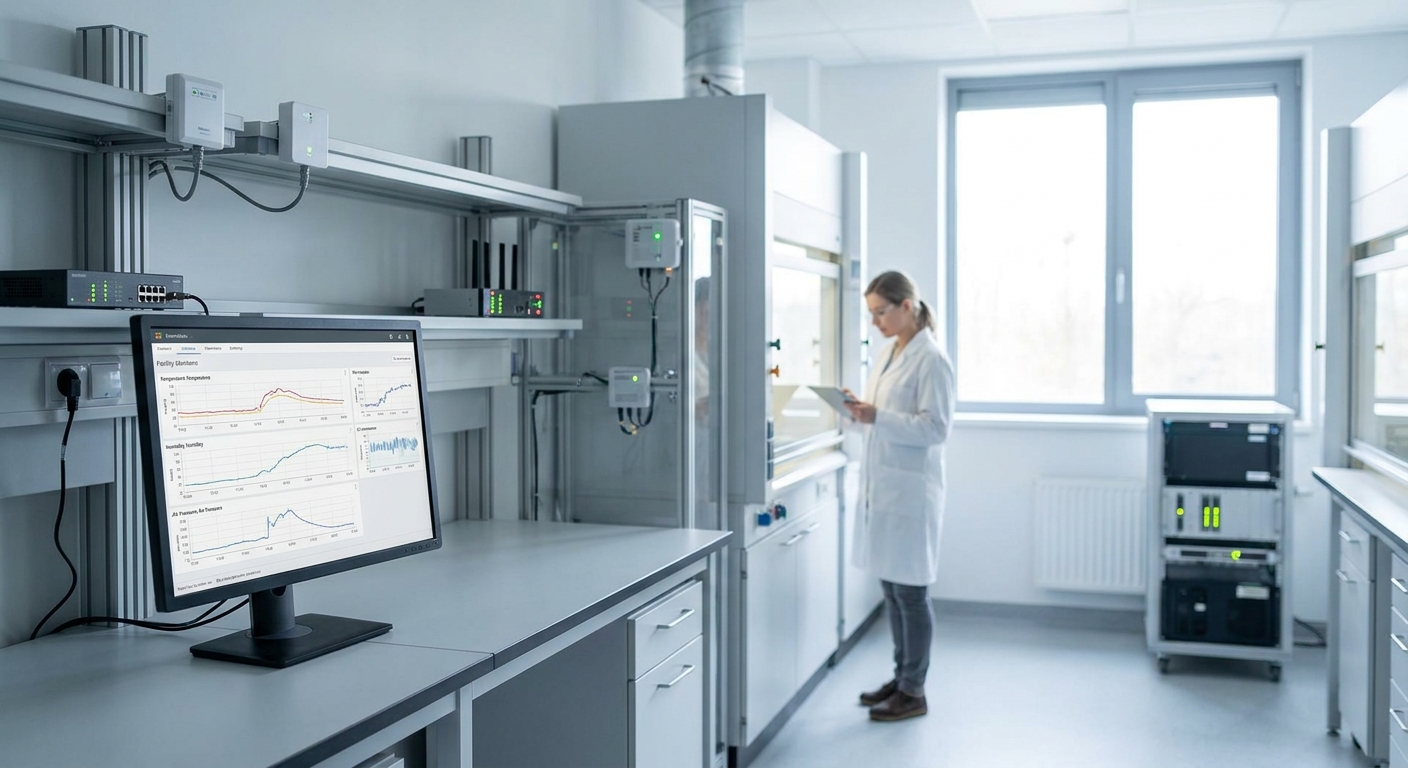
A research building runs more failure points than most facilities managers admit out loud: -80°C freezers holding irreplaceable cell lines, incubators running at 37°C for weeks at a stretch, fume hoods with airflow requirements tied to safety compliance, and cold rooms that lose power on a Friday night with nobody on site until Monday.
A single missed alarm on a cold storage temperature monitoring setup costs more than the hardware that would have caught it. In 2026, the labs still relying on a clipboard log and a compressor light are the ones that lose the sample library, not the ones with a sensor on every door.
Who this is for
This guide is for facilities managers, lab operations directors, and EHS coordinators running research buildings — university research towers, biotech and pharma R&D sites, hospital-affiliated labs — where a single equipment failure can destroy months or years of stored material. If your site has more than one freezer, more than one building, or a compliance reviewer who wants records, this applies to you.
What to look for in a facility monitoring system for research laboratories
Multi-parameter sensing across the room, not just the freezer
Temperature alone misses the failure mode. A door left ajar, a compressor drawing more current than normal, or a power interruption all precede a temperature excursion by minutes to hours — catching those signals first buys you time to react before the freezer itself drifts.
Alarm escalation that doesn't rely on someone checking an app
An alarm that only shows up on a dashboard is a suggestion, not a warning. Look for a rules engine that escalates through SMS, call, or email tiers so a freezer excursion at 2 a.m. reaches someone who can act, not just someone who happens to be logged in.
Connectivity that survives concrete cold rooms and shielded basements
Research buildings put freezers and cold rooms in basements with reinforced concrete walls, which is exactly where WiFi and cellular signal drop off. LoRaWAN and mioty connectivity are built for long-range, low-power transmission through that kind of construction, which matters more in a sub-basement lab than in an open office.
An audit trail you can hand to a compliance reviewer
A dashboard that only shows the current reading is useless when a reviewer asks what the freezer did last Tuesday at 3 a.m. Continuous logging with timestamped history turns a monitoring system into a record, not just a screen.
One dashboard for the whole research building, not one per instrument
A lab with six freezers, three incubators, and two cold rooms does not need six logins. A consolidated view across a building — or across a whole campus — is what separates a monitoring system from a pile of point sensors.
Top picks for research lab monitoring
Cold storage and ULT freezer dashboards — the safe pick. Configure alarm thresholds in minutes, not degrees alone: flag anything past 2°C off the setpoint for 10 minutes on a walk-in cold room, and something faster on a -80°C ULT unit where the margin is thinner. Cold storage temperature monitoring dashboards pair temperature with door and power state on one screen. Verdict: Buy.
Water leak detection near cold rooms and RO lines — the underrated pick. Compressor condensate lines and RO water systems sit next to the same freezers holding your sample archive, and a slow leak under a raised floor goes unnoticed until it reaches equipment. Water leak monitoring sensors placed at floor level catch it before it reaches a compressor or an electrical panel. Verdict: Buy.
Humidity monitoring across multiple lab zones — the humidity control pick. A tissue culture room and a paper archive room need different humidity bands — roughly 45-55% RH for culture work versus under 30% for long-term paper or reagent storage — and one blended reading across a floor hides both problems. Humidity monitoring across multiple zones sets separate thresholds per room instead of one average for the building. Verdict: Consider.
Multi-site dashboard for a research campus — the scale-up pick. A campus with three or four buildings does not need three or four separate logins and three or four separate alarm feeds. A multi-location facility monitoring dashboard puts every building's alarms on one screen, so a single facilities coordinator can watch the whole campus instead of switching tabs. Verdict: Buy.
Digital twin for HVAC and energy load — the wildcard. Fume hood exhaust and HVAC balance interact in ways a single sensor reading never shows, and a digital twin for building energy optimization visualizes that load across the building rather than room by room. It is not the first thing a lab needs, but it earns its place once the basics are covered. Verdict: Consider.
Map your lab's monitoring gaps
See how Kilo Cloud dashboards, alarms and mioty/LoRaWAN sensors fit your building.
What to avoid
- Consumer smart plugs and WiFi temperature sensors that stop logging the moment the router reboots — a research freezer needs a sensor that keeps recording locally and syncs when connectivity returns, not one that goes silent during an outage.
- Single-point sensors with no escalation path — a temperature reading with no alarm tier attached is a data point, not a warning system, and it will not wake anyone up at 2 a.m.
- A dashboard per instrument — buying a separate app for the freezer, a separate app for the incubator, and a separate app for the cold room defeats the point of centralized monitoring for a multi-instrument lab.
Verdict comparison
| Pick | Best for | Key detail | Verdict |
|---|---|---|---|
| Cold storage dashboards | ULT freezers, cold rooms | 10-minute alarm window, door + power tracked | Buy |
| Water leak detection | Areas near cold room compressors | Floor-level sensors, early catch | Buy |
| Humidity monitoring | Tissue culture and archive rooms | Per-room thresholds (30-55% RH) | Consider |
| Multi-site dashboard | Multi-building research campuses | One login across all buildings | Buy |
| Digital twin (HVAC/energy) | Fume hood + HVAC balance | Building-wide load visualization | Consider |
A facility monitoring system for research laboratories earns its cost the first time it catches a freezer excursion before the sample archive is gone, and 2026 is the year most labs are replacing clipboard logs with something that logs continuously and escalates on its own.
FAQ
What is the best facility monitoring system for research laboratories in 2026?
The best setup pairs cold storage dashboards for freezers and cold rooms with alarm escalation and a consolidated multi-building view. A single-instrument app is not a facility monitoring system on its own.
Is LoRaWAN or mioty better for a research lab basement?
Both outperform WiFi and cellular in reinforced concrete basements and shielded cold rooms because they use long-range, low-power transmission built for that kind of construction. The choice between them depends on density of sensors and existing network infrastructure on site.
How fast should a freezer temperature alarm trigger?
A walk-in cold room can tolerate a threshold of several degrees off setpoint for around 10 minutes before alarming, but a -80°C ULT freezer needs a tighter window because the margin before sample damage is thinner. Set thresholds per equipment type, not one blanket rule.
Do research labs need an audit trail for temperature data?
Yes, continuous timestamped logging turns a monitoring dashboard into a record a compliance reviewer can check after the fact. A system that only shows the current reading cannot answer what happened last week.
Can one dashboard cover multiple lab buildings on the same campus?
Yes, a multi-location facility monitoring dashboard consolidates alarms and readings from every building into one screen instead of requiring a separate login per site. This matters most once a campus passes two or three buildings.
What sensors matter most for a research lab besides temperature?
Door state, power status, humidity, and water leak detection near cold room compressors all matter as much as temperature because they often precede a temperature excursion by minutes to hours. Monitoring temperature alone misses the early warning signs.
How does an AI integrator help set up lab monitoring alarms?
An AI integrator built into the platform can provision devices, build rules, and set alarms through plain-language conversation instead of manual configuration screens. That shortens setup time for a facilities team that is not writing rule logic by hand.
One last thing
The building itself decides your connectivity choice before you pick a single sensor: a research lab in a reinforced concrete basement needs mioty or LoRaWAN range, not a WiFi tracker that loses signal two floors down. Get that decision right in 2026 and the rest of the monitoring system — dashboards, alarms, audit trail — falls into place around it.