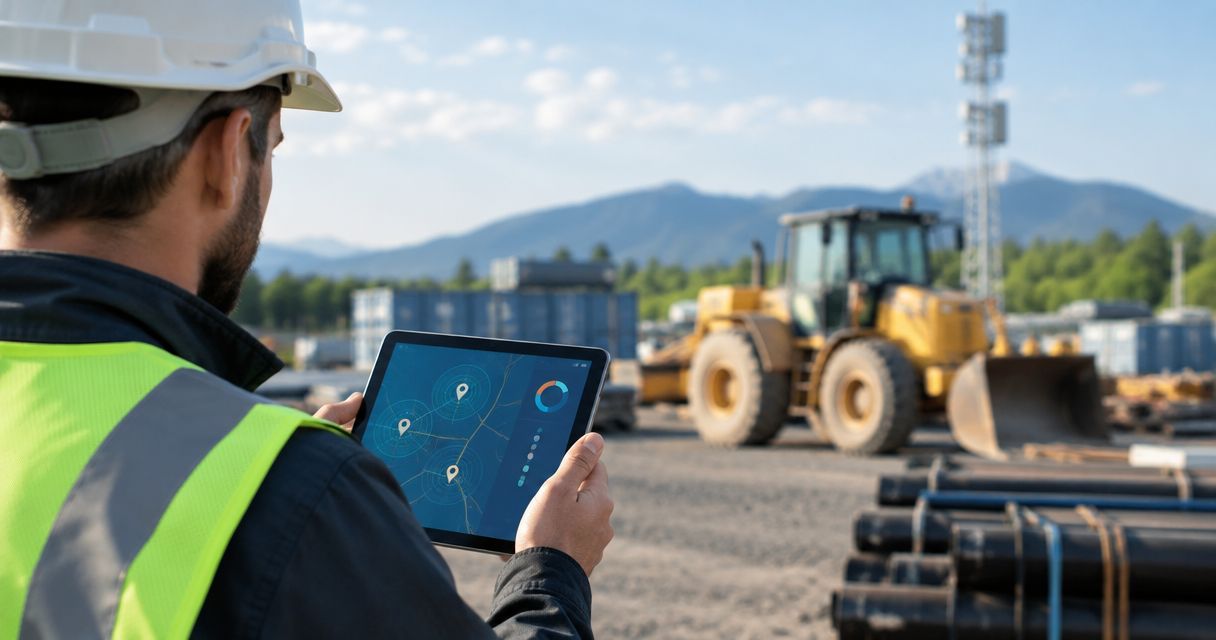
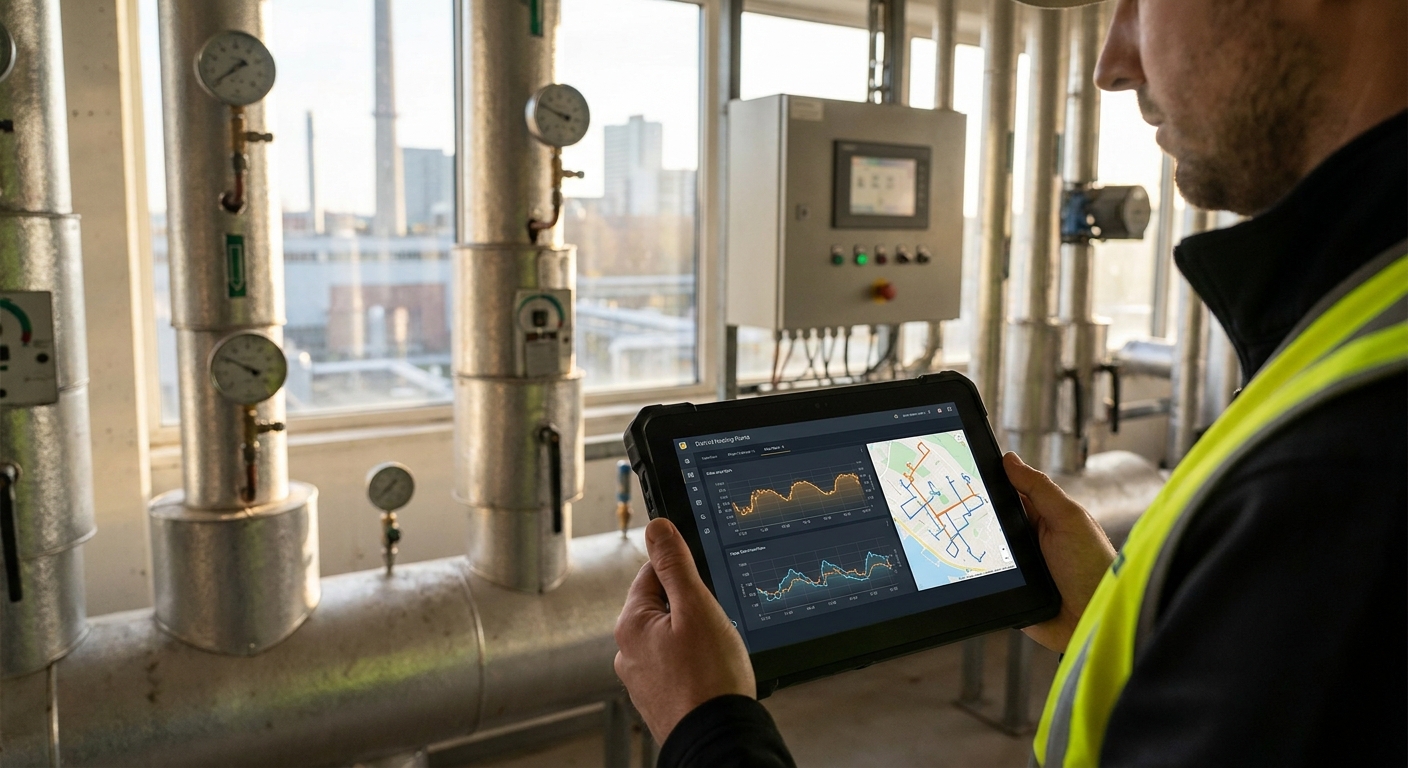
District heating operators run substations, buffer tanks, and kilometers of buried pipe across a city, and most legacy SCADA setups won't tell you a return temperature drifted 15°C until a resident calls in cold. Here's what an iot platform for district heating actually needs to cover in 2026, and where a platform like Kilo Cloud fits.
- Kilo Cloud covers temperature, level, and alarm monitoring for district heating substations and buffer tanks: Buy for multi-site rollouts.
- mioty outperforms LoRaWAN in buried vaults and concrete basements; LoRaWAN wins on cost for above-ground pipe runs.
- A digital twin view tied to supply/return delta flags a 10°C swing before it becomes a service complaint.
- Skip consumer WiFi sensors past roughly 50 meters through concrete or soil, since signal loss defeats the point of monitoring.
Why this matters
A district heating network in 2026 is dozens of substations, a handful of buffer tanks, and pipe runs that pass through basements, vaults, and soil where cellular and WiFi signal drop fast. Manual rounds catch a leak or a stuck valve after the fact, usually when a resident complains about a cold radiator or a wet basement.
An iot platform for district heating replaces the round with a dashboard: supply and return temperature per substation, buffer tank level, and alarms that fire the moment a reading moves outside range. The gap between "we noticed" and "the sensor flagged it three hours ago" is the whole business case.
Who this is for
This guide is for utility operations managers, municipal energy providers, and district heating cooperatives running substations, buffer tanks, and pipe networks across more than one site — teams currently relying on manual checks or a patchwork of single-site tools and looking to centralize monitoring under one Kilo IoT dashboard with automated alarms instead of a rotation of site visits.
What to look for in an IoT platform for district heating
Long-range connectivity for buried and multi-km networks
District heating pipe runs cross soil, concrete vaults, and multi-story basements where cellular and WiFi drop out fast. LoRaWAN covers 2 to 15 kilometers depending on terrain in 2026 field deployments, which handles most above-ground and semi-buried runs at low cost per node.
Signal penetration through concrete and soil
mioty was built for exactly the environment district heating vaults create: thick concrete, buried conduits, and dense urban basements where LoRaWAN's line-of-sight advantage doesn't help. If your substations sit below street level, mioty's penetration matters more than LoRaWAN's raw range.
Multi-site dashboards that roll up every substation
A network with 20 substations needs one view, not 20 logins. The dashboard has to aggregate temperature and level data across every site and let an operator drill into one substation without losing the network-wide picture.
Automated alarms tied to supply and return temperature
A rules engine that only logs data is a spreadsheet with extra steps. It needs to fire an alarm the moment return temperature drifts outside a set band, not wait for someone to open the dashboard and notice.
Buffer tank and reservoir level visibility
Buffer tanks smooth out demand spikes, and a tank running low during peak load is the difference between stable delivery and a pressure drop across the network. Level monitoring on these tanks needs the same alarm logic as temperature, not a manual gauge check.
Device management at scale
A city-wide network means hundreds or thousands of sensor endpoints. The platform needs bulk provisioning and a way for a system integrator to manage devices across sites without touching each one by hand.
Top picks for district heating monitoring
The private-network pick. A LoRaWAN network server for private enterprise deployments puts the network under your control instead of a public carrier's gateway — one substation with 30+ endpoints runs on a single gateway in most 2026 deployments. Verdict: Buy for above-ground and semi-buried pipe networks where cost per node matters.
The buried-vault pick. mioty-based sensors handle underground substations and basement vaults where LoRaWAN's range advantage doesn't offset weak penetration through concrete. If more than a third of your substations sit below grade, this is the connectivity to standardize on. Verdict: Buy for buried and below-grade sites.
The buffer tank pick. Tank level monitoring for water towers and municipal utilities applies directly to district heating buffer tanks — alarm thresholds set at 20% capacity catch a draw-down before it hits the network. Verdict: Buy for any network running buffer or reservoir tanks.
The energy-optimization pick. A digital twin for building energy optimization maps supply and return temperature deltas per substation, flagging a drift over roughly 10°C automatically instead of surfacing it in a monthly report. Verdict: Consider once base monitoring and alarms are running — it's the layer that pays off after the fundamentals are in place, not before.
The utility-scale pick. For networks already running dozens of sites, a platform built around utility company use cases handles the device count and multi-tenant access system integrators need without a custom build. Verdict: Consider for networks past 20 substations; smaller networks can start with a single dashboard and add scale later.
See district heating monitoring live
Map substation temperature, tank level, and alarms to one dashboard.
What to avoid
- Consumer WiFi sensors underground. They look cheap on a spec sheet but fail past roughly 50 meters through concrete or soil — exactly where district heating vaults sit.
- Open-source stacks with no rules engine. They work fine for a single pilot site, then someone has to build and maintain the alarm logic in-house across 20 substations. That's a staffing cost most utility teams don't budget for.
- Single-tenant dashboards. A tool built for one building can't roll up a city-wide network. If it can't aggregate multiple sites into one operator view by 2026 standards, it's not built for district heating.
Verdict comparison
| Component | Best for | Key metric | Verdict |
|---|---|---|---|
| Private LoRaWAN network | Above-ground, semi-buried pipe runs | 2–15 km range per gateway | Buy |
| mioty sensors | Underground vaults, basements | Strong penetration through concrete | Buy for buried assets |
| Buffer tank level monitoring | Storage and pressure buffer tanks | Alarm at 20% capacity | Buy |
| Digital twin / energy view | Supply/return delta tracking | Flags >10°C drift automatically | Consider |
| Consumer WiFi sensors | Not recommended underground | Fails past ~50m through concrete | Skip |
FAQ
What's the best iot platform for district heating network monitoring in 2026?
A platform combining LoRaWAN or mioty connectivity with multi-site dashboards and an automated rules engine, since district heating networks span buried pipe, substations, and buffer tanks that manual rounds can't cover in real time. Kilo Cloud handles this stack directly.
Is mioty better than LoRaWAN for district heating pipe networks?
mioty performs better in underground vaults and concrete basements where signal penetration matters more than range. LoRaWAN is the better fit for above-ground and semi-buried runs where cost per node is the priority.
How much does IoT monitoring for a district heating substation cost?
Cost depends on sensor count, connectivity type, and site count, so get a quote scoped to your substation and pipe network layout rather than relying on a flat per-site number. mioty and LoRaWAN hardware pricing differ by deployment density.
Can one dashboard cover multiple district heating substations?
Yes, a multi-site dashboard aggregates temperature, level, and alarm data across every substation into one operator view. Drilling into a single site doesn't require a separate login or tool.
How do automated alarms catch a heating pipe leak before it floods a basement?
Alarms fire the moment a temperature or level reading moves outside a set band, rather than waiting for a scheduled manual check. A buffer tank dropping past a 20% threshold or a substation return temperature drifting more than 10°C both trigger a notification in real time.
What sensors work for buried district heating pipe monitoring?
mioty-based sensors handle buried and below-grade installations better than standard LoRaWAN or WiFi because of stronger signal penetration through concrete and soil. Above-ground runs can use standard LoRaWAN sensors at lower cost.
How long do battery-powered temperature sensors last on a heating network?
Battery-powered LoRaWAN and mioty sensors are built for multi-year deployment cycles without a swap, which matters for buried and hard-to-access substations. Actual life depends on reporting frequency and sensor model.
Do I need a private LoRaWAN network for a city-wide heating grid?
A private LoRaWAN network gives you control over gateway placement and coverage instead of relying on public carrier infrastructure, which matters once a network crosses more than a handful of substations. Smaller single-site deployments can often run on fewer gateways without a full private buildout.
One last thing
The failure that actually shuts down a district heating substation isn't usually the sensor — it's the buffer tank nobody was watching. A tank sitting at 15% capacity for two days looks fine until demand spikes and the pressure drop shows up three substations downstream. Level alarms on buffer tanks catch that before temperature alarms ever see the problem.