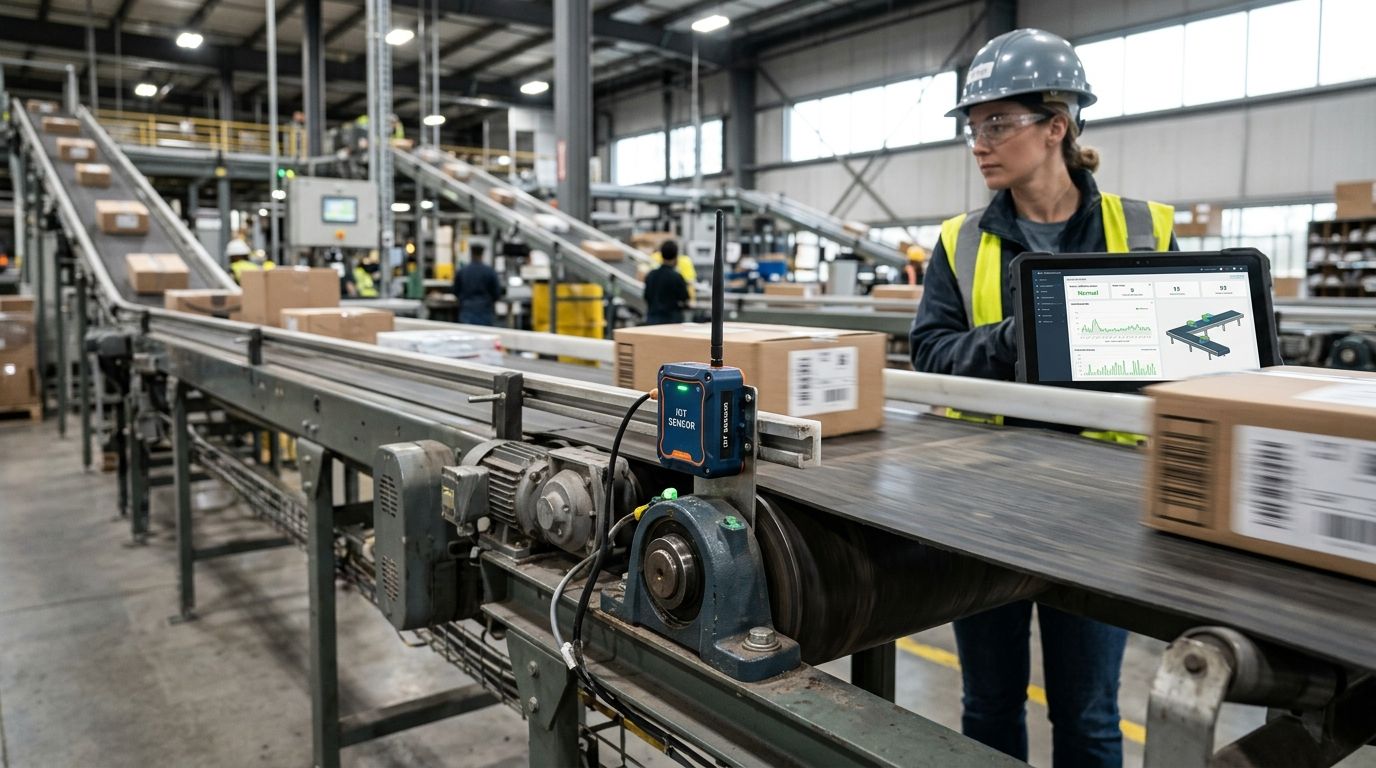
Predictive maintenance for conveyor belts means tracking vibration, temperature, and motor current on belts, idlers, pulleys, and drive motors so a maintenance team catches bearing wear or misalignment before the line stops mid-shift. Conveyor systems fail differently than a single pump or motor: a stopped belt on one segment backs up everything downstream, so the monitoring approach has to cover dozens of failure points across a run instead of one machine. This guide walks through how a facilities or reliability team actually builds that program in 2026, sensor by sensor and alarm by alarm.
- Predictive maintenance for conveyor belts starts with vibration, temperature, and current baselines, not one blanket threshold.
- Idler bearings turn over more often than drive motors or pulleys on long conveyor runs, per CEMA idler design guidance.
- The Kilo IoT Platform turns sensor drift into threshold alarms with five severity tiers, not machine-learning failure forecasts.
- ISO 10816-3 defines documented vibration severity zones for flagging bearing wear before it becomes a stoppage.
- Manual vibration-pen walkarounds work for single-line audits; multi-line plants need continuous sensor coverage in 2026.
Why does predictive maintenance matter for conveyor belt systems?
A conveyor run doesn't fail as one unit — it fails idler by idler, bearing by bearing, and a stoppage anywhere on the belt stops everything feeding into it. OSHA's general machine guarding standard (29 CFR 1910.212) and the conveyor-specific provisions in 29 CFR 1926.555 cover the safety side of a belt system, but neither standard tells a technician when a bearing is about to seize. That's a condition-monitoring gap, not a compliance one.
CEMA, the Conveyor Equipment Manufacturers Association, publishes idler selection and load-rating standards precisely because idler bearings are the highest-turnover component on a typical belt run — there are more of them per conveyor than pulleys, motors, and gearboxes combined. Catching one bearing running hot or noisy costs a part and an hour. Replacing a belt torn open by a seized idler at 2 a.m. costs a shift.
Teams that build automated alarms for equipment vibration anomalies catch that drift days before a bearing locks up, instead of finding out when the belt stops.
How to build predictive maintenance for conveyor belts step by step
Map the failure modes on every conveyor segment
Before any sensor goes on the belt, list what actually breaks on this specific run. A 40-foot inclined belt feeding a crusher fails differently than a flat packaging line.
- Idler bearing seizure or excessive play
- Belt misalignment and edge tracking drift
- Pulley lagging wear and slippage
- Drive motor overload or bearing overheating
- Gearbox oil degradation and gear wear
- Splice or lacing failure at high-tension points
Baseline normal vibration, temperature, and current draw
A threshold only means something against a known-good baseline. Record readings during a defect-free run before setting any alarm level.
- Log vibration at the motor, gearbox, and at least three idler points per segment
- Record ambient temperature range across a full shift, not one reading
- Capture motor current draw at rated belt speed and typical load
- Note belt speed and tension settings alongside every baseline reading
- Repeat the baseline after any belt replacement, splice, or re-tensioning
Install condition-monitoring sensors on bearings, idlers, and drive motors
A handheld vibration pen or ultrasonic tester works for a single line checked once a week — a technician walks the run, takes readings, logs them by hand. It doesn't catch a bearing that starts trending hot on a Tuesday and seizes by Friday's rounds.
For continuous coverage, the Kilo IoT Platform connects vibration and temperature sensors over LoRaWAN for battery-powered idler and bearing points, mioty for runs shielded by steel structure or dense equipment, and MQTT for motor drives, PLCs, or energy meters already publishing data. Kilo Electronics, Kilo's sister hardware company, ships condition-monitoring sensors worldwide if the plant doesn't already have a preferred vendor.
- Vibration and temperature sensors on drive-end and tail-end bearings
- Current sensors on the motor to catch overload before a bearing does
- Belt tracking or misalignment sensors on long or inclined runs
- MQTT bridge for any PLC or motor drive already publishing telemetry
- mioty connectivity where steel structure blocks standard wireless signal
Configure threshold alarms and escalation chains
Raw sensor data doesn't page anyone — a rule does. Kilo's visual rules engine builds threshold and CEL-expression logic without custom code, with version control and one-click rollback if a rule needs adjusting after deployment.
- Set per-segment thresholds instead of one plant-wide vibration limit
- Use five severity tiers so a slow drift doesn't page the same person as a stalled motor
- Build multi-step escalation chains so an unacknowledged alarm reaches a second technician
- Route by email, SMS, or push depending on shift and urgency
- Set quiet hours for low-severity alerts so night shift isn't paged for a 2°F drift
A plant running the rules engine software for industrial IoT alarms approach gets one alarm inbox across every conveyor segment instead of a spreadsheet per line.
Build a live dashboard to track vibration and temperature trends
A single reading tells you almost nothing. A trend line tells you a bearing is getting worse three days before it fails outright.
- Chart widgets showing vibration and temperature trend per bearing point
- Gauge widgets for at-a-glance current shift status
- A digital twin per sensor so a technician clicks the physical idler location, not a device ID
- Image floor-plan pins mapping sensor position to the actual conveyor layout
Current sensors matter here as much as vibration: a motor pulling more current than its baseline is often the earliest sign of a load or bearing problem, and the current sensors for equipment power monitoring guide covers what to install and where.
Review trends weekly and recalibrate after belt or bearing replacement
A baseline goes stale the moment something mechanical changes.
- Re-baseline vibration and current after any belt, bearing, or splice replacement
- Audit alarm history monthly to catch thresholds set too tight or too loose
- Check sensor battery and signal strength on a fixed schedule, not only when an alarm goes silent
- Cross-check sensor trend data against physical inspection at least once a quarter
Which conveyor belt monitoring option fits your operation?
| Option | Best for | Key limitation |
|---|---|---|
| Handheld vibration pen / ultrasonic walkarounds | Single-line plants or periodic audits | Only a snapshot — misses drift between rounds |
| Wired sensors into existing PLC/SCADA | Sites with conveyor PLCs already in place | Wiring cost scales fast across long runs |
| Dedicated CMMS with a condition-monitoring add-on | Teams already running a work-order system | Condition data often sits in a tool separate from the alarm |
| Kilo IoT Platform (LoRaWAN/mioty/MQTT + rules engine + alarms) | Multi-line plants wanting one dashboard across bearings, motors, and idlers | Threshold and CEL-rule based — flags trend changes, doesn't forecast a failure date |
Set up conveyor vibration monitoring
Connect bearing and motor sensors to one dashboard with threshold alarms.
What mistakes do plants make with conveyor belt predictive maintenance?
- Treating one bearing failure as isolated instead of checking every idler installed in the same batch — bad bearings often ship together.
- Mounting sensors only on the drive pulley and skipping idlers, which fail more often on long runs than the motor end ever does.
- Setting one blanket vibration threshold across segments running different belt speeds and loads, so a normal reading on one line trips an alarm on another.
- Skipping recalibration after belt splicing or re-tensioning, which shifts the whole baseline and makes every alarm after it unreliable.
- Routing every alarm to one inbox instead of severity tiers, so operators start ignoring pages during a rush and miss the one that matters.
Which conveyor belt component fails first?
Idler bearings, consistently. CEMA's idler design and selection standards exist because idlers outnumber every other conveyor component and take the most continuous load cycling of anything on the belt. A drive motor or gearbox gets scheduled service; an idler bearing usually just runs until it doesn't. That's the component worth instrumenting first if a plant is starting predictive maintenance for conveyor belts with a limited sensor budget in 2026 — not the motor, not the pulley, the idler bearings closest to the highest-tension points on the run.
FAQ
What's the best way to detect a failing conveyor belt bearing?
Continuous vibration and temperature monitoring on the bearing itself catches a drift days before failure, compared to periodic handheld walkarounds that only capture a snapshot. ISO 10816-3 defines the vibration severity zones used to judge whether a reading is normal, borderline, or damaging.
Is predictive maintenance for conveyor belts different from condition-based monitoring?
In practice they overlap: both track vibration, temperature, and current against a baseline and alarm on drift. Threshold and rule-based condition monitoring, which is what most conveyor programs actually run in 2026, differs from machine-learning failure prediction, which forecasts a specific failure date.
How much vibration is too much for a conveyor idler?
ISO 10816-3 sets vibration severity zones from newly-commissioned machinery through zones where damage is likely, and the right threshold depends on idler size, speed, and mounting. A documented baseline from defect-free operation is what makes any threshold meaningful.
Can Kilo predict when a conveyor belt will fail?
No. Kilo doesn't run machine-learning failure predictions — it applies threshold and CEL-expression rules to live sensor data and fires a severity-tiered alarm with escalation when a reading crosses a set point. That's condition-based alerting, not a forecasted failure date.
How many sensors does a conveyor belt system need for monitoring?
Coverage depends on run length and number of failure-prone points, but idler bearings near high-tension sections, the drive motor, and the gearbox are the priority locations. A 100-foot run with a dozen idlers rarely needs a sensor on every one — the highest-load idlers matter most.
What sensors are used for conveyor belt predictive maintenance?
Vibration sensors on bearings and idlers, temperature sensors on motors and gearboxes, and current sensors on the drive motor cover the most common failure modes. Belt tracking or misalignment sensors add coverage on long or inclined runs.
How often should conveyor sensors be recalibrated?
Recalibrate after any belt replacement, splice, or re-tensioning, since those events change the mechanical baseline the thresholds were set against. A quarterly cross-check against physical inspection catches drift that recalibration events alone might miss.
Does predictive maintenance for conveyor belts require LoRaWAN, or can it run on MQTT?
Either works, and most plants use both: LoRaWAN for battery-powered wireless sensors on idlers spread across a long run, and MQTT for motor drives, PLCs, or energy meters that already publish telemetry. mioty is worth considering where steel structure blocks standard wireless signal.