
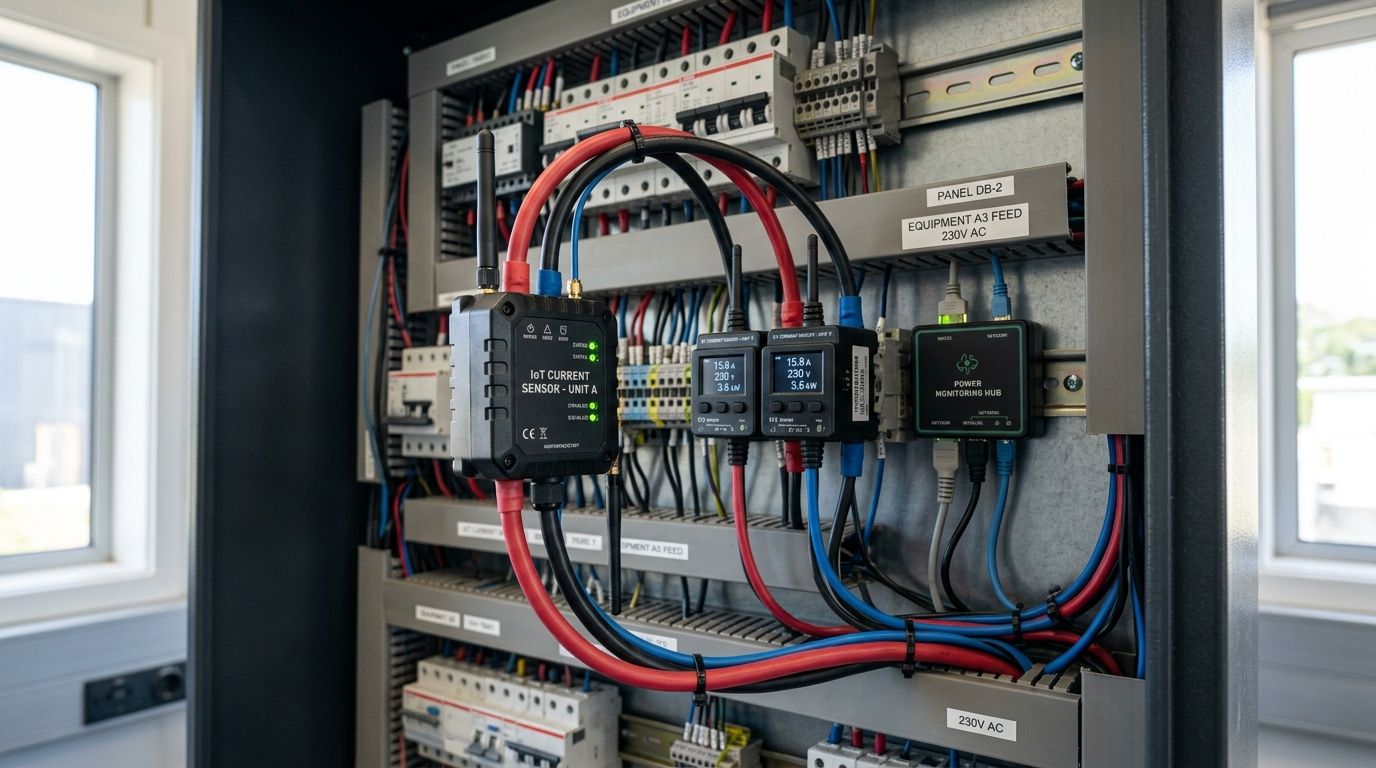
Best overall: split-core CT clamps paired with a LoRaWAN node. Best for large motors and pumps: Rogowski coil current sensors. Best for panels with an existing meter: MQTT-connected power meters. This guide compares six IoT current sensor types for equipment power monitoring and how each reports into a platform like the Kilo IoT Platform in 2026.
- Split-core CT clamps with a LoRaWAN node top this iot current sensor equipment power monitoring guide for retrofits.
- Rogowski coil sensors handle motor and bus-bar conductors that a rigid CT clamp physically can't close around.
- mioty current sensors read through steel and concrete where LoRaWAN link budget struggles in basements and vaults.
- MQTT is the right protocol when a panel already has a Modbus or BACnet meter installed and reporting.
- Match accuracy class and output type to the alarm threshold you need, not the longest spec sheet.
What is an IoT current sensor and how does it monitor equipment power
An IoT current sensor measures the amperage flowing through a conductor - a motor lead, a compressor circuit, a panel feeder - and reports that reading wirelessly or over a wired network instead of requiring someone to walk up with a clamp meter. The sensor itself is almost always a current transformer (CT) or a Rogowski coil; the "IoT" part is the radio or protocol that gets the reading off the panel.
The Kilo IoT Platform sits on the receiving end: a built-in LoRaWAN and mioty network server ingests the readings, an MQTT connector takes them from any publishing meter or PLC, and a rules engine evaluates each reading against a threshold. The U.S. Department of Energy estimates electric motors account for roughly 70% of the electricity used in U.S. manufacturing, which is why motor and pump circuits are usually the first candidates for current monitoring rather than lighting or plug loads.
Most current transformers sold for metering follow IEC 61869-2, the international standard for instrument transformers, or the ANSI/IEEE C57.13 equivalent used in North American gear. Facilities managers, controls engineers, and electricians all touch this decision differently: the electrician cares about clamp aperture and whether the circuit needs to come down; the facilities manager cares about which circuit triggers an alarm at 2 a.m.
Failure modes worth watching for: phase imbalance on three-phase motors, compressor short-cycling that spikes inrush current repeatedly, and a feeder running above nameplate current for hours before a breaker trips. A current sensor that only logs to a dashboard misses all three - the value comes from pairing the reading with a rule.
What makes the best IoT current sensor for equipment power monitoring
- Install method - split-core (clamps around a live conductor), solid-core (conductor threads through before termination), or flexible Rogowski coil for oversized bus bars
- Output type - pulse (kWh counting), analog 4-20mA, or a digital protocol like Modbus that carries kW, power factor, and harmonics
- Connectivity - LoRaWAN for battery-powered retrofits, mioty for high-interference or shielded rooms, MQTT for panels with a meter already talking Modbus or BACnet
- Accuracy class - matters more for billing-grade submetering than for a simple overload alarm
- Environmental rating - IP rating and operating temperature range for the panel or equipment room the sensor lives in
- Alarm integration - whether the platform can turn a raw amperage reading into an escalation, not just a chart
IoT current sensors for equipment power monitoring at a glance
| Sensor type | Best for | Standout feature | Key limitation |
|---|---|---|---|
| Split-core CT + LoRaWAN | Retrofitting live panels | Clamps around the conductor, no shutdown | Fixed aperture limits conductor diameter |
| Rogowski coil | Large motors and pumps | Flexible coil fits oversized bus bars | Needs signal conditioning for true RMS |
| Solid-core CT | New panel builds | Better accuracy class, lower cost per channel | Conductor must be disconnected to install |
| MQTT power meter | Panels with an existing Modbus/BACnet meter | Reuses metering already on-site | Needs a wired network run |
| mioty current sensor | Underground or shielded rooms | Telegram splitting survives interference | Fewer manufacturers build mioty clamps |
| Single-channel CT + pulse | Spot-checking one circuit | Simplest, smallest node footprint | No panel-wide visibility |
1. Split-core CT sensors: best for retrofitting existing panels
A split-core CT clamps around a conductor without disconnecting the circuit, then reports pulse, 4-20mA, or Modbus output to a wireless node. It's the default choice for retrofitting equipment monitoring onto a panel that's already energized.
Split-core CT pros:
- Installs on a live panel with no shutdown
- Works on single-phase or three-phase circuits, one clamp per phase
- Pairs with a LoRaWAN node, so no new conduit run
- Battery or externally powered node options
Split-core CT cons:
- Clamp aperture size limits which conductor diameters fit
- Accuracy drops near the low end of the clamp's rated range
- Still requires a licensed electrician working near live conductors
Best for: facilities teams adding monitoring to panels that can't come offline. Verdict: Buy for almost any retrofit project in 2026.
2. Rogowski coil current sensors: best for large motors and pumps
A Rogowski coil is a flexible loop that wraps around bus bars, motor leads, or switchgear conductors too large or irregularly shaped for a rigid CT clamp. It measures the changing magnetic field and needs an integrator circuit to convert that signal into true RMS current before it reaches a node.
Rogowski coil pros:
- Fits large or irregular conductors a snap-on CT can't close around
- No core saturation at high fault currents
- Lightweight and easy to route in a crowded panel
Rogowski coil cons:
- Raw output needs conditioning before it reaches a LoRaWAN or MQTT node
- More setup steps than a snap-on CT
- Typically costs more per channel than a solid-core CT
Best for: motor control centers, pump stations, and switchgear with oversized conductors. Verdict: Buy when a standard CT clamp physically won't close. See how vibration and current readings pair up on industrial pumps and motors.
3. Solid-core CT sensors: best for new panel and equipment builds
A solid-core CT is a closed-loop transformer installed on the conductor before it's terminated - standard practice on new panel builds and switchgear that follow IEC 61869-2 instrument transformer specs.
Solid-core CT pros:
- Better accuracy class than most split-core equivalents
- Lower cost per channel
- Familiar to panel builders and electrical inspectors
Solid-core CT cons:
- Conductor must be disconnected to thread it through the core
- Fixed aperture size, no flexibility for future conductor changes
- Adds a step to new-build wiring schedules
Best for: new construction and panel refurbishment projects. Verdict: Buy for new builds, Skip for retrofits on live panels.
4. MQTT-connected power meters: best for panels with an existing meter
Many panels already have a multi-circuit power meter reporting kW, kWh, and power factor over Modbus RTU, Modbus TCP, or BACnet. Kilo's MQTT connector subscribes to that data directly, so no new sensor hardware is needed if the meter is already there.
MQTT power meter pros:
- No new sensor if a compatible meter is already installed
- Richer data than pulse-only CTs, including power factor on some models
- Wired connection removes battery maintenance
MQTT power meter cons:
- Only works where a compatible meter already exists
- Wired network runs cost more than a wireless retrofit
- Register mapping between the meter and the platform takes setup time
Best for: buildings and plants with a BMS or energy meter already in the panel. Verdict: Buy if a meter exists, Skip if you're starting from bare conductors. Details on wiring a meter's protocol into a dashboard are in connecting Modbus PLCs to a cloud IoT dashboard.
5. mioty current sensors: best for underground and shielded equipment rooms
mioty is a telegram-splitting radio protocol built for high-interference sites - basements, transformer vaults, and steel-and-concrete machine rooms where a standard LoRaWAN link budget struggles to punch through.
mioty current sensor pros:
- Designed to survive dense interference and structural shielding
- Long range even through multiple concrete floors
- Runs on Kilo's built-in mioty network server, so there's no separate network server to deploy
mioty current sensor cons:
- Fewer sensor manufacturers currently build mioty current clamps compared to LoRaWAN
- Base station coverage still needs planning on a large site
Best for: underground rooms, transformer vaults, and shielded equipment closets. Verdict: Buy where LoRaWAN packets are dropping. More detail on the protocol's fit for hard environments is in mioty sensors for underground and shielded environments.
6. Single-channel CT with pulse counter: best for spot-checking one circuit
A single-channel CT wired to a pulse-output node counts kWh pulses on one circuit and reports over LoRaWAN. It's the fastest way to check whether one suspect circuit is running hot before committing to a panel-wide rollout.
Single-channel CT pros:
- Fastest single-circuit install
- Smallest node footprint
- Good first step before scaling to multiple circuits
Single-channel CT cons:
- No panel-wide visibility
- Adding circuits later means adding a node per circuit
- Doesn't scale as cheaply as a multi-channel option once you're past two or three circuits
Best for: diagnosing one suspect circuit. Verdict: Buy for a single spot-check, Hold on panel-wide monitoring - start with a split-core or MQTT setup instead.
How do you choose between CT, Rogowski, and MQTT current sensors
Work backward from the install constraint, not the spec sheet. If the panel can't come offline, a split-core CT wins by default. If the conductor is too large for a rigid clamp, a Rogowski coil is the only option that physically fits. If a Modbus or BACnet meter is already sitting in the panel, MQTT skips the sensor purchase entirely.
Accuracy class matters far less than most spec sheets suggest for alarm-driven monitoring - a rule that fires at 85% of rated current doesn't need billing-grade precision. It matters a lot more for submetering used in tenant billing or energy audits, where IEC 61869-2 accuracy classes are worth checking against the meter's datasheet.
Turn current readings into alerts
Set thresholds and escalation chains for overload and short-cycling alarms.
Which IoT current sensor should you choose for power monitoring in 2026
Default to a split-core CT with a LoRaWAN node for most retrofit projects in 2026 - it installs without a shutdown and covers single or three-phase circuits with one clamp per phase. Switch to a Rogowski coil the moment a conductor is too large or irregularly shaped for a rigid clamp, which is common on motor control centers and switchgear. Switch to MQTT the instant a Modbus or BACnet meter is already installed and reporting - buying a new sensor at that point is redundant.
Once the sensor and protocol are chosen, the reading only matters if something acts on it. A CEL rule that compares live current against a threshold, escalates through severity tiers, and notifies the right person by SMS or push is what turns a current sensor from a chart into an alarm system.
FAQ
What is the best IoT current sensor for equipment power monitoring?
A split-core CT clamp paired with a LoRaWAN node is the best default for equipment power monitoring in 2026 because it installs without disconnecting the circuit. Rogowski coils take over for oversized conductors, and MQTT-connected meters win when a Modbus or BACnet meter already exists.
Is a split-core CT better than a solid-core CT?
Split-core CTs win for retrofits because they clamp around a live conductor without a shutdown, while solid-core CTs need the conductor disconnected to thread through the core. Solid-core CTs generally hit a better accuracy class, which matters more for new panel builds than retrofits.
Can I monitor equipment power without shutting down the panel?
Yes - a split-core CT clamp installs around an energized conductor without disconnecting the circuit. A Rogowski coil does the same for oversized bus bars that a rigid clamp can't close around.
How accurate do current sensors need to be for equipment monitoring?
For threshold-based overload or short-cycling alarms, accuracy class matters less than the reading being consistent over time. For tenant billing or energy audits, check the sensor's accuracy class against IEC 61869-2 or ANSI/IEEE C57.13 before buying.
What's the difference between LoRaWAN and mioty for current sensors?
LoRaWAN covers most standard indoor and outdoor deployments with a large base of available sensor hardware. mioty uses telegram splitting to survive high interference and structural shielding, which makes it the better fit for basements, transformer vaults, and steel-and-concrete machine rooms.
Do current transformer sensors need calibration after installation?
Most CT and Rogowski sensors ship pre-calibrated from the manufacturer and don't need field calibration for threshold-based alarming. Billing-grade submetering applications sometimes verify calibration against a reference meter at commissioning.
Can current sensors trigger real-time alarms instead of just logging data?
Yes - a rules engine can evaluate a CEL expression against every incoming reading and fire a multi-step escalation alarm the moment current crosses a threshold. Logging alone only helps after the fact; the alarm is what catches an overload while it's happening.
How long does a battery-powered CT sensor last in the field?
Battery life depends heavily on reporting interval and radio protocol rather than the CT itself - less frequent reporting and a low-power protocol like LoRaWAN both extend it. Check the specific node's datasheet rather than assuming a universal figure.
Do current transformer sensors need calibration after installation
Most pre-calibrated CT and Rogowski sensors don't drift enough to matter for alarm-driven monitoring, but a sensor stuck reporting a flat-line current after a panel change is a more common failure than a calibration drift. Check that a new install shows a live, moving reading in the dashboard within the first reporting cycle, not just that it appears in the device list. Wiring a current sensor incorrectly - reversed polarity on a directional CT, for example - shows up as a negative or zero reading immediately, which is easier to catch than accuracy drift months later.