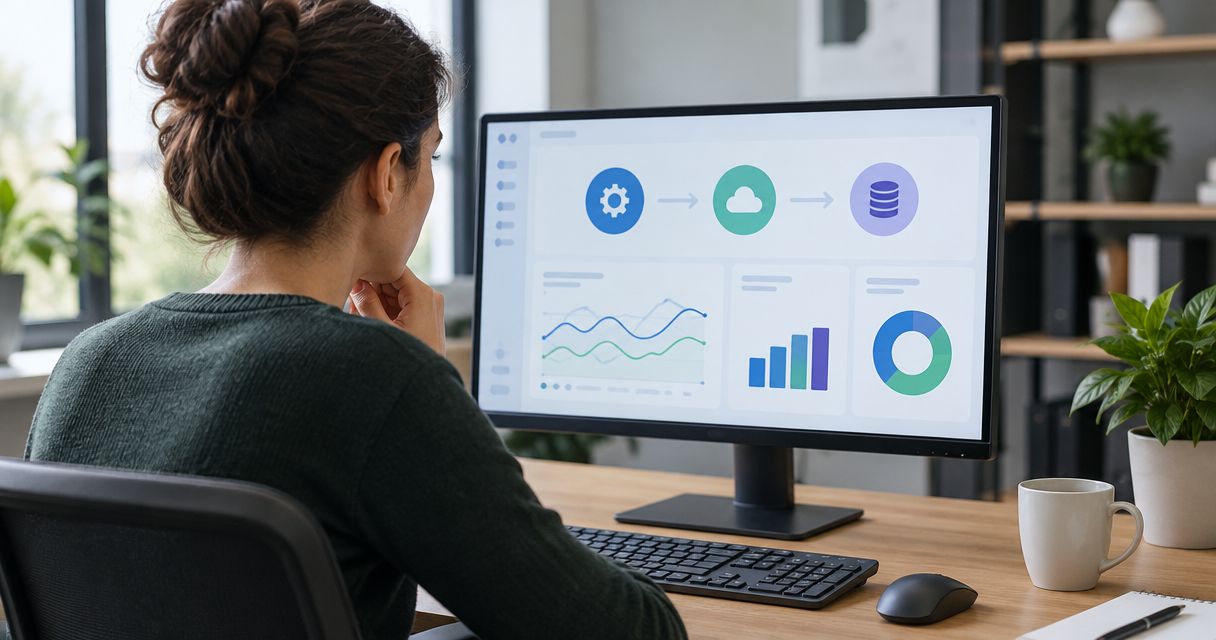
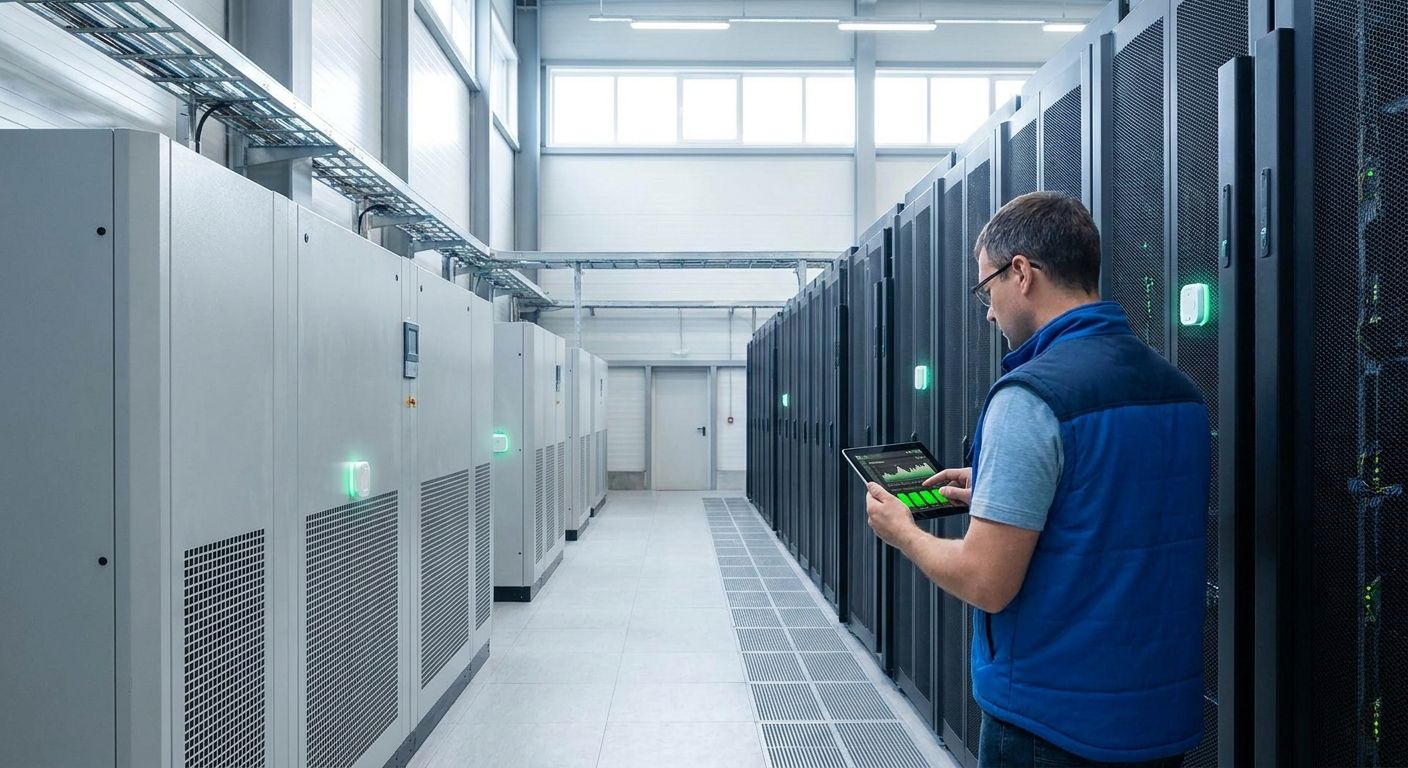
Power and cooling infrastructure inside a data hall doesn't fail slowly. A CRAC unit trips, a UPS switches to battery, or a PDU circuit creeps past its rated load, and the window before racks start throttling is short. IoT monitoring for data center power and cooling infrastructure puts sensors directly on that equipment and routes the readings into an alarm system before the room drifts out of spec.
- IoT monitoring for data center power and cooling combines MQTT feeds from PDUs and UPS units with wireless temperature sensors on CRAC intakes.
- ASHRAE TC9.9 sets the recommended thermal envelope at 18-27C, with 15-32C allowable for short excursions on Class A1 gear.
- The Kilo IoT Platform runs a built-in LoRaWAN and mioty network server, so power and cooling data lands on one dashboard.
- IEEE 1188 recommends monthly VRLA battery float voltage checks - a rule, not a spreadsheet reminder, should trigger that.
- Skip single-point room sensors; map hot aisle and cold aisle separately or the average hides the one rack that's overheating.
How does IoT monitoring for data center power and cooling infrastructure work?
Power and cooling infrastructure doesn't degrade on a schedule you can plan around. IoT monitoring for data center power and cooling infrastructure means wireless temperature and humidity sensors in the cold aisle, MQTT feeds pulled from UPS and PDU controllers, and LoRaWAN fuel-level sensors on the generator tank, all landing in one place instead of three vendor portals.
The Kilo IoT Platform runs a built-in LoRaWAN and mioty network server alongside an MQTT connector, so there's no separate network server to stand up for the sensor side while PDU and BMS data comes in over MQTT. That consolidation matters more in a data hall than almost anywhere else. ASHRAE TC9.9's Thermal Guidelines for Data Processing Environments set the recommended envelope at 18C to 27C, with an allowable short-term range of 15C to 32C for Class A1 equipment - drift outside that band and both warranty terms and hardware lifespan take a hit.
In 2026, most of that monitoring still runs on a mix of BMS point-lists and manual rounds with a handheld thermometer. IoT sensors close the gap between a quarterly walk-through and a real-time alarm.
Who needs IoT monitoring for data center power and cooling infrastructure?
This is written for facilities managers and critical infrastructure engineers running a data hall, server room, or edge micro data center without a full DCIM build-out. It's also relevant to colocation operators who need per-tenant power and environmental data, and to MSPs managing server closets across client sites where a dedicated BMS was never in the budget.
If your current setup is a CRAC unit with a local thermostat and a UPS that emails you when it's already on battery, this is the gap IoT monitoring for data center power and cooling infrastructure fills in 2026.
What features matter in IoT monitoring for data center power and cooling?
Six things separate a monitoring setup that catches problems early from one that just generates noise.
Redundant connectivity for power and cooling sensors
A data hall is a metal box full of interference, so the network layer under your sensors needs to hold up. mioty's telegram-splitting approach spreads each transmission across multiple sub-packets and frequencies specifically to survive that kind of environment, and running both LoRaWAN and mioty on one network server means you're not locked into a single radio standard for the life of the deployment.
Environmental coverage across the ASHRAE envelope
Sensor placement at the server inlet - not the room's geographic center - is what makes temperature data usable against the ASHRAE 18-27C recommended range. ASHRAE's guidelines also cap relative humidity at 80% noncondensing for allowable Class A1 conditions, and humidity swings outside that band raise static discharge risk on exposed boards.
Electrical monitoring via PDU, UPS and PLC integration
An MQTT connector for any publishing device, PLC, energy meter or BMS means existing PDU and UPS controllers that already speak MQTT or sit behind a Modbus gateway don't need to be ripped out. The guide on how to connect Modbus PLCs to a cloud IoT dashboard covers the gateway pattern most PDUs and switchgear use.
Alarm escalation matched to on-call rotations
Five severity tiers and multi-step escalation chains matter because a CRAC filter warning and a UPS-on-battery event should never hit the same person the same way. Email, SMS and push notifications, quiet hours, and a centralized alarm inbox keep a 3 a.m. power event from sitting unread in a shared inbox until the morning shift.
A rules engine for compound power-and-cooling conditions
A single-threshold alarm on temperature alone misses the cases that actually matter - temperature climbing while humidity also drops, or a CRAC unit offline while the room is still within range. A visual rules engine built on BPMN with CEL expressions, version control, one-click deploy and rollback, and step-through debugging against a test payload lets you build that compound logic and verify it before it goes live on a production site.
Rack-level visibility with a digital twin
A digital twin per device, paired with a live 3D digital building twin that binds sensors to physical objects, turns a wall of numbers into a floor plan you can actually read during an incident. Dashboard widgets - map, chart, floor-plan pins, gauges - make it obvious which rack row is drifting without cross-referencing a spreadsheet.
What does a phased IoT monitoring setup for data center power and cooling look like?
Five monitoring layers, roughly in the order most sites should tackle them.
CRAC/CRAH intake and return air monitoring. The one every ASHRAE-referenced audit checks first - wireless temperature and humidity sensors at the intake and return of each cooling unit, alarmed against the 18-27C envelope. Priority: implement first.
UPS and battery string monitoring. The alarm nobody wants to explain after the fact. Float voltage, bypass status and runtime remaining pulled over MQTT from the UPS controller, with IEEE 1188's monthly VRLA check built into a rule instead of a calendar reminder someone forgets. Priority: implement first.
PDU and rack-level power submetering. Not urgent for uptime, essential for capacity planning - per-rack kW draw and phase balance data that tells you which row is close to its provisioned limit before you add another chassis. Priority: phase two.
Generator fuel level and run-hours. The failure mode everyone forgets until the tank runs dry mid-outage. A LoRaWAN or MQTT fuel-level sensor on the day tank, alarmed well above the point where a delivery truck could still make it in time, closes that gap. Sites relying on standby power should treat diesel generator fuel monitoring as part of the same rollout as CRAC monitoring, not a separate project. Priority: implement first where generators exist.
Under-floor and condensate line leak detection. Cheap coverage against one of the more preventable outage causes - a leak sensor under the raised floor or on CRAC condensate lines catches water before it reaches a busway. Priority: phase two.
Sensors for these layers - temperature probes, current transformers, fuel level sensors, leak rope - ship from Kilo Electronics, Kilo's hardware partner, with worldwide shipping; the AI assistant inside the Kilo IoT Platform only recommends devices from that catalog and confirms before it provisions anything, scoped to the signed-in user's permissions.
How do data center power and cooling monitoring layers compare?
| Layer | Connector/Protocol | Key metric | Example alarm trigger | Standard reference |
|---|---|---|---|---|
| Cooling (CRAC/CRAH) | LoRaWAN or mioty wireless sensor | Supply/return air temp, RH% | Return air exceeds 27C for 5 min | ASHRAE TC9.9 |
| Power (UPS/battery) | MQTT via Modbus/SNMP gateway | Float voltage, bypass status | On battery bypass over 2 min | IEEE 1188 / IEEE 450 |
| Power (PDU) | MQTT/Modbus | kW draw per rack, phase balance | Rack draw exceeds provisioned capacity | NFPA 70B (thermal scanning) |
| Generator | MQTT or LoRaWAN fuel sensor | Fuel level %, run hours | Fuel level below set threshold | - |
| Water/leak | LoRaWAN leak rope or point sensor | Leak detected, moisture | Leak detected under raised floor | - |
What mistakes derail IoT monitoring for data center power and cooling?
- Averaging room temperature instead of mapping aisles. A single room-average sensor hides the one rack running hot while the rest of the hall reads fine against the ASHRAE envelope.
- No escalation path, just one email alert. Without severity tiers and quiet-hours logic, a power event at 3 a.m. sits in an inbox until someone happens to check it.
- Treating battery health as a manual calendar task. IEEE 1188's monthly float voltage check belongs in a rule that fires on its own, not a reminder that gets skipped during a busy quarter.
- Installing sensors once and never revisiting placement. Rack layouts change; a temperature sensor mounted for a 2023 floor plan may be reading dead air by 2026 if the row next to it got reconfigured.
See your power and cooling data on one dashboard
Free plan covers up to 5 devices, 1 dashboard and 1 rule at 0 EUR.
FAQ
What is IoT monitoring for data center power and cooling?
It's the use of wireless sensors and connected controllers - temperature and humidity sensors, MQTT-fed PDUs and UPS units, fuel-level sensors on generators - to track power and cooling equipment in real time and trigger alarms before a failure causes downtime. In 2026 it typically replaces manual rounds and standalone BMS point-lists with one dashboard.
What temperature should a data center be kept at?
ASHRAE TC9.9 recommends 18C to 27C for most equipment classes, with an allowable short-term range of 15C to 32C for Class A1 hardware. Staying inside the recommended band, not just the allowable one, protects hardware lifespan and warranty terms.
How often should UPS batteries be checked?
IEEE 1188 recommends monthly float voltage checks on VRLA batteries, with more detailed internal ohmic testing on a longer interval. Building that check into an automated rule catches drift faster than a manual inspection schedule.
Can IoT sensors monitor PDUs and circuit breakers?
Yes - most modern PDUs expose data over Modbus or a similar protocol, and an MQTT connector can pull that data straight into a dashboard alongside wireless sensor readings. This covers per-rack kW draw and phase balance without replacing the PDU hardware.
Is LoRaWAN reliable enough for a data center?
LoRaWAN and mioty both work in metal-dense environments; mioty's telegram-splitting design in particular spreads transmissions across sub-packets to handle interference. Running a built-in network server for both protocols avoids locking a facility into one radio standard.
What causes most data center cooling failures?
CRAC/CRAH unit trips, blocked or dirty intakes, and undetected humidity swings are the most common preventable causes flagged by facilities teams. Real-time environmental monitoring against the ASHRAE envelope catches these before they show up as a rack throttling event.
How much does IoT monitoring cost for a data center?
Costs scale with device count on most platforms. The Kilo IoT Platform's free plan covers up to 5 devices, 1 dashboard and 1 rule at 0 EUR with no card required, and the Starter plan is 25 EUR per month for up to 25 devices, with gateways uncapped on every tier.
Do I need a BMS if I already have IoT sensors?
Not necessarily - a rules engine, dashboards and alarm escalation can cover server room and small data hall monitoring without a dedicated BMS install. Sites already running a BMS can still feed that data in over MQTT rather than replacing it.
What's the most overlooked part of IoT monitoring for data center power and cooling?
Humidity gets less attention than temperature, but ASHRAE's allowable band caps relative humidity at 80% noncondensing for a reason - swings toward the dry end raise electrostatic discharge risk on exposed boards, and swings toward the wet end raise condensation risk on cold surfaces. Most facilities alarm on temperature in 2026 and treat humidity as a secondary reading; building a compound rule that checks both together catches the failure mode that a single-metric alarm misses.