
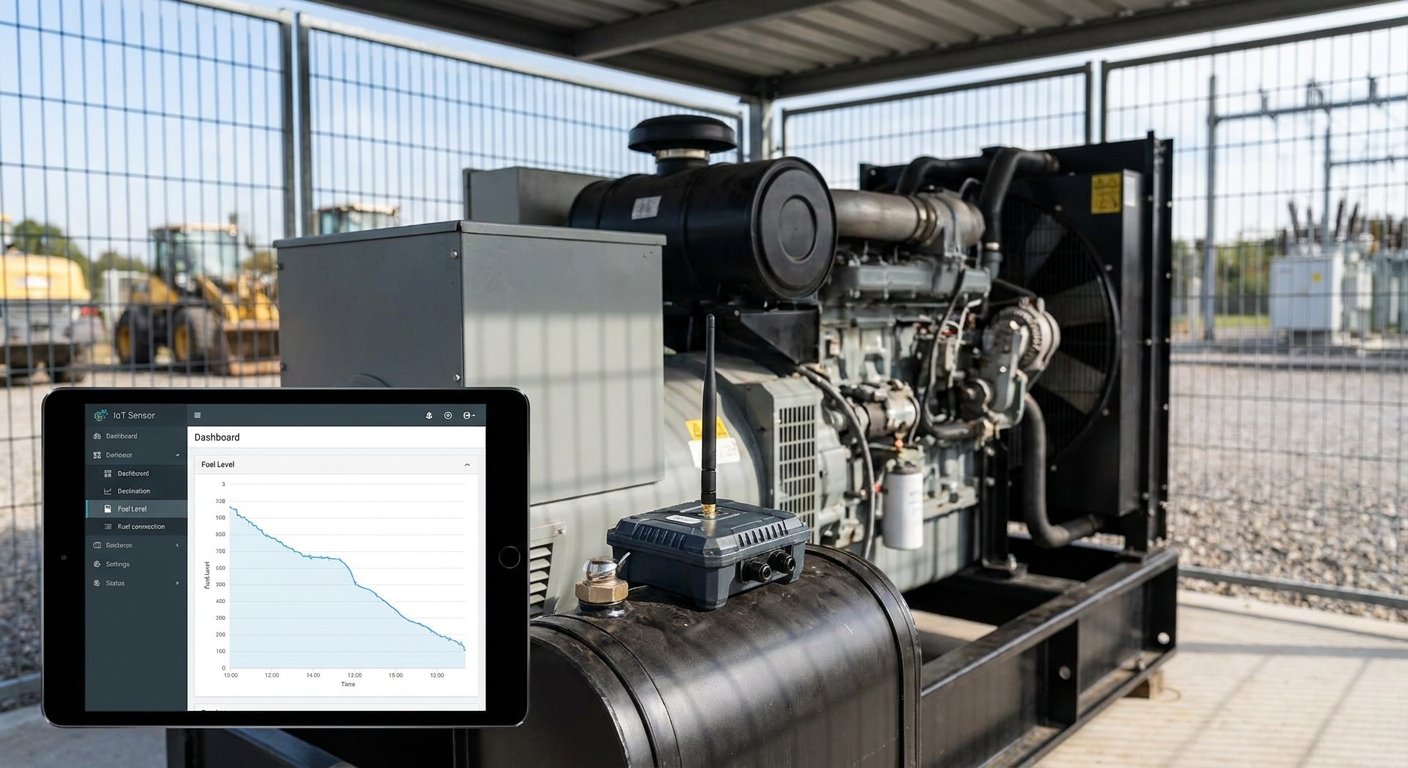
Diesel generators fail quietly, most of the time from an empty tank rather than a bad engine — and by the time anyone notices, the outage they were supposed to cover has already started. IoT fuel monitoring for diesel generators fixes the blind spot: continuous tank level data, theft alerts, and run-hour tracking instead of a clipboard and a dipstick.
- IoT fuel monitoring diesel generators setups now combine tank sensors with LoRaWAN or mioty so ops teams stop guessing fuel levels.
- A 15-20% tank drop in under an hour is the standard theft-alarm threshold, not a slow-consumption pattern.
- Sites with no cellular signal need a store-and-forward or mioty setup, not a standard cellular sensor — Buy that path deliberately.
- Hospitals and data centers should pair fuel alarms with run-status alerts; a dashboard alone won't wake anyone up at 2am.
Why this matters
A standby generator that sits idle for 11 months a year is easy to forget about until the grid goes down. If the tank is low, or fuel has been siphoned off since the last manual check, the generator runs for an hour and stops — right when it's needed most.
Manual dipstick rounds catch this maybe once a week. A fuel tank level monitoring system on https://kiloiot.byryze.com/best-tank-level-monitoring-system-for-fuel-distributors reports continuously, so a drop shows up in minutes, not days.
Fuel theft is the other driver. Diesel is a liquid asset sitting in an unlocked-adjacent tank on a job site or a cell tower pad, and the only way to catch a siphon in progress is a rate-of-change alarm, not a monthly reconciliation.
“If the tank drops more than 15% in under an hour, that's not consumption — that's theft.”
Who this guide is for
This is written for facilities managers, generator service contractors, and ops teams responsible for standby or prime power at data centers, hospitals, telecom towers, construction sites, or remote well pads. If you're the person who gets the call when a genset doesn't start during an outage, this is your buyer profile.
What to look for in IoT fuel monitoring for diesel generators
Sensor type matched to your tank shape and material
Ultrasonic sensors work well on open-top or vented steel tanks; capacitive probes handle tighter clearances. Get this wrong and you'll spend 2026 chasing false readings instead of trusting the data.
Alarm thresholds for theft, not just low fuel
A "low fuel" alarm at 20% remaining is useful for scheduling a refill. It does nothing for catching a 200-gallon drop over two hours in the middle of the night — that needs a separate rate-of-change rule.
Connectivity that survives a generator yard, not a lab
Generator pads sit behind mechanical rooms, in basements, or on remote sites with no cell tower for miles. LoRaWAN and mioty were built for exactly this kind of range and interference; standard cellular trackers weren't.
Run-hour and burn-rate correlation
Fuel level alone tells you what's in the tank. Pairing it with run-hours tells you whether burn rate matches expected load — a jump in consumption per hour of runtime usually means a mechanical problem, not a fuel problem.
Who the alarm actually reaches
A dashboard that nobody watches at 3am is a compliance checkbox, not a monitoring system. Alarms need to route to an on-call phone or a maintenance ticket, not just a screen in an office that's empty overnight.
Monitoring setups worth considering
The default pick — on-site ultrasonic sensor over LoRaWAN. For a single standby generator with existing cellular backhaul at the gateway, this is the standard build in 2026: a level sensor reporting on a 15-minute interval, feeding a rules engine that flags both low-fuel and rapid-drop conditions. It covers the common case — one tank, one site, decent connectivity nearby. Buy if you're monitoring one to three units at a site with cell coverage.
The no-signal pick — mioty or store-and-forward for dead zones. Remote well pads, cell towers on ridgelines, and rural pump stations often sit outside any cellular footprint. Remote tank monitoring without cellular signal covers the store-and-forward and long-range radio approach that keeps reporting when there's no bar on the phone. Buy for any site where you'd otherwise be driving out just to check a gauge.
The safety-critical pick — combined fuel and run-status alarms. Hospitals, data centers, and any site where a failed genset during an outage isn't an option need more than a fuel reading. Automated alarms for equipment anomalies walks through pairing fuel thresholds with vibration and run-status triggers so a problem surfaces before the tank runs dry mid-outage. Consider this the moment downtime has a real cost attached to it.
The scattered-fleet pick — one dashboard across many remote sites. Oil and gas operators and mining sites often run 10, 20, or more standby generators across pads that are miles apart. Industrial IoT for oil and gas remote sites is built for exactly that spread — one rules engine, per-site alarm thresholds, no separate app for every location. Consider if you're managing more than a handful of units across disconnected sites.
See fuel data on one dashboard
Connect tank sensors and generator alarms on the Kilo IoT platform.
What to avoid
- A single ultrasonic probe with no rate-of-change rule. It'll tell you the tank is low after the fact, but it won't catch a siphon in progress. Skip any setup that only alarms on absolute level.
- Consumer cellular trackers on remote pads. They look cheap upfront, but a dead zone means silent gaps in the log exactly when theft is most likely. Skip for any site without confirmed cellular coverage.
- Dashboards with no run-hour field. Fuel level without runtime context can't tell you whether burn rate is normal or a sign the engine is working harder than it should. Skip if run-hours aren't part of the reporting.
Verdict comparison
| Setup | Connectivity | Theft alarm | Best for | Verdict |
|---|---|---|---|---|
| On-site ultrasonic + LoRaWAN | Cellular gateway | Rate-of-change rule | 1-3 units, cell coverage on site | Buy |
| mioty / store-and-forward | No cellular needed | Rate-of-change rule | Remote pads, towers, pump stations | Buy |
| Fuel + run-status combined alarms | Cellular or LoRaWAN | Rate-of-change + run alarm | Hospitals, data centers | Consider |
| Multi-site fleet dashboard | LoRaWAN across sites | Per-site thresholds | 10+ generators, scattered locations | Consider |
FAQ
What is IoT fuel monitoring for diesel generators?
It's continuous tank level tracking using sensors and wireless connectivity instead of manual dipstick checks. Data feeds a dashboard and rules engine that can alarm on low fuel, rapid drops, or abnormal burn rate in 2026 deployments.
How much fuel drop counts as theft versus normal use?
A drop of 15-20% in under an hour with the generator not running usually points to theft, not consumption. Setting that as a separate alarm from the standard low-fuel threshold is what catches it early.
Do fuel level sensors work without cellular signal?
Yes, with mioty or LoRaWAN using store-and-forward reporting instead of relying on a live cellular connection. This matters for remote well pads, towers, and pump stations with no reliable cell coverage.
Can fuel monitoring predict a generator running dry before an outage?
It can flag a low-fuel condition well before the tank empties, giving time to schedule a refill. Combined with run-hour data, it also flags abnormal burn rates that suggest a mechanical issue building before failure.
What's the difference between LoRaWAN and mioty for fuel monitoring?
LoRaWAN and mioty are both low-power wireless protocols suited to remote generator pads, but mioty handles dense sensor networks and interference differently than LoRaWAN. The right choice depends on how many devices and how much RF noise is on site.
How often should a fuel level sensor report?
A 15-minute interval is a common default for standby generators, tight enough to catch a rapid drop without flooding the dashboard. Safety-critical sites sometimes shorten that interval further.
Does IoT fuel monitoring replace manual dipstick checks entirely?
It replaces the routine checks but most sites still keep periodic manual verification for calibration and audit purposes. The sensor data becomes the primary record; the manual check becomes the spot-check.
How much does IoT fuel monitoring cost for a single generator?
Cost depends on tank count, sensor type, and whether cellular or LoRaWAN/mioty connectivity is needed at the site. Check current setup options directly rather than assuming a flat per-unit price.
One last thing
Most generator failures during an actual outage trace back to fuel, not the engine — and an empty tank looks identical to a dead engine until someone pulls the log. The generators that never fail on the day it matters are the ones where fuel level was already boring, unremarkable data for months before the outage hit.